Discussion
of Issues
Issue 1:
Is the quality of service provided by Grenelefe
satisfactory?
Recommendation:
No. While the Utility is
in compliance with the Department of Environmental Protection (DEP) standards, staff
recommends that the Utility’s attempt to address customer satisfaction could be
improved. In addition, staff has identified managerial
issues, such as the Utility’s failure to maintain required complaint and
service interruption records. As such, staff
recommends that Grenelefe’s quality of service be considered marginal, but that
no penalty be imposed at this time. Staff further recommends that the Utility
meet with its customers within three months of issuance of the Consummating or
Final Order to discuss its quality of service issues. The Office of Public
Counsel and Commission staff should be timely made aware of the meeting date,
place, and time. Lastly, within one month after such meeting with its
customers, the Utility shall file a report in this docket summarizing the
results of the meeting. (Ramirez-Abundez)
Staff Analysis:
Pursuant to Section 367.081(2)(a)1, F.S., and Rule
25-30.433(1), Florida Administrative Code (F.A.C.), in water and wastewater
rate cases, the Commission shall determine the overall quality of service
provided by the utility. This determination is made from an evaluation of the
quality of the utility’s product (water) and the utility’s attempt to address
customer satisfaction (water and wastewater). The Rule further states that the
most recent chemical analyses for the water system, outstanding citations,
violations, and consent orders on file with the DEP and the County health
department, as well as any DEP and county health department officials’
testimony concerning quality of service, shall be considered. In addition, any
customer testimony, comments, or complaints received by the Commission are to
be reviewed. The operating conditions of the water and wastewater systems are
addressed in Issue 2.
Quality of Utility’s Product
In evaluation of Grenelefe’s product quality, staff
reviewed the Utility’s compliance with the DEP’s primary and secondary drinking
water standards. Primary standards protect public health, while secondary
standards regulate contaminants that may impact taste, odor, and color of
drinking water. In the DEP’s last Sanitary Survey Report, dated May 10, 2023,
no chemical or bacteriological exceedances were noted for the previous 12
months and the Utility was determined to be in compliance with DEP standards.
Staff also reviewed the DEP’s triennial Safe Drinking Water Program chemical
analysis of samples taken at the point of entry on February 26, 2025. The
results were in compliance with DEP standards.
The Utility’s Attempt to Address Customer
Satisfaction
Staff reviewed the complaints filed in the Commission’s
Consumer Activity Tracking System (CATS) records, those received by the Utility,
and those filed with the DEP since 2022 when the Utility transferred to the
current owner. For the analyzed time period, there was one complaint recorded
in CATS under the current owner, which related to a delay in establishing
service.
In its first data request, staff asked the Utility to provide
a list of all service complaints received during the test year and four years
prior to the test year and also requested an explanation of how each
complaint was resolved. In response, the Utility indicated it had received 215
complaints over nine broad categories since taking ownership and provided
generalized responses for each category on how the complaints were addressed. As
this question was not fully answered, staff asked the question again in its
fourth data request. Grenelefe responded that it was unaware of its obligation
to record every service complaint prior to staff’s first data request and
therefore the Utility did not have the complaint records to provide.
Based on the information available to staff, the accuracy of which is uncertain,
the majority of the 215 complaints were related to improper billing and quality
of service issues, such as minerals in the water, smell, pipe leaks, water
pressure, and lift station alarm noise. While staff was unable to analyze the
Utility’s complaints, they have been included in the summary table below.
The DEP reported that it received three water complaints
under the current owner regarding the number of Boil Water Notices (BWN) issued
and reports of cloudy water, but did not receive any wastewater complaints. A
review of the customer complaints indicates the Utility has resolved all
complaints filed with the Commission and with the DEP. Specific disposition of
complaints received by the Utility is unknown. Table 1-1 summarizes the
complaints from May 31, 2022, through the end of the test year recorded with
CATS, the DEP, and the Utility.
Table 1-1
Number of Complaints by
Source and Subject
|
|
Current
Owner
(CATS)
|
DEP
Records
|
Utility
Records
|
Total
|
|
Delay in Connection
|
1
|
-
|
-
|
1
|
|
Improper Billing
|
|
-
|
153
|
153
|
|
Improper Disconnects
|
-
|
-
|
-
|
-
|
|
Outages
|
-
|
-
|
-
|
-
|
|
Quality of Service
|
-
|
3
|
62
|
65
|
|
Total
|
1
|
3
|
215
|
219
|
Staff performed a supplemental review of the complaints
filed in CATS following the Customer Meeting held on September 15, 2025. This
review found two additional complaints in CATS. These two CATS complaints
addressed a sewer main line back up and improper billing. Additionally, one of
the CATS complaints resulted in an apparent violation of Rule 25-22.032(6)(b),
F.A.C., due to the Utility not responding within the required 15 days to staff
inquiries.
At the virtual customer meeting held on September 15,
2025, 20 customers provided comments. At the meeting, customers echoed the concerns
discussed above as well as opposing the rate increase. In addition, eight
customers specifically commented on the number of BWNs issued and one customer
had outage concerns. Further, one customer discussed multiple sewage overflows
he experienced in his upstairs condominium unit that emanated from line breaks
underneath the customer’s landing. The DEP investigated the sewer overflow
issues on October 22, 2025, upon receiving a customer complaint from the
Department of Health. After a facility inspection, the DEP determined Grenelefe
to be in compliance by letter dated December 12, 2025.
There were approximately 209 customer comments filed in
the docket file as of December 12, 2025.
The majority of these comments expressed concerns with the rate increase and argued
that the water service is not reliable enough to justify such an increase.
Other comments addressed: quality of service for both the water and wastewater
systems (13); outages (11); and improper billing (3). In addition, customers
expressed their dissatisfaction with the frequency and length of service
interruptions. With respect to these service interruptions, customers also
expressed communication concerns in regard to the Utility not providing
comprehensive information as to the location of the areas affected by BWNs and
when the BWNs were rescinded. Further, customers also identified communication
issues regarding irrigation water services and not being notified of the
discontinuation of those irrigation services.
On December 15, 2025, the Utility filed a letter in the
docket file addressing the Office of Public Counsel’s (OPC) original
observation letter dated October 3, 2025. The Utility’s letter stated that it
had received 17 service-related complaints during this proceeding, of which the
majority were related to BWNs and service interruptions, while two customer
complaints concerned sewer backups, which it determined were not caused by
reasons attributed to the Utility. On December 18, 2025, the OPC filed a
subsequent letter detailing the level of customer participation in this
proceeding (noting an unprecedented 16 percent of the customer base), and also
expressing concerns on the amount of the overall rate increase.
After the customer meeting, staff
asked the Utility to explain how it addressed the concerns of the customers
that spoke. Specifically regarding the sewage overflows, Grenelefe stated that
sewage overflows into customer homes are a rare event and, when they occur, the
homeowner must attempt to clear their line to the Utility first. If the plumber
hired by the customer is unable to clear the line, then the Utility will
investigate to see if the blockage is the responsibility of the customer or the
Utility. Grenelefe also stated that the Utility responded to each customer who
provided comment at the customer meeting and that these responses were provided
to the Commission. Staff requested copies of the Utility’s responses to its
customers in its seventh data request and the Utility provided copies of two
different letters it sent to the customers that spoke at the customer meeting.
One of the letters summarized service-related issues while the other summarized
the reasons for the Utility’s rate increase requests.
As noted above, several
customers expressed concerns with service interruptions and BWNs. Specifically,
customers reported confusion when receiving BWNs via text, uncertainty about
whether the notices had been rescinded, and frustration with the frequency of
the interruptions. The Utility indicated that the number of BWNs and service
interruptions are due to the age of the system and the corresponding needs to
replace its outdated meters and equipment, repair its lift stations, and
replace the valves used to isolate the areas of the system that caused the
BWNs.
These pro forma projects are discussed in Issue 4.
While the quality of the Utility’s product passes DEP
drinking water standards, staff believes the Utility’s attempt to address
customer satisfaction could be improved. CATS and the DEP recorded a minimal
number of customer complaints since the transfer of ownership in 2022.
Unfortunately, the number of complaints received by the Utility is unclear and
of the 215 complaints the Utility initially stated it has received, staff
cannot specifically analyze the types of complaints, frequency, or resolutions.
Based on the customers who spoke at the customer meeting and comments filed in
the docket file, there is a common theme of communication issues from the
Utility to its customers. In addition to communication issues, customers also
complained about the frequency and duration of service interruptions. As such,
staff is recommending the Utility meet with its customers within three months of issuance of the Consummating or Final Order
to discuss its quality of service.
Managerial Concerns
Staff’s investigation into
the Utility’s attempt to address its customer service revealed several
managerial issues related to poor recordkeeping and reporting. Such actions
negatively impact the customer service provided by Grenelefe as well as the
Utility’s obligation to provide timely and accurate information to the
Commission.
First, as discussed above,
customers raised concerns regarding several service interruptions and BWNs.
Staff first attempted to review any records the Utility filed with the Commission
pursuant to Rule 25-30.251(1) and (2), F.A.C. The Rule states: “each utility is
required to maintain a record of all interruptions in service which affect 10
percent or more of its customers, and to notify the Commission of these
interruptions. The record is required to show the cause of the interruption,
its date, time, duration, remedy, and steps taken to prevent recurrence.”
Grenelefe has not filed any
such reports with the Commission. As such, staff analyzed BWNs received from
the Utility and Department of Health/DEP and it appears that the Utility has
issued at least seven BWNs since taking ownership of the Utility in 2022. Additionally,
in response to staff’s seventh data request, Grenelefe stated it has not
maintained records in accordance with Rule 25-30.251(1), F.A.C.; however, it
estimated approximately 10 service interruptions that may have affected 10
percent or more of its customers since taking ownership. The provided
information did not address all items required by the Rule, nor did the Utility
notify the Commission of the interruptions.[14]
As such, staff recommends that the Utility maintain its service interruption
records meeting the 10 percent threshold in the manner outlined in Rule
25-30.251(1), F.A.C., and notify the Commission of any such interruptions on a
going-forward basis.
Second, as the Utility
acknowledged, it was unaware of its obligation to record every service
complaint. This is required pursuant to Rules 25-30.130 and 25-30.355, F.A.C.,
which direct, in part: each utility shall maintain a record of all complaints
received and each record shall show the name, address of the complainant, the
nature of the complaint, the date received, the result of any investigation,
the disposition of the complaint, and the date of the disposition. Not
maintaining this information is not only an apparent Rule violation, it also
hampers staff’s ability to conduct a complete and accurate quality of service
evaluation for the Commission’s consideration pursuant to Florida Statute.
Further, the Utility did not timely respond to a CATS complaint, which is an
apparent violation of Rule 25-22.032(6)(b), F.A.C. Other issues with the
managerial concerns for this Utility are listed below:
1.)
Pursuant to Rule 25-30.110, F.A.C., Records and
Reports; Annual Reports. The Utility is required to report any recorded
accounted for water loss through flushing or other uses. The Utility also did
not provide this information regarding other uses for water when prompted
through data requests.
2.)
In its first, second, and fourth data requests, as well
as in two separate emails and a call to the Utility, staff requested copies of
the failed fire hydrant inspections. The Utility did not respond to those
inquiries. The Utility did provide copies of its failed fire hydrant inspections
on December 29, 2025; however, this information was both late and incomplete.
3.)
Grenelefe did not provide copies of the lift station
inspection reports requested by staff in its fourth and fifth data requests.
4.)
The Utility only provided one inspection report for the
two hydropneumatic (hydro) storage tanks.
Staff located the inspection report for the second hydro storage tank on the
DEP’s website. That report stated that the inspection was done on September 5,
2025, even though the Utility had previously stated it was done prior to April
25, 2025. In
addition, the Utility did not provide a standalone cost breakdown of the hydro
storage tanks inspection cost as requested in the second and third data
requests.
5.)
Staff contacted the Utility multiple times, both in
writing and via telephone, regarding billing information and there have been billing
inconsistencies throughout the rate case as discussed in Issue 6.
Conclusion
The Utility is in compliance
with the DEP standards; however, several customer comments regarding service
interruptions, BWNs, and billing issues have been received. In addition, staff
has identified managerial issues, such as the Utility’s failure to
maintain required complaint and service interruption records. As such, staff recommends that Grenelefe’s quality of
service be considered marginal, but that no penalty be imposed at this time.
Staff further recommends that the Utility meet with its customers within three
months of issuance of the Consummating or Final Order to discuss its quality of
service issues. The Office of Public Counsel and Commission staff should be
made aware of the meeting date, place, and time. Last, within one month after
meeting with its customers, the Utility shall file a report in this docket
summarizing the results of the meeting.
Issue 2:
Are the infrastructure and operating conditions of
Grenelefe’s water and wastewater system in compliance with DEP regulations?
Recommendation:
Yes. Grenelefe’s water and wastewater treatment
facilities are in compliance with DEP regulations. (Ramirez-Abundez)
Staff Analysis:
Rule 25-30.225(2), F.A.C., requires each water and
wastewater utility to maintain and operate its plant and facility by employing
qualified operators in accordance with the DEP Rules. Rule 25-30.433(2),
F.A.C., requires consideration of whether the infrastructure and operating
conditions of the plant and facilities are in compliance with Rule 25-30.225,
F.A.C. In making this determination, the Commission must consider testimony of
the DEP and county health department officials, sanitary surveys for water and
compliance evaluation inspections for wastewater systems, citations,
violations, consent orders issued to the utility, customer testimony, comments,
complaints, utility testimony, and responses to the aforementioned items.
Water and Wastewater Operating Conditions
Grenelefe’s water system has a permitted capacity of
2,160,000 gallons per day (gpd) and a design capacity of 4,320,000 gpd. The
system has two wells with pumping capacities of 1,500 gallons per minute (gpm)
each, and two hydro storage tanks with capacities of 25,000 gallons each. There
are 75 fire hydrants located throughout the service area. Groundwater from the
wells is treated through liquid chlorination. Staff reviewed the Utility’s most
recent Sanitary Survey Report conducted by the DEP on May 10, 2023. The DEP
noted seven deficiencies which included: nonfunctioning air release valves for
a hydro tank and both wells; one well concrete pad was cracked; seals on both
wells were leaking; and no corrosion control on either plant. The DEP received
a letter from the Utility that stated they had corrected all the deficiencies
within 30 days of the Sanitary Survey Report.
Grenelefe’s wastewater system consists of an existing
0.680 million gallons per day (MGD) Three-Month Rolling Average Daily Flow
design capacity extended aeration domestic wastewater facility, with disposal
to an existing 0.340 MGD annual average daily flow permitted capacity rapid
infiltration basin system. Staff reviewed the Utility’s last DEP Compliance
Evaluation Inspection report, dated December 6, 2022. The DEP noted two
deficiencies: 1) three of the four groundwater monitoring wells were not
labeled or secured; and 2) alarm malfunctions at all three lift stations. The
DEP subsequently determined that all non-compliance items identified at the
time of the inspection had been corrected and deemed the Utility to be in
compliance as of March 15, 2023.
The DEP renewed Grenelefe’s operations permit on November
16, 2022, and also issued the Utility an Administrative Order (AO), which was
accompanied by a schedule of compliance. The schedule of compliance noted that
the Utility will not meet specific conditions of its permit relating to total
nitrogen (TN) and total phosphorus (TP) limits of its reclaimed water with its
current wastewater system. Grenelefe’s wastewater treatment plant (WWTP) is
located in the Lake Okeechobee Basin Management Action Plan (BMAP) area. TN and
TP limits for wastewater effluent must be met for wastewater facilities located
in the BMAP area. As part of the instant docket, the Utility requested cost
recovery for Project No. 10 (wastewater treatment plant modifications) to help
address the TN and TP limits, as discussed further in Issue 4. The AO ordered
that the Utility should submit a proposal with the most feasible option to meet
the TN and TP requirements and also obtain the DEP’s approval of the proposal
prior to September 30, 2025. On November 12, 2025, the DEP issued a Compliance
Assistance Offer and Complaint Inspection Report letters to the Utility;
however, both of these items have been closed and the Utility is currently in
compliance with the DEP.
Conclusion
Grenelefe’s water and wastewater treatment facilities are
in compliance with DEP regulations.
Issue 3:
What are the used and useful (U&U) percentages
of Grenelefe’s water treatment plant (WTP), WWTP, water distribution, and
wastewater collection systems?
Recommendation:
Grenelefe’s WTP, WWTP, water distribution, and
wastewater collections systems should be considered 100 percent U&U.
Additionally, staff recommends that a 53.9 percent adjustment to purchased
power and chemicals should be made for excessive unaccounted for water (EUW).
No adjustment is recommended for excessive infiltration and inflow (I&I).
(Ramirez-Abundez)
Staff Analysis:
As stated in Issue 2, the Utility’s water system has
two wells with pumping capacities of 1,500 gpm each and two hydro storage tanks
with capacities of 25,000 gallons each. Grenelefe’s water distribution system
is comprised of 214,368 feet of 4 inch to 10 inch polyvinyl chloride (PVC)
pipe. There are 75 fire hydrants throughout the water distribution system.
Additionally, Grenelefe’s wastewater system consists of a
0.340 MGD extended aeration system, consisting of ten aeration basins, four
clarifiers, seven deep bed automatic backwash filters, three prefilter chlorine
contact chambers, one post chlorine contact chamber, one fluent pump wet well,
and three digesters. The Utility’s wastewater collection system is composed of
67,584 feet of 8 inch to 10 inch PVC pipe. There are five duplex
lift stations throughout the wastewater collection system.
Used and Useful Percentages
Rules 25-30.432 and 25-30.4325, F.A.C., address the method
by which the U&U of a wastewater and water system is determined,
respectively. Grenelefe’s U&U percentages were last determined in Docket
No. 20110141-WS. In that
docket, the Commission determined the Utility’s WTP, WWTP, water distribution,
and wastewater collection system to be 100 percent U&U. As discussed in the
Case Background, the Commission recently approved amendments to the Utility’s
water and wastewater service territories. The
Utility has requested an increase to the permitted capacity of its WWTP with
the DEP. This project, along with other WWTP upgrades, is discussed further in
Issue 4. Consistent with the Commission’s previous decision, staff recommends
that the Utility’s WTP, WWTP, water distribution, and wastewater collections
systems be considered 100 percent U&U. The U&U of the WWTP and
collections systems may be reevaluated in a future proceeding pending the final
modifications to the Utility’s WWTP which may increase its permitted capacity.
Excessive Unaccounted for Water
Rule 25-30.4325, F.A.C., provides factors to be considered
in determining whether adjustments to operating expenses are necessary for EUW.
EUW is defined as “unaccounted for water in excess of 10 percent of the amount
produced.”
Unaccounted for water is all water produced that is not sold, metered, or
accounted for in the records of the utility. In determining whether adjustments
to plant and operating expenses are necessary in accordance with Rule
25-30.4325(10), F.A.C., staff considers several factors. These include the
causes of EUW, any corrective action taken, or the economic feasibility of a
proposed solution. EUW is calculated by subtracting both the gallons sold to
customers and the gallons used for other services, such as flushing, from the
total gallons pumped for the test year.
The Monthly Operating Reports that the Utility files with
the DEP indicate that the Utility treated 116,252,434 gallons during the test
year. In response to a staff data request, the Utility indicated that it
purchased no water and did not provide water for other uses during the test
year. Staff determined that the Utility sold 42,020,392 gallons of water for
the test year. When both gallons sold and water used for other uses are
subtracted from the total gallons pumped, there are 77,405,258 gallons that are
unaccounted for. The formula for determining EUW as a percentage is given by
gallons of unaccounted water / (total gallons pumped + gallons purchased). The
resulting unaccounted for water is 63.9 percent and the excessive unaccounted
for water is 53.9 percent. Regarding the cause, the Utility stated that the
amount of EUW can be attributed to line breaks, lost water due to the age of
the Utility infrastructure, and poor recordkeeping by the previous owner.
However, as discussed in Issue 1, the Utility did not provide any recorded amount
for water loss through flushing or other uses pursuant to Rule 25-30.110,
F.A.C.
Infiltration and Inflow
Rule 25-30.432, F.A.C., provides that in determining the
amount of U&U plant, the Commission will consider I&I. Excessive
I&I is a calculation that is based on a comparison of the allowable
wastewater treated to the actual amount of wastewater treated. Staff calculated
the allowable infiltration based on system parameters and calculated that
allowable inflow based on the water sold to customers. The sum of these amounts
is allowable I&I. Staff next calculated the estimated amount of wastewater
returned from customers. The estimated return is determined by summing 80
percent of the water sold to residential customers with 90 percent of the water
sold to non-residential customers. Adding the estimated return to the allowable
I&I yields the maximum amount of wastewater that should be treated by the
wastewater system without incurring an adjustment to operating expenses. If
this amount exceeds the actual amount of wastewater treated, no adjustments are
made. If it is less than the gallons treated, then the difference is the
excessive amount of I&I. By convention, the allowance for infiltration is
500 gpd per inch diameter pipe per mile, and an additional 10 percent of
residential water billed is allowed for inflow.
Using the pipe lengths of Grenelefe’s collection system,
the infiltration allowance is calculated to be 21,024,000 gallons per year. Ten
percent of the total gallons sold to customers is allowed for inflow, which
totals 3,897,718 gallons. The sum of these amounts is the total allowable
I&I, which is 24,915,718 gallons per year. The amount calculated for
estimated return is 31,348,410 gallons per year. To find the total amount of
wastewater allowed, the total allowable I&I and the estimated return are
summed, yielding 56,264,427 gallons per year. Finally, this total is compared
to the total treated during the test year, which is 46,296,700 gallons
according to the Utility’s daily flow report. This is less than the estimated
maximum amount allowed. Therefore, there is no excessive I&I, and no
adjustment to operating expenses is necessary.
Conclusion
Grenelefe’s WTP, WWTP, water distribution, and wastewater
collections system should be considered 100 percent U&U. Staff recommends
there is 53.9 percent EUW, therefore, an adjustment to purchased power and
chemicals should be made. Additionally, no adjustment is recommended for
excessive I&I.
Issue 4:
What is the appropriate average test year rate base
for Grenelefe?
Recommendation:
The appropriate average test year rate bases for
Grenelefe are $1,866,312 for water and $1,241,585 for wastewater. Further,
staff recommends the Utility be required to submit a report no later than
November 30, 2026, detailing the status of each Commission-approved pro forma
project. (Cohn, Ramirez-Abundez)
Staff Analysis:
The appropriate components of the Utility’s rate base include utility
plant in service (UPIS), land and land rights, accumulated depreciation,
contributions-in-aid of construction (CIAC), accumulated amortization of CIAC,
capital recovery, accumulated capital recovery, and working capital. Staff
selected the test year ended October 31, 2024, for the instant rate case. A
summary of each component and the recommended adjustments are discussed below.
Utility Plant in Service
The Utility recorded UPIS of $3,212,594 for water and
$3,290,936 for wastewater. Audit staff decreased these amounts by $85,059 for
water and $187,115 for wastewater to reflect adjustments from a prior
Commission order, reclassify amounts from WWTP, and to reflect plant
retirements. Staff
reduced water UPIS by an additional $9,386 to reflect an averaging adjustment.
Additionally, staff increased water UPIS by $1,758,389 and wastewater UPIS by
$949,844 to reflect pro forma additions. Staff then made subsequent adjustments
to reflect pro forma-related retirements, reducing water UPIS by $543,861 and
reducing wastewater UPIS by $131,852. These adjustments result in a net increase
to UPIS of $1,120,084 for water and $630,877 for wastewater. Therefore, staff
recommends a UPIS of $4,332,678 for water and $3,921,813 for wastewater.
Pro Forma Plant Additions
Grenelefe requested pro forma projects for both its water
and wastewater systems. However, since some items are not system specific, like
a replacement vehicle, those costs would be allocated to both the water and
wastewater systems. The pro forma projects are shown in Table 4-1 and each pro
forma project is described below. Additionally, it is Commission practice for
staff to evaluate whether a minimum of three bids were solicited for each
project or the utility’s reasoning as to why three could not be obtained.
Table 4-1
Pro-Forma Plant Projects
|
|
Project
|
Account
Number
|
Utility
Requested
|
Staff Recommended
|
Retirement*
|
|
Water
|
|
1.
|
Neptune 5/8 by 3/4 T10 P/C R900i cellular USG meters
(Meters and Meter boxes)
|
334
|
$823,643
|
$758,838
|
($167,461)*
|
|
2.
|
Radio Read Meter Installations
|
334
|
$271,800
|
$242,385
|
($53,493)*
|
|
3.
|
Replacing 15 Fire Hydrants
|
-
|
$234,000
|
$0
|
-
|
|
4.
|
Hydro Tank #6 Rehabilitation
|
330
|
$413,000
|
$66,786
|
($11,547)*
|
|
5.
|
Hydro Tank #10 Rehabilitation
|
330
|
$66,786
|
$66,786
|
($11,547)*
|
|
6.
|
Potable Well #6 Refurbishment
|
311
|
$121,000
|
$115,000
|
($10,421)*
|
|
7.
|
Potable Well #10 Refurbishment
|
311
|
$121,000
|
$115,000
|
($10,421)*
|
|
8.
|
Irrigation/Non-potable Wells
|
-
|
$840,000
|
$0
|
-
|
|
9.
|
20 Valve Replacements
|
331
|
$1,897,176
|
$363,200
|
($272,400)
|
|
Wastewater
|
|
10.
|
Wastewater Treatment Plant Modifications
|
-
|
$16,300,000
|
$0
|
-
|
|
11.
|
Lift Station #1 Refurbishment
|
371
|
$198,672
|
$197,433
|
($26,901)*
|
|
12.
|
Lift Station #2 Refurbishment
|
371
|
$195,000
|
$195,000
|
($26,570)*
|
|
13.
|
Lift Station #3 Refurbishment
|
371
|
$170,545
|
$166,992
|
($22,754)*
|
|
14
|
Lift Station #4 Refurbishment
|
371
|
$188,500
|
$188,500
|
($25,684)*
|
|
15.
|
Lift Station #5 Refurbishment
|
371
|
$175,500
|
$171,525
|
($23,371)*
|
|
Water/Wastewater
|
|
16.
|
Utility Truck – F-250
|
341/391
|
$52,239
|
$52,239
|
($9,874)*
|
|
17.
|
Utility Truck – F-150
|
-
|
$43,168
|
$0
|
-
|
|
18.
|
Utility Golf Cart
|
341/391
|
$51,870
|
$8,549
|
($3,268)*
|
|
-
|
Total
|
-
|
$22,163,899
|
$2,708,233
|
($675,713)
|
Source:
Responses to staff data requests and staff calculations.
*Denotes capped retirement
Project Nos. 1 & 2 – Meter Replacements
Project Nos. 1 and 2 are for replacement meters and the
associated installation costs. The Utility is proposing to install radio read
meters as a replacement for its existing manual read meters. Radio read meters
are digital read water meters that record water usage and send data to the
master database center monthly. According to Grenelefe, its existing manual
read meters are: 1) obsolete, and replacements and parts are hard to obtain; 2)
close to or past their expected useful service life; and, 3) not functioning
properly or are otherwise inaccessible.
The Utility considered the alternative of replacing the
existing meters with other manual meters, but decided not to since those meters
would not diminish human error or the quantity of meter readings. In staff’s
fourth data request, staff asked the Utility if it considered Advanced Metering
Infrastructure (AMI) meters or Automated Meter Reading (AMR) as alternatives.
Grenelefe’s response stated that the Neptune Digital Meter system is the
industry standard meter used by Utility companies.
The Utility provided three bids for the installation cost
and only one bid for the material cost. The Utility explained that only one bid
was solicited for the meters because the bidder was able to provide the Utility
with a price no one would match and others would not waste time providing a
proposal. The
provided bid was for 1,350 5/8 inch meters. However, this number was updated to
1,377 meters in a data request response, and also included meters of other
sizes.
Staff is recommending approval of the replacement meters
due to the number of improper billing complaints from customers, the high EUW
discussed in Issue 3, and the fact that the existing meters are past their
useful lives. Also in response to staff’s fourth data request, the Utility
stated that there should be $32,472 in annual Operations & Maintenance (O&M)
savings related to the installation of the radio read meters since no staff
will be required to manually read each meter every month. Specifically, staff
recommends total project costs of $1,001,223. This includes selecting the
lowest bid for the installation costs ($242,385) and cost recovery for 1,243
5/8 inch meters ($757,838), based upon the updated meter count provided in
response to staff’s fourth data request, minus the additional meter sizes.
Grenelefe stated that it expects the replacements to take six to eight weeks
and will begin replacing meters as soon as cost recovery for this project is
approved. As such, the anticipated completion date for this project is June 30,
2026.
No. 3 – Fire Hydrants
Project No. 3 is the replacement of 15 fire hydrants at a
cost of approximately $234,000. The
Utility has 75 fire hydrants in its service territory and stated that every
year the fire hydrants need to be flow tested as ordered by the Polk County
Fire Marshall’s Office. Staff requested the flow testing documents numerous
times as noted below:
1.
Staff’s second data request, No. 5a (dated June 6,
2025):
“On page three of this document, the Utility provided a list of its requested
pro forma projects. (a) Column 8 is labeled ‘Regulatory Mandate (M) or
Enhancement (E).’ For each of the following projects labeled as ‘Regulatory
Mandate,’ please provide the government agency that required the project, a
brief explanation as to why it was required, and all documentation that supports
this designation. (ii) Hydrants.”
Utility’s response to staff’s second
data request: Response to 5a. ii.) “The Polk County Fire Marshall's office
requires fire hydrants to be flow tested annually to ensure residents have
adequate fire protection. When flow tests on hydrants fail the Fire Marshall
wants a timeline as to when the hydrant can be replaced. These outdated
hydrants, well past their useful lives, frequently fail these tests by the Fire
Marshall.” Also as part of its response, the Utility provided a single bid to
replace 15 fire hydrants for $266,000.
2.
Staff’s fourth data request, No. 25 (dated July 23,
2025):
“Grenelefe is requesting to replace 15 of its fire hydrants, as these hydrants
have failed inspections and are past their useful service lives. Provide copies
of the inspection failure reports and any other pertinent documentation to
justify the need for this request.”
Utility’s response to staff’s fourth
data request: “Replace 15 fire hydrants -The Flow tests performed on the aged
fire hydrants reveal that a large number of them failed the flow tests and due
to their age and functionality being diminished they require replacement due to
failing the flow tests. The replacement plan was made due to the Ben Tech LLC
Flow tests done on all the Fire Hydrants and reported to Polk County Fire
Inspector. This report showed 15 failed the flow test and require replacement.
The Utility is attempting to replace 3 per quarter, it could be faster if funds
become available.”
3.
Staff’s fifth data request did not contain any
questions regarding fire hydrants. However, as part of its response to staff’s
fifth data request, the Utility included a bid to replace 20 fire hydrants and
a quarterly inspection program for $298,000.
4.
Staff emailed the Utility on October 10, 2025, and
again on December 17, 2025, (as well as a follow-up phone call on December 17,
2025), requesting copies of the inspection failure reports. On December 17,
2025, the Utility responded via email that 15 fire hydrants needed to be
replaced. More specifically, 13 fire hydrants are inoperable and have failed
inspection and that 2 additional fire hydrants have caps that could not be
removed during inspection and need to be addressed. The Utility did provide
inspection report copies on December 29, 2025; however, the partial information
was provided late. The partial information consisted of 68 fire hydrant
inspection reports; however, the Utility indicated it has a total of 75 fire
hydrants in its 2024 Annual Report. Of the 68 fire hydrant inspection reports
provided, 22 fire hydrants failed inspection. The Utility also indicated that
it has already replaced 6 of the 15 fire hydrants.
To date, the Utility has not provided the documentation to
support all 15 fire hydrant replacements.
While the Utility originally indicated that 15 fire hydrants needed
replacement, it later changed its request to be 20 fire hydrants, and then
provided documentation that showed 22 fire hydrants failed inspection. However,
in its late response, the Utility also indicated it already replaced 6 fire
hydrants. As a result, the total number of fire hydrants that still need to be
replaced is unclear. Therefore, staff recommends denying the Utility’s request
for cost recovery of this project. This does not prevent the Utility from
replacing the fire hydrants and the Utility may request cost recovery for this
project in the future when it is able to provide supporting documentation.
Project
No. 4 & 5 – Hydro Tanks #6 and #10
Project Nos. 4 and 5 are related to
Grenelefe’s hydro tanks. The DEP requires hydro tanks to be inspected every
five years. In response to staff’s fifth data request, the inspection report
for tank #10, dated March 27, 2025, was provided. Tank #10 passed its
inspection but needed minor repairs and to be repainted. Initially, the Utility
stated that tank #6 failed its inspection and needed to be replaced.
However, staff found the inspection report for Tank #6 in Oculus, DEP’s
electronic document management system, dated September 5, 2025, which indicated
that Tank #6 passed its inspections, but also needed repairs and to be
repainted. Three bids were provided that included both hydro tanks. The Utility
has not yet started this project and therefore, has not yet selected a vendor.
Staff is recommending approval of the necessary repairs and repainting of tanks
#6 and #10 due to the inspection results and the regulatory requirement from
DEP. Further, staff recommends selecting the lowest bid of $66,786 for each
hydro tank ($133,572 total). The estimated in-service date is October 31, 2026.
Project
No. 6 & 7 – Potable Wells #6 and #10
Project Nos. 6 and 7 are the
refurbishment of potable wells #6 and #10. The Utility is requesting cost
recovery for these refurbishments, which include the installation of new pumps,
motors, and control panels. As part of this project, Grenelefe also proposed
adding Supervisory Control and Data Acquisition (SCADA) monitoring systems to minimize
water outages, as well as new output meters to accurately measure flows. Grenelefe
determined that both wells are past their useful service lives. As explained in
Issue 1, there are several customer complaints and comments regarding service interruptions.
The installation of SCADA at these wells can help reduce the duration of the
interruptions. Three bids were provided for each well. The Utility has not yet
started this project and therefore, has not yet selected a vendor. Staff agrees
with the Utility that these projects should minimize water outages and, in
turn, reduce the duration of interruptions. Therefore, these projects appear to
be a reasonable request from the Utility and staff recommends selecting the
lowest bid of $121,000 for each well refurbishment and the addition of SCADA
($242,000 total). The estimated in-service date is October 31, 2026.
Project No. 8 – Irrigation/Non-potable Wells
(Withdrawn)
Project No. 8 was the proposed upgrade of eight
non-potable wells to potable wells. In its response to staff’s fourth data
request, Grenelefe stated it was no longer pursuing this project.
Project
No. 9 – Valve Replacements
Project No. 9 is the replacement of 20
valves throughout Grenelefe’s water distribution system. The Utility stated
that the DEP office that works with the Polk County Health Department had
received multiple customer complaints for excessive issuances of BWNs. The
Utility stated that they are unable to isolate sections of the water system,
when necessary, due to most water distribution valves being inoperable. The
Utility originally requested to replace 100 valves over ten years; but, the
three bids provided only indicated 10 valves per bid.
Staff agrees this project is needed so that service
interruptions may be isolated and thereby lessen the number of customers that
may be impacted by an outage. However, pursuant to Section 367.081(a)(2), F.S.,
there is a 24-month deadline from the end of the test year for completing pro
forma projects, unless a longer period is approved by the Commission.
Therefore, staff does not believe the Utility’s request to replace 100 valves
over a ten-year period is appropriate. Moreover, Grenelefe indicated that it has
replaced only four valves between November 1, 2024, and October 31, 2025.
In its seventh data request, staff requested copies of the paid invoices for
the four valves the Utility stated it replaced, to which the Utility provided a
signed service contract with U.S. Water Services for one valve dated October
11, 2022, and another invoice for three valves dated January 27, 2025. However,
staff did not rely on these invoices for its recommendation for the cost of the
valves since the October 2022 invoice did not match the current estimates for
the valves, and the three invoices from 2025 appear to only represent partial
costs for materials. As such, staff recommends cost recovery for an additional
16 valves, for a total of 20 valves, which will be replaced within the 24
months following the test year, for a total cost of $363,200. This value is
based upon the lowest bid received by the Utility for new 6 inch water valves.
The estimated in-service date is October 31, 2026.
Project
No. 10 – Wastewater Treatment Plant Modifications
Project No. 10 is the proposed
modifications to Grenelefe’s WWTP. In response to staff’s first data request,
Grenelefe provided its DEP permit as well as the AO, which is discussed below.
Grenelefe falls within the boundaries of the Lake Okeechobee BMAP. Section
403.067, F.S., provides the foundational statutory framework for BMAPs.
Additionally, BMAP is addressed by a regulatory framework within the Florida
Administrative Code, developed by the DEP to manage and improve water quality
in specific areas. The AO requires Grenelefe’s WWTP to meet a 10 mg/1 total
nitrogen limit and a 6 mg/1 total phosphorus limit, which are based on the
permitted capacity of the WWTP.
The Utility is requesting cost recovery for two phases.
The first phase would be to update the existing tankage for flow equalization
to occur as well as improvements to the plant’s headwork structures. The
headwork structure improvements would include clearing and emptying the
existing tankage, cleaning tank interior walls, necessary external tank repair
and recoating, new air supply and distribution, new surge pumps, new controls,
and a new flow regulator box. The first phase has an estimated cost of
$1,840,281. The second phase is to provide an effluent that meets the BMAP
requirements, with a 0.495 MGD permitted plant capacity. Grenelefe plans to
accomplish this by constructing three sequencing batch reactor (SBR) chambers,
installing SBR equipment, and converting the existing filter clearwell to a
chlorine contact tank. The second phase has an estimated cost of $10,741,174.
There are additional estimated costs of $877,737 for the construction of a
rapid infiltration basin, as well as $2,888,062 for bonds, contingencies, and
engineering costs. The Utility’s total estimated cost to modify the WWTP is
$16,374,254.
In its SARC Application, the Utility stated that this
project’s proposed modifications would allow the WWTP to meet the BMAP nutrient
reduction requirements, as well as bring the permitted capacity of the plant up
to at least 0.495 MGD of the 0.680 MGD design capacity. In response to staff’s
fourth data request, Grenelefe stated that the Utility owner requested the
treatment plant be developed to meet these two objectives in order to comply
with the DEP BMAP nutrient reduction requirements and to ensure plant capacity
was available to meet the demand created by the expected new housing
development, and other redevelopment in the area, over the next five years. In
response to staff’s fifth data request, the Utility explained that Grenelefe is
not being required directly by the DEP to increase the permitted capacity of
the wastewater treatment facilities.
Staff requested additional bids in its first, second, and
fourth data requests. The Utility provided one bid with three alternative cost
options, which consisted of projects that differed slightly in nature and
ranged from $9,345,039 to $13,908,210. In a supplemental response to staff’s
fifth data request, on November 12, 2025, the Utility provided staff with a cost
break down. The cost breakdown provided a report that does not reflect finalized
costs for this project and is marked as “Draft.” The Utility stated it was
never completed because the management, in conjunction with the consulting
engineer, decided to move directly to the SBR design with concrete tankage. No
additional information was provided as to why the report was not finalized, and
Grenelefe did not provide any additional bids for this project.
In response to staff’s fourth data request, which
requested additional details on this project, Grenelefe stated that staff
should discuss this project with Grenelefe’s engineer. On October 9, 2025,
staff held an informal meeting with Grenelefe’s engineer, at which time staff
was informed that the expected completion date of the WWTP would be in 2027, as
the Utility was just starting the bidding process. Additionally, in response to
staff’s fifth data request, Grenelefe stated that funding could not be secured
for this project until final rates and charges are in place. However, as
discussed above, it is required by statute that all pro forma projects must be
completed within 24 months of the end of the test year, unless the Commission
approves a longer time period.
Staff recognizes that the DEP has required the Utility to
meet the BMAP guidelines and has established timeline requirements for
compliance. Despite these requirements, Grenelefe is currently only in the
initial bidding phase of this project. Accordingly, total project cost is still
uncertain, and the Utility’s estimated completion date for the project is
beyond the statutory 24-month timeframe. Based on these facts, staff is not
recommending approval of this project for cost recovery at this time. Staff
recognizes the DEP requirements set forth in the AO and notes that Grenelefe
may file a request for cost recovery of this project after the DEP has approved
its proposal, and total project cost and the in-service date are established.
Project
Nos. 11, 12, 13, 14, & 15 – Lift Stations Refurbishments
Project Nos. 11 through 15 are
refurbishments for five lift stations. The Utility stated that all five of the
lift stations have been neglected for years with old electrical panels that are
improperly grounded. Grenelefe is requesting to refurbish the five lift
stations with new panels, pumps, valves, check valves, and the installation of
new wet well liners. While the Utility indicated it provided lift station
reports to Commission staff, no additional documents were attached to that
response or were otherwise provided.
Grenelefe has provided service since 1977.
The Utility system is over 40 years old, but staff does not know the age of
each of the lift stations requested. Staff believes these projects are needed
and recommends approval due to the Utility’s aging system. Four bids were
provided for each lift station. The Utility has not yet started this project
and therefore, has not yet selected a vendor. As such, staff recommends
selecting the lowest bids which are: $197,433 for Lift Station #1; $195,000 for
Lift Station #2; $166,992 for Lift Station #3; $188,500 for Lift Station #4;
and, $171,525 for Lift Station #5. The estimated in-service date for the five
lift stations is October 31, 2026.
Project
Nos. 16, 17, & 18 – Utility Trucks and Golf Carts
Project Nos. 16, 17, and 18 are the Utility’s
request for two new pickup trucks and three golf carts. Grenelefe stated
that the current Utility vehicles have outlived their useful service lives,
with one being 21 years old and the other being 18 years old. Both were
acquired from the previous Utility owner. For Project No. 16, Grenelefe is
requesting a new Ford F-250 pickup truck, which the Utility says is needed to
tow heavy equipment like mini excavators, backhoes, and tractors around the
service territory. Project 17 is for a new Ford F-150 pickup truck, which the
Utility says is needed to transport Utility personnel around the expansive
service territory, along with the necessary tools to be able to do repairs in a
timely manner. Project No. 18 is the Utility’s request to purchase three new
golf carts. Grenelefe stated that the current golf carts are past their useful
service lives and are no longer operable. The Utility stated that it can no
longer depend on the current golf carts for customer service calls and meter
readings.
Staff agrees that Grenelefe’s
vehicles are past their useful lives and need to be replaced. However, the
Utility’s payroll only includes two employees, one being the owner of the
Utility. All other operations for Grenelefe are contracted. Given this, the
need for two trucks and three golf carts does not seem reasonable. Additionally,
as the radio read meters are placed into service (Project Nos. 1 and 2), the
need for golf carts is lessened because meters will no longer be read manually.
Therefore, staff is recommending approval of the Ford F-250 truck and one golf
cart for the two payroll employees, which thereby eliminates project No. 17
(Ford F-150 Truck). The Utility provided two bids for the F-250 truck.
Grenelefe stated that it did not provide a third bid, per Commission practice,
because there is no point in giving the Commission another bid when the price,
in all probability, will be at least as high as the two bids already provided.
Grenelefe provided three bids for the golf carts and staff recommends the
lowest bid for both the F-250 pickup truck and the golf cart. The total cost
for the F-250 truck is $52,239 and the total cost for the golf cart is $8,549.
The costs of the truck and golf cart will be split evenly between the water and
wastewater systems, with an estimated in-service date of June 30, 2026.
Capped Retirement
In general, it is Commission
practice to use the 75 percent of pro forma addition methodology to estimate
the retirement amount of assets being replaced when the original cost is
unknown. In this case, for certain accounts, application of the 75 percent
retirement methodology results in an overall negative plant balance. Therefore,
staff has capped the retirement amounts at the average test year plant balance
for respective accounts. This methodology has been utilized in Docket No.
20160101-WS and was approved by Order No. PSC-2017-0101-FOF.
In that order, the Commission found that: “the amount of retirement to plant in
service and accumulated depreciation reflected in the adjusted test year shall
be calculated based on either the 75 percent methodology . . . or on the actual
balance in the impacted plant in service account . . . if that balance would be
negative as a result of the 75 percent methodology.”
The capped pro forma plant project retirements are shown on Table 4-1.
Due to the capped retirement, two
accounts have remaining undepreciated plant balances. Staff believes that these
remaining balances should be recovered as amortization expense over a 10-year
period. Although Rule 25-30.433(10), F.A.C., prescribes the formula for
determining the appropriate amortization period for forced abandonment or the
prudent retirement of plant assets prior to the end of their depreciable life,
staff recommends an amortization period of 10 years. Staff notes an alternate
amortization period is allowed by the aforementioned rule. Staff’s
recommendation is intended to spread the recovery of these costs over a longer
period in order to mitigate the immediate annual rate impacts. Staff identified
two accounts that have remaining undepreciated plant balances, as reflected in
Table 4-2 and Table 4-3 below.
Table 4-2
Water Capital
Amortization
|
Account
|
Plant Balance
|
Accumulated
Depreciation
|
Undepreciated Plant
Balance
|
Amortization
Expense
|
|
330
|
$82,951
|
$76,515
|
$6,436
|
$644
|
|
Total
|
$82,951
|
$76,515
|
$6,436
|
$644
|
Source: Staff calculations.
Table 4-3
Wastewater Capital
Amortization
|
Account
|
Plant Balance
|
Accumulated
Depreciation
|
Undepreciated Plant
Balance
|
Amortization
Expense
|
|
371
|
$126,476
|
$49,289
|
$80,115
|
$8,011
|
|
Total
|
$126,476
|
$49,289
|
$80,115
|
$8,011
|
Source: Staff calculations.
As described above, staff increased UPIS for pro
forma-related additions by $1,758,389 for water and $949,844 for wastewater.
This amount is offset by retirements of $543,861 for water and $131,852 for
wastewater. Further, staff recommends capital recovery of $6,436 for water and
$80,115 for wastewater over a 10-year amortization period. The corresponding
annual amortization expense is $644 for water and $8,011 for wastewater.
Used and Useful
As discussed in Issue 2, the Utility’s system is considered
100 percent U&U. Therefore, no U&U adjustment is necessary.
Land and Land Rights
The Utility recorded a test year land and land rights
balance of $7,000 for water and $49,400 for wastewater. Audit staff reduced
this account by $4,000 for water to reflect amounts approved in the last
Commission Order.
Therefore, staff recommends a land and land rights balance of $3,000 for water
and $49,400 for wastewater.
Accumulated Depreciation
The Utility recorded an accumulated depreciation balance
of $2,926,284 for water and $3,149,184 for wastewater. Audit staff decreased
these amounts by $127,254 for water and $382,576 for wastewater to reflect
adjustments from a prior Commission Order, to reclassify amounts from WWTP, to
reclassify from O&M Expense, and to reflect additions and retirements not
booked.
Staff decreased accumulated depreciation by $30,217 for water and $95,769 for
wastewater to reflect averaging adjustments. Additionally, staff decreased
accumulated depreciation by $485,718 for water and $84,158 for wastewater due
to pro forma additions and retirements.
Staff’s adjustments to accumulated depreciation result in
a net decrease of $643,189 for water and a net decrease of $562,502 for
wastewater. Therefore, staff recommends an accumulated depreciation balance of
$2,283,095 for water and $2,586,682 for wastewater.
Contributions-In-Aid-of-Construction
(CIAC)
The Utility recorded CIAC of $2,302,685 for water and
$1,051,361 for wastewater. Staff made no adjustments and therefore recommends
an average CIAC balance of $2,302,685 for water and $1,051,361 for wastewater.
Accumulated Amortization of CIAC
The Utility recorded accumulated amortization of CIAC of
$2,191,692 for water and $872,227 for wastewater. Audit staff reduced these
amounts by $115,270 for water and $90,250 for wastewater to reflect
amortization based on depreciation rates of the related plant accounts.
Additionally, staff further decreased these amounts by $21,092 for water and
$5,968 for wastewater to reflect averaging adjustments.
Staff’s adjustments result in a net reduction to
accumulated amortization of CIAC of $136,362 for water and $96,218 for
wastewater. Therefore, staff recommends an average accumulated amortization of
CIAC balance of $2,055,330 for water and $776,009 for wastewater.
Working Capital Allowance
Working capital is defined as the short-term
investor-supplied funds that are necessary to meet operating expenses.
Consistent with Rule 25-30.433(2), F.A.C., staff used the one-eighth O&M expense
(less rate case expense) formula for calculating the working capital allowance.
As such, staff removed the rate case expense of $6,179 for water and $3,823 for
wastewater. This resulted in an adjusted O&M expense balance of $439,767
for water and $450,375 for wastewater. Applying the aforementioned formula,
staff recommends a working capital allowance of $54,971 for water and $56,297
for wastewater.
Conclusion
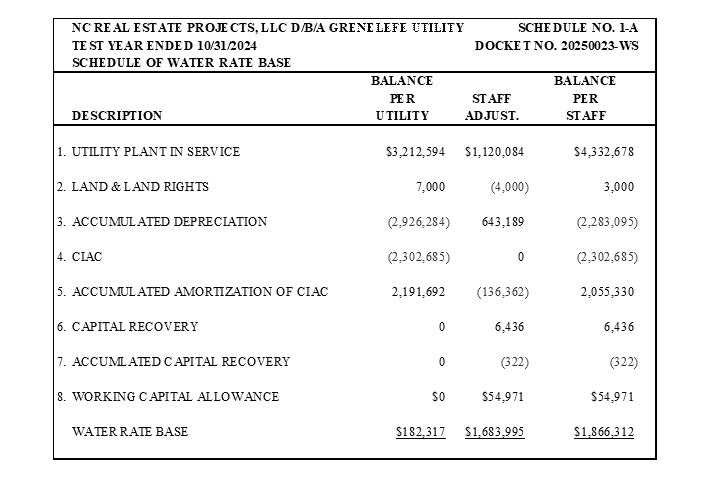
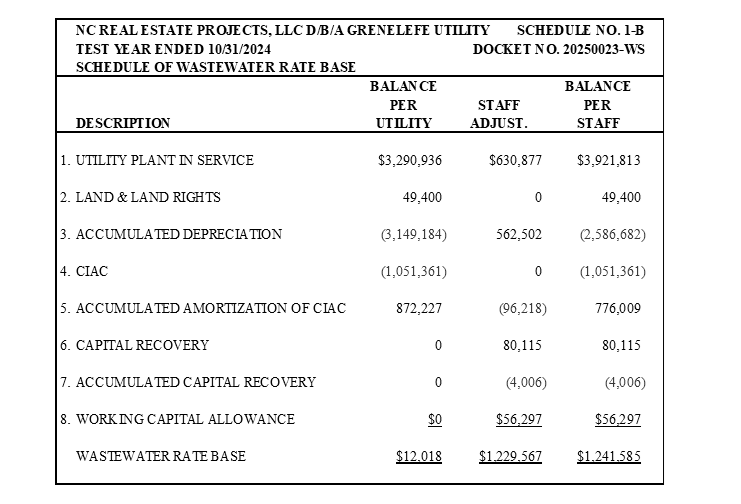
Based on the foregoing, staff recommends that the
appropriate average test year rate base is $1,866,312 for water and $1,241,585
for wastewater. Rate base is shown on Schedule No. 1-A for water and Schedule
No. 1-B for wastewater. The related adjustments are shown on Schedule No. 1-C.
Further, staff recommends the Utility be required to submit a report no later
than November 30, 2026, detailing the status and in-service date of each
Commission-approved pro forma project.
Issue 5:
What is the appropriate return on equity and overall
rate of return for Grenelefe?
Recommendation:
The appropriate return on equity (ROE) is 10.51
percent with a range of 9.51 percent to 11.51 percent. The appropriate overall
rate of return is 9.00 percent. (Cohn)
Staff Analysis:
The Utility’s capital structure consists of
long-term debt, common equity, and customer deposits. In response to a staff
inquiry, the Utility provided information regarding the financing of its pro
forma additions.
Grenelefe intends to finance approximately 75 percent of its capital additions
through long-term debt and the other 25 percent through common equity. Although
the Utility has yet to secure the long-term loan, it has been quoted an
estimated interest rate range of 6.5 percent to 9.0 percent. Thus, staff has
developed a hypothetical capital structure utilizing the information provided
by the Utility. With respect to the pro forma additions, staff assumed a 7.75
percent cost rate for the Utility’s prospective long-term loan, as it
represents the midpoint of the estimated range. Since the time of the Staff
Report, the Utility has not obtained actual loan information. When
coupled with the Utility’s pre-existing long-term debt obligation at a cost
rate of 9.75 percent, staff calculated a weighted average cost of long-term
debt of 8.52 percent.
Conclusion
The Utility’s (hypothetical) capital structure has been
reconciled with staff’s recommended rate base. The appropriate ROE is 10.51
percent based on the Commission-approved leverage formula currently in effect.
Staff recommends an ROE of 10.51 percent with a range of 9.51 percent to 11.51
percent, and an overall rate of return of 9.00 percent. The ROE and overall
rate of return are shown on Schedule No. 2.
Issue 6:
What are the appropriate test year revenues for
Grenelefe’s water and wastewater system?
Recommendation:
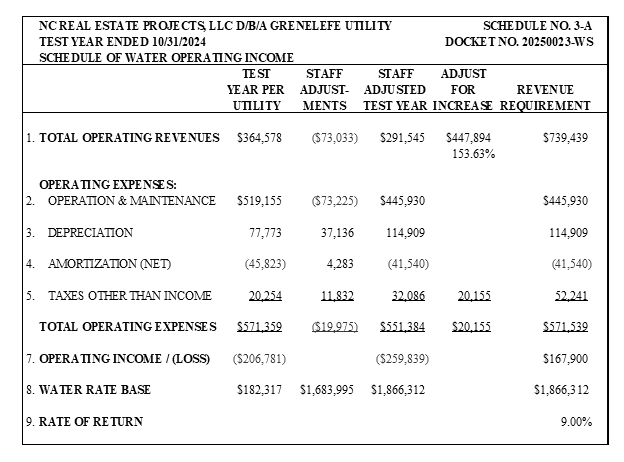
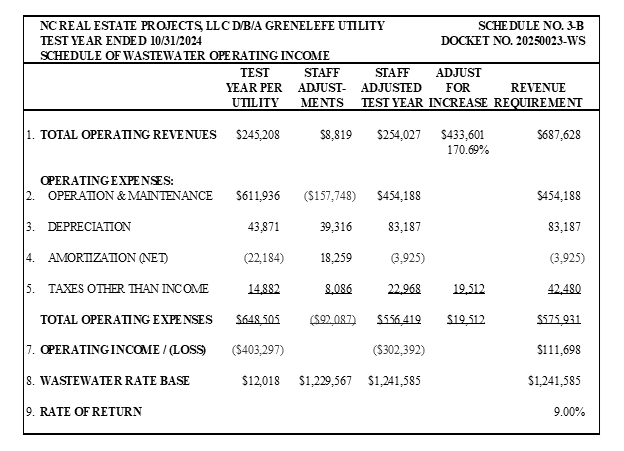
The appropriate test year
operating revenues for Grenelefe’s are $291,545
for the water system and $254,027 for the wastewater system. (Sibley)
Staff Analysis:
The Utility recorded test
year operating revenues of $364,578 for water and $245,208 for wastewater. The
water revenues included $331,092 of service revenues and $33,486 of
miscellaneous revenues. The Utility did not include any miscellaneous revenues
for the wastewater system.
During the test year, the
Utility had several changes in its billing software, which resulted in
inconsistent billing data. The Utility was unable to provide the billing data
for the months of November and December 2023. Audit staff believed it was
necessary to use the calendar year 2024 billing data to prepare the billing
analysis. However, due to a change in the billing software, the billing data
for the months of January 2024 and February 2024 were combined into one billing
register. Since the billing data was combined for two billing periods and a
monthly average was used for the two months in audit staff’s billing analysis,
staff believes it was appropriate to use January 2025 and February 2025 billing
data to complete the billing analysis.
Upon deciding to use the January
2025 and February 2025 billing data, staff discovered the Utility had another
software change. In addition, from prior
dockets, staff was familiar with the customer classifications and meter sizes
and noticed that some customers were misclassified. Recently, the Utility
informed staff that there was another change to its billing software and a
change from non-potable irrigation service to providing only potable irrigation
service. In order to reflect the appropriate billing determinants, staff shared
with the Utility the customer classifications and meter sizes from a prior
docket to address the inconsistencies and adjusted the billing determinants. To
determine the appropriate service revenues, staff applied the adjusted billing
determinants to the existing rates. As a result, staff determined that service
revenues for water should be $258,059, which is a decrease of $73,033 ($331,092
- $258,059) and $254,027 for wastewater, which is an increase of $8,819
($254,027 - $245,208).
Based
on the above, the appropriate test year operating revenues for Grenelefe are $291,545 ($258,059 + $33,486) for the water system and
$254,027 for the wastewater system.
Issue 7:
What is the appropriate amount of operating expense
for Grenelefe?
Recommendation:
The appropriate amount of operating expense for Grenelefe
is $571,555 for water and $575,941 for wastewater. (Cohn)
Staff Analysis:
The Utility recorded operating expense of $571,359
for water and $648,505 for wastewater. The test year operating expenses have
been reviewed by staff, including invoices and other supporting documentation.
Staff has made several adjustments to the Utility’s operating expenses as
described below.
Operation and
Maintenance Expenses
Salaries
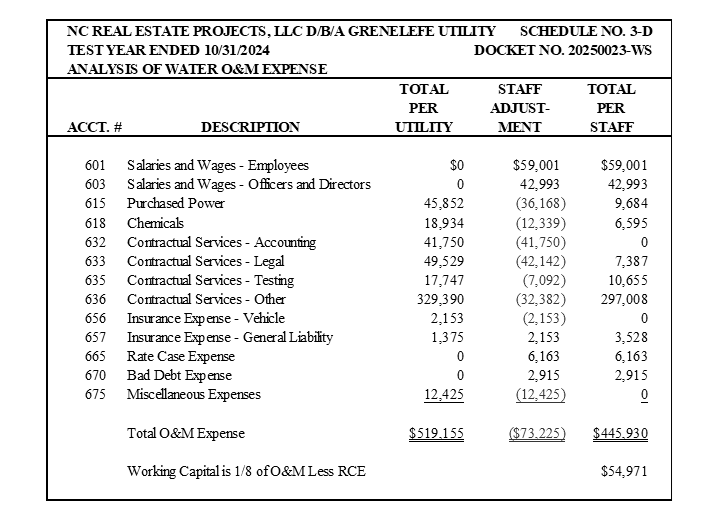
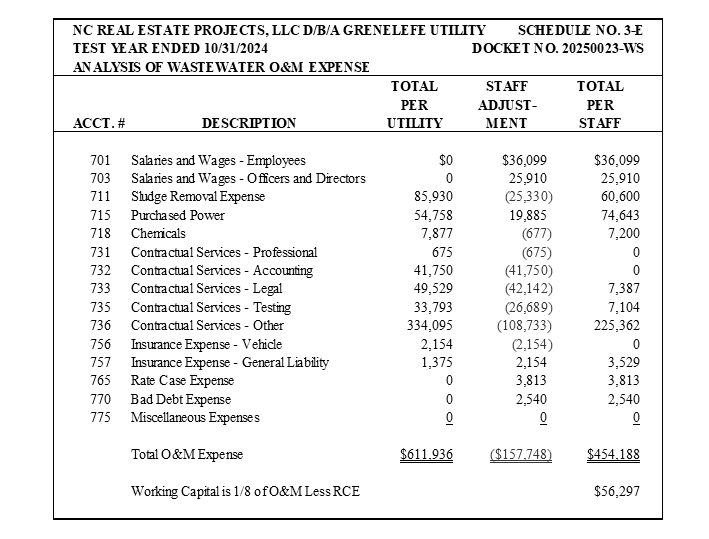
and Wages – Employees (601/701)
The Utility recorded a salaries and wages – employees
expense of $0 for both water and wastewater. Staff increased this figure by
$59,001 for water and $36,099 for wastewater to account for the addition
(transfer) of an “Accounting and Operations Manager” position that was previously
subsumed in contractual services - accounting. As this position is being
transferred to the Utility’s payroll, staff finds it reasonable to apply a
standard 160-hour month for a full-time employee in determining the appropriate
salary expense. Therefore, staff recommends a salaries and wages – employees
expense of $59,001 for water and $36,099 for wastewater.
Salaries
and Wages – Officers and Directors (603/703)
The Utility recorded a salaries and wages – officers and
directors expense of $0 for both water and wastewater. The Utility requested
the addition of an Owner’s salary of $100,000. Staff reviewed the duties and
responsibilities of the position and found they most closely align with the
“Small General Manager” classification in the 2023 AWWA Compensation Survey,
which reflects a midpoint salary of $104,456. Applying the Commission’s 2024
and 2025 Price Indices of 3.24 percent and 2.23 percent results in a compound
indexed amount of $110,245.
However, staff and OPC believe that the work hours
reported by the Owner appear overstated and are unsupported.
In response to staff’s sixth data request, the Utility stated that maintaining
a timesheet would not be an efficient use of the Owner’s time.
In addition, the Utility provided a summary of the various entities to which
the Owner devotes time beyond the Utility, including: Ronin Assets, LLC; SJD
Development, LLC; Smokey Grove Development; and Grenelefe Resort Development,
LLC. Given this information and fair assumptions regarding time management,
staff believes it reasonable to base the Owner’s salary on a 100-hour work
month. Staff calculated a salary of $68,903 using the aforementioned
compensation and duration assumptions. Therefore, staff recommends a salaries
and wages – officers and directors expense of $42,993 for water and $25,910 for
wastewater.
Sludge
Removal (711)
The Utility recorded sludge removal expenses of $85,930
for wastewater. Audit staff decreased the sludge removal expense by $25,330 to
reflect actual invoices provided for the test year. Therefore, staff recommends
a sludge removal expense of $60,600 for wastewater.
Purchased Power (615/715)
The Utility recorded purchased power expenses of $45,852
for water and $54,758 for wastewater. Audit staff decreased the purchased power
expense by $24,846 for water and increased the expense by $19,914 for
wastewater. Staff further decreased purchased power by $29 for wastewater to
accurately reflect invoices received for the test year. Additionally, staff
decreased water by $11,322 to reflect the 53.90 percent EUW discussed in Issue
3. Staff’s adjustments to purchased power result in a total decrease of $36,168
to water and an increase of $19,885 to wastewater. Therefore, staff recommends
a purchased power expense of $9,684 for water and $74,643 for wastewater.
Chemicals
(618/718)
The Utility recorded chemicals expenses of $18,934 for
water and $7,877 for wastewater. Audit staff decreased these amounts by $2,134
and $677 for water and wastewater, respectively, to reflect actual invoices
provided for the test year. Additionally, staff decreased water by $10,205 to
reflect the 53.90 percent EUW discussed in Issue 3. Therefore, staff recommends
a chemicals expense of $6,595 for water and $7,200 for wastewater.
Contractual
Services – Professional (731)
The Utility recorded contractual services – professional
expenses of $675 for wastewater. Audit staff reduced this amount by $675 due to
the lack of supporting documentation. Therefore, staff recommends a contractual
services – professional wastewater expense of $0.
Contractual
Services – Accounting (632/732)
The Utility recorded contractual services – accounting
expenses of $41,750 for water and $41,750 for wastewater. Audit staff increased
both of these expenses by $6,250 to reflect the correct invoiced contractual
services amount. Additionally, staff decreased these accounts by $48,000 for
water and $48,000 for wastewater to reflect the reclassification of the
“Accounting and Operations Manager” expense from contractual services to salaries
and wages - employees. Therefore, staff recommends contractual services –
accounting expenses of $0 for water and $0 for wastewater.
Contractual
Services – Legal (633/733)
The Utility recorded contractual services – legal expenses
of $49,529 for water and $49,529 for wastewater. Audit staff reduced each
account by $40,722 to reflect actual contractual amounts and to remove legal
expenses from a past proceeding.
Additionally, staff removed $1,420 from water and $1,420 from wastewater to
reflect the removal of out-of-test-year expenses. Staff’s adjustments result in
a total decrease of $42,142 to both water and wastewater. Therefore, staff
recommends contractual services – legal expenses of $7,387 for water and $7,387
for wastewater.
Contractual
Services – Testing (635/735)
The Utility recorded contractual services – testing
expenses of $17,747 for water and $33,793 for wastewater. Audit staff reduced
the accounts by $7,092 for water and $26,689 for wastewater to reflect actual
invoices recorded for the test year. Therefore, staff recommends a contractual
services – testing expense of $10,655 for water and $7,104 for wastewater.
Contractual
Services – Other (636/736)
The Utility recorded contractual services – other expenses
of $329,390 for water and $334,095 for wastewater. Audit staff reduced these
amounts by $24,472 for water and $100,823 for wastewater to reflect actual
invoices recorded for the test year. Additionally, staff removed $7,910 for
water and $7,910 for wastewater to reflect the removal of out-of-test-year
expenses. Staff’s adjustments result in a total decrease of $32,382 to water
and $108,733 to wastewater. Therefore, staff recommends contractual services –
other expense of $297,008 for water and $225,362 for wastewater.
Insurance
Expense – Vehicle (656/756)
The Utility recorded insurance expense – vehicle amounts
of $2,153 for water and $2,154 for wastewater. Audit staff reclassified these
amounts to insurance expense – general liability as it reflects property
insurance for plant and not vehicles. Therefore, staff recommends an insurance
expense – vehicle expense of $0 for water $0 for wastewater.
Insurance
Expense – General Liability (657/757)
The Utility recorded an insurance expense – general
liability of $1,375 for water $1,375 for wastewater. Audit Staff increased this
figure by $2,153 for water and $2,154 for wastewater to reflect the
reclassification of expenses from insurance expense – vehicle to insurance
expense – general liability. Therefore, staff recommends a general liability
insurance expense of $3,528 for water and $3,529 for wastewater.
Rate
Case Expense (665/765)
The Utility did not record a rate case expense for water
or wastewater. The Utility is required by Rule 25-22.0407, F.A.C., to mail
notices of the rate case overview, interim rates, final rates, and four-year
rate reduction. Staff calculated noticing costs to be $6,203. Staff calculated
the distance from the Utility to Tallahassee as 273 miles. Based on the 2025
Internal Revenue Service business mileage rate of $0.70, staff calculated a
round-trip travel and lodging expense to the Commission Conference of $582.
Additionally, the Utility paid a filing fee of $1,000 for water $1,000 for
wastewater.
On December 15, 2025, the Utility submitted invoices for
additional rate case expense including legal expenses and consulting fees.
The summary of actual expenses attached to the invoices reflect additional
legal expense of $4,360, $10,840, and $12,720 for the months of September 2025,
October 2025, and November 2025, respectively. The Utility also incurred
consulting fees of $3,300 for the period of August 22, 2025 through November
30, 2025. The Utility further included an estimated rate case expense of
$24,500. Staff relied on costs that were supported by documentation at the time
of review; therefore, staff did not include the estimated portion. As such,
staff included $31,220 for legal and consulting fees as part of the rate case
expense. The non-filing portion of the rate case expense is $23,714 for water
and $14,291 for wastewater.
Staff recommends a total rate case expense, consisting of
noticing costs, travel and lodging expenses, and filing fee of $24,714 for
water and $15,291 for wastewater, which amortized over four years is $6,163 for
water and $3,813 for wastewater. Therefore, staff recommends a total annual
rate case expense of $6,163 for water and $3,813 for wastewater.
Bad
Debt Expense (670/770)
The Utility recorded $0 bad debt for both water and
wastewater in the test year. In its three most recent Annual Reports (2022,
2023, and 2024), the Utility reported bad debt expenses of $0 in all three
years. However, in response to staff’s third data request, the Utility
responded that it does in fact have accounts in delinquency.
Thus, staff believes it is appropriate to include a level of bad debt expense
in its revenue requirements. It is Commission practice to use a percentage of
total revenues to determine bad debt expense when a three-year average is not
available or reliable.
As such, staff recommends a bad debt expense of one percent of total revenues,
or $2,915 for water and $2,540 for wastewater.
Miscellaneous
Expense (675)
The Utility recorded miscellaneous expenses of $12,425 for
water. Audit staff removed the $12,425 for water to reflect a lack of
supporting documentation. Therefore, staff recommends a miscellaneous expense
amount of $0 for water.
Operation
and Maintenance Expense Summary
The Utility recorded test year O&M expenses of
$519,155 for water and $611,936 for wastewater. Based on the above adjustments,
staff recommends the O&M expense be reduced by $73,210 for water and
$157,738 for wastewater. This results in a total O&M expense of $445,945
for water and $454,198 for wastewater. Staff’s recommended adjustments to
O&M are shown on Schedule No. 3-D for water and Schedule 3-E for
wastewater.
Depreciation
Expense
The Utility recorded depreciation expenses of $77,773 for
water and $43,871 for wastewater. Based on the depreciation rates prescribed in
Rule 25-30.140, F.A.C., audit staff decreased these amounts by $21,007 for
water and $8,378 for wastewater. Additionally, to account for pro forma
additions, staff increased depreciation expenses by $58,143 for water and
$47,694 for wastewater. This results in a net increase to a depreciation
expense of $37,136 for water and $39,316 for wastewater. Therefore, staff
recommends a depreciation expense of $114,909 for water and $83,187 for
wastewater.
Amortization
of CIAC
The Utility recorded CIAC amortization expenses of $45,823
for water and $22,184 for wastewater. Audit staff decreased the amounts by
$3,639 for water and $10,248 for wastewater to reflect amortization expense
based on depreciation rates specific to the related plant accounts. Therefore,
staff recommends CIAC amortization expenses of $42,184 for water and $11,936
for wastewater.
Capital
Amortization
As discussed in Issue 4, staff recommends a capital
recovery schedule of $6,436 for water and $80,115 for wastewater over a 10-year
amortization period. The corresponding annual amortization expense is $644 for
water and $8,011 for wastewater.
Therefore, staff recommends the total annual amortization
expense, reflecting CIAC and capital amortization expense, is $41,540 for water
and $3,925 for wastewater.
Taxes
Other Than Income (TOTI)
The Utility recorded TOTI of $20,254 for water and $14,882
for wastewater which includes property taxes, payroll taxes, and regulatory
assessment fees (RAFs). Audit staff decreased TOTI by $3,902 for water and by
$3,580 for wastewater to reflect actual invoiced amounts for the test year.
Staff increased TOTI by $15,119 for water and $10,071 for wastewater to reflect
property taxes associated with pro forma plant additions. These amounts are net
of property tax reductions associated with the pro forma plant retirements.
Based on revenues discussed in Issue 6, TOTI should be
increased by $616 for water and $1,595 for wastewater to reflect a RAF rate of
4.5 percent applied to the change in revenues.
As discussed in Issue 9, staff recommends revenues be
increased by $447,911 for water and $433,611 for wastewater to reflect the
increased revenue required to cover expenses and allow an opportunity to earn
the recommended rate of return. As a result, TOTI should be increased by
$20,156 for water and $19,513 for wastewater to reflect a RAF rate of 4.5
percent of the change in revenues. Staff’s adjustments result in a total
increase of $31,989 to water and $27,599 to wastewater. Therefore, staff
recommends a TOTI of $52,242 for water and $42,481 for wastewater.
Total Operating Expenses
Summary
The Utility recorded operating expenses of $571,359 for
water and $648,505 for wastewater. The application of staff’s recommended
adjustments to the Utility’s operating expenses results in a total operating
expense of $571,555 for water and $575,941 for wastewater. Operating expenses
are shown on Schedule No. 3-A for water and Schedule 3-B for wastewater, and
the related adjustments are shown on Schedule No. 3-C.
Issue 8:
Does Grenelefe meet the criteria for application of
the operating ratio methodology?
Recommendation:
No, Grenelefe does not meet the requirement for
application of the operating ratio methodology for calculating the revenue
requirement. (Cohn)
Staff Analysis:
Rule 25-30.4575(2), F.A.C., provides that in rate
cases processed under Rule 25-30.455, F.A.C., the Commission will use the
operating ratio methodology to establish the Utility’s revenue requirement when
its rate base is not greater than 125 percent of O&M expenses, less
regulatory commission expense, and the use of the operating ratio methodology
does not change the Utility’s qualification for a SARC.
With respect to Grenelefe, staff
has recommended a rate base of $1,866,312 for water and $1,241,585 for
wastewater. After removal of rate case expense, staff has calculated an adjusted
O&M expense of $439,767 for water and $450,375 for wastewater. Based on
staff’s preliminary recommended amounts, the Utility’s rate bases are 424.39
percent and 275.68 percent of its adjusted O&M expense for water and
wastewater, respectively. Based on this, the Utility does not qualify for
application of the operating ratio methodology.
Issue 9:
What is the appropriate revenue requirement for
Grenelefe?
Recommendation:
The appropriate revenue requirement is $739,456 for
water and $687,638 for wastewater, resulting in an annual increase of $447,911
(153.63 percent) for water and $433,611 (170.69 percent) for wastewater. (Cohn)
Staff Analysis:
Grenelefe should be allowed
an annual increase of $447,911 (153.63 percent) for water and $433,611 (170.69
percent) for wastewater. This should allow the Utility the opportunity to
recover its expenses and earn a 9.00 percent return on its respective rate
base. The calculations for revenue requirement are shown on Table 9-1 and Table
9-2.
Table
9-1
Water Revenue Requirement
|
Water Rate Base
|
$1,866,312
|
|
Rate of Return (%)
|
× 9.00%
|
|
Return On Rate Base ($)
|
$167,900
|
|
Water O&M Expense
|
445,945
|
|
Depreciation Expense
|
114,909
|
|
Amortization
|
(41,540)
|
|
Taxes Other Than Income
|
52,242
|
|
Revenue Requirement
|
$739,456
|
|
Less Test Year Revenues
|
$291,545
|
|
Annual Increase
|
$447,911
|
|
Percent Increase
|
153.63%
|
Source: Staff
calculations.
Table
9-2
Wastewater Revenue Requirement
|
Wastewater Rate Base
|
$1,241,585
|
|
Rate of Return (%)
|
× 9.00%
|
|
Return On Rate Base ($)
|
$111,698
|
|
Wastewater O&M Expense
|
454,198
|
|
Depreciation Expense
Amortization
|
83,187
(3,925)
|
|
Taxes Other Than Income
|
42,481
|
|
Revenue Requirement
|
$687,638
|
|
Less Test Year Revenues
|
$254,027
|
|
Annual Increase
|
$433,611
|
|
Percent Increase
|
170.69%
|
Source: Staff
calculations.
Issue 10:
What are the appropriate rate structure and rates
for Grenelefe’s water and wastewater systems?
Recommendation:
The recommended rate
structure and monthly water and wastewater rates are shown on Schedule Nos. 4-A
and 4-B. The Utility should file revised tariff sheets and a proposed customer
notice to reflect the Commission-approved rates. The approved rates should be
effective for service rendered on or after the stamped approval date on the
tariff sheets pursuant to Rule 25-30.475(1), F.A.C. In addition, the approved
rates should not be implemented until staff has approved the proposed customer
notice and the notice has been received by the customers. The Utility should
provide proof of the date notice was given within 10 days of the date of the
notice. (Sibley)
Staff Analysis:
Water Rates
Grenelefe
is located in Polk County within the SWFWMD. The
Utility provides water service to 1,213 residential customers, with 78 of the
customers having a separate meter for irrigation. There are also 192 general
service customers, which includes 85 irrigation customers. According to the
billing data, approximately 14 percent of the residential customer bills during
the test year had zero gallons, which signifies a non-seasonal customer base. However,
when seasonal customers are out of residence, they will continue to irrigate
their lawns, which will distort the percentage of cumulative bills at the zero
consumption level. Staff believes that
the cumulative bills at the 1,000 gallon consumption level, which represents
approximately 37 percent of the residential customer bills, indicates a
moderate seasonal customer base. The average residential water demand is 2,706
gallons. The average water demand, excluding zero gallon bills, is 3,660
gallons per month. The Utility’s current rate
structure for the water system consists of a base facility charge (BFC) and a
four-tier inclining block rate, which includes separate gallonage charges for non-discretionary
and discretionary usage for residential water customers. The rate blocks are:
1) 0-5,000 gallons; 2) 5,001-10,000 gallons; 3) 10,001-15,000 gallons; and 4)
all usage in excess of 15,000 gallons. The general service rate structure consists
of a monthly BFC and uniform gallonage charge.
Staff
performed an analysis of the Utility’s billing data in order to evaluate the
appropriate rate structure for the residential water customers. The goal of the
evaluation was to select the rate design parameters that: (1) produce the
recommended revenue requirement; (2) equitably distribute cost recovery among
the Utility’s customers; (3) establish the appropriate discretionary usage
threshold for restricting repression; and (4) implement, where appropriate,
water conserving rate structures consistent with Commission practice.
As
mentioned above, the billing data indicates a moderate seasonal customer base
coupled with low average consumption. The Utility’s current BFC allocation is
64 percent, which exceeds the Commission’s practice of recovering at least 50
percent of costs through the BFC for a seasonal customer base. In this case,
staff recommends that the BFC allocation be reduced from 64 percent to 55
percent, which will minimize the rate impact at non-discretionary levels of
consumption. Staff’s recommended BFC allocation of 55 percent will also allow
the Utility to maintain revenue stability and target customers that are using a
higher levels of usage.
The
average people per household served by the water system is 2.35;
therefore, based on the number of people per household, 50 gallons per day per
person, and the number of days per month, the non-discretionary usage threshold
should be 4,000 gallons per month.
Furthermore, staff evaluated whether the current rate structure is appropriate
in this case. Based on staff’s evaluation, there is very little discretionary
usage above 15,000 gallons; therefore, staff believes the current rate
structure is aggressive and should be changed. Staff recommends a BFC and a
three-tier inclining block rate structure, which includes separate gallonage
charges for discretionary and non-discretionary usage for residential water
customers. The rate blocks are: (1) 0 – 4,000 gallons; 2) 4,000 – 10,000
gallons; 3) over 10,000 gallons per month.
General service customers should be billed a BFC and a uniform gallonage
charge.
Based
on staff’s recommended revenue increase of 173.6 percent, which excludes
miscellaneous revenues, the residential consumption can be expected to decline
by 10,711,000 gallons, resulting in anticipated average residential demand of
1,979 gallons per month. Staff recommends a 26.9 percent reduction in test year
residential gallons for rate setting purposes. As a result, the corresponding
reductions are $2,074 for purchased power expense, $1,412 for chemical expense,
and $164 for RAFs to reflect the anticipated repression, which results in a post-repression revenue requirement of $702,320.
Wastewater Rates
The Utility provides wastewater service
to approximately 1,213 residential customers and 107 general service customers.
Currently, the wastewater rate structure for residential customers consists of
a monthly uniform BFC for all meter sizes and gallonage charge with an 8,000
gallonage cap. The general service customers are billed a BFC by meter size and
a gallonage charge that is 1.2 times higher than the residential gallonage
charge.
Staff performed an analysis of the
Utility’s billing data in order to evaluate various BFC cost recovery percentages
and gallonage caps for the residential wastewater customers. The goal of the
evaluation was to select the rate design parameters that: 1) produce the
recommended revenue requirement; 2) equitably distribute cost recovery among
the Utility’s customers; and 3) implement a gallonage cap that considers
approximately the amount of water that may return to the wastewater system.
Currently, the Utility’s
BFC allocation is 60 percent of the wastewater revenue. Consistent with
Commission practice, staff allocated 60 percent of the wastewater revenue to
the BFC due to the capital intensive nature of wastewater plants coupled with a
moderate seasonal customer base. The Utility’s current wastewater gallonage cap
is set at 8,000 gallons per month. The wastewater gallonage cap recognizes that
not all water used by the residential customers is returned to the wastewater
system. It is Commission practice to set the wastewater cap at approximately 80
percent of residential water sold, which typically results in gallonage caps of
6,000, 8,000, or 10,000. Based on staff’s review of the billing analysis, 82
percent of the gallons are captured at the 6,000 gallon consumption level.
Therefore, staff recommends that the wastewater gallonage cap be changed to
6,000 gallons. Staff also recommends that the general service gallonage charge
continue to be 1.2 times greater than the residential gallonage charge, which
is consistent with Commission practice.
In addition, based on the expected reduction in water
demand described above, staff recommends that a repression adjustment also be
made for wastewater. Because wastewater rates are calculated based on
customers’ water demand, if those customers’ water demand is expected to
decline, then the billing determinants used to calculate wastewater rates
should also be adjusted. Based on the billing analysis for the wastewater
system, staff recommends that a repression adjustment of 680,794 gallons to
reflect the anticipated reduction in water demand be used to calculate
wastewater rates. Staff recommends a 2.25 percent reduction in total
residential consumption and corresponding reductions of $ $1,366 for sludge
removal, $1,682 for purchased power, $162 for chemicals and $144 for RAFs to
reflect the anticipated repression, which results in a post repression revenue
requirement of $684,283.
Conclusion
The recommended rate structures
and monthly water and wastewater rates are shown on Schedule Nos. 4-A and 4-B.
The Utility should file revised tariff sheets and a proposed customer notice to
reflect the Commission-approved rates. The approved rates should be effective
for service rendered on or after the stamped approval date on the tariff sheets
pursuant to Rule 25-30.475(1), F.A.C. In addition, the approved rates should
not be implemented until staff has approved the proposed customer notice and
the notice has been received by the customers. The Utility should provide proof
of the date notice was given within 10 days of the date of the notice.
Issue 11:
What are the appropriate initial customer deposits
for Grenelefe?
Recommendation:
The appropriate initial customer deposits for the residential
5/8 inch x 3/4 inch meter size should be $72 and $89 for water and wastewater.
Additionally, non-potable water customer deposits should be removed. The
initial customer deposit for all other residential meter sizes and all general
service meter sizes should be two times the average estimated bill for water.
The approved initial customer deposits should be effective for connections made
on or after the stamped approval date on the tariff sheets pursuant to Rule
25-30.475, F.A.C. The Utility should be required to collect the approved
deposits until authorized to change them by the Commission in a subsequent
proceeding. (Sibley)
Staff Analysis:
Rule
25-30.311, F.A.C., provides the criteria for collecting, administering, and
refunding customer deposits. Customer deposits are designed to minimize the
exposure of bad debt expense for the Utility and, ultimately, the general body
of ratepayers. An initial customer deposit ensures that the cost of providing
service is recovered from the cost causer. Historically, the Commission has set
initial customer deposits equal to two times the average estimated bill.[55] Currently,
the Utility has an initial customer deposit of $19.80 and $25.56 for 5/8 inch x
3/4 inch meters for potable water and wastewater, respectively. The Utility
also has non-potable water customer deposits of $16.48 for 5/8 inch x 3/4 inch
meters; $100.46 for the 1 inch meter; $110.38 for the 1.5 inch meter; $224.90
for 2 inch meter; and two times the average bill for all other general service
meter sizes. However, the Utility no longer charges these non-potable water
customer deposits, and thus staff recommends removal of these non-potable customer
deposits from the Utility’s tariff. Furthermore, the current customer deposit amounts
for residential do not cover two months’ average bills using staff’s
recommended rates. The Utility’s anticipated post-repression average monthly
residential usage for water is 2,512 gallons per customer. The Utility’s
anticipated post-repression average monthly residential usage for wastewater is
2,075 gallons per customer. Therefore, the average residential monthly bill is
$35.66 for water service and $44.55 for wastewater service.
Conclusion
Staff recommends that the appropriate initial customer
deposits for the residential 5/8 inch x 3/4 inch meter size should be $72 and $89
for water and wastewater. Staff recommends that the non-potable water customer
deposits should be removed. The initial customer deposit for all other
residential meter sizes and all general service meter sizes should be two times
the average estimated bill for water. The approved initial customer deposits
should be effective for connections made on or after the stamped approval date
on the tariff sheets pursuant to Rule 25-30.475, F.A.C. The Utility should be
required to collect the approved deposits until authorized to change them by
the Commission in a subsequent proceeding.
Issue 12:
Should Grenelefe's requested service availability
charges be approved?
Recommendation:
The service availability charges requested by
Grenelefe should not be approved. Staff recommends service availability charges
should be set as a plant capacity charge of $147 for water and $1,138 for
wastewater. The Utility should file a revised tariff sheet to reflect the
Commission-approved charges. The approved charges shall be effective for
connections made on or after the stamped approval date on the tariff sheet. In addition, the approved charges should not be implemented
until staff has approved the proposed customer notice and the notice has
been received by property owners who requested service beginning 12 months
prior to the establishment of this docket. The Utility shall provide proof of
noticing within 10 days of rendering the approved notice. (Hudson)
Staff Analysis:
Historically,
the Utility’s water service availability charges consisted of a meter
installation charge of $65 and a service line extension and tap-in charge at
actual cost. As part of a certificate transfer docket, Grenelefe was approved
for an increase in its meter installation charge to $600.[56]
There have been no approved service availability charges for the wastewater
system. As mentioned in the case background, the Commission approved
Grenelefe’s requested interim service availability charges of $2,402 for water
and $7,434 for wastewater subject to refund. However, the Utility did not
implement the charges.
By letter,
dated October 13, 2025, Grenelefe revised its requested service availability
charges to $1,126 for water and $9,802 for wastewater. The
Utility did not categorize its service availability charge request (i.e., main
extension or plant capacity charge). A main extension charge is for the purpose
of covering all or part of the Utility’s capital costs in extending its off-site
water or wastewater facilities to provide service to a specified property,
whereas a plant capacity charge is for the purpose of covering all or a part of
a Utility’s capital costs in construction or expansion of treatment facilities.
In a 2003 transfer
of majority organizational control docket, the Utility did not have adequate
books and records to provide the CIAC balances. As result, in that docket, the
Commission imputed, per Rule 25-30.570, F.A.C., the cost of Grenelefe’s water
transmission and distribution lines and wastewater collection lines to reflect
the appropriate CIAC.[58] As a
result, the Utility is unable to receive a main extension charge. Further,
Grenelefe did not propose any pro forma plant additions for lines in this SARC.
Therefore, staff has conducted an evaluation of Grenelefe’s request to
determine whether a plant capacity charge is appropriate.
Rule
25-30.580, F.A.C., establishes guidelines for designing service availability
charges. Pursuant to the Rule, the maximum amount of CIAC, net of amortization,
should not exceed 75 percent of the total original cost, net of accumulated
depreciation, of the utility’s facilities and plant when the facilities and
plant are at their designed capacity. The minimum amount of CIAC should not be
less than the percentage of such facilities and plant that is represented by
the water transmission and distribution system and sewage collection systems.
Design Capacity
Design capacity refers to the
total capacity of the Utility’s facilities and plant. The cost recorded in the
Utility’s books represents the total cost for construction of the facilities
and plant and its total and full capacity. In justifying its requested charges,
the Utility has proposed using the permitted capacity of the facilities and
plant, which is less than the total capacity for both water and wastewater.
This is inconsistent with the Commission Rule and the matching principle. The
permitted capacity does not align with the total cost of the facilities.
Developing service availability charges based on the design capacity allows
customers to pay an equitable share of the total costs of the facilities and
plant.
The water treatment facilities have
a capacity of 4,320,000 gpd, which equates to a design capacity of 12,342
equivalent residential connections (ERCs) based on an ERC of 350 gpd. Grenelefe
indicated that it anticipates growth of 200 ERCs per year, which would result
in the Utility reaching design capacity in approximately 55 years. Due to the
length of time before the water system reaches design capacity, staff believes
it is unrealistic to set the charges at complete design capacity.
In a comparable situation, the
Commission determined that a shortened period of 10 years was appropriate for
calculating service availability charges.[59]
A 10-year shortened period would result in Grenelefe foreseeably connecting an
additional 2,000 ERCs. Based on the maximum average flow, the Utility is
currently serving 1,408 ERCs (492,917/350). As a result, staff recommends that
the total ERCs for calculating the appropriate plant capacity charge be set at
3,408 (1,408 + 2,000). The adjusted ERCs will allow Grenelefe to achieve a
reasonable contribution level. The wastewater treatment facilities have a
capacity of 680,000 gpd, which equates to a design capacity of 2,428 ERCs based
on an ERC of 280 gpd. Based on the Utility’s growth projections of 200 ERCs per
year, the wastewater system will reach design capacity in approximately 10
years.
Minimum Contribution
Level
Pursuant to
Rule 25-30.580, F.A.C., “[t]he minimum amount of [CIAC] should not be less than
the percentage of such facilities and plant that is represented by the water
transmission and distribution system and sewage collection systems.” For water,
staff’s recommended utility plant in service plus land is $4,335,678 and the
transmission and distribution mains, including services, are $2,175,467,
resulting in a minimum contribution level of 50.18 percent
($2,175,467/$4,335,678). For wastewater, staff’s recommended utility plant in
service plus land is $3,971,213 and the collection lines, including services,
are $899,422, resulting in a minimum contribution level of 22.65 percent
($899,422/$3,971,213). Based on staff’s recommended rate base Grenelefe’s
contribution level is 12.07 percent for water and 19.89 percent for wastewater.
Both the water and wastewater systems are below the minimum guideline pursuant
to the referenced Rule.
Plant Capacity Charge
Water
In order to determine the plant
capacity charge, staff calculated the average cost per ERC for the water
treatment plant per Commission precedent.[60]
Staff believes that using the average costs per ERC will result in reasonable
service availability charges. Staff calculated the total treatment plant cost
of $502,413. Staff then divided this amount by 3,408 (which represents total
capacity, as discussed above, in ERCs of the treatment plant). This calculation
results in an average plant capacity cost per ERC of approximately $147, as shown
on Schedule No. 5. The corresponding plant capacity charge for “all others-per
gallon/day” would be $.42 ($147/350 gpd). Staff recommends a plant capacity
charge of $147. The plant capacity charge of $147, along with its prior
approved meter installation charge of $600, will allow Grenelefe to be at a 46.41
percent contribution level in 10 years. Staff recognizes that the anticipated
contribution level is less than the minimum guideline pursuant to the
referenced Rule. However, the amount of the charge is limited to cost in the
associated accounts for a plant capacity charge.
Wastewater
The total treatment plant is
$2,763,562. Staff then divided this amount by 2,428 (which represents total
capacity, as discussed previously, in ERCs for the treatment plant). This
calculation results in an average plant capacity cost per ERC of approximately
$1,138, as shown on Schedule No. 5. This charge would result in the wastewater
system being over-contributed at build out. However, it is anticipated that the
Utility will undertake plant upgrades over the next couple of years which would
decrease the contribution level at build out. Therefore, staff believes $1,138
is an appropriate plant capacity charge at this time. The corresponding plant
capacity charge for “all others-per gallon/day” would be $4.06 ($1,138/280
gpd).
Staff’s recommended charges are
significantly lower than the Utility’s requested service availability charges
due to staff’s recommended denial of some of the requested pro forma plant
additions and the differences in plant accounts and capacity used to calculate
the charges. Specifically, for water,
Grenelefe included plant account no. 334 – Meters and Meter Installations in
its calculation, which is part of transmission and distribution plant and is
not appropriate. For meter replacements,
the Commission has capitalized the cost and the Utility earns a return on its
investment or the Commission has allowed the costs of a certain number meter
replacements per year to be expensed.
In this case, the cost to replace the meter have been capitalized. The cost of
system-wide meter replacements is not recovered from new customers through a
service availability charge.
The recommended plant capacity
charges are only applicable to new customers. New customers will be required to
pay the staff recommend plant capacity charges.
In addition, new customers are also responsible for connecting its
service lateral to the water and wastewater system consistent with the Utility’s
existing service availability policy.
Conclusion
Based on the above, the service availability charges
requested by Grenelefe should not be approved. Staff recommends service
availability charges should be set as a plant capacity charge of $147 for water
and $1,138 for wastewater. The Utility should file a revised tariff sheet to
reflect the Commission-approved charges. The approved charges shall be
effective for connections made on or after the stamped approval date on the
tariff sheet. In addition, the approved charges
should not be implemented until staff has approved the proposed customer notice
and the notice has been received by property owners who requested service
beginning 12 months prior to the establishment of this docket. The Utility shall
provide proof of noticing within 10 days of rendering the approved notice.
Issue 13:
What is the appropriate amount by which rates should
be reduced four years after the published effective date to reflect the removal
of the amortized rate case expense?
Recommendation:
The rates should be reduced as shown on Schedule Nos.
4-A and 4-B, to remove rate case expense grossed-up for RAFs and amortized over
a four-year period. Pursuant to Section 367.081(8), F.S., the decrease in rates
should become effective immediately following the expiration of the rate case
expense recovery period. Grenelefe should be required to file revised tariffs
and a proposed customer notice setting forth the lower rates and rationale no
later than one month prior to the effective date of the new rates. If the
Utility files revised tariffs reflecting this reduction in conjunction with a
price index or pass-through rate adjustment, separate data should be filed for
the price index and/or pass-through increase and the reduction in the rates due
to the amortized rate case expense. (Cohn)
Staff Analysis:
Section 367.081, F.S.,
requires that the rates be reduced immediately following the expiration of the
4-year period by the amount of the rate case expense previously included in
rates. The reduction will reflect the removal of revenue associated with the
amortization of rate case expense, the associated return in working capital,
and the gross-up for RAFs. This results in a reduction of $6,470 for water and
$4,003 for wastewater.
Staff recommends that the rates should be reduced, as
shown on Schedule Nos. 4-A and 4-B, to remove rate case expense grossed-up for
RAFs and amortized over a four-year period. Pursuant to Section 367.081(8),
F.S., the decrease in rates should become effective immediately following the
expiration of the rate case expense recovery period. Grenelefe should be
required to file revised tariffs and a proposed customer notice setting forth
the lower rates and rationale no later than one month prior to the effective
date of the new rates. If the Utility files revised tariffs reflecting this
reduction in conjunction with a price index, or pass-through rate adjustment,
separate data should be filed for the price index and/or pass-through increase
and the reduction in the rates due to the amortized rate case expense.
Issue 14:
Should the recommended rates be approved for
Grenelefe on temporary basis, subject to refund with interest, in the event of
a protest filed by a party other than the Utility?
Recommendation:
Yes. Pursuant to Section 367.0814(7), F.S., the
recommended rates should be approved for the Utility on a temporary basis,
subject to refund with interest, in the event of a protest filed by a party
other than the Utility. Grenelefe should file revised tariff sheets and a
proposed customer notice to reflect the Commission-approved rates. The approved
rates should be effective for service rendered on or after the stamped approval
date on the tariff sheet, pursuant to Rule 25-30.475(1), F.A.C. In addition, the
temporary rates should not be implemented until staff has approved the proposed
notice, and the notice has been received by the customers. Prior to
implementation of any temporary rates, the Utility should provide appropriate
security.
If the recommended rates are approved on a temporary
basis, the rates collected by the Utility should be subject to the refund
provisions discussed below in the staff analysis. In addition, after the
increased rates are in effect, pursuant to Rule 25-30.360(6), F.A.C., the
Utility should file reports with the Commission’s Office of Commission Clerk no
later than the 20th of each month indicating the monthly and total amount of
money subject to refund at the end of the preceding month. The report filed
should also indicate the status of the security being used to guarantee
repayment of any potential refund. (Cohn)
Staff Analysis:
This recommendation proposes an increase in
water rates. A timely protest might delay what may be a justified rate increase
resulting in an unrecoverable loss of revenue to the Utility. Therefore,
pursuant to Section 367.0814(7), F.S., in the event of a protest filed by a
party other than the Utility, staff recommends that the recommended rates be
approved as temporary rates. Grenelefe should file revised tariff sheets and a
proposed customer notice to reflect the Commission-approved rates. The approved
rates should be effective for service rendered on or after the stamped approval
date on the tariff sheet, pursuant to Rule 25-30.475(1), F.A.C. In addition,
the temporary rates should not be implemented until staff has approved the
proposed notice, and the notice has been received by the customers. The
recommended rates collected by the Utility should be subject to the refund
provisions discussed below.
The
Utility should be authorized to collect the temporary rates upon staff’s
approval of an appropriate security for the potential refund and the proposed
customer notice. Security should be in the form of a bond or letter of credit
in the amount of $306,331 for water and $296,552 for wastewater. Alternatively,
the Utility could establish an escrow agreement with an independent financial
institution.
If the
Utility chooses a bond as security, the bond should contain wording to the
effect that it will be terminated only under the following conditions:
1) The Commission approves the rate increase;
or,
2) If the Commission denies the increase, the
Utility shall refund the amount collected that is attributable to the increase.
If the
Utility chooses a letter of credit as a security, it should contain the
following conditions:
1) The letter of credit is irrevocable for the
period it is in effect, and,
2) The letter of credit will be in effect until
a final Commission order is rendered, either approving or denying the rate
increase.
If
security is provided through an escrow agreement, the following conditions
should be part of the agreement:
1) The Commission Clerk, or his or her
designee, must be a signatory to the escrow agreement; and,
2) No monies in the escrow account may be
withdrawn by the Utility without the prior written authorization of the
Commission Clerk, or his or her designee;
3) The escrow account shall be an interest
bearing account;
4) If a refund to the customers is required,
all interest earned by the escrow account shall be distributed to the
customers;
5) If a refund to the customers is not
required, the interest earned by the escrow account shall revert to the
Utility;
6) All information on the escrow account shall
be available from the holder of the escrow account to a Commission
representative at all times;
7) The amount of revenue subject to refund
shall be deposited in the escrow account within seven days of receipt;
8) This escrow account is established by the
direction of the Florida Public Service Commission for the purpose(s) set forth
in its order requiring such account. Pursuant to Consentino v. Elson, 263 So.
2d 253 (Fla. 3d DCA 1972), escrow accounts are not subject to garnishments;
and,
9) The account must specify by whom and on
whose behalf such monies were paid.
In no
instance should the maintenance and administrative costs associated with the
refund be borne by the customers. These costs are the responsibility of, and
should be borne by, the Utility. Irrespective of the form of security chosen by
the Utility, an account of all monies received as a result of the rate increase
should be maintained by the Utility. If a refund is ultimately required, it
should be paid with interest calculated pursuant to Rule 25-30.360(4), F.A.C.
The
Utility should maintain a record of the amount of the security, and the amount
of revenues that are subject to refund. In addition, after the increased rates
are in effect, pursuant to Rule 25-30.360(6), F.A.C., the Utility should file
reports with the Commission’s Office of Commission Clerk no later than the 20th
of each month indicating the monthly and total amount of money subject to
refund at the end of the preceding month. The report filed should also indicate
the status of the security being used to guarantee repayment of any potential
refund.
Issue 15:
Should Grenelefe be required to notify the
Commission within 90 days of an effective order finalizing this docket, that it
has adjusted its books for all the applicable National Association of
Regulatory Utility Commissioners’ Uniform System of Accounts (NARUC USOA)
primary accounts?
Recommendation:
Yes. Grenelefe should be required to notify the
Commission, in writing, that it has adjusted its books in accordance with the
Commission’s decision. The Utility should submit a letter within 90 days of the
Commission’s final order in this docket, confirming that the adjustments to all
applicable NARUC USOA primary accounts have been made to the Utility’s books
and records. In the event the Utility needs additional time to complete the
adjustments, a notice providing good cause should be filed not less than seven
days prior to the deadline requesting an extension. Upon providing a notice of
good cause, staff should be given administrative authority to grant an
extension of up to 60 days. (Cohn)
Staff Analysis:
Grenelefe should be required to notify the
Commission, in writing, that it has adjusted its books in accordance with the
Commission’s decision. The Utility should submit a letter within 90 days of the
Commission’s final order in this docket, confirming that the adjustments to all
applicable NARUC USOA primary accounts have been made to the Utility’s books
and records. In the event the Utility needs additional time to complete the
adjustments, a notice providing good cause should be filed not less than seven
days prior to the deadline requesting an extension. Upon providing a notice of
good cause, staff should be given administrative authority to grant an
extension of up to 60 days.
Issue 16:
Should this docket be closed?
Recommendation:
No. If no person whose substantial interests are
affected by the proposed agency action files a protest within 21 days of the
issuance of the order, a consummating order should be issued. The docket should
remain open for staff’s verification that the revised tariff sheets and
customer notice have been filed by the Utility and approved by staff. In
addition, this docket should remain open until (1) the report with the summary
of the results of the customer meeting and (2) the report detailing the status
of each of the Commission approved pro-forma projects has been submitted by the
Utility. Once these actions are complete, this docket should be closed
administratively. (Imig)
Staff Analysis:
If no person whose substantial interests are
affected by the proposed agency action files a protest within 21 days of the
issuance of the order, a consummating order should be issued. The docket should
remain open for staff’s verification that the revised tariff sheets and
customer notice have been filed by the Utility and approved by staff. In
addition, this docket should remain open until (1) the report with the summary
of the results of the customer meeting and (2) the report detailing the status
of each of the Commission approved pro-forma projects has been submitted by the
Utility. Once these actions are complete, this docket should be closed
administratively.