Discussion
of Issues
Issue 1:
Is the quality of service provided by Citrus
Waterworks, Inc. satisfactory?
Recommendation:
Yes. Citrus Waterworks, Inc. has been responsive to
customer complaints and is in compliance with the Department of Environmental
Protection (DEP) standards; therefore, the quality of service should be
considered satisfactory. (Lewis)
Staff Analysis:
Pursuant
to Section 367.081(2)(a)(l), F.S., and Rule 25-30.433(1), F.A.C., in water rate
cases the Commission shall determine the overall quality of service provided by
the Utility. This determination is made from an evaluation of the quality of
the Utility’s product and the Utility’s attempt to address customer
satisfaction. Rule 25-30.433(1) F.A.C., further states that the most recent
chemical analyses for the water system, outstanding citations, violations, and
consent orders on file with the DEP and the county health department, and any
DEP and county health department official’s testimony concerning quality of
service shall be considered. In addition, any customer testimony, comments, or
complaints received by the Commission are also reviewed. The operating
condition of the water system is addressed in Issue 2.
Quality of
the Utility’s Product
In
evaluation of Citrus’ product quality, staff reviewed the Utility’s compliance
with the DEP’s primary and secondary drinking water standards. Primary
standards protect public health while secondary standards regulate contaminants
that may impact the taste, odor, and color of drinking water. Staff reviewed
the DEP’s Safe Drinking Water Program chemical analysis of samples taken on
April 11, 2024, at Ellsworth Point, and on April 24, 2024, at Blackwater
Heights, and both plants were deemed in compliance with DEP standards. In
addition, staff reviewed the most current Disinfection Byproducts testing
conducted on July 1, 2024, at the Ellsworth Point water treatment plant (WTP),
and on July 26, 2024, at the Blackwater Heights WTP, and the results were in
compliance with DEP standards.
The
Utility’s Attempt to Address Customer Satisfaction
Staff
reviewed the Commission’s Consumer Activity Tracking System records, and
discovered that no complaints were recorded during the test year and four years
prior for Citrus. There were no complaints filed against the Utility with the
DEP during the same timeframe. Citrus reported receiving 38 complaints during
this timeframe. Table 1-1 shows the number of complaints, by subject and year,
received by the Utility.
Table 1-1
Number of Utility Complaints by Subject
|
Subject
of Complaint
|
2020
|
2021
|
2022
|
2023
|
2024
|
Total
|
|
Water Service
Interruption
|
0
|
1
|
9
|
4
|
6
|
20
|
|
Pressure Issue
|
0
|
3
|
3
|
10
|
0
|
16
|
|
Water Quality
|
0
|
1
|
0
|
0
|
1
|
2
|
|
Total
|
0
|
5
|
12
|
14
|
7
|
38
|
Source: Utility responses to staff data requests.
Staff
investigated the causes for the complaints displayed above. The complaints
related to water service interruptions can be attributed to specific instances
such as, a tree falling and damaging one of the hydropneumatic tanks, a circuit
breaker trip due to a bad wire, and Hurricane Helene. The water pressure
complaints resulted from broken service lines which have since been repaired by
the Utility. There were two water quality complaints from customers
experiencing cloudy water. One instance occurred on October 19, 2021, after a
main break and another on September 30, 2024, after Hurricane Helene. The
cloudiness was caused by air in the service lines and was resolved by flushing.
A review of the complaints indicates that they have been resolved. For reference,
Citrus serves approximately 154 customers. A virtual customer meeting was held
on October 30, 2025, and no customers participated.
Conclusion
Citrus has been responsive to
customer complaints and is in compliance with the DEP standards; therefore, the
quality of service should be considered satisfactory.
Issue 2:
Are the infrastructure and operating conditions of Citrus
Waterworks, Inc. in compliance with DEP regulations?
Recommendation:
Yes. Citrus
Waterworks, Inc.’s water system is currently in compliance with the DEP.
(Lewis)
Staff Analysis:
Rule
25-30.225(2), F.A.C., requires each water utility to maintain and operate its
plant and facilities by employing qualified operators in accordance with the
rules of the DEP. Rule 25-30.433(2), F.A.C., requires consideration of whether
the infrastructure and operating conditions of the plant and facilities are in
compliance with Rule 25-30.225, F.A.C. In making this determination, the
Commission must consider testimony of the DEP and county health department
officials, sanitary surveys for water systems, citations, violations, and
consent orders issued to the Utility, customer testimony, comments, and
complaints, and Utility testimony and responses to the aforementioned items.
Water
System Operating Conditions
Citrus
consists of two separate systems, Blackwater Heights and Ellsworth Point. The
Blackwater Heights system has two wells that each have a pumping capacity of 60
gallons per minute (gpm). This system is also served by hydropneumatic tanks
with capacities of 1,000 and 2,000 gallons. The Ellsworth Point system has one
well with a pumping capacity of 60 gpm along with a hydropneumatic tank with a
capacity of 1,400 gallons. Groundwater from the wells is treated through
hypochlorination.
Staff
reviewed Citrus’ most recent Sanitary Survey Reports conducted by the DEP to
determine the Utility’s overall compliance. Staff reviewed the March 7, 2023,
report for the Blackwater Heights system which indicated three deficiencies.
These deficiencies were for not having an Operation and Maintenance Manual
onsite, a missing screen on tank number one, and the accuracy of the flow meter
had not been checked as required. The corrections were made and the plant was
deemed in compliance on March 23, 2023. A review of the Report dated May 11,
2023, for the Ellsworth Point system indicated no deficiencies, and the plant
was deemed in compliance on May 18, 2023.
Conclusion
Citrus Waterworks, Inc.’s water
system is in compliance with the DEP.
Issue 3:
What are the used and useful percentages (U&U)
of Citrus Waterworks, Inc. water treatment plants (WTP) and water distribution
system?
Recommendation:
Citrus
Waterworks Inc.’s WTPs and water distribution systems should be considered 100
percent U&U. There is 23.1 percent Excessive Unaccounted for Water (EUW). Therefore,
an adjustment to reduce the operating expenses of purchased power and chemicals
should be made. (Lewis)
Staff Analysis:
As
stated in Issue 2, Citrus’ water system consists of two separate systems,
Blackwater Heights and Ellsworth Point.
The Blackwater Heights system consists of two wells, each with a pumping
capacity of 60 gpm, and two hydropneumatic tanks with capacities of 1,000 and
2,000 gallons. The Ellsworth Point system has one well with a pumping capacity
of 60 gpm and one hydropneumatic tank with a capacity of 1,400 gallons. The
Utility’s water distribution system is comprised of 3,050 linear feet of 2-inch
polyvinyl chloride pipe.
Used and Useful Percentages
Rule
25-30.4325, F.A.C., addresses the method by which the U&U of a water system
is determined. Rule 25-30.4325(4), F.A.C., states that a water treatment system
is considered 100 percent U&U if the service territory the system is
designed to serve is built out and there is no apparent potential for expansion
of the service territory or the system is served by a single well. Citrus provided data indicating the number of
customers served from 2020 to 2024 has ranged from 149 to 157 customers. From
staff’s review of the customer billing data, the Utility served 155 customers
during the test year. Based on the numbers, customer growth appears to be flat.
In addition, both the Blackwater Heights and Ellsworth Point service
territories appear to be built out. Therefore, the U&U percentage for the
Utility’s Blackwater Heights and Ellsworth Point WTPs and distribution systems
should be considered 100 percent. As discussed in the Case Background, this is
Citrus’ first SARC before the Commission, and therefore the first time the Commission
has set U&U for the Utility.
Excessive Unaccounted for Water
Rule
25-30.4325, F.A.C., provides factors to be considered in determining whether
adjustments to operating expenses are necessary for EUW. EUW is defined as
“unaccounted for water in excess of 10 percent of the amount produced.”
Unaccounted for water is all water produced that is not sold, metered, or
accounted for in the records of the Utility.
EUW is
calculated by subtracting both the gallons sold to customers and the gallons
used for other services, such as flushing, from the total gallons pumped and
purchased for the test year, and dividing by the sum of gallons pumped and
purchased. The amount in excess of 10 percent, if any, is the EUW percentage.
A review
of the Utility’s 2024 monthly operating reports on file with the DEP indicates
that Citrus produced 11,339,693 gallons of water during the test year. No water
was purchased during the test year. An examination of the Utility’s billing
records indicates 7,267,000 gallons of treated water was sold to its customers.
Citrus’ 2024 Annual Report on file with the Commission states that the Utility
estimated 318,000 gallons were used for line flushing and main breaks. The
calculation ([11,339,693 + 0 – 7,267,000 – 318,000] / [11,339,693 + 0]) results
in 33.1 percent unaccounted for water. The Commission allows a 10 percent
margin; therefore, there is 23.1 percent EUW. The Utility indicated that due to
the age of the system, there are many leaks in the mains and services. Also,
after the Staff Report was issued, the Utility evaluated the system and several
leaks were discovered and repaired. Additionally, the Utility indicated, since
purchasing the system, it has spent $18,103 to address leaks. As discussed
later in Issue 4, the Utility also replaced older meters, which were
incorrectly reading water usage due to their age, which may also mitigate the
Utility’s EUW.[5]
Conclusion
Citrus’ Waterworks Inc.’s WTPs and water distribution
systems should be considered 100 percent U&U. There is 23.1 percent EUW. Therefore,
an adjustment to reduce the operating expenses of purchased power and chemicals
should be made.
Issue 4:
What is the appropriate average test year rate base
for Citrus Waterworks, Inc.?
Recommendation:
The appropriate average test year rate base for
Citrus Waterworks, Inc. is $90,147. (Lenberg)
Staff Analysis:
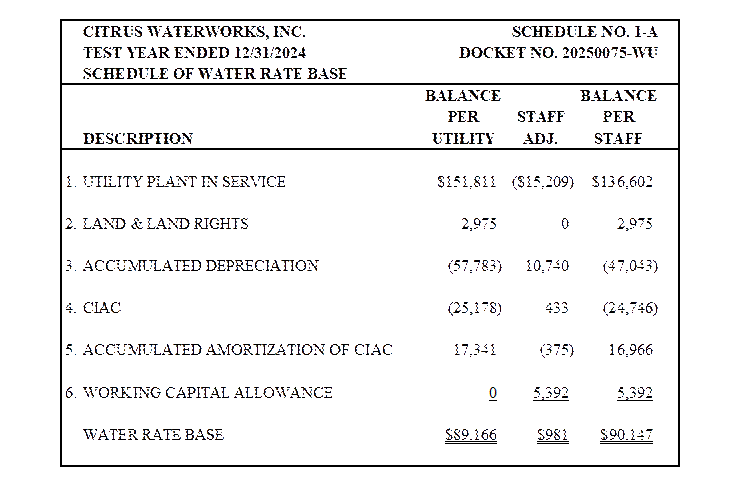
The appropriate components of the Utility’s rate
base include utility plant in service (UPIS), land and land rights, accumulated
depreciation, contributions-in-aid of construction (CIAC), accumulated
amortization of CIAC, and working capital. Staff selected the test year ended
December 31, 2024, for the current rate case. Commission audit staff determined
that the Utility’s books and records are in compliance with the National
Association of Regulatory Utility Commissioners’ Uniform System of Accounts
(NARUC USOA). A summary of each component and the recommended adjustments are
discussed below.
Utility Plant in Service
The
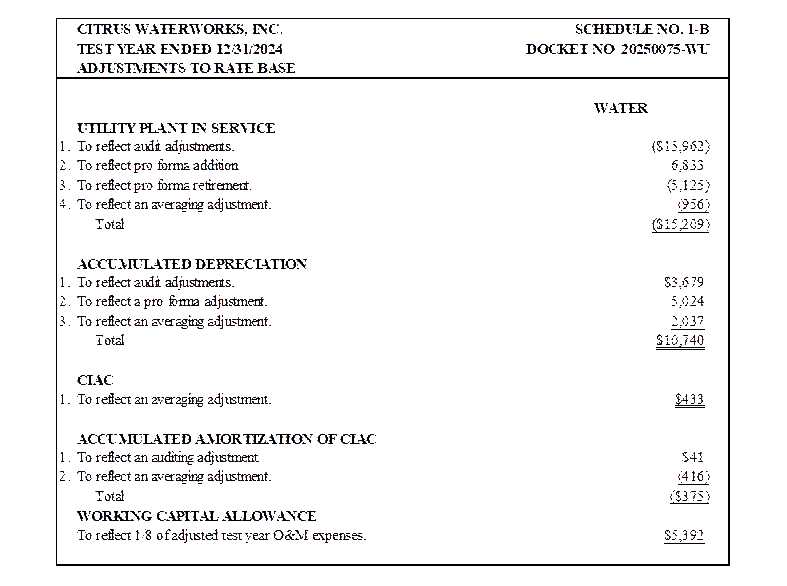
Utility recorded UPIS of $151,811. Audit staff decreased this amount by $15,744
to reflect UPIS reductions approved by the CCWWA in Final Order No. 24-02 that
were not reflected in the Utility’s general ledger. Audit staff also made a
reduction of $216 to remove two additions that were unsupported by the Utility.
In a letter from Citrus, the Utility requested a pro forma addition to cover
the cost of 43 meter replacements.
Staff increased UPIS by $6,833 to reflect pro forma place additions; this
amount is offset by retirements of $5,125. Additionally, staff decreased this
amount by $956 to reflect an averaging adjustment. Staff’s adjustments to UPIS
result in a decrease of $15,209. Therefore, staff recommends a UPIS of $136,602.
Pro Forma Plant Additions
Citrus is
requesting recovery of costs to replace 43 residential meters. While the
Utility serves 154 customers, Citrus stated that it had replaced 94 meters
since 2021 and is requesting recovery of 43 additional meters.[7] The
Utility stated that these 43 meters were replaced during the first five months
of 2025. Citrus explained that meters
are typically replaced once they have reached the end of their expected service
life, registered a certain amount of water, or are not operating properly.[8] Citrus’
reasoning behind the meter replacements is to address the high EUW experienced
by the Utility and reduce lost revenue. When meters get older they register
slow and eventually become inoperable which causes customer’s bills to not
reflect the actual water used. This in turn lowers the amount of revenue
received by the Utility. Further, unaccounted for water will also be reduced
since the new meters are now accurately recording actual water usage.
Citrus also
provided invoices totaling to $6,833, which is $159 per meter, including
installation.[9] The
Utility stated it has a service contract with U.S. Water Services Corporation
(USWSC), the operator of the facility, which includes a provision for meter
replacements. Staff believes the cost per meter of $159 is reasonable based on
previous Commission-approved meter replacements which have ranged from
approximately $103 to $206.[10] Based on
the above, staff believes this project is reasonable and recommends approval of
this pro forma expense.
Land and Land Rights
The
Utility recorded a test year land and land rights balance of $2,975. Staff did
not make any adjustments to this account and, therefore, recommends a land and
land rights balance of $2,975.
Used and Useful
As discussed in Issue 3, the Utility’s system is
considered 100 percent U&U. Therefore, no U&U adjustment is necessary.
Accumulated Depreciation
The Utility recorded accumulated depreciation
of $57,783. Audit staff decreased this amount by $3,679 to reflect the balance
approved by the CCWA in Final Order No. 24-02, and recalculated the balance
using depreciation rates established by Rule 25-30.140, F.A.C. Staff further decreased
accumulated depreciation by $5,024 due to pro forma additions and retirements. Additionally,
staff decreased this amount by $2,037 to reflect an averaging adjustment.
Staff’s adjustments to accumulated depreciation results in a decrease of
$10,740. Therefore, staff recommends an average accumulated depreciation
balance of $47,043.
Contributions In Aid of
Construction
The
Utility recorded CIAC of $25,178. Staff decreased this amount by $433 to
reflect an averaging adjustment and, therefore, recommends an average CIAC
balance of $24,746.
Accumulated Amortization of CIAC
The Utility recorded accumulated amortization
of CIAC of $17,341. Audit staff recalculated this amount using a composite,
which resulted in an increase of $41. Per Rule 25-30.140(9)(b), F.A.C., the
specific depreciation rates of the related plant accounts should be used, with
the use of a composite rate reserved for instances when the specific associated
plant accounts are unknown. Additionally, staff decreased this amount by $416
to reflect an averaging adjustment. Staff’s adjustments to accumulated CIAC
result in a decrease of $375. Therefore, staff recommends an average
accumulated amortization of CIAC balance of $16,966.
Working Capital Allowance
Working
capital is defined as the short-term investor-supplied funds that are necessary
to meet operating expenses. Consistent with Rule 25-30.433(2), F.A.C., and
Commission practice, staff used the one-eighth of operation and maintenance
(O&M) expense (less rate case expense) formula for calculating the working
capital allowance.
As such, staff removed the rate case expense of $675. This resulted in an
adjusted O&M expense balance of $43,137. Applying this formula, staff
recommends a working capital allowance of $5,392.
Rate Base Summary
Based on the foregoing, staff recommends that
the appropriate average test year rate base is $90,147. Rate base is shown on
Schedule No. 1-A. The related adjustments are shown on Schedule No. 1-B.
Issue 5:
What is the appropriate return on equity and overall
rate of return for Citrus Waterworks, Inc.?
Recommendation:
The appropriate return on equity (ROE) is 8.51
percent with a range of 7.51 percent to 9.51 percent. The appropriate overall
rate of return is 8.41 percent. (Lenberg)
Staff Analysis:
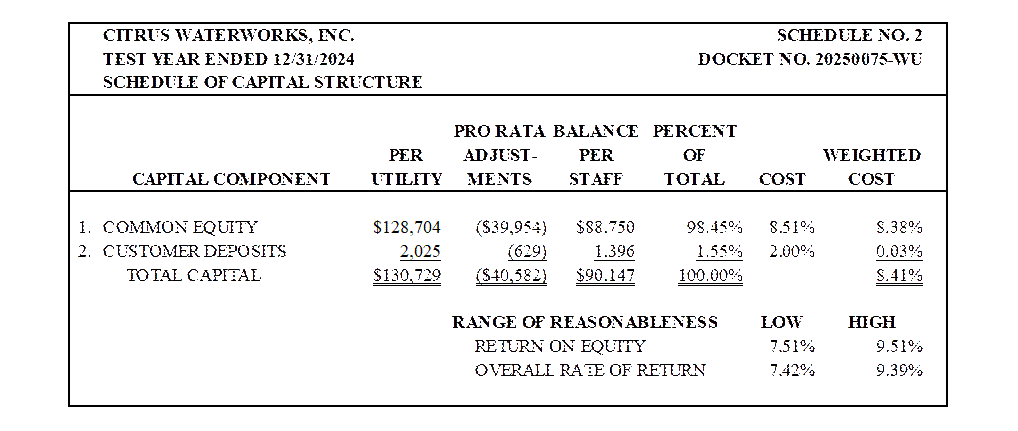
The Utility’s capital structure consists of common
equity and customer deposits. The Utility’s capital structure has been
reconciled with staff’s recommended rate base. The appropriate ROE is 8.51
percent based on the Commission-approved leverage formula currently in effect.
Staff recommends an ROE of 8.51 percent with a range of 7.51 percent to 9.51
percent, and an overall rate of return of 8.41 percent. The ROE and overall
rate of return are shown on Schedule No. 2.
Issue 6:
What are the appropriate test year operating
revenues for the water system of Citrus Waterworks, Inc.?
Recommendation:
The appropriate test year operating revenues are
$56,613. (Chambliss)
Staff Analysis:
The Utility recorded total test year operating
revenues of $53,223 for water. The water revenues included $50,824 of service
revenues and $2,399 of miscellaneous revenues. During the test year, the
Utility had rate changes in April 2024 and July 2024 when it was under the
jurisdiction of Citrus County. In the months wherein there was a rate change
due to prorating bills, the Utility’s billing data indicated two bills per
customer. Therefore, staff adjusted the billing data to correct the number of
bills during the months of a rate change. To determine the appropriate service
revenues, staff applied the adjusted billing determinants to the existing
rates. As a result, staff determined services revenues to be $54,250, which is
an increase of $3,426 ($54,250 - $50,824).
Staff made an adjustment to miscellaneous revenues. During
the test year, the Utility recorded $2,399 for its miscellaneous revenues. The
Utility’s tariff charge for a violation reconnection is $21. However, the
Utility billed four customers a violation reconnection charge in the amount of
$30 each. Therefore, staff made an adjustment to reduce miscellaneous revenues
by $36 [($30 - $21) x 4]. As a result, miscellaneous revenues should be $2,363
($2,399 - $36).
Based on the above, the appropriate test year operating
revenues for Citrus’ water system are $56,613 ($54,250 + $2,363) for the water
system.
Issue 7:
What is the appropriate amount of operating expenses
for Citrus Waterworks, Inc.?
Recommendation:
The appropriate amount of operating expense for
Citrus Waterworks is $51,562. (Lenberg)
Staff Analysis:
The Utility recorded operating expense of $55,817.
The test year O&M expenses have been reviewed by staff, including invoices
and other supporting documentation. Staff has made several adjustments to the
Utility’s operating expense as described below.
Operation and
Maintenance Expenses
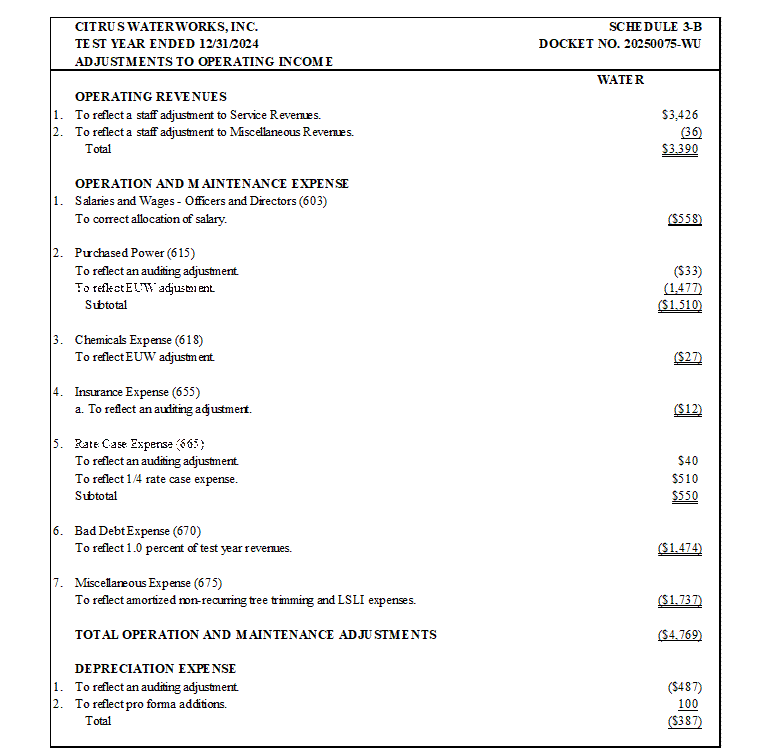
Salaries
and Wages – Officers and Directors (603)
The Utility
recorded a salaries and wages expense of $2,500. According to the Utility’s
2024 Annual Report, this amount represents compensation to Citrus’ President, who
is also the Owner of Citrus. In Order No. PSC-2024-0046-PAA-WS, the Commission approved
a total owner’s salary of $159,034 for all U.S. Water–affiliated systems.
Citrus makes up approximately 1.18 percent of all U.S. Water-affiliated
systems; therefore, staff calculated a total owner’s salary for Citrus of $1,877.
Applying the Commission’s 2024 Price Index of 3.24 percent, staff recommends a
salaries and wages expense of $1,942, a decrease of $558.
Purchased Power (615)
The Utility recorded purchased power expense of $6,396.
Audit staff decreased this amount by $33 to reflect the removal of an
out-of-test-year expense. Additionally, staff decreased this amount by $1,477
to reflect the 23.1 percent EUW discussed in Issue 3. Staff’s adjustments to
purchase power expense result in a decrease of $1,510. Therefore, staff
recommends a purchased power expense of $4,886.
Chemicals (618)
The Utility recorded chemicals expense of $118.
Staff decreased this amount by $27 to reflect the 23.10 percent EUW
discussed in Issue 3. Therefore, staff recommends a chemicals
expense of $91.
Contractual Services - Accounting (632)
The Utility recorded contractual services -
accounting expense of $525. Staff made no adjustments to this amount and,
therefore, recommends a contractual services - accounting expense of $525.
Contractual Services - Legal (633)
The Utility recorded contractual services -
legal expense of $300. Staff made no adjustments to this amount and, therefore,
recommends a contractual services - legal expense of $300.
Contractual Services - Testing (635)
The Utility recorded contractual services -
testing expense of $445. Staff made no adjustments to this amount and,
therefore, recommends a contractual services - testing expense of $445.
Contractual Services - Other (636)
The Utility recorded contractual services -
other expense of $31,534. Staff made no adjustments to this amount and,
therefore, recommends a contractual services - other expense of $31,534.
Insurance Expense
(655)
The
Utility recorded insurance expense of $1,677. Staff decreased this amount by $12
to reflect an auditing adjustment based on the currently effective insurance
policy. Therefore, staff recommends an insurance expense of $1,665.
Regulatory
Commission Expense (665)
The
Utility recorded an annual rate case expense of $125. Audit staff increased
this amount by $40 to reflect the annual rate case expense of $165 approved by
the CCWWA in Final Order No. 24-02.
The Utility is required by Rule 25-22.0407, F.A.C., to
mail notices of the rate case overview, interim rates, final rates, and
four-year rate reduction. Staff calculated noticing costs to be $541. Staff
calculated a distance of 215 miles from the Utility to Tallahassee. Based on
the 2025 Internal Revenue Service (IRS) business mileage rate of $0.70, staff
calculated round trip travel and lodging expense to the Commission Conference
of $501.
Additionally, the Utility paid a filing fee of $1,000.
Staff
recommends a total rate case expense, consisting of noticing costs, travel, and
lodging expenses, and filing fee of $2,042, which amortized over four years is
$510. Therefore, staff recommends an increase of $550 and a total annual rate
case expense of $675.
Bad Debt Expense (670)
Citrus recorded
a bad debt expense of $2,040 for the test year. Staff notes that it is
Commission practice to calculate bad debt expense using a three-year average
when the information is available.
In response to staff’s second data request, the Utility provided the bad debt
amounts of ($292), $757, and $2,040 for 2022, 2023, and 2024, respectively. Because
the negative bad debt in 2022 reflects recovery of prior-year write-offs,
relying on it would skew the historical three-year average. Therefore, staff
calculated a bad debt expense of 1 percent of total revenues, resulting in a
bad debt expense of $566, a decrease of $1,474. The Commission has previously
used a percent of revenue as an approximate proxy for bad debt expense in
previous dockets.
Miscellaneous
Expense (675)
The Utility
recorded miscellaneous expense of $2,921. During the test year, the Utility
incurred certain non-recurring expenses. Pursuant to Rule 25-30.433(9), F.A.C.,
staff amortized these expenses over a five-year period. Specifically, the
Utility incurred $1,430 for tree trimming and $741 in fees associated with
compliance actions related to DEP’s Lead Service Line Inventory (LSLI)
requirements. Staff amortized these costs over a five-year period resulting in
a total annual expense of $434. This amount represents a reduction of $1,737.
Therefore, staff recommends a miscellaneous expense of $1,184.
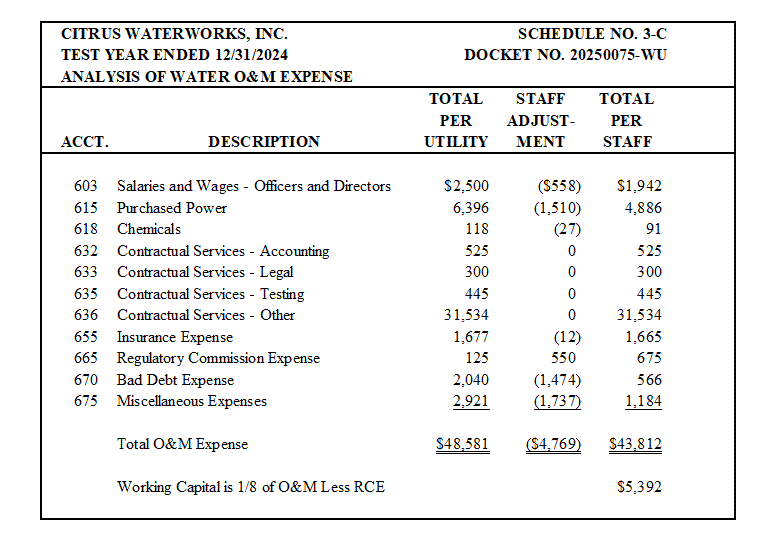
Operation and Maintenance Expense Summary
The Utility recorded test year O&M expense of $48,581.
Based on the above adjustments, staff recommends O&M expense be decreased
by $4,769. This results in a total O&M expense of $43,812. Staff’s
recommended adjustments to O&M are shown on Schedule No. 3-C.
Depreciation Expense
The
Utility recorded depreciation expense of $5,142. Based on the depreciation
rates prescribed in Rule 25-30.140, F.A.C., audit staff decreased this amount
by $487. Staff increased this amount by $100 to reflect pro forma additions. Therefore,
staff recommends depreciation expense of $4,755.
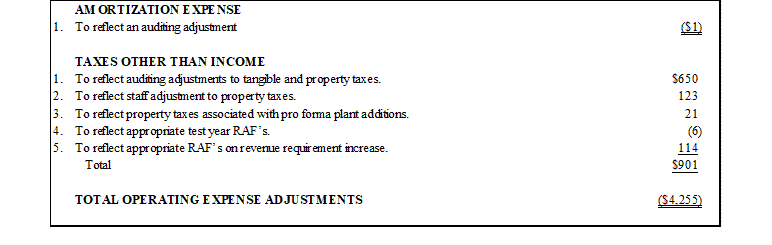
Amortization of CIAC
The
Utility recorded amortization of CIAC expense of $831. Staff decreased this amount
by $1 to reflect an auditing adjustment, and therefore recommends an amortization
of CIAC of $832.
Taxes Other Than Income (TOTI)
The
Utility recorded TOTI of $2,925. Audit staff increased tangible tax by $525 to
reflect 2024 Real and Tangible Personal Property tax assessments from Citrus
County. Audit staff increased TOTI by $159 to reflect the appropriate RAFs
related to the revenue adjustment. Audit staff also decreased property tax by
$34 to reflect the maximum early-payment discount of four percent. Staff
increased TOTI by $123 to reflect updated property tax information filed by the
Utility.
Staff further increased TOTI by $21 to reflect property taxes associated with
pro forma plant additions.
Based
on revenues discussed in Issue 6, TOTI should be decreased by $6 to reflect a
regulatory assessment fee (RAF) rate of 4.5 percent applied to the adjustment
in revenues.
As
discussed in Issue 9, staff recommends revenues be increased by $2,527 to
reflect the increased revenue required to cover expenses and allow an
opportunity to earn the recommended rate of return. As a result, TOTI should be
increased by $114 to reflect a RAF rate of 4.5 percent of the change in
revenues. Staff’s adjustments result in a total increase of $901. Therefore, staff
recommends a TOTI of $3,826.
Operating Expense Summary
The
Utility recorded operating expenses of $55,817. The application of staff’s
recommended adjustments to the Utility’s recommended operating expense results
in a total operating expense of $51,562, which is a decrease of $4,255.
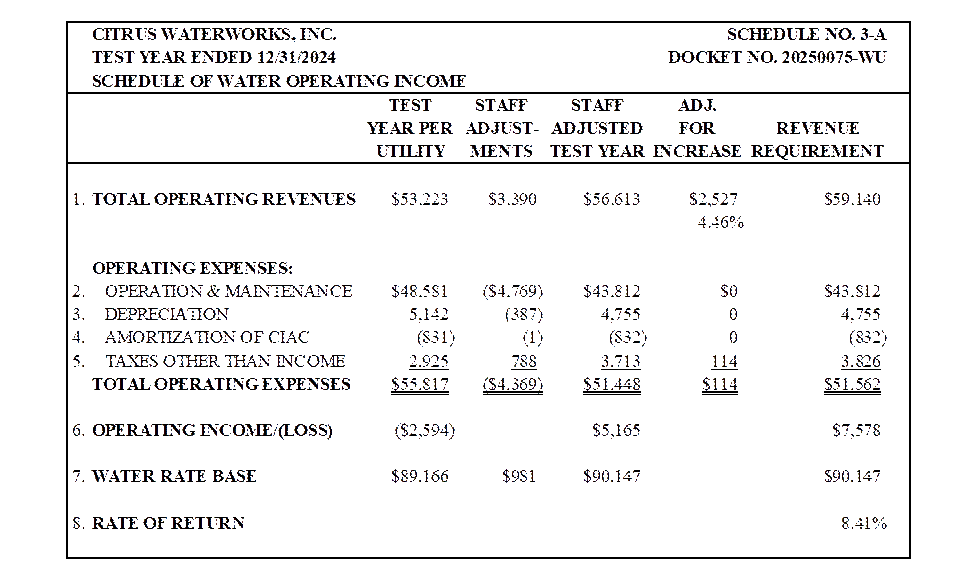
Operating expenses are shown on Schedule No. 3-A, and the related adjustments
are shown on Schedule No. 3-B.
Issue 8:
Does Citrus Waterworks, Inc. meet the criteria for
application of the operating ratio methodology?
Recommendation:
No. Citrus does not meet the requirement for
application of the operating ratio methodology for calculating the revenue
requirement. (Lenberg)
Staff Analysis:
Rule 25-30.4575(2), F.A.C., indicates that in rate
cases processed under Rule 25-30.455, F.A.C., the Commission will use the
operating ratio methodology to establish the Utility’s revenue requirement when
its rate base is not greater than 125 percent of O&M expenses, less
regulatory commission expense, and the use of the operating ratio methodology
does not change the Utility’s qualification for a SARC.
With respect to Citrus, staff has recommended a rate base
of $90,147. After removal of rate case expense, staff has calculated an
adjusted O&M expense of $43,137. Based on staff’s preliminary recommended
amounts, the Utility’s rate base is 208.98 percent of its adjusted O&M
expense. Pursuant to the above analysis, the Utility does not qualify for
application of the operating ratio methodology.
Issue 9:
What is the appropriate revenue requirement for Citrus
Waterworks, Inc.?
Recommendation:
The appropriate revenue requirement is $59,140,
resulting in an annual increase of $2,527 (4.46 percent). (Lenberg)
Staff Analysis:
Citrus should be allowed an annual increase of
$2,527 (4.46 percent). This should allow the Utility the opportunity to recover
expenses and earn an 8.41 percent return on rate base. The calculations for
revenue requirement are shown on Table 9-1.
Table 9-1
Revenue Requirement
|
Water Rate Base
|
$90,147
|
|
Rate of Return
|
× 8.41%
|
|
Return on Rate Base
|
$7,578
|
|
Water O&M Expense
|
43,812
|
|
Depreciation Expense
|
4,755
|
|
Amortization of CIAC
|
(832)
|
|
Taxes Other Than Income
|
3,826
|
|
Revenue Requirement
|
$59,140
|
|
Less Test Year Revenues
|
$56,613
|
|
Annual Increase
|
$2,527
|
|
Percent Increase
|
4.46%
|
Source: Staff calculations.
Issue 10:
What are the appropriate rate structure and rates
for Citrus Waterworks, Inc.?
Recommendation:
The recommended rate structure and monthly water
rates are shown on Schedule No. 4. The Utility should file revised tariff
sheets and a proposed customer notice to reflect the Commission-approved rates.
The approved rates should be effective for service rendered on or after the
stamped approval date on the tariff sheets pursuant to Rule 25-30.475(1),
F.A.C. In addition, the approved rates should not be implemented until staff
has approved the proposed customer notice and the notice has been received by
the customers. The Utility should provide proof of the date notice was given by
affidavit within 10 days of the date of the notice. (Chambliss)
Staff Analysis:
Citrus is located in Citrus County within the
Southwest Florida Water Management District. The Utility provides water service
to 154 residential customers and one general service customer. A review of the
billing data indicates approximately 22 percent of the residential customer
bills during the test year had zero gallons. However, the billing data at the
1,000 gallon level reflects approximately 42 percent of the residential
customer bills, which indicates a moderate seasonal customer base. The average
residential water demand was 3,883 gallons per month during the test period.
The average water demand, excluding zero gallons bills, was 5,005 gallons per
month. The Utility’s current rate structure for both residential and general
service customers consists of a monthly base facility charge (BFC) and uniform
gallonage charge.
Staff performed an analysis of the Utility’s billing in
order to evaluate the appropriate rate structure for the residential water
customers. The goal of the evaluation was to select the rate design parameters
that: (1) produce the recommended revenue requirement; (2) equitably distribute
cost recovery among the Utility’s customers; (3) establish the appropriate
discretionary usage threshold for restricting repression; and (4) implement,
where appropriate, water conserving rate structures consistent with Commission
practice.
As mentioned in Issue 9, staff’s recommended revenue
requirement increase is 4.46 percent. Typically, when the revenue requirement
is less than 20 percent, staff does an across-the board increase to the
existing rates. However, in this case, staff is recommending redesigning the
rates because the Utility serves a seasonal customer base and is currently
using incorrect meter equivalents.
Currently, 58 percent of the revenues are recovered
through the BFC. Due to the seasonal customer base, staff recommends that 60
percent of the revenue requirement be recovered through the BFC in an effort to
maintain sufficient revenue stability. Although the billing analysis indicates
a seasonal customer base, there is also some discretionary usage at higher
levels of consumption. The average number of people per household is 2.5. Based
on the number of people per household, 50 gallons per day per person, and the
number of days per month, the discretionary usage threshold should be 4,000
gallons per month. Staff’s review of the billing data indicates that
discretionary usage above 4,000 gallons represents approximately 33 percent of
the bills, which accounts for approximately 47 percent of water demand. This
indicates that there is some high discretionary usage above 4,000 gallons.
The meter equivalents for Citrus’ rates are not based on
the American Water Works Association (AWWA) meter equivalents, which are used
by the Commission when designing rates. The meter equivalents assign the demand
on a system as well as cost recovery by meter size in terms of equivalent
residential connections (ERCs). In comparison to the AWWA meter equivalents,
Citrus’ meter equivalents for larger meter sizes are significantly lower than
the AWWA. Redesigning rates based on the AWWA meter equivalents distributes the
cost recovery to the appropriate meter size. The table below shows a comparison
of the AWWA meter equivalents to Citrus’ existing meter equivalents.
Table 10-1
Comparison
of ERCs
|
Meter Sizes
|
AWWA
|
Citrus
|
|
5/8” x 3/4”
|
1
|
1
|
|
3/4”
|
1.5
|
1.5
|
|
1”
|
5
|
2.5
|
|
2”
|
8
|
5
|
|
3”
|
15
|
8
|
Source: Rule
25-30.055, F.A.C. and Citrus’ tariff rates
Staff recommends a two-tier inclining block rate
structure, which includes separate gallonage charges for non-discretionary and
discretionary usage for residential water rates. The rate blocks are: (1) 0 -
4,000 gallons; and (2) all usage in excess of 4,000 gallons per month. Staff’s
recommended rate structure will target those customers with higher levels of
consumption. General service customers should continue to be billed a BFC and
uniform gallonage charge.
Based on staff’s recommended revenue increase of 4.5
percent, which excludes miscellaneous revenues, the residential consumption can
be expected to decline by 269,000 gallons resulting in an anticipated average
residential demand of 3,739 gallons per month. Staff recommends a 3.7 percent
reduction in test year residential gallons for ratesetting purposes. As a
result, the corresponding reductions for purchase power expense is $236, $4 for
chemicals expense, and $11 for RAFs to reflect the anticipated repression,
which results in a post repression revenue requirement of $56,526.
The recommended rate structure and monthly water rates are
shown on Schedule No. 4. The Utility should file revised tariff sheets and a
proposed customer notice to reflect the Commission-approved rates. The approved
rates should be effective for service rendered on or after the stamped approval
date on the tariff sheets pursuant to Rule 25-30.475(1), F.A.C. In addition,
the approved rates should not be implemented until staff has approved the
proposed customer notice and the notice has been received by the customers. The
Utility should provide proof of the date notice was given by affidavit within
10 days of the date of the notice.
Issue 11:
What are the appropriate initial customer deposits
for Citrus Waterworks, Inc.?
Recommendation:
The appropriate initial customer deposit should be
$54 for the residential 5/8 inch x 3/4 inch meter size. The initial customer
deposit for all other residential meter sizes and all general service meter
sizes should be two times the average estimated bill for water. The approved
initial customer deposits should be effective for connections made on or after
the stamped approval date on the tariff sheets pursuant to Rule 25-30.475,
F.A.C. The Utility should be required to collect the approved deposits until
authorized to change them by the Commission in a subsequent proceeding.
(Chambliss)
Staff Analysis:
Rule 25-30.311, F.A.C., provides the criteria for
collecting, administering, and refunding customer deposits. Customer deposits
are designed to minimize the exposure of bad debt expense for the Utility and,
ultimately, the general body of ratepayers. An initial customer deposit ensures
that the cost of providing service is recovered from the cost causer.
Historically, the Commission has set initial customer deposits equal to two
times the average estimated bill.
Currently, the Utility has an initial customer deposit of $45 for the
residential 5/8 inch x 3/4 inch meter size. However, this amount does not cover
two months’ average bills based on staff’s recommended rates. The Utility’s
anticipated post-repression average monthly residential usage is 3,739 gallons
per customer. Therefore, the average residential monthly bill is approximately
$27.04 for water service based on staff’s recommended rates.
Staff recommends that the appropriate initial customer
deposit should be $54 for the residential 5/8 inch x 3/4 inch meter size. The
initial customer deposit for all other residential meter sizes and all general
service meter sizes should be two times the average estimated bill for water.
The approved initial customer deposits should be effective for connections made
on or after the stamped approval date on the tariff sheets pursuant to Rule
25-30.475, F.A.C. The Utility should be required to collect the approved
deposits until authorized to change them by the Commission in a subsequent
proceeding.
Issue 12:
What is the appropriate amount by which rates should
be reduce four years after the published effective date to reflect the removal
of the amortized rate case expense?
Recommendation:
The rates should be reduced as shown on Schedule No.
4, to remove rate case expense grossed-up for RAFs and amortized over a
four-year period. Pursuant to Section 367.081(8), F.S., the decrease in rates
should become effective immediately following the expiration of the rate case
expense recovery period. Citrus should be required to file revised tariffs and
a proposed customer notice setting forth the lower rates and rationale no later
than one month prior to the effective date of the new rates. If the Utility
files revised tariffs reflecting this reduction in conjunction with a price
index or pass-through rate adjustment, separate data should be filed for the
price index and/or pass-through increase and the reduction in the rates due to
the amortized rate case expense. (Lenberg, Chambliss)
Staff Analysis:
Section 367.081(8), F.S., requires that the rates be
reduced immediately following the expiration of the four-year period by the
amount of the rate case expense previously included in rates. The reduction
will reflect the removal of revenue associated with the amortization of rate
case expense and the gross-up for RAFs. This results in a reduction of $535.
Staff recommends that the rates should be reduced as shown
on Schedule No. 4, to remove rate case expense grossed-up for RAFs and
amortized over a four-year period. Pursuant to Section 367.081(8), F.S., the
decrease in rates should become effective immediately following the expiration
of the rate case expense recovery period. Citrus should be required to file
revised tariffs and a proposed customer notice setting forth the lower rates
and rationale no later than one month prior to the effective date of the new
rates. If the Utility files revised tariffs reflecting this reduction in
conjunction with a price index, or pass-through rate adjustment, separate data
should be filed for the price index and/or pass-through increase and the
reduction in the rates due to the amortized rate case expense.
Issue 13:
Should the recommended rates be approved for Citrus
Waterworks, Inc. on temporary basis, subject to refund with interest, in the
event of a protest filed by a party other than the Utility?
Recommendation:
Yes. Pursuant to Section 367.0814(7), F.S., the
recommended rates should be approved for the Utility on a temporary basis,
subject to refund with interest, in the event of a protest filed by a party
other than the Utility. Citrus should file revised tariff sheets and a proposed
customer notice reflecting the Commission-approved rates. The approved rates
should be effective for services rendered on or after the stamped approval date
on the tariff sheet, pursuant to Rule 25-30.475(1), F.A.C. In addition, the
temporary rates should not be implemented until staff has approved the proposed
notice, and the notice has been received by the customers. Further, prior to
implementing any temporary rates, the Utility should provide appropriate
financial security.
If the recommended rates are approved on a temporary
basis, the rates collected by the Utility should be subject to the refund
provisions discussed below in the staff analysis. In addition, after the
increased rates are in effect, pursuant to Rule 25-30.360(6), F.A.C., the
Utility should file reports with the Commission’s Office of Commission Clerk no
later than the 20th of each month indicating both the current monthly and total
amount subject to refund at the end of the preceding month. The report filed
should also indicate the status of the security being used to guarantee
repayment of any potential refund. (Lenberg)
Staff Analysis:
This recommendation proposes an increase in rates. A
timely protest might delay a rate increase resulting in an unrecoverable loss
of revenue to the Utility. Therefore, pursuant to Section 367.0814(7), F.S., in
the event of a protest filed by a party other than the Utility, staff
recommends that the proposed rates be approved on a temporary basis. Citrus
should file revised tariff sheets and a proposed customer notice reflecting the
Commission-approved rates. The approved rates should be effective for service
rendered on or after the stamped approval date on the tariff sheet, pursuant to
Rule 25-30.475(1), F.A.C. In addition, the temporary rates should not be
implemented until staff has approved the proposed notice, and it has been
received by the customers. The additional revenue produced by staff’s recommended
rates and collected by the Utility should be subject to the refund provisions
discussed below.
Citrus should be authorized to initiate the temporary
rates upon staff’s approval of an appropriate security for the potential refund
and cost of the proposed customer notice. Security should be in the form of
either a bond or letter of credit in the amount of $1,726. Alternatively, the
Utility may establish an escrow agreement with an independent financial
institution.
If the Utility chooses a bond for securing the potential
refund, the bond should contain wording to the effect that it will be
terminated only under the following conditions:
1. The
Commission approves the rate increase; or,
2. If the
Commission denies the increase, the Utility shall refund the amount collected
that is attributable to the increase.
If the Utility chooses a letter of credit for securing the
potential refund, the letter of credit should contain the following conditions:
1. The letter of credit is irrevocable for
the period it is in effect.
2. The letter of credit will be in effect
until a final Commission order is rendered, either approving or denying the
rate increase.
If security is provided through an escrow agreement, the
following conditions should be part of the agreement:
1. The Commission Clerk, or his or her
designee, must be a signatory to the escrow agreement.
2. No monies in the escrow account may be
withdrawn by the Utility without the prior written authorization of the
Commission Clerk, or his or her designee.
3. The escrow account shall be an interest
bearing account.
4. If a refund to the customers is
required, all interest earned by the escrow account shall be distributed to the
customers.
5. If a refund to the customers is not
required, the interest earned by the escrow account shall revert to the
Utility.
6. All information on the escrow account
shall be available from the holder of the escrow account to a Commission
representative at all times.
7. The amount of revenue subject to refund
shall be deposited in the escrow account within seven days of receipt.
8. This escrow account is established by
the direction of the Florida Public Service Commission for the purpose(s) set
forth in its order requiring such account. Pursuant to Cosentino v. Elson, 263 So. 2d 253 (Fla. 3d DCA 1972), escrow
accounts are not subject to garnishments.
9. The account must specify by whom and on
whose behalf such monies were paid.
In no instance should the maintenance and administrative
costs associated with the refund be borne by the customers. These costs are the
responsibility of, and should be borne by, the Utility. Irrespective of the
form of security chosen by the Utility, an account of all monies received as a
result of the rate increase should be maintained by the Utility. If a refund is
ultimately required, it should be paid with interest calculated pursuant to
Rule 25-30.360(4), F.A.C.
The Utility should maintain a record of the amount of the
bond, and the amount of revenues that are subject to refund. In addition, after
the increased rates are in effect, pursuant to Rule 25-30.360(6), F.A.C., the
Utility should file reports with the Commission Clerk’s office no later than
the 20th of every month indicating the monthly and total amount of money
subject to refund at the end of the preceding month. The report filed should
also indicate the status of the security being used to guarantee repayment of
any potential refund.
Issue 14:
Should Citrus Waterworks, Inc. be required to notify
the Commission within 90 days of an effective order finalizing this docket,
that it has adjusted its books for all the applicable NARUC USOA?
Recommendation:
Yes. Citrus should be required to notify the
Commission, in writing, that it has adjusted its books in accordance with the
Commission’s decision. The Utility should submit a letter within 90 days of the
Commission’s final order in this docket, confirming that the adjustments to all
applicable National Association of Regulatory Utility Commissioners (NARUC)
Uniform System of Accounts (USOA) primary accounts have been made to the
Utility’s books and records. In the event the Utility needs additional time to
complete the adjustments, a notice providing good cause should be filed not
less than seven days prior to the deadline requesting an extension. Upon
providing a notice of good cause, staff should be given administrative
authority to grant an extension of up to 60 days. (Lenberg)
Staff Analysis:
Citrus should be required to notify the Commission,
in writing, that it has adjusted its books in accordance with the Commission’s
decision. The Utility should submit a letter within 90 days of the Commission’s
final order in this docket, confirming that the adjustments to all applicable
NARUC USOA primary accounts have been made to the Utility’s books and records.
In the event the Utility needs additional time to complete the adjustments, a
notice providing good cause should be filed not less than seven days prior to the
deadline requesting an extension. Upon providing a notice of good cause, staff
should be given administrative authority to grant an extension of up to 60
days.
Issue 15:
Should this docket be closed?
Recommendation:
No. If no person whose
substantial interests are affected by the proposed agency action files a
protest within 21 days of the issuance of the proposed agency action order, a
consummating order should be issued. The docket should remain open for staff’s
verification that the revised tariff sheets and customer notice have been filed
by the Utility and approved by staff, and that the Utility submitted its letter
confirming all adjustments to applicable NARUC USOA primary accounts were made.
Once these actions are complete, this docket should be closed administratively.
(Farooqi)
Staff Analysis:
If no person whose substantial interests are
affected by the proposed agency action files a protest within 21 days of the issuance
of the proposed agency action order, a consummating order should be issued. The
docket should remain open for staff’s verification that the revised tariff
sheets and customer notice have been filed by the Utility and approved by staff,
and that the Utility submitted its letter confirming all adjustments to
applicable NARUC USOA primary accounts were made. Once these actions are
complete, this docket should be closed administratively.