Discussion
of Issues
Issue 1:
Is the quality of service provided by Gulfstream
Utility LLC satisfactory?
Recommendation:
Yes. Gulfstream is currently in compliance with the Department of Environmental
Protection (DEP) and there were no complaints recorded during the test
year or four years prior. Therefore, the quality of service should be
considered satisfactory. (Olivieri)
Staff Analysis:
Pursuant to Section 367.081(2)(a)(1), F.S., and Rule
25-30.433(1), Florida Administrative Code (F.A.C.), in wastewater rate cases,
the Commission shall determine the overall quality of service provided by the utility.
This determination is made from an evaluation of the utility’s attempt to
address customer satisfaction. Rule 25-30.433, F.A.C., further states that the
most recent outstanding citations, violations, and consent orders on file with
the DEP, the county health department, and any DEP and county health department
officials’ testimony concerning quality of service shall be considered. In
addition, any customer testimony, comments, or complaints received by the
Commission are also reviewed. The operating condition of the wastewater system
is addressed in Issue 2.
The Utility’s Attempt to Address Customer
Satisfaction
There were no complaints recorded by the Commission’s
Consumer Activity Tracking System (CATS), received by the Utility, or filed
with the DEP for the test year and four years prior. As of March 2, 2026, there
were six customer comments filed in the docket file, including a letter
submitted by each of the three Homeowner’s Associations within Gulfstream’s
service territory. The majority of the comments were in opposition to the overall
rate increase. The remaining comments addressed potential Utility under
earnings due to malfunctioning meters and being billed a lower rate than
approved by the Commission. Table 1-1 summarizes the customer comments filed in
this docket.
Table 1-1
Number of Comments by Source and
Subject
|
Subject of Comment
|
Total
|
|
Billing
|
3
|
|
Noticing
|
4
|
|
Rate Increase
|
5
|
|
Meters
|
1
|
|
Total*
|
13
|
*A single customer comment may be counted multiple times if it fits into
multiple categories.
A customer meeting was held on January 13,
2026, and one customer provided comment. This customer echoed the same concerns
identified in their written comment which was included in the above analysis. Staff
performed a supplemental review, through March 2, 2026, of complaints filed in
CATS following the customer meeting and found one billing complaint, which was
addressed by the Utility. Based on the above, the Utility’s quality of service
appears to be satisfactory.
Conclusion
Gulfstream is
currently in compliance with the DEP and there were no complaints
recorded during the test year or four years prior. Therefore, the quality of
service should be considered satisfactory.
Issue 2:
Are the infrastructure and operating conditions of
Gulfstream Utility LLC’s wastewater system in compliance with DEP regulations?
Recommendation:
Yes. Gulfstream’s wastewater treatment facilities
are in compliance with DEP regulations. (Olivieri)
Staff Analysis:
Rule 25-30.225(2), F.A.C., requires each wastewater
utility to maintain and operate its plant and facilities by employing qualified
operators in accordance with the rules of the DEP. Rule 25-30.433(2), F.A.C.,
requires consideration of whether the infrastructure and operating conditions
of the plant and facilities are in compliance with Rule 25-30.225, F.A.C. In
making this determination, the Commission must consider testimony of the DEP
and county health department officials, compliance evaluations, inspections,
citations, violations, consent orders issued to the utility, customer
testimony, comments, complaints, utility testimony, and responses to the
aforementioned items.
Wastewater System Operating Conditions
Gulfstream’s
wastewater system has a permitted capacity of 99,000 gallons per day (gpd)
Annual Average Daily Flow (AADF) and is a contact stabilization domestic
wastewater treatment plant. Liquid chlorine disinfection is applied prior to
wastewater effluent flowing into the percolation ponds and spray field. Staff
reviewed the Utility’s compliance evaluation inspections conducted by the DEP
to determine the Utility’s overall wastewater facility compliance. A review of
the inspection conducted on May 5, 2025, indicated that the Gulfstream
wastewater treatment facility was in compliance with the DEP’s rules and
regulations.
Conclusion
Gulfstream’s wastewater treatment facilities are in
compliance with DEP regulations.
Issue 3:
What are the used and useful (U&U) percentages
of Gulfstream Utility LLC’s wastewater treatment plant (WWTP) and the
wastewater collection system?
Recommendation:
Gulfstream’s WWTP and wastewater collection system
should both be considered 100 percent U&U. There is no excessive
infiltration and inflow (I&I) and no adjustment to operating expenses is
necessary. (Olivieri)
Staff Analysis:
As stated in Issue 2, Gulfstream’s WWTP is permitted
by the DEP as a 99,000 gpd facility. According to the Utility, its wastewater
collection system is comprised of approximately 39,117 feet of 8-inch polyvinyl
chloride (PVC) collecting mains. There are fifty-one manholes and six lift
stations throughout the service area.
Infiltration and Inflow (I&I)
Rule 25-30.432, F.A.C., provides that in determining the
amount of U&U plant, the Commission will consider I&I. Excessive
I&I is a calculation that is based on a comparison of allowable wastewater
treated to the actual amount of wastewater treated. Allowable treated water was
calculated as 18,871,043 gallons and the amount of wastewater treated was
15,095,000 gallons. The amount treated is less than the estimated allowable
amount. Therefore, there is no excessive I&I and no adjustment to operating
expenses is necessary.
Wastewater Treatment Plant and Collection System
U&U
The formula
for calculating U&U for the WWTP is (AADF + growth – excessive I&I) /
permitted plant capacity. The AADF for the Utility during the
test year is 41,356 gpd. There is no excessive I&I and no
growth based on a linear regression. The permitted capacity of the plant is 99,000
gpd. Based on this calculation, the WWTP is 42 percent U&U.
However, Rule 25-30.432, F.A.C., provides that in
calculating U&U, the Commission will also consider other factors, such as
whether the area served by the plant is built out. Based on staff’s review of
the customer growth and the maps provided by Gulfstream, the service territory
has experienced little to no growth over the last five years. Additionally, all
lots within the service territory are occupied. Therefore, staff recommends
that Gulfstream’s WWTP and the wastewater collection system be considered 100
percent U&U.
Conclusion
Staff recommends Gulfstream’s WWTP and wastewater
collection system should both be considered 100 percent U&U. There is no
excessive I&I and no adjustment to operating expenses is necessary.
Issue 4:
What is the appropriate average test year rate base
for Gulfstream Utility LLC?
Recommendation:
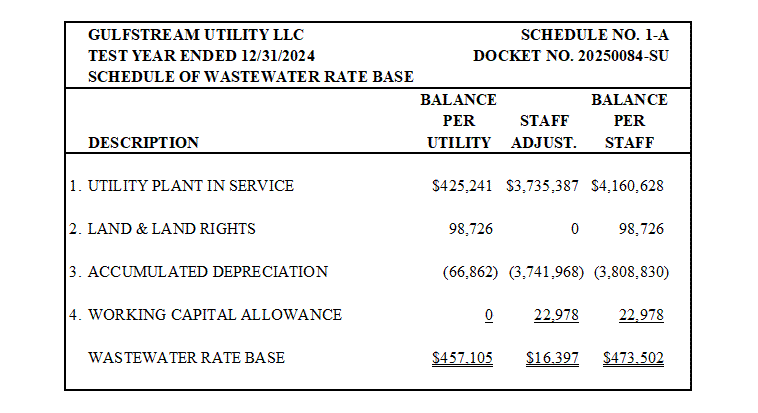
The appropriate average test year rate base for
Gulfstream Utility LLC is $473,502. (Lenberg, Olivieri)
Staff Analysis:
The
appropriate components of the Utility’s rate base include utility plant in
service (UPIS), land and land rights, accumulated depreciation, and working
capital. Staff selected the test year ended December 31, 2024, for the current
rate case. A summary of each component and the recommended adjustments are
discussed below.
Pro Forma Plant Additions
Gulfstream
is requesting recovery of three pro forma projects. Staff requested that the
Utility provide any bids solicited for each project. However, in response to
staff’s data request, Gulfstream indicated that, although it is standard
practice is to obtain three bids for every project, multiple bids were not
obtained for any of these projects due to the urgent nature of each repair. The
Utility’s requested pro forma projects are described below.
Project No. 1 – Lift Station Repair
Project No. 1 was for repairs to lift station No. 1. This
project required the removal of hydraulic cement covering the float wires
before replacing all four floats. Additionally, a repair to a 4-inch discharge
pipe was required. Gulfstream stated that this repair was urgent in order to
avoid any potential leaks or contamination. The Utility provided an invoice for
this project totaling $7,809, with an in-service date of February 2025.
Project No. 2 – Trolley Cable/Wheel, Diffuser
Pull, and Digester Repair
Project No. 2 involved the construction of a trolley cable
system and the replacement of a wheel for the #1 trolley, pulling and cleaning
of diffusers in the tanks, and the welding of a hole in the digester.
Gulfstream stated that this repair was urgent due to the vital role the trolley
system plays in uninterrupted operation of large machinery at the WWTP,
including enabling continuous sludge removal. The Utility provided an invoice
for this project totaling $20,232, with an in-service date of July 2025.
Project No. 3 – LED Lights
(Withdrawn)
In its initial filing, Gulfstream requested recovery for
the installation of LED lighting. However, this request was withdrawn as the
lighting was installed at the Clubhouse and therefore not on utility property.
Project No. 4 – Blower Replacement
Project No. 4 was the replacement of the starter on blower
#1 due to item failure, and the replacement of the belts, oil, and intake
filters for both blowers as preventative maintenance. Blowers are an essential
element of a WWTP as they serve several functions. Gulfstream explained that
this project was urgent given that the blower system is vital to biological
treatment, odor control of the plant, and maintaining proper discharge
standards. The Utility provided an invoice totaling $2,385 for this project,
with an in-service date of March 2025.
Staff believes the Utility’s three requested pro forma
projects are reasonable and should be approved because these projects involve
repairs to vital utility infrastructure necessary to maintain safe and reliable
service to customers.
Utility Plant in Service
The Utility
recorded UPIS of $425,241. Audit staff increased this amount by $3,750,000 to
reflect the Original Cost Study provided by the Utility in Docket No.
20210191-SU.[2] The
Original Cost Study reflected plant balances totaling $3,750,000 as of December
31, 2021, which were deemed fully depreciated. Additionally, audit staff decreased
this amount by $12,351 to remove installation costs of backflow preventers that
were unrelated to the wastewater system. As described above, the Utility
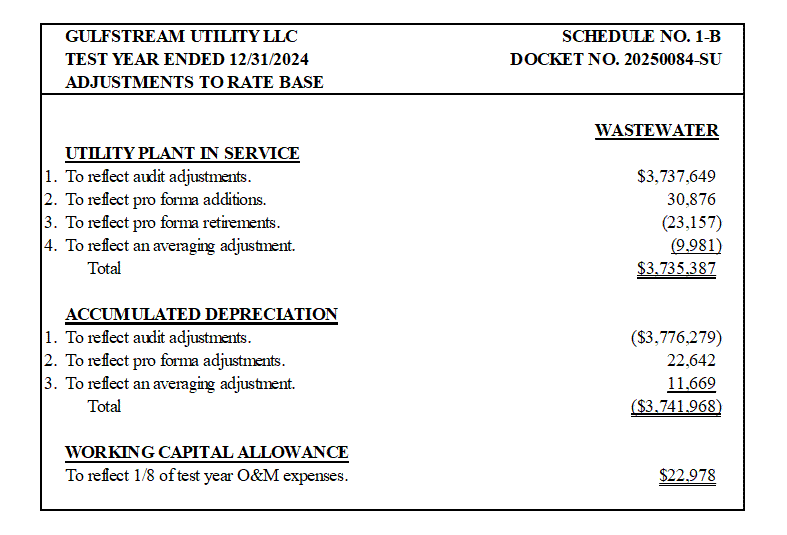
requested pro forma additions to UPIS. Therefore, staff increased UPIS by $30,876
to reflect the three pro forma additions to UPIS; this amount is offset by the
retirements of $23,157. Staff further decreased this amount by $9,981 to
reflect an averaging adjustment. Staff’s net adjustment to UPIS results in an
increase of $3,735,387. Therefore, staff recommends a total UPIS of $4,160,628.
Land and Land Rights
The Utility
recorded a test year land and land rights balance of $98,726. Staff made no
adjustments to this amount and, therefore, recommends a land and land rights
balance of $98,726.
Used and Useful
As discussed
in Issue 3, the Utility’s system is considered 100 percent U&U. Therefore,
no U&U adjustment is necessary.
Accumulated Depreciation
The Utility
recorded accumulated depreciation of $66,862. However, the Utility did not
record the accumulated depreciation associated with the UPIS identified in the
Original Cost Study. Audit staff increased this amount by $3,750,000 to reflect
the fully depreciated plant balance from the Original Cost Study. Audit staff
further increased this amount by $3,263 to reflect depreciation the Utility did
not record in Account 351 – Organization. Audit staff then decreased this
amount by $377 to remove over depreciation for Account 364. Audit staff further
increased accumulated depreciation by $24,628 to reflect the use of the correct
depreciation rates per Rule 25-30.140, F.A.C. Additionally, audit staff decreased
this amount by $1,235 to reflect the backflow preventers removed from UPIS.
Staff decreased accumulated depreciation by $22,642 to reflect pro forma
additions and retirements. Lastly, staff decreased this amount by $11,669 to
reflect an averaging adjustment. Staff’s adjustments are summarized on Table
4-1.
Table 4-1
Staff Adjustments to Accumulated
Depreciation
|
Description
|
Adjustment
|
|
To reflect an auditing adjustment from the Original Cost
Study.
|
$3,750,000
|
|
To reflect an auditing adjustment for unrecorded
depreciation.
|
3,263
|
|
To reflect an auditing adjustment to remove over
deprecation.
|
(377)
|
|
To reflect an auditing adjustment for the use of correct
depreciation rates.
|
24,628
|
|
To reflect an auditing adjustment to remove backflow
preventers.
|
(1,235)
|
|
To reflect pro forma additions.
|
(22,642)
|
|
To reflect an averaging adjustment.
|
(11,669)
|
|
Total adjustments
to accumulated depreciation.
|
$3,741,968
|
Source:
Staff calculations.
As described
above and summarized in Table 4-1, staff’s net adjustment to accumulated
depreciation result in an increase of $3,741,968. Therefore, staff recommends
an accumulated depreciation of $3,808,830.
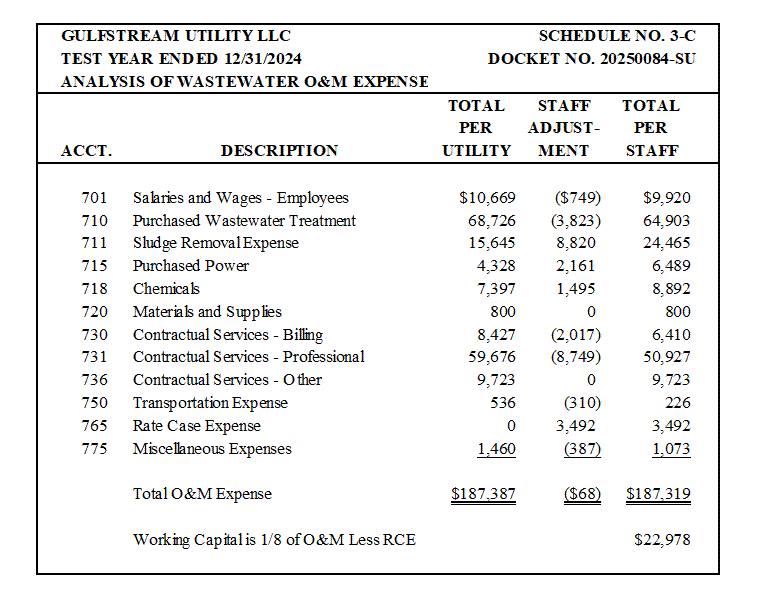
Working Capital Allowance
Working
capital is defined as the short-term investor-supplied funds that are necessary
to meet operating expenses. Consistent with Rule 25-30.433(3), F.A.C., and
Commission practice, staff used the one-eighth of operation and maintenance
(O&M) expense (less rate case expense) formula for calculating the working
capital allowance.[3] As such,
staff removed the rate case expense of $3,492. This resulted in an adjusted
O&M expense balance of $183,828. Based on this calculation, staff
recommends a working capital allowance of $22,978.
Rate Base Summary
Based on the
foregoing, staff recommends that the appropriate average test year rate base is
$473,502. Rate base is shown on Schedule No. 1-A. The related adjustments are
shown on Schedule No. 1-B.
Issue 5:
What is the appropriate return on equity and overall
rate of return for Gulfstream Utility LLC?
Recommendation:
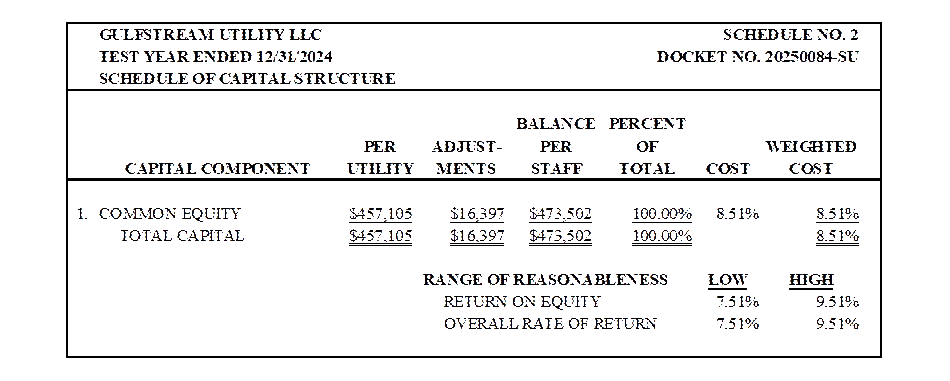
The appropriate return on equity (ROE) is 8.51
percent, with a range of 7.51 percent to 9.51 percent. The appropriate overall
rate of return is 8.51 percent. (Lenberg)
Staff Analysis:
The Utility’s capital structure consists of common
equity. The Utility’s capital structure has been reconciled with staff’s
recommended rate base. The appropriate ROE is 8.51 percent based on the
Commission-approved leverage formula currently in effect.[4]
Staff recommends an ROE of 8.51 percent, with a range of 7.51 percent to 9.51
percent, and an overall rate of return of 8.51 percent. The ROE and overall
rate of return are equal, as shown on Schedule No. 2.
Issue 6:
What are the appropriate amount of test year
operating revenues for Gulfstream Utility LLC’s wastewater system?
Recommendation:
The appropriate test year operating revenues for Gulfstream’s
wastewater system are $157,926. (Bethea)
Staff Analysis:
The Utility recorded total
test year operating revenues of $139,605 for wastewater. The wastewater
revenues included $139,605 of service revenues and no miscellaneous revenues. During
the test year, Gulfstream was approved for a price index rate adjustment, which
was effective August 13, 2024. However, a review of the billing data indicated
that the Utility incorrectly billed customers at a lower base facility (BFC)
and usage charge, resulting in the Utility not collecting the appropriate test
year operating revenues. Therefore, staff applied the current rates to the
billing determinants to determine the appropriate test year operating revenues.
As a result, staff determined test year service revenues should be $157,926 for
wastewater. This results in an increase to service revenue of $18,321 ($157,926
– $139,605) for wastewater.
Based on the above, the appropriate test year operating
revenues for Gulfstream’s wastewater system are $157,926.
Issue 7:
What is the appropriate amount of operating expense
for Gulfstream Utility LLC?
Recommendation:
The appropriate amount of operating expense
for Gulfstream is $232,036. (Lenberg, Olivieri)
Staff Analysis:
The Utility
recorded operating expenses of $216,748. The test year expenses have been
reviewed by staff, including invoices and other supporting documentation. Staff
has made several adjustments to the Utility’s operating expenses as described
below.
Pro Forma O&M
Gulfstream is requesting recovery of the cost to submit a
WWTP Permit Renewal to the DEP. In order to complete this process, Gulfstream
contracted with a professional engineering firm to prepare the following: a
Capacity Analysis Report; an Operations and Maintenance Performance Report; a
Power Outage Contingency Plan; and a Collection System Action Plan. The cost
for preparing these reports was $4,050. Staff has reviewed the supporting
documentation submitted with the Utility’s application in this SARC and
believes this cost to be reasonable. The Utility’s WWTP permit was renewed by
the DEP on March 24, 2025. Since this expense is required for the Utility to
maintain its permit with the DEP, staff recommends approval of this expense.
Operation and Maintenance Expenses
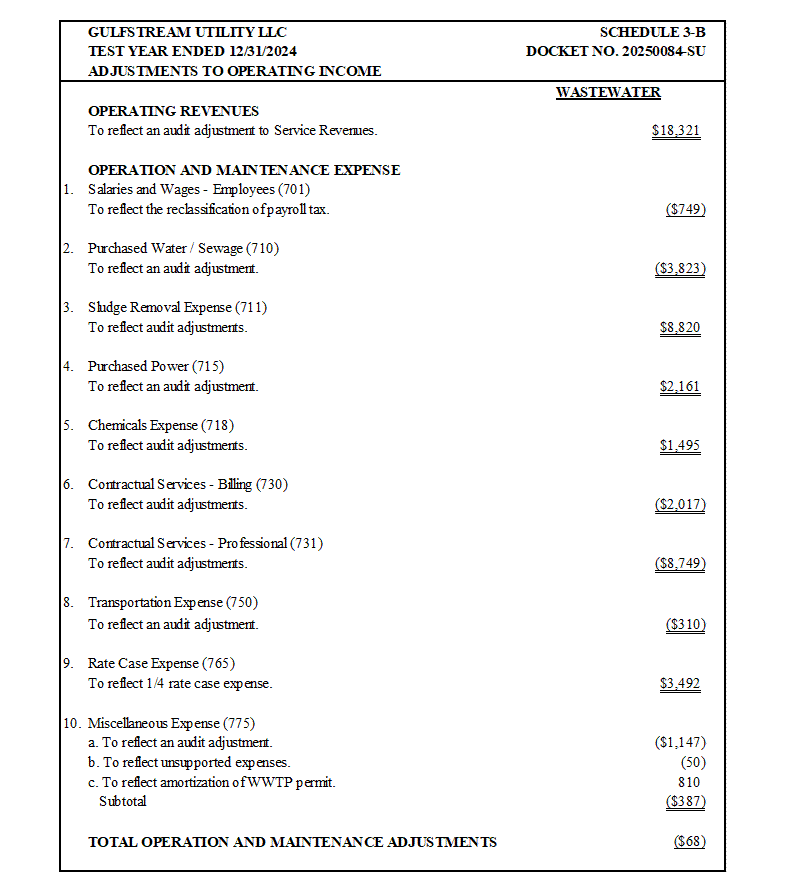
Salaries
and Wages – Employees (701)
The Utility
recorded a salaries and wages expense of $10,669, which included payroll tax.
Staff decreased this amount by $749 to reclassify payroll taxes to Taxes Other
Than Income (TOTI). Therefore, staff recommends a salaries and wages expense of
$9,920.
Purchased Wastewater
Treatment (710)
The Utility recorded
purchased wastewater treatment expense of $68,726. Staff decreased this amount
by $3,823 to reflect an audit adjustment based on actual invoices provided by
the Utility. Therefore, staff recommends a purchased wastewater treatment
expense of $64,903.
Sludge
Removal Expense (711)
The Utility
recorded sludge removal expense of $15,645. Staff decreased this amount by $998
to reflect an audit adjustment related to an out-of-period invoice. Staff also
increased this amount by $3,923 to reflect an audit adjustment for invoices
provided by the Utility that had not been charged to an expense account. Staff
further increased this amount by $5,895 to reflect a reclassification of sludge
removal costs that had been recorded in Account 731 – Contractual Services –
Professional. Staff’s net adjustment to sludge removal expense results in an
increase of $8,820. Therefore, staff recommends a sludge removal expense of
$24,465.
Purchased
Power (715)
The Utility
recorded purchased power expense of $4,328. Staff increased this amount by
$2,161 to reflect an audit adjustment based on invoices for the test year
provided by the Utility. Therefore, staff recommends a purchased power expense
of $6,489.
Chemicals
(718)
The Utility
recorded chemicals expense of $7,397. Staff decreased this amount by $561 to
reflect an audit adjustment to remove an out-of-period invoice. Staff also increased
this amount by $2,056 to reflect an audit adjustment for the reclassification
of chemicals expense that had been recorded in Account 731 – Contractual
Services – Professional. Staff’s net adjustment to chemical expense results in
an increase of $1,495. Therefore, staff recommends a chemicals expense of
$8,892.
Materials
and Supplies (720)
The Utility
recorded materials and supplies expense of $800. Staff made no adjustments to
this amount. Therefore, staff recommends a materials and supplies expense of
$800.
Contractual
Services – Billing (730)
The Utility
recorded contractual services – billing expense of $8,427. Staff decreased this
amount by $651 to reflect an audit adjustment to remove an out-of-period
invoice. Staff further decreased this amount by $1,366 to remove charges for
November and December 2024 for which no supporting documentation was provided.
Staff’s net adjustment to contractual services – billing expense results in a
decrease of $2,017. Therefore, staff recommends a contractual services –
billing expense of $6,410.
Contractual
Services – Professional (731)
The Utility
recorded contractual services – professional expense of $59,676. Staff
increased this amount by $481 to reflect a full year of groundskeeping services
at the wastewater treatment plant. Staff decreased this amount by $1,279 to
reflect an audit adjustment due to lack of supporting documentation. In addition,
staff decreased this amount by $5,895 and $2,056 to reclassify expenses that
had been inappropriately recorded in Account 731 – Contractual Services and
properly assign them to Accounts 711 – Sludge Removal and 718 – Chemicals,
respectively. Staff’s net adjustment to contractual services – professional
expense results in a decrease of $8,749. Therefore, staff recommends a
contractual services – professional expense of $50,927.
Contractual
Services – Other (736)
The Utility
recorded contractual services – other expense of $9,723. Staff made no
adjustments to this amount. Therefore, staff recommends a contractual services
– other expense of $9,723.
Transportation
Expense (750)
The Utility recorded transportation expense of
$536. Staff decreased this amount by $310 to reflect an audit adjustment due to
lack of supporting documentation. Therefore, staff recommends a transportation
expense of $226.
Regulatory
Commission Expense (765)
The Utility did not record any rate case expense for the current docket.
The Utility is required by Rule 25-22.0407, F.A.C., to mail notices of the rate
case overview, final rates, and four-year rate reduction. Staff calculated
noticing costs to be $3,368.
Under
Section 367.0814(3), F.S., the Commission may award rate case expense for
attorney fees or fees of other outside consultants if such fees are incurred
after the initial staff report. On February 13, 2026, the Utility provided
documentation to support $9,407 in additional rate case expense including legal
expenses and consulting fees incurred to date and estimated through the end of
the proposed agency action process.
Staff reviewed the documentation and believes the Utility’s requested rate case
expense is reasonable.
Staff
calculated the distance from the Utility representative’s office in Orlando,
Florida, to Tallahassee, Florida as 261 miles. Based on the 2026 Internal
Revenue Service business mileage rate of $0.725, staff calculated round trip
travel and lodging expense to the Commission Conference of $578. However,
because the same Utility representative will be attending the Commission
Conference on behalf of this and two sister utilities, staff allocated only
33.3 percent of the total travel expense, or $193, to Gulfstream. Additionally,
the Utility paid a filing fee of $1,000 for its SARC application.
Staff recommends a total rate
case expense, consisting of noticing costs, travel, lodging expenses and filing
fee of $13,967, which amortized over four years is $3,492. Therefore, staff
recommends total annual rate case expense of $3,492.
Miscellaneous Expenses (775)
The Utility recorded
miscellaneous expenses of $1,460. Staff decreased
this amount by $1,147 to remove telephone and cable expenses the Utility
elected not to include for recovery. Staff further decreased this amount by $50
to remove unsupported office expenses. As described above, the Utility
requested O&M pro forma to recover the costs of its WWTP permit renewal,
which is a non-recurring cost estimated to be $4,050. Pursuant to Rule
25-30.433(9), F.A.C., staff amortized this amount over five years, resulting in
an increase to the test year expense of $810. Staff’s net
adjustment to miscellaneous expenses results in a
decrease of $387. Therefore, staff recommends miscellaneous expenses of
$1,073.
Operation and
Maintenance Expense Summary
The Utility recorded test year
O&M expense of $187,387. Based on the above adjustments, staff recommends
O&M expense be decreased by $68. This results in a total O&M expense of
$187,319. Staff’s recommended adjustments to O&M are shown on Schedule No.
3-C.
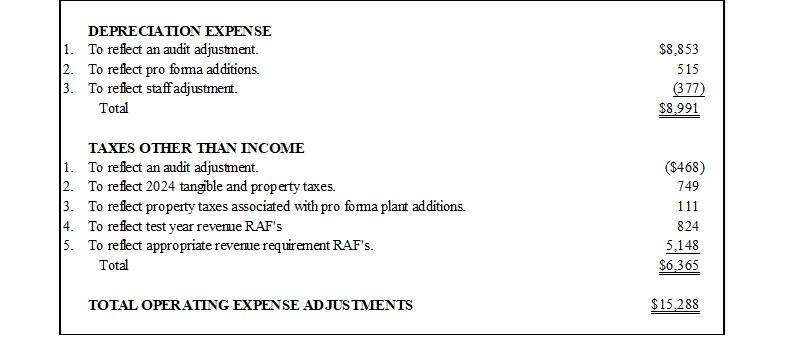
Depreciation Expense
The Utility recorded depreciation
expense of $14,861. Based on the depreciation rates prescribed in Rule
25-30.140, F.A.C., audit staff increased this amount by $8,853. Staff further
increased this amount by $515 to reflect pro forma additions and retirements. In
addition, staff decreased this amount by $377 to remove depreciation expense
associated with a fully depreciated account.
Staff’s net adjustments to
depreciation expense result in an increase of $8,991. Therefore, staff
recommends depreciation expense of $23,852.
Taxes Other Than Income (TOTI)
The Utility recorded TOTI of
$14,500. Audit staff decreased property tax by $468 to reflect 2024 Real and
Tangible Personal Property tax assessments from Orange County. Staff increased payroll tax by $749 to reflect the
reclassification of payroll tax expense that had been recorded in Account 701 –
Salaries and Wages. Staff further increased TOTI by $111 to reflect property
taxes associated with pro forma plant additions.
Furthermore, based on revenues
discussed in Issue 6, TOTI should be increased by $824 to reflect a regulatory
assessment fee (RAF) rate of 4.5 percent applied to the adjustment in revenues.
As discussed
later in Issue 9, staff recommends revenues be increased by $114,391 to reflect
the increased revenue required to cover expenses and allow an opportunity to
earn the recommended rate of return. As a result, TOTI should be increased by
$5,148 to reflect a RAF rate of 4.5 percent of the change in revenues. Staff’s
adjustments result in a total increase of $6,365. Therefore, staff recommends a
TOTI of $20,865.
Operating Expense
Summary
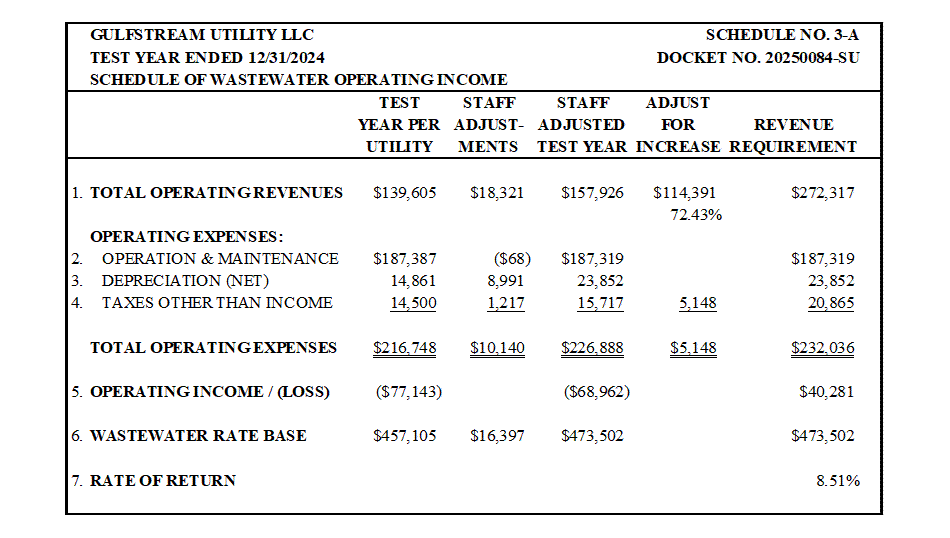
The Utility recorded operating expenses of $216,748. The
application of staff’s recommended adjustments to the Utility’s recommended
operating expense results in a total operating expense of $232,036, an increase
of $15,288. Operating expenses are shown on Schedule No. 3-A, and the related
adjustments are shown on Schedule No. 3-B.
Issue 8:
Does Gulfstream Utility LLC meet the criteria for application
of the operating ratio methodology?
Recommendation:
No. Gulfstream does not meet the criteria for
application of the operating ratio methodology for calculating the revenue
requirement. (Lenberg)
Staff Analysis:
Rule
25-30.4575(2), F.A.C., indicates that in rate cases processed under Rule
25-30.455, F.A.C., the Commission will use the operating ratio methodology to establish
the utility’s revenue requirement when its rate base is not greater than 125
percent of O&M expenses, less regulatory Commission expense and purchased
wastewater treatment expense, and the use of the operating ratio methodology
does not change the utility’s qualification for a SARC.
With respect
to Gulfstream, staff has recommended a rate base of $473,502. After removal of
rate case expense and purchased wastewater treatment expense, staff calculated
an adjusted O&M expense of $118,925. Based on staff’s recommended amounts,
the Utility’s rate base is 398.15 percent of its adjusted O&M expense. Therefore,
the Utility does not qualify for application of the operating ratio methodology.
Issue 9:
What is the appropriate revenue requirement for
Gulfstream Utility LLC?
Recommendation:
The appropriate revenue requirement is $272,317,
resulting in an annual increase of $114,391 (72.43 percent). (Lenberg)
Staff Analysis:
Gulfstream
should be allowed an annual increase of $114,391 (72.43 percent). This should
allow the Utility the opportunity to recover its expenses and earn an 8.51
percent return on rate base. The calculations for the revenue requirement are
shown on Table 9-1.[6]
Table
9-1
Revenue Requirement
|
Wastewater Rate Base
|
$473,502
|
|
Rate of Return
|
× 8.51%
|
|
Return on Rate Base
|
$40,281
|
|
Water O&M Expense
|
187,319
|
|
Depreciation Expense
|
23,852
|
|
Taxes Other Than Income
|
20,865
|
|
Revenue Requirement
|
$272,317
|
|
Less Test Year Revenues
|
$157,926
|
|
Annual Increase
|
$114,391
|
|
Percent Increase
|
72.43%
|
Source: Staff calculations.
Issue 10:
What are the appropriate rate structure and rates
for Gulfstream Utility LLC?
Recommendation:
The recommended rate structure and monthly
wastewater rates are shown on Schedule No. 4. The Utility’s proposal to include
a repression adjustment should be denied. The Utility should file revised
tariff sheets and a proposed customer notice to reflect the Commission-approved
rates. The approved rates should be effective for service rendered on or after
the stamped approval date on the tariff sheets, pursuant to Rule 25-30.475(1),
F.A.C. In addition, the approved rates should not be implemented until staff
has approved the proposed customer notice and the notice has been received by
the customers. The Utility should provide proof of the date notice was given by
affidavit within 10 days of the date of the notice. (Bethea)
Staff Analysis:
Gulfstream
provides wastewater service to approximately 965 residential customers and no
general service customers. Currently, the wastewater rate structure for
residential and general service customers consists of a monthly uniform BFC for
all meter sizes and a gallonage charge with no gallonage cap for residential
customers.
Staff
performed an analysis of the Utility’s billing data in order to evaluate
various BFC cost recovery percentages and gallonage caps for the residential
wastewater customers. The goal of the evaluation was to select the rate design
parameters that: (1) produce the recommended revenue requirement; (2) equitably
distribute cost recovery among the Utility’s customers; and (3) implement a
gallonage cap, where appropriate, that considers the approximate amount of
water that may return to the wastewater system.
Staff
allocated 50 percent of the wastewater revenue to the BFC due to the capital
intensive nature of wastewater plants. As mentioned above, the Utility currently
does not have a wastewater gallonage cap set. The wastewater gallonage cap
recognizes that not all water used by the residential customers is returned to
the wastewater system. The wastewater cap of most utilities is set at
approximately 80 percent of residential water sold, which typically results in
gallonage caps of 6,000, 8,000, or 10,000. Based on staff’s review of the
billing analysis, 86 percent of the gallons are captured at the 4,000 gallon
level. Although the approved residential wastewater cap is typically based on
80 percent of total water sold, in this case, doing so would yield an exceptionally
low residential wastewater cap. In addition, lowering the gallonage cap below
6,000 gallons would have an adverse effect on the residential gallonage charge
and resulting customer bills. Based on staff’s review of the billing data,
staff recommends that the gallonage cap for residential customers be set at
6,000 gallons.
In addition,
although the Utility does not have any general service customers, staff
recommends implementing general service rates by meter size for future
customers. Staff also recommends that the general service gallonage charge be
set 1.2 times greater than the residential gallonage charge, which is
consistent with Commission practice.
Finally, in
its application, Gulfstream requested a repression adjustment. The Commission,
as a result of an increase in the price of water, has applied a corresponding
wastewater repression adjustment when the water and wastewater provider are the
same utility.[7] Even in
cases with a single water and wastewater utility provider, there has still been
no recognition of an adjustment due to an increase in the price of wastewater.
The Commission has only recognized the effect on customer demand from an
increase in the price of water. It is Commission practice that an increase in
the price of water is the catalyst for whether or not to make a repression
adjustment, which would ultimately flow through to wastewater. Therefore, a
repression adjustment for the Utility’s wastewater system is not applicable in
this case.
Based on the
above, staff’s recommended rate structure and monthly wastewater rates are
shown on Schedule No. 4. The Utility’s proposal to include a repression
adjustment should be denied. The Utility should file revised tariff sheets and
a proposed customer notice to reflect the Commission-approved rates. The
approved rates should be effective for service rendered on or after the stamped
approval date on the tariff sheets, pursuant to Rule 25-30.475(1), F.A.C. In
addition, the approved rates should not be implemented until staff has approved
the proposed customer notice and the notice has been received by the customers.
The Utility should provide proof of the date notice was given by affidavit within
10 days of the date of the notice.
Issue 11:
What are the appropriate initial customer deposits
for Gulfstream Utility LLC?
Recommendation:
The appropriate initial customer deposit is $49 for all residential meter sizes. The initial
customer deposit for all other residential meter sizes and all general service
meter sizes should be two times the average estimated bill for wastewater. The approved initial customer deposits should be
effective for service rendered or connections made on or after the stamped
approval date on the tariff sheets pursuant to Rule 25-30.475, F.A.C. The
Utility should be required to collect the approved initial customer deposits
until authorized to change them by the Commission in a subsequent proceeding.
(Bethea)
Staff Analysis:
Rule
25-30.311, F.A.C., provides the criteria for collecting, administering, and
refunding customer deposits. Customer deposits are designed to minimize the
exposure of bad debt expense for the utility and, ultimately, the general body
of ratepayers. An initial customer deposit ensures that the cost of providing
service is recovered from the cost causer. Historically, the Commission has set
initial customer deposits equal to two times the average estimated bill.[8] Currently,
Gulfstream has an initial customer deposit of $28 for the 5/8 inch x 3/4 inch
meter size, and two times the average estimated bill for the general service
customers. However, this amount does not cover two months’ average bills based
on staff’s recommended rates. Based on the Utility’s average monthly residential
consumption, the appropriate initial customer deposit should be $49 to reflect
an average residential customer bill for two months. The monthly average
residential water bill is $24.67.
Staff recommends the appropriate initial customer deposit
is $49 for all residential meter sizes. The initial customer deposit for all
other residential meter sizes and all general service meter sizes should be two
times the average estimated bill for wastewater. The approved initial customer
deposits should be effective for service rendered or connections made on or
after the stamped approval date on the tariff sheets pursuant to Rule
25-30.475, F.A.C. The Utility should be required to collect the approved
initial customer deposits until authorized to change them by the Commission in
a subsequent proceeding.
Issue 12:
What is the appropriate amount by which rates should
be reduced four years after the published effective date, to reflect the
removal of the amortized rate case expense?
Recommendation:
The rates should be reduced as shown on Schedule No.
4, to remove rate case expense grossed-up for RAFs and amortized over a
four-year period. Pursuant to Section 367.081(8), F.S., the decrease in rates
should become effective immediately following the expiration of the rate case
expense recovery period. Gulfstream should be required to file revised tariffs
and a proposed customer notice setting forth the lower rates and rationale no later
than one month prior to the effective date of the new rates. If the Utility
files revised tariffs reflecting this reduction in conjunction with a price
index or pass-through rate adjustment, separate data should be filed for the
price index and/or pass-through increase and the reduction in the rates due to
the amortized rate case expense. (Lenberg, Bethea)
Staff Analysis:
Section
367.081(8), F.S., requires that the rates be reduced immediately following the
expiration of the four-year period by the amount of the rate case expense
previously included in rates. The reduction will reflect the removal of revenue
associated with the amortization of rate case expense and the gross-up for
RAFs. This results in a reduction of $3,656.
Staff recommends that the rates be reduced as shown on
Schedule No. 4, to remove rate case expense grossed-up for RAFs and amortized
over a four-year period. Pursuant to Section 367.081(8), F.S., the decrease in
rates should become effective immediately following the expiration of the rate
case expense recovery period. Gulfstream should be required to file revised
tariffs and a proposed customer notice setting forth the lower rates and
rationale no later than one month prior to the effective date of the new rates.
If the Utility files revised tariffs reflecting this reduction in conjunction
with a price index, or pass-through rate adjustment, separate data should be
filed for the price index and/or pass-through increase and the reduction in the
rates due to the amortized rate case expense.
Issue 13:
Should the recommended rates be approved for
Gulfstream Utility LLC on a temporary basis, subject to refund with interest,
in the event of a protest filed by a party other than the Utility?
Recommendation:
Yes.
Pursuant to Section 367.0814(7), F.S., the recommended rates should be approved
for the Utility on a temporary basis, subject to refund with interest, in the
event of a protest filed by a party other than the Utility. Gulfstream should
file revised tariff sheets and a proposed customer notice reflecting the
Commission-approved rates. The approved rates should be effective for services
rendered on or after the stamped approval date on the tariff sheets, pursuant
to Rule 25-30.475(1), F.A.C. In addition, the temporary rates should not be
implemented until staff has approved the proposed notice, and the notice has
been received by the customers. Further, prior to implementing any temporary
rates, the Utility should provide appropriate financial security.
If the
recommended rates are approved on a temporary basis, the rates collected by the
Utility should be subject to the refund provisions discussed below in the staff
analysis. In addition, after the increased rates are in effect, pursuant to
Rule 25-30.360(6), F.A.C., the Utility should file reports with the
Commission’s Office of Commission Clerk no later than the 20th of each month
indicating both the current monthly and total amount of money subject to refund
at the end of the preceding month. The report filed should also indicate the
status of the security being used to guarantee repayment of any potential
refund. (Lenberg)
Staff Analysis:
This
recommendation proposes an increase in rates. A timely protest might delay a
rate increase resulting in an unrecoverable loss of revenue to the Utility.
Therefore, pursuant to Section 367.0814(7), F.S., in the event of a protest
filed by a party other than the Utility, staff recommends that the proposed
rates be approved on a temporary basis. Gulfstream should file revised tariff
sheets and a proposed customer notice reflecting the Commission-approved rates.
The approved rates should be effective for service rendered on or after the
stamped approval date on the tariff sheets, pursuant to Rule 25-30.475(1),
F.A.C. In addition, the temporary rates should not be implemented until staff
has approved the proposed notice, and it has been received by the customers.
The additional revenue produced by staff’s recommended rates and collected by
the Utility should be subject to the refund provisions discussed below.
Gulfstream
should be authorized to initiate the temporary rates upon staff’s approval of
an appropriate security for the potential refund and cost of the proposed customer
notice. Security should be in the form of either a bond or letter of credit in
the amount of $78,111. Alternatively, the Utility may establish an escrow
agreement with an independent financial institution.
If the
Utility chooses a bond for securing the potential refund, the bond should
contain wording to the effect that it will be terminated only under the
following conditions:
1. The Commission approves the rate
increase; or,
2. If the Commission denies the increase,
the Utility shall refund the amount collected that is attributable to the
increase.
If the
Utility chooses a letter of credit for securing the potential refund, the
letter of credit should contain the following conditions:
1. The letter of credit is irrevocable for
the period it is in effect.
2. The letter of credit will be in effect
until a final Commission order is rendered, either approving or denying the
rate increase.
If security
is provided through an escrow agreement, the following conditions should be
part of the agreement:
1. The Commission Clerk, or his or her
designee, must be a signatory to the escrow agreement.
2. No monies in the escrow account may be
withdrawn by the Utility without the prior written authorization of the
Commission Clerk, or his or her designee.
3. The escrow account shall be an interest
bearing account.
4. If a refund to the customers is
required, all interest earned by the escrow account shall be distributed to the
customers.
5. If a refund to the customers is not
required, the interest earned by the escrow account shall revert to the
Utility.
6. All information on the escrow account
shall be available from the holder of the escrow account to a Commission
representative at all times.
7. The amount of revenue subject to refund
shall be deposited in the escrow account within seven days of receipt.
8. This escrow account is established by
the direction of the Florida Public Service Commission for the purpose(s) set
forth in its order requiring such account. Pursuant to Cosentino v. Elson, 263 So. 2d 253 (Fla. 3d DCA 1972), escrow
accounts are not subject to garnishments.
9. The account must specify by whom and on
whose behalf such monies were paid.
In no
instance should the maintenance and administrative costs associated with the
refund be borne by the customers. These costs are the responsibility of, and
should be borne by, the Utility. Irrespective of the form of security chosen by
the Utility, an account of all monies received as a result of the rate increase
should be maintained by the Utility. If a refund is ultimately required, it
should be paid with interest calculated pursuant to Rule 25-30.360(4), F.A.C.
The Utility should maintain a record of the amount of the
bond, and the amount of revenues that are subject to refund. In addition, after
the increased rates are in effect, pursuant to Rule 25-30.360(6), F.A.C., the
Utility should file reports with the Commission Clerk’s office no later than
the 20th of every month indicating the monthly and total amount of money
subject to refund at the end of the preceding month. The report filed should
also indicate the status of the security being used to guarantee repayment of
any potential refund.
Issue 14:
Should Gulfstream Utility LLC be required to notify
the Commission within 90 days of an effective order finalizing this docket,
that it has adjusted its books for all the applicable NARUC USOA?
Recommendation:
Yes. Gulfstream should be required to notify the
Commission, in writing, that it has adjusted its books in accordance with the
Commission’s decision. The Utility should submit a letter within 90 days of the
Commission’s final order in this docket, confirming that the adjustments to all
applicable National Association of Regulatory Utility Commissioners (NARUC)
Uniform System of Accounts (USOA) primary accounts have been made to the
Utility’s books and records. In the event the Utility needs additional time to
complete the adjustments, a notice providing good cause should be filed not
less than seven days prior to the deadline requesting an extension. Upon
providing a notice of good cause, staff should be given administrative
authority to grant an extension of up to 60 days. (Lenberg)
Staff Analysis:
Gulfstream should be required to notify the
Commission, in writing, that it has adjusted its books in accordance with the
Commission’s decision. The Utility should submit a letter within 90 days of the
Commission’s final order in this docket, confirming that the adjustments to all
applicable NARUC USOA primary accounts have been made to the Utility’s books
and records. In the event the Utility needs additional time to complete the
adjustments, a notice providing good cause should be filed not less than seven
days prior to the deadline requesting an extension. Upon providing a notice of
good cause, staff should be given administrative authority to grant an
extension of up to 60 days.
Issue 15:
Should this docket be closed?
Recommendation:
No. If no person whose substantial interests are
affected by the proposed agency action files a protest within 21 days of the
issuance of the proposed agency action order, a consummating order should be
issued. The docket should remain open for staff’s verification that the revised
tariff sheets and customer notice have been filed by the Utility and approved
by staff, and that the Utility submitted its letter confirming all adjustments
to applicable NARUC USOA primary accounts were made. Once these actions are
complete, this docket should be closed administratively. (Marquez)
Staff Analysis:
If no person whose substantial
interests are affected by the proposed agency action files a protest within 21
days of the issuance of the proposed agency action order, a consummating order
should be issued. The docket should remain open for staff’s verification that
the revised tariff sheets and customer notice have been filed by the Utility
and approved by staff, and that the Utility submitted its letter
confirming all adjustments to applicable NARUC USOA primary accounts were made.
Once these actions are complete, this docket should be closed administratively.