Discussion
of Issues
Issue 1:
Is the quality of service provided by GCP Plantation
Landings, LLC satisfactory?
Recommendation:
Yes. GCP is currently in compliance with the Department
of Environmental Protection (DEP) and there were no complaints recorded during
the analyzed time period. Therefore, the quality of service should be
considered satisfactory. (Lewis)
Staff Analysis:
Pursuant to Section
367.081(2)(a)(l), F.S., and Rule 25-30.433(1), Florida Administrative Code
(F.A.C.), in water and wastewater rate cases, the Commission shall determine
the overall quality of service provided by the utility. This determination is
made from an evaluation of the quality of the utility’s product (water) and the
utility’s attempt to address customer satisfaction (water and wastewater). The
Rule further states that the most recent chemical analyses for the water
system, outstanding citations, violations, and consent orders on file with the
DEP and the county health department, and any DEP and county health department
officials’ testimony concerning quality of service shall be considered. In
addition, any customer testimony, comments, or complaints received by the
Commission are also reviewed. The operating condition of the water and
wastewater systems are addressed in Issue 2.
Quality of the Utility’s
Product
In evaluation of GCP’s product
quality, staff reviewed the Utility’s compliance with the DEP’s primary and
secondary drinking water standards. Primary standards protect public health
while secondary standards regulate contaminants that may impact the taste,
odor, and color of drinking water. Staff reviewed the DEP’s Safe Drinking Water
Program chemical analysis of samples taken on September 25, 2024, and the Utility
was determined to be in compliance with DEP standards. In addition, staff
reviewed the most current Disinfection Byproducts testing conducted on July 15,
2025, at the GCP water treatment plant (WTP) and the results were in compliance
with DEP standards.
The Utility’s Attempt to Address Customer
Satisfaction
There have been no complaints recorded by the Commission’s
Consumer Activity Tracking System (CATS), received by the Utility, or filed
with the DEP for the test year and four years prior.
At the January 27, 2026 customer meeting, four customers
(representing three households) provided comments. The customers expressed
their opposition to the proposed rate increase, the smell of the finished
water, and the number of service outages and subsequent Boil Water
Notices. One customer expressed concerns
about the odor emanating from the wastewater plant (WWTP). In response to staff’s fourth data request,
the Utility indicated that it was not aware of its customers’ concerns prior to
the customer meeting regarding the smell of the water or foul odors from the
WWTP.
The Utility also explained that it has reached out to the customers who spoke
at the customer meeting and was able to connect with three out of the four to
address their concerns. When responding to the customers who spoke at the
customer meeting, the Utility explained that it previously discovered low
chlorine-levels, which can result in a sulfur-type smell and replaced the
chlorine injector to improve the odor. As for the odors emanating from the
WWTP, the Utility explained that it will monitor these conditions daily, but as
stated above, was not aware of this issue prior to the customer meeting.
Pursuant to Rule 25-30.251(1) and (2), F.A.C., staff
requested the Utility provide record of all interruptions in service which
affect 10 percent or more of its customers since January 1, 2021. In response,
the Utility indicated that a total of 24 service interruptions occurred during
the specified period, 16 of which may have affected 10 percent or more of its
customers. The information provided by the Utility did not address all items
required by the Rule, such as the cause of the interruption, nor did the
Utility provide notification to the Commission of any interruptions. As such,
staff recommends that the Utility maintain its service interruption records
meeting the 10 percent threshold in the manner outlined in Rule 25-30.251(1),
F.A.C., and notify the Commission of any such interruptions on a going-forward
basis.
In addition to the customer comments during the customer
meeting, 28 customers filed comments in the docket file. All 28 customers were opposed to the rate
increase, with 13 providing negative comments concerning the smell of the
finished water. Eleven customers expressed concerns regarding the condition of
the distribution and collection mains.
One customer expressed concerns about the capacity of the wastewater
treatment plant. Staff performed a supplemental review though March 2, 2026, of
complaints filed in CATS following the customer meeting and none were found.
Conclusion
GCP is currently in compliance
with the DEP and there were no complaints recorded during the analyzed time
period. Therefore, the quality of service should be considered satisfactory.
Issue 2:
Are the infrastructure and operating conditions of
GCP Plantation Landings, LLC’s water and wastewater system in compliance with
DEP regulations?
Recommendation:
Yes. GCP’s water and wastewater treatment facilities
are in compliance with DEP regulations. (Lewis)
Staff Analysis:
Rule 25-30.225(2), F.A.C., requires each water and
wastewater utility to maintain and operate its plant and facilities by
employing qualified operators in accordance with the rules of the DEP. Rule
25-30.433(2), F.A.C., requires consideration of whether the infrastructure and
operating conditions of the plant and facilities are in compliance with Rule
25-30.225, F.A.C. In making this determination, the Commission must consider testimony
of the DEP and county health department officials, sanitary surveys for water
and compliance evaluations for wastewater systems, citations, violations, and
consent orders issued to the utility, customer testimony, comments, complaints,
utility testimony, and responses to the aforementioned items.
Water
and Wastewater Operating Conditions
GCP’s
water system has two wells that each have a pumping capacity of 350 gallons per
minute (gpm). The system is served by a hydropneumatic tank with a capacity of 15,000
gallons. There are 13 fire hydrants throughout
the service territory. Groundwater from the wells is treated through
hypochlorination. Staff reviewed GCP’s most recent Sanitary Survey Reports
conducted by the DEP on September 15, 2021, which indicated no deficiencies.
GCP’s wastewater system consists of a 0.080 million gallons per day
(MGD) Three-Month Rolling Average Daily Flow (3MADF) design capacity, Type III,
extended aeration domestic wastewater treatment plant, with disposal to a
two-cell Rapid Infiltration Basin (RIB). Staff reviewed the Utility’s
compliance evaluation inspections conducted by the DEP to determine GCP’s
overall wastewater facility compliance. A Compliance Evaluation Inspection on
April 2, 2024, determined the facility to be in compliance with the DEP’s rules
and regulations.
Conclusion
GCP’s water and wastewater treatment facilities are in
compliance with DEP regulations.
Issue 3:
What are the used and useful (U&U) percentages
of GCP Plantation Landings, LLC’s WTP, WWTP, water distribution, and wastewater
collection systems?
Recommendation:
GCP’s WTP, WWTP, water distribution, and wastewater
collection systems should all be considered 100 percent U&U. Additionally,
staff recommends that a 17.3 percent adjustment to purchased power and
chemicals should be made for excessive unaccounted for water (EUW). However, as
the Utility declined recovery of purchased power expense, no adjustment was
made to purchased power. No adjustment is recommended for excessive
infiltration and inflow (I&I). (Lewis)
Staff Analysis:
As stated in Issue 2, GCP’s
WTP consists of two wells, each with a pumping capacity of 350 gpm, and a
15,000 gallon hydropneumatic tank. There is no water storage tank. The
Utility’s water distribution system is comprised of 6,960 linear feet of
6-inch; 5,110 linear feet of 4-inch; and 2,120 linear feet of 2-inch PVC
(polyvinyl chloride) pipe. There are 13 fire hydrants throughout the service
territory.
GCP’s WWTP
is permitted by the DEP as a 0.080 MGD, 3MADF design capacity, Type III,
extended aeration domestic wastewater treatment plant, with disposal to a
two-cell RIB. There are 50 manholes throughout the service territory. The Utility’s wastewater collection system is
comprised of approximately 12,660 feet of 8-inch, and 2,980 feet of 4-inch PVC
collecting mains.
Infiltration and Inflow (I&I)
Rule
25-30.432, F.A.C., provides that in determining the amount of U&U plant,
the Commission will consider I&I. Excessive I&I is a calculation that
is based on a comparison of allowable wastewater treated to the actual amount
of wastewater treated. Allowable treated
wastewater was calculated as 16,109,084 gallons, and the actual amount of
wastewater treated was 9,872,000 gallons. The actual amount does not exceed the
allowable amount, therefore, there is no excessive I&I and no adjustment to
operating expenses is necessary.
Used and Useful Percentages (U&U)
Rules 25-30.432 and 25-30.4325,
F.A.C., address the method by which the U&U percentages of a wastewater and
water system is determined, respectively.
GCP’s U&U percentages were last determined in Docket No. 20070416.[4] In that
docket, the Commission determined the Utility’s WTP, WWTP, water distribution,
and wastewater collection systems to be 100 percent U&U. GCP has not
increased the capacity of its facilities and the service territory is built
out. As such, and consistent with the Commission’s previous decision, staff
recommends that the Utility’s WTP, WWTP, water distribution, and wastewater
collections systems be considered 100 percent U&U.
Excessive
Unaccounted for Water (EUW)
Rule 25-30.4325, F.A.C.,
additionally provides factors to be considered in determining whether
adjustments to operating expenses are necessary for EUW. EUW is defined as
“unaccounted for water in excess of 10 percent of the amount produced.”[5]
Unaccounted for water is all water produced that is not sold, metered, or
accounted for in the records of the utility. In determining whether adjustments
to plant and operating expenses are necessary in accordance with Rule
25-30.4325(10), F.A.C., staff considers several factors. These include the
causes of EUW, any corrective action taken, or the economic feasibility of a
proposed solution. EUW is calculated by subtracting both the gallons sold to
customers and the gallons used for other services, such as flushing, from the
total gallons pumped and purchased for the test year, and dividing by the sum
of gallons
pumped and purchased. The amount in excess of 10 percent, if any, is the EUW
percentage.
A review of
the Utility’s 2024 monthly operating reports on file with the DEP indicates
that GCP produced 26,300,000 gallons of water during the test year. In response
to a staff data request, the Utility indicated that it purchases no water and
did not record any water for flushing or other uses for each month during the
test year.[6] An
examination of the Utility’s billing records indicates 19,115,488 gallons of
treated water were sold to customers. The calculation ([26,300,000 + 0 -
19,115,488 - 0 / [26,300,000 + 0]) results in 27.3 percent unaccounted for
water. The Commission allows a 10 percent margin; therefore, there is 17.3
percent EUW. Accordingly, staff
recommends an adjustment of 17.3 percent be made to purchased power and
chemicals. However, the Utility declined
recovery of purchased power. Therefore, no adjustment was made to purchased
power.
Conclusion
GCP’s WTP,
WWTP, water distribution, and wastewater collection systems should all be
considered 100 percent U&U. Additionally, staff recommends that a 17.3
percent adjustment to purchased power and chemicals should be made for EUW. However,
as the Utility declined recovery of purchased power expense, no adjustment was
made to purchased power. No adjustment is recommended for excessive I&I.
Issue 4:
What are the appropriate average test year water
rate base and wastewater rate base amounts for GCP Plantation Landings, LLC?
Recommendation:
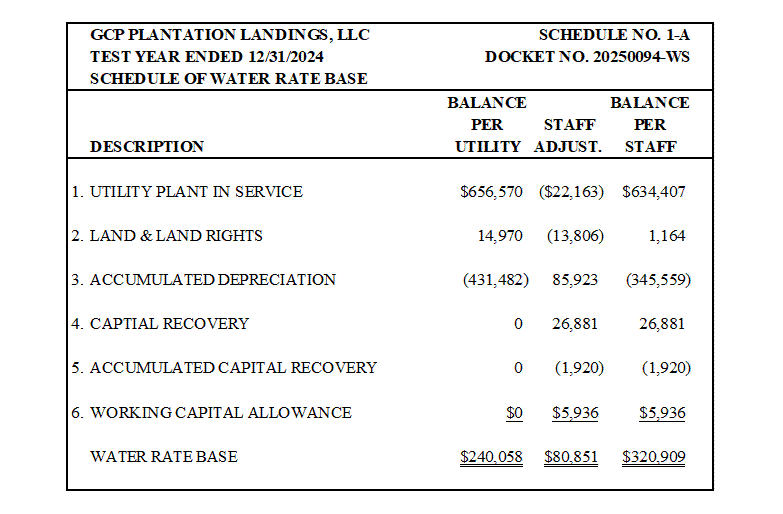
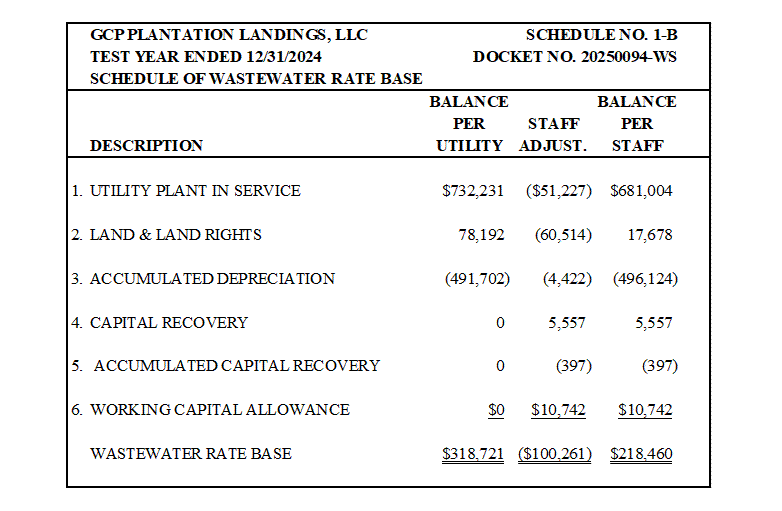
The appropriate average test year rate bases
for GCP Plantation Landings, LLC are $320,909 for water
and $218,460 for wastewater. (Lenberg, Higgins)
Staff Analysis:
The
components of the Utility’s rate base include utility plant in service (UPIS),
land and land rights, accumulated depreciation, capital recovery, accumulated
amortization of capital recovery, and working capital. Staff selected the test
year ended December 31, 2024, for the instant rate case. A summary of each
component and the recommended adjustments are discussed below.
Utility Plant in Service
The Utility
recorded UPIS balances of $656,570 for water and $732,231 for wastewater. Audit
staff reconciled these balances to the last Commission order and adjusted UPIS
to reflect proper account classifications and historical adjustments that had
not been recorded. Because the Utility did not maintain complete ledgers or
property records for several years, staff reconstructed the Utility’s UPIS by
using Commission Order No. PSC-13-0121-PAA-WS, the Utility’s annual reports,
and any available invoices.[7]
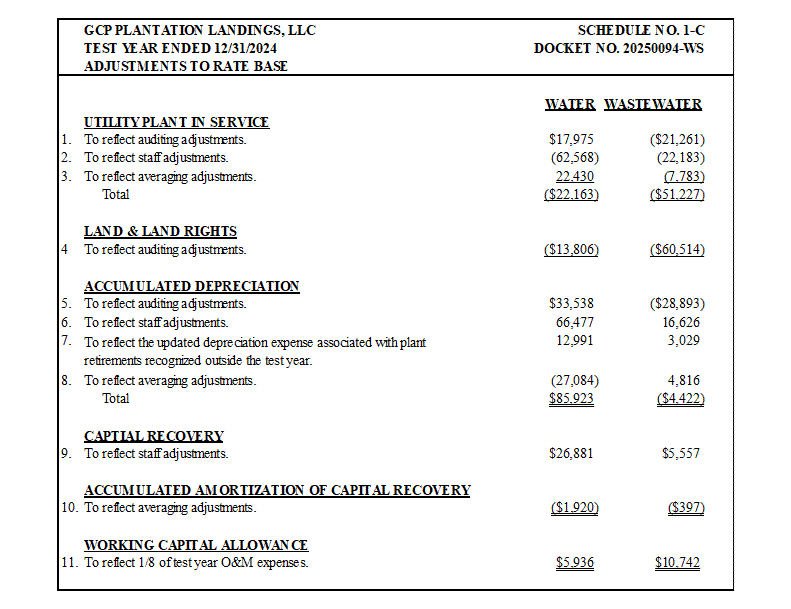
Audit staff
corrected misclassified additions, applied previously-ordered adjustments, and
removed items that had been improperly booked or recorded in the wrong period.
These adjustments increased water UPIS by $17,975 and decreased wastewater UPIS
by $21,261. Staff decreased water UPIS by $62,568 and wastewater UPIS by
$22,183 to reflect the appropriate retirements of assets. In addition, staff
increased water UPIS by $22,430 and decreased wastewater UPIS by $7,783 to
reflect averaging adjustments. Staff’s adjustments result in a net decrease of
$22,163 to water UPIS and a net decrease of $51,227 to wastewater UPIS.
Therefore, staff recommends total UPIS balances of $634,407 for water and
$681,004 for wastewater.
Capped
Retirement
In
general, it is Commission practice to apply the 75 percent of plant addition methodology to estimate the
retirement amount of assets being replaced when the original cost is unknown.
In this case, the Utility did not record retirements for certain accounts in
prior years. When performing these retirements after the fact by staff,
application of the 75 percent retirement methodology would result in negative
plant balances. Therefore, staff capped the retirement amounts at the plant
balances for the respective accounts.
This
methodology was utilized in Docket No. 20160101-WS and approved by Order No.
PSC-2017-0361A-FOF-WS. In that order, the Commission found that:
…the amount of retirement to
plant in service and accumulated depreciation reflected in the adjusted test
year shall be calculated based on either the 75 percent methodology . . . or on
the actual balance in the impacted plant in service account . . . if that
balance would be negative as a result of the 75 percent methodology.”[8]
Due
to the capped retirements, three accounts have remaining undepreciated plant
balances. Staff recommends that these balances be placed on amortization
schedules for recovery. Rule 25-30.433(10), F.A.C., prescribes the methodology
for determining the appropriate amortization period for forced abandonment or
the prudent retirement of plant assets prior to the end of their depreciable
life, unless specific circumstances demonstrate a more appropriate amortization
period should be used. Staff recommends an alternative amortization period in
this instance.
Staff
initially contemplated a five-year amortization period, as presented in the
Staff Report. However, OPC raised concerns regarding this proposal, stating
that a longer amortization period is warranted due to the overall revenue
requirement increases and associated rate impacts.[9]
OPC suggested applying the formula outlined in Rule 25-30.433(10), F.A.C.,
which results in approximately 5.5 years for the unrecovered water investment
and approximately 8.2 years for the unrecovered wastewater investment, based on
the values in the Staff Report.
After
consulting with OPC, staff agreed to recommend a compromise amortization period
of seven years for both systems. This change lowers the proposed revenue
requirements by $1,540 for water and $318 for wastewater.
The
specific balances and associated amortization expenses are shown in Tables 4-2
and 4-3 below. Staff notes that the accumulated amortization for both water and
wastewater on Schedules 1-A and 1-B reflects half of the accumulated annual
expense due to mid-year (half-year) averaging.
Table 4-2
Water
Capital Amortization
|
Account
|
Plant Balance
|
Accumulated
Depreciation
|
Undepreciated
Plant Balance
|
Amortization
Expense
|
|
320
|
$7,507
|
$5,009
|
$2,498
|
$357
|
|
334
|
$38,597
|
$14,214
|
$24,383
|
$3,483
|
|
Total
|
$46,104
|
$19,223
|
$26,881
|
$3,840
|
Source: Staff calculations.
Table 4-3
Wastewater
Capital Amortization
|
Account
|
Plant Balance
|
Accumulated
Depreciation
|
Undepreciated
Plant Balance
|
Amortization
Expense
|
|
382
|
$5,903
|
$346
|
$5,557
|
$794
|
|
Total
|
$5,903
|
$346
|
$5,557
|
$794
|
Source:
Staff calculations.
Used and Useful
As discussed
in Issue 2, the Utility’s system is considered 100 percent U&U. Therefore, no U&U
adjustment is necessary.
Land and Land Rights
The Utility
recorded land and land rights balances of $14,970 for water and $78,192 for
wastewater. Audit staff determined that these balances were not recorded at
original cost. The Utility stated that no land has been purchased or sold since
the last Commission order.
Audit staff
decreased water land by $13,806 and wastewater land by $60,514 to reflect the
original cost values established in Commission Order No. PSC-13-0121-PAA-WS.[10]
Therefore, staff recommends land and land rights balances of $1,164 for water
and $17,678 for wastewater.
Accumulated Depreciation
The Utility
recorded accumulated depreciation of $431,482 for water and $491,702 for
wastewater. Audit staff decreased this amount by $33,538 for water and
increased this amount by $28,893 for wastewater to reflect corrections to UPIS
and the application of the correct depreciation rates per Rule 25-30.140,
F.A.C.
Staff
decreased this amount by $66,477 for water and by $16,626 for
wastewater to reflect the appropriate retirements of assets and to correct
over-depreciation associated with Account 331 – Transmission and Distribution
Lines. Staff further decreased this amount by $12,991 for water and by $3,029
for wastewater to reflect the updated depreciation expense associated with
plant retirements recognized outside the test year.
Additionally,
Staff increased this amount by $27,084 for water and decreased this amount by
$4,816 for wastewater to reflect averaging adjustments. Staff’s adjustments to
accumulated depreciation result in a net decrease of $85,923 for water and a
net increase of $4,422 for wastewater. Therefore, staff recommends accumulated
depreciation balances of $345,559 for water and $496,124 for wastewater.
Working Capital Allowance
Working
capital is defined as the short-term investor-supplied funds that are necessary
to meet operating expenses. Consistent with Rule 25-30.433(3), F.A.C., and
Commission practice, staff used the one-eighth operation and maintenance
(O&M) expense (less rate case expense) formula for calculating the working
capital allowance.[11] As such,
staff removed the rate case expense of $1,016 for water and $1,022 for
wastewater. This resulted in an adjusted O&M expense balance of $47,490 for
water and $85,940 for wastewater. Applying this formula, staff recommends a
working capital allowance of $5,936 for water and $10,742 for wastewater.
Rate Base Summary
Based on the foregoing, staff recommends that the
appropriate average test year rate bases are $320,909 for water and $218,460
for wastewater. Rate base is shown on Schedule No. 1-A for water and Schedule
No. 1-B for wastewater. The related adjustments are shown on Schedule No. 1-C.
Issue 5:
What is the appropriate return on equity and overall
rate of return for GCP Plantation Landings, LLC?
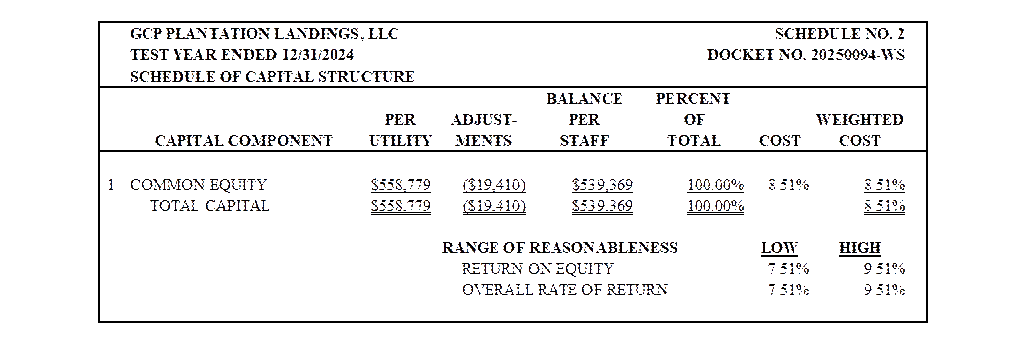
Recommendation:
The appropriate return on equity (ROE) is 8.51
percent with a range of 7.51 percent to 9.51 percent. The appropriate overall
rate of return is 8.51 percent. (Lenberg)
Staff Analysis:
The Utility’s capital structure consists of common
equity. The Utility’s capital structure has been reconciled to staff’s
recommended rate base. The ROE is 8.51 percent based on the Commission-approved
leverage formula currently in effect.[12]
Staff recommends an ROE of 8.51 percent with a range of 7.51 percent to 9.51
percent, and an overall rate of return of 8.51 percent. The ROE and overall
rate of return are shown on Schedule No. 2.
Issue 6:
What are the appropriate test year revenues for GCP
Plantation Landings, LLC’s water and wastewater systems?
Recommendation:
The appropriate test year operating revenues for GCP
Plantation Landing are $68,949 for the water system and $103,275 for the
wastewater system. (Chambliss)
Staff Analysis:
GCP recorded test year
revenues of $65,900 for water and $100,535 for wastewater. The Utility did not
record any miscellaneous revenues during the test year. Staff’s review of the
audit indicated that the Utility’s billing register consisted of several
inaccuracies for both the water and wastewater systems during the test year.
For water, the Utility billed an
incorrect base facility charge (BFC) of $5.74, rather than the
Commission-approved BFC of $5.72 for the 5/8-inch x 3/4-inch meter size, which
resulted in an overcharge of two cents per month. The Utility also improperly
billed a 6-inch meter size general service customer as a 5/8-inch x 3/4-inch
meter size residential customer. In addition, staff discovered that there was
one month of billing data missing for the general service customer. Finally,
for water, staff discovered that two months of bills were not recorded for some
of the residential customers. For wastewater, there were four residential
customers that were billed incorrect BFCs as well as duplicate bills for
several customers.
Staff removed the duplicate bills
and adjusted the billing data to reflect the appropriate billing determinants
for water and wastewater. To determine the appropriate service revenues, staff
applied the adjusted number of billing determinants to the Utility’s existing Commission-approved
rates. As a result, staff determined that service revenues for water should be
$68,949, which is an increase of $3,049 ($68,949 - $65,900), and $103,275 for
wastewater, which is an increase of $2,740 ($103,275 - $100,535).
Based on the above, staff recommends the appropriate test
year operating revenues for GCP’s water system are $68,949 and $103,275 for the
wastewater system.
Issue 7:
What are the appropriate amount of operating
expenses for GCP Plantation Landings, LLC?
Recommendation:
The appropriate amount of operating expenses are
$80,780 for water and $126,333 for wastewater. (Lenberg)
Staff Analysis:
The
Utility recorded operating expenses of $83,558 for water and $130,311 for
wastewater. The test year expenses have been reviewed by staff, including
invoices and other supporting documentation. Staff has made several adjustments
to the Utility’s operating expenses as described below.
Operation and Maintenance Expenses
Salaries
and Wages – Employees (601/701)
The Utility did
not record salaries and wages – employees expense for water or wastewater.
Audit staff increased this amount by $5,218 for water and wastewater to reflect
the appropriate salaries and wages expense, which included payroll taxes. Staff
decreased this amount by $343 for water and wastewater to reclassify payroll
taxes to Taxes Other Than Income. Therefore, staff recommends a salaries and wages
- employees expense of $4,875 for water and $4,875 for wastewater.
Sludge
Removal Expense (711)
The
Utility recorded sludge removal expense of $18,850. Staff made no adjustments
to this amount. Therefore, staff recommends a sludge removal expense of $18,850.
Fuel
for Power Production (616/716)
The Utility did not record fuel for
power production expense for water or wastewater. Audit staff increased each
amount by $256 to reclassify the Utility’s generator fuel expense that had been
incorrectly recorded in Accounts 650/750 – Transportation Expense. Therefore,
staff recommends a fuel for power production expense of $256 for water and $256
for wastewater.
Chemicals
(618/718)
The Utility recorded chemicals
expense of $12,443 for water and $27,330 for wastewater. Audit staff decreased
the water amount by $311 to remove an out-of-period expense. Audit staff
increased the wastewater amount by $499 to reclassify chemicals expense that
had been incorrectly recorded in Account 720 – Materials and Supplies. Staff
decreased this amount by $2,099 to reflect the 17.3 percent EUW discussed in
Issue 3. Therefore, staff recommends chemicals expense of $10,033 for water
and $27,829 for wastewater.
Materials
and Supplies (620/720)
The Utility recorded materials and
supplies expense of $240 for water and $1,799 for wastewater. Staff made no
adjustments to the water amount. Staff decreased the wastewater amount by $499
to reclassify chemicals expense that had been incorrectly recorded in Account
720 – Materials and Supplies. Therefore, staff recommends materials and
supplies expense of $240 for water and $1,300 for wastewater.
Contractual
Services – Billing (630/730)
The
Utility recorded contractual services – billing expense of $3,298 for water and
$3,298 for wastewater. Audit staff increased each amount by $204 to reflect
actual invoices provided by Utility. Therefore, staff recommends contractual
services – billing expense of $3,502 for water and $3,502 for wastewater.
Contractual
Services – Professional (631/731)
The
Utility recorded contractual services – professional expense of $29,725 for
water and $45,740 for wastewater. Audit staff decreased the water amount by
$7,263 to remove three out-of-period invoices and to reclassify expenses that
were incorrectly recorded in Account 635 – Contractual Services – Testing and
Account 636 – Contractual Services – Other. Staff also decreased the water
amount by $2,922 to reflect the amortization of non-recurring Environmental
Protection Agency – Related Regulatory costs over five years pursuant to Rule
25-30.433(9), F.A.C.
Audit
staff decreased the wastewater amount by $13,157 to remove unrecoverable legal
costs and overstated grounds keeping expenses. Staff further reduced wastewater
contractual services – professional expense by $11,700 to reclassify grounds keeping
costs that had been incorrectly recorded in Account 731–
Contractual Services – Professional.
Staff’s adjustments result in a net decrease of $10,185 for
water and $24,857 for wastewater. Therefore, staff recommends contractual
services – professional expense of $19,540 for water and $20,883 for
wastewater.
Contractual
Services – Accounting (632/732)
The Utility did not record
contractual services – accounting expense. The Utility requested recovery of a
pro forma accounting consulting expense to ensure compliance with the NARUC
Uniform System of Accounts. This pro forma expense is a non-recurring cost
estimated to be $5,000. Pursuant to Rule
25-30.433(9), F.A.C., staff amortized this amount over five years, resulting in
an increase to the test year expense of $500 for both water and wastewater.
Therefore, staff recommends contractual service – accounting expense of $500
for water and wastewater.
Contractual
Services – Testing (635)
The
Utility recorded contractual services – testing expense of $2,983. Audit staff
decreased this amount by $484 to remove items that were incorrectly recorded in
this account and to properly allocate general Utility service expenses.
Therefore, staff recommends contractual services – testing expense of $2,499.
Contractual
Services – Other (636/736)
The Utility recorded contractual
services – other expense of $7,150 for water and $7,103 for wastewater. Audit
staff decreased the water amount by $7,150 to reclassify expenses that had been
incorrectly recorded in this account and to remove out-of-period invoices.
Audit staff decreased the wastewater amount by $5,068 to reclassify expenses
that had been incorrectly recorded in this account. Technical staff increased
both the water and wastewater amount by $5,850 to reclassify and properly
allocate grounds keeping expenses that had been
incorrectly recorded in Account 731– Contractual Services –
Professional. Staff’s adjustments result in a net decrease of
$1,300 for water and a net increase of $782 for wastewater. Therefore,
staff recommends contractual services – other expense of $5,850 for water and
$7,885 for wastewater.
Transportation
Expense (650/750)
The
Utility recorded transportation expense of $256 for
water and $256 for wastewater. Audit staff reduced each amount by $256 to
reclassify expenses that had been incorrectly recorded in this account.
Therefore, staff recommends eliminating transportation expense for both water
and wastewater.
Rate Case
Expense (665/765)
The Utility did not record any rate case expense for the instant
docket. The Utility is required by Rule 25-22.0407, F.A.C., to mail
notices of the rate case overview, interim rates, final rates, and four-year
rate reduction. Staff calculated noticing costs to be $1,368.
Under
Section 367.0814(3), F.S., the Commission may award rate case expense for
attorney fees or fees of other outside consultants after the initial staff
report. On February 13, 2026, the Utility provided documentation to support
$5,090 in additional rate case expense including legal expenses and consulting
fees incurred to date and estimated through the end of the PAA process. Staff
reviewed the documentation and believes the Utility’s requested rate case
expense is reasonable.
Staff
calculated the distance from the Utility representative’s office in Orlando,
Florida, to Tallahassee as 261 miles. Based on the 2026 Internal Revenue
Service (IRS) business mileage rate of $0.725, staff calculated round trip
travel and lodging expense to the Commission Conference of $578.
However, because the same Utility representative will be attending the
Commission Conference on behalf of this and two sister utilities, staff
allocated only 33.3 percent of the total travel expense, or $193, to GCP
Plantation Landings, LLC. Additionally, the Utility paid a filing fee, of $750
for water and $750 for wastewater.
Staff
recommends a total rate case expense, consisting of noticing costs, travel,
lodging expenses and filing fee of $4,063 for water and $4,088 for wastewater,
which amortized over four years is $1,016 for water and $1,022 for wastewater.
Therefore, staff recommends total annual rate case expense of $1,016 for water
and $1,022 for wastewater.
Bad Debt
(670/770)
The
Utility did not record any bad debt for water or wastewater. In its three most
recent Annual Reports (2022, 2023, 2024), the Utility reported bad debt
expenses of $0 in all three years. In response to staff’s third data request,
the Utility confirmed that this reporting is accurate and reflects its accounting
records.[14]
The Utility has not recorded bad debt expense in the test year or in recent
historical periods, thus, staff recommends a bad debt expense of zero
for both water and wastewater.
Miscellaneous
Expenses (675/775)
The
Utility recorded miscellaneous expenses of $135 for water and $0 for
wastewater. Audit staff increased both the water and wastewater amount by $60
to reclassify expenses that had been incorrectly recorded in Account 636 –
Contractual Services – Other. Therefore, staff recommends miscellaneous
expenses of $195 for water and $60 for wastewater.
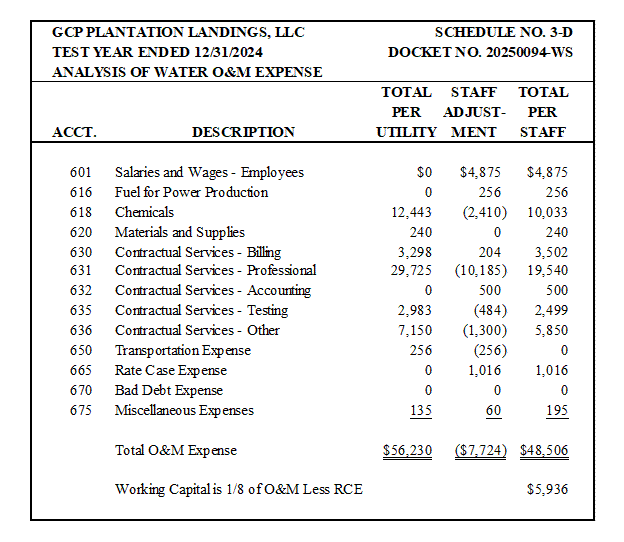
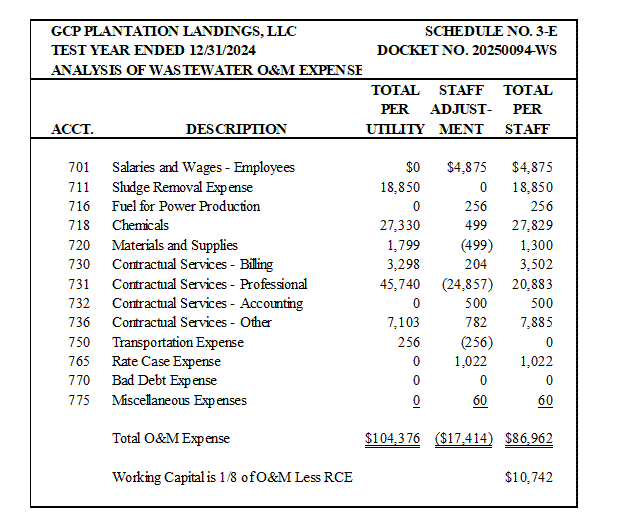
Operation and Maintenance Expense
Summary
The Utility
recorded test year O&M expense of $56,230 for water and $104,376 for
wastewater. Based on the above adjustments, staff recommends that O&M
expenses be decreased by $7,724 and $17,414 for water and wastewater,
respectively. This results in a total O&M expense of $48,506 for water and
$86,962 for wastewater. Staff’s recommended adjustments to O&M are shown on
Schedule No. 3-D and Schedule No. 3-E, respectively.
Depreciation
Expense
The Utility recorded depreciation
expense of $24,362 for water and $21,411 for wastewater. Audit staff increased
this amount by $1,036 for water and increased this amount by $7,876 for
wastewater to reflect corrections to UPIS and the application of the
appropriate depreciation rates pursuant to Rule 25-30.140, F.A.C. Additionally,
staff decreased this amount by $2,738 for water and $33 for wastewater to
reflect the appropriate retirements to UPIS and accumulated depreciation and to
reflect net salvage associated with Accounts 341 and 391. These adjustments
result in a net decrease of $1,702 for water and a net increase of $7,843 for
wastewater. Therefore, staff recommends depreciation expense of $22,660 for water
and $29,254 for wastewater.
Capital Amortization
As
discussed in Issue 4, staff recommends a capital recovery schedule of $26,881
for water and $5,557 for wastewater over a seven-year amortization period. The
corresponding annual amortization expense is $3,840 for water and $794 for
wastewater.
Taxes Other Than Income (TOTI)
The Utility
recorded TOTI of $2,966 for water and $4,524 for wastewater. Audit staff
increased this amount by $562 for water and $2,383 for wastewater to reflect
2024 property tax assessments and audit adjusted revenue regulatory assessment
fees (RAFs). Technical staff further increased property taxes by $59 for water
and $139 for wastewater to reflect the updated acreage allocation of 0.178
percent for water and 0.434 percent for wastewater. The adjustment is based on
an updated total acreage of 192.96, as reported on the Polk County Property
Appraiser’s website, rather than the 214.52 acres used in the Audit.
Staff also
increased both water and wastewater TOTI by $343 to reclassify payroll tax
expense that had been incorrectly recorded in Accounts 631/731 – Salaries and
Wages – Employees.
Based
on revenues discussed in Issue 6, TOTI should be increased by $84 for water and
$60 to reflect a RAF rate of 4.5 percent applied to staff-adjusted revenues. As
such, staff recommends the appropriate amount of RAFs are $3,103 for water and
$4,647 for wastewater.
As discussed
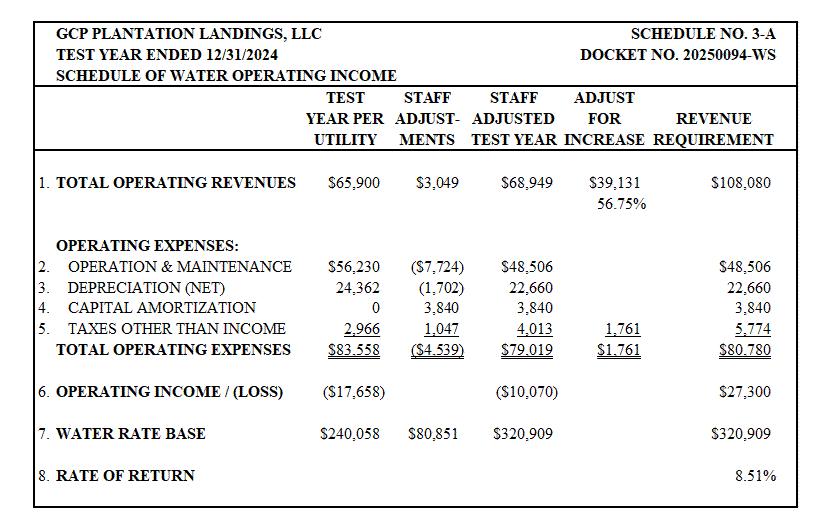
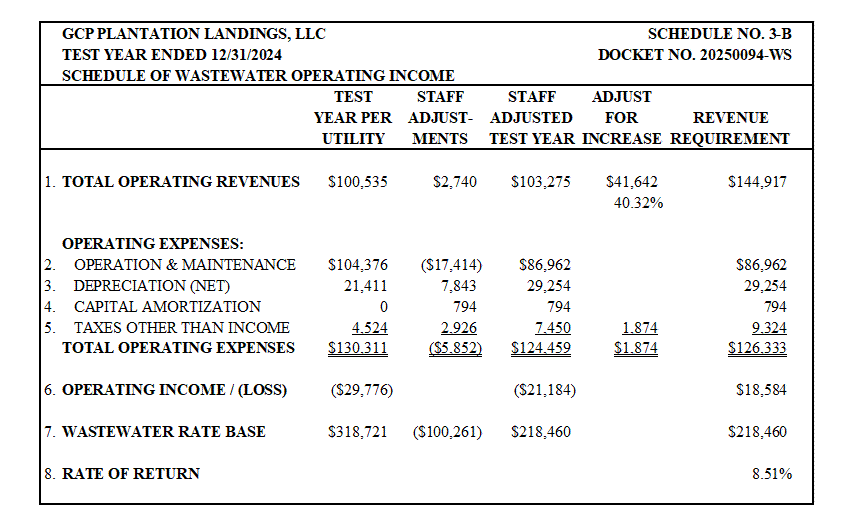
in Issue 9, staff recommends revenues be increased by $39,131 for water and
$41,642 for wastewater in order to reflect the change in revenue required to
cover expenses and allow an opportunity to earn the recommended operating
margin. As a result, TOTI should be increased by $1,761 for water and $1,874
for wastewater to reflect RAFs of 4.5 percent of the change in revenues.
Staff’s adjustments result in a net increase of $2,808 for water and $4,799 for
wastewater. Therefore, staff recommends TOTI of $5,774 for water and $9,324 for
wastewater.
Operating Expense Summary
The Utility recorded operating expenses of $83,558 for water
and $130,311 for wastewater. Staff’s net adjustments result in a decrease of
$2,778 for water and $3,978 for wastewater. The application of staff’s
recommended adjustments to the Utility’s recommended operating expense results
in a total operating expense of $80,780 for water and $126,333 for wastewater.
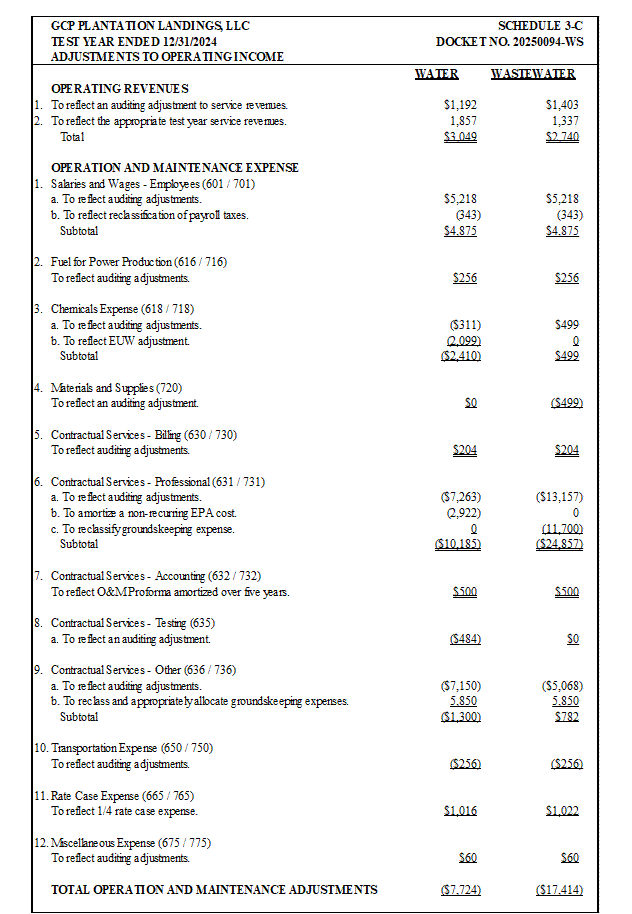
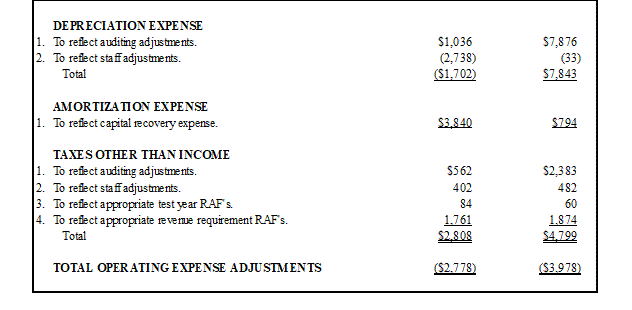
Operating expenses are shown on Schedule Nos. 3-A and 3-B, and the related
adjustments are shown on Schedule No. 3-C.
Issue 8:
Does GCP Plantation Landings, LLC meet the criteria
for application of the operating ratio methodology?
Recommendation:
No, GCP does not meet the requirement for
application of the operating ratio methodology for calculating the revenue
requirement. (Lenberg)
Staff Analysis:
Rule
25-30.4575(2), F.A.C., indicates that in rate cases processed under Rule
25-30.455, F.A.C., the Commission will use the operating ratio methodology to
establish the Utility’s revenue requirement when its rate base is not greater
than 125 percent of O&M expenses, less regulatory commission expense and
purchased wastewater treatment expense (where applicable), and the use of the
operating ratio methodology does not change the Utility’s qualification for a
SARC.
With respect to GCP, staff has recommended a rate base of
$320,909 for water and $218,460 for wastewater. After removal of rate case
expense, staff has calculated an adjusted O&M expense of $47,490 for water
and $85,940 for wastewater. Based on staff’s preliminary recommended amounts,
the Utility’s water rate base is 675.74 percent of its adjusted O&M expense
and wastewater rate base is 254.20 percent of its adjusted O&M expense.
Based on this, the Utility does not qualify for application of the operating
ratio methodology.
Issue 9:
What is the appropriate revenue requirement for GCP
Plantation Landings, LLC?
Recommendation:
The appropriate revenue requirement is $108,080 for
water and $144,917 for wastewater, resulting in an annual increase of $39,131 (56.75
percent) for water and $41,642 (40.32 percent) for wastewater. (Lenberg)
Staff Analysis:
GCP
should be allowed an annual increase of $39,131 (56.75 percent) for water and
$41,642 (40.32 percent) for wastewater. This should allow the Utility the
opportunity to recover its expenses and earn an 8.51 percent rate of return for
water and wastewater. The calculations of the revenue requirement are shown on
Table 9-1 and Table 9-2.[15]
Table
9-1
Water Revenue Requirement
|
Water Rate Base
|
$320,909
|
|
Rate of Return
|
× 8.51%
|
|
Return on Rate Base
|
$27,300
|
|
Water O&M Expense
|
48,506
|
|
Depreciation Expense
|
22,660
|
|
Amortization Expense
|
3,840
|
|
Taxes Other Than Income
|
5,774
|
|
Revenue Requirement
|
$108,080
|
|
Less Test Year Revenues
|
$68,949
|
|
Annual Increase
|
$39,131
|
|
Percent Increase
|
56.75%
|
Source: Staff calculations.
Table
9-2
Wastewater Revenue Requirement
|
Wastewater Rate Base
|
$218,460
|
|
Rate of Return
|
× 8.51%
|
|
Return on Rate Base
|
$18,584
|
|
Water O&M Expense
|
86,962
|
|
Depreciation Expense
|
29,254
|
|
Amortization Expense
|
794
|
|
Taxes Other Than Income
|
9,324
|
|
Revenue Requirement
|
$144,917
|
|
Less Test Year Revenues
|
$103,275
|
|
Annual Increase
|
$41,642
|
|
Percent Increase
|
40.32%
|
Source: Staff calculations.
Issue 10:
What are the appropriate water and wastewater rate
structures and rates for GCP Plantation Landings, LLC?
Recommendation:
The recommended rate structures and monthly water and
wastewater rates are shown on Schedule Nos. 4-A and 4-B. The Utility’s proposal
to include a repression adjustment for wastewater should be denied. The Utility
should file revised tariff sheets and a proposed customer notice to reflect the
Commission-approved rates. The approved rates should be effective for service
rendered on or after the stamped approval date on the tariff sheets pursuant to
Rule 25-30.475(1), F.A.C. In addition, the approved rates should not be
implemented until staff has approved the proposed customer notice and the
notice has been received by the customers. The Utility should provide proof of
the date notice was given by affidavit within 10 days of the date of the notice.
(Chambliss)
Staff Analysis:
Water Rates
GCP provides water service to 388
residential customers and one general service customer. A review of the billing
data indicated that 12 percent of the residential customer bills during the
test year had zero gallons, which reflects a non-seasonal customer base. The
average residential water demand was 3,700 gallons per month during the test
year. Currently, the rate structure for the residential and general services
classes consists of a BFC and a uniform gallonage charge.
Staff performed an analysis of
the Utility’s billing in order to evaluate the appropriate rate structure for
the residential water customers. The goal of the evaluation was to select the
rate design parameters that: (1) produce the recommended revenue requirement;
(2) equitably distribute cost recovery among the Utility’s customers; (3)
establish the appropriate discretionary usage threshold for restricting
repression; and (4) implement, where appropriate, water conserving rate
structures consistent with Commission practice.
Due to the Utility’s non-seasonal
customer base, staff recommends that 35 percent of the water revenues be
generated from the BFC, which will provide sufficient revenues to design
gallonage charges that will send the appropriate pricing signals to customers
using above the non-discretionary level. The average number of people per
household is 2.60;
therefore, based on the number of people per household, 50 gallons per day, per
person, and the number of days per month, the discretionary usage threshold
should be 4,000 gallons per month. Staff’s review of the billing data indicates
that discretionary usage above 4,000 gallons represents approximately 26
percent of the bills, which accounts for approximately 43 percent of water
demand. This indicates that there are some customers with high discretionary
usage above 4,000 gallons.
Staff recommends a three-tier inclining block rate structure, which includes
separate gallonage charges for non-discretionary and discretionary usage for
residential water rates. Due to the high usage above 4,000 gallons per month,
staff believes that it is appropriate in this case to recommend rate factors of
1.50 in the second tier and 1.75 in the third tier because it will target those
customers with higher levels of consumption. General service customers should
continue to be billed a BFC and uniform gallonage charge.
Based on staff’s recommended
revenue increase of 56.8 percent, which excludes miscellaneous revenues, the
residential consumption can be expected to decline by 2,779,000 gallons
resulting in an anticipated average residential demand of 3,105 gallons per
month. Staff recommends a 16.1 percent reduction in test year residential
gallons for rate setting purposes. As a result, the corresponding
reduction for chemicals expense is $1,458 and $69 for RAFs to reflect the
anticipated repression, which results in a post repression revenue requirement
of $106,553.
Wastewater Rates
As for
wastewater, the Utility provides service to approximately 388 residential
customers and one general service customer. Currently, the Utility’s
residential rate structure consists of a uniform BFC for all meter sizes and a
gallonage charge with a 6,000 gallon cap. The general service rate structure
consists of a BFC charge per meter size and a gallonage charge that is 1.2
times higher than the residential gallonage charge.
Staff performed an analysis of
the Utility’s billing data in order to evaluate various BFC cost recovery
percentages and gallonage caps for the residential wastewater customers. The
goal of the evaluation was to select the rate design parameters that: 1)
produce the recommended revenue requirement; 2) equitably distribute cost
recovery among the Utility’s customers; and 3) implement a gallonage cap, where
appropriate, that considers approximately the amount of water that may return
to the wastewater system.
Consistent with Commission
practice, staff allocated 50 percent of the wastewater revenue to the BFC due
to the capital intensive nature of wastewater plants. Currently, the Utility’s
residential wastewater gallonage cap is set at 6,000 gallons. The wastewater
gallonage cap recognizes that not all water used by the residential customers
is returned to the wastewater system. However, it is Commission practice to set
the wastewater cap at approximately 80 percent of residential water sold, which
typically results in gallonage caps of 6,000, 8,000, or 10,000. Based on
staff’s review of the billing analysis, 68 percent of the gallons are captured
at the 6,000 gallon consumption level, which should be changed because the
wastewater gallonage cap is not consistent with Commission practice. According
to the billing data, approximately 80 percent of the gallons are captured at
10,000 gallons. Therefore, staff recommends that the residential wastewater cap
be set at 10,000 gallons. Staff recommends that the general service gallonage
charge continue to be 1.2 times greater than the residential charge, which is
consistent with Commission practice.
Furthermore, in its application,
the Utility requested a repression adjustment for wastewater. It is Commission
practice to calculate increases in the price of water as the catalyst for
whether or not there is a repression adjustment which would ultimately flow
through to wastewater. Staff recommended a reduction in water gallons to
determine the appropriate wastewater repression adjustment. This resulted in a
wastewater repression adjustment of 4.58 percent, which is de minimis.
Therefore, no repression adjustment for wastewater is necessary in this case.
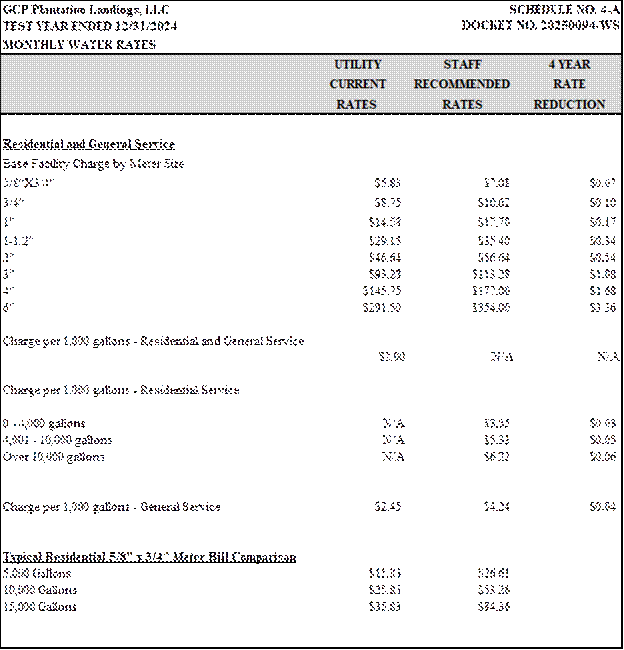
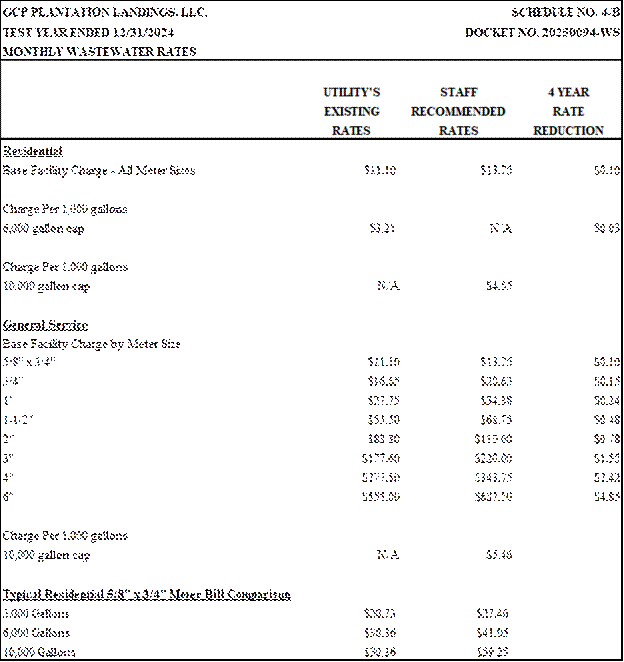
Based on the above, staff’s recommended rate structures
and monthly water and wastewater rates are shown on Schedule Nos. 4-A and 4-B. The
Utility’s proposal to include a repression adjustment for wastewater should be
denied. The Utility should file revised tariff sheets and a proposed customer
notice to reflect the Commission-approved rates. The approved rates should be
effective for service rendered on or after the stamped approval date on the
tariff sheets pursuant to Rule 25-30.475(1), F.A.C. In addition, the approved
rates should not be implemented until staff has approved the proposed customer
notice and the notice has been received by the customers. The Utility should
provide proof of the date notice was given by affidavit within 10 days of the
date of the notice.
Issue 11:
What is the appropriate amount by which rates should
be reduce four years after the published effective date to reflect the removal
of the amortized rate case expense?
Recommendation:
The rates should be reduced as shown on Schedule Nos.
4-A and 4-B, to remove rate case expense grossed-up for RAFs and amortized over
a four-year period. Pursuant to Section 367.081(8), F.S., the decrease in rates
should become effective immediately following the expiration of the rate case
expense recovery period. GCP should be required to file revised tariffs and a
proposed customer notice setting forth the lower rates and rationale no later
than one month prior to the effective date of the new rates. If the Utility
files revised tariffs reflecting this reduction in conjunction with a price
index or pass-through rate adjustment, separate data should be filed for the
price index and or pass-through increase and the reduction in the rates due to
the amortized rate case expense. (Lenberg, Chambliss)
Staff Analysis:
Section 367.081(8), F.S.,
requires that the rates be reduced by the amount of the rate case expense
previously included in rates immediately following the expiration of the
recovery period. The reduction will reflect the removal of revenue associated
with the amortization of rate case expense and the gross-up for RAFs. The total
reduction is $1,064 for water and $1,070 for wastewater.
Staff recommends that the rates should be reduced as shown
on Schedule Nos. 4-A and 4-B, to remove rate case expense grossed-up for RAFs
and amortized over a four-year period. Pursuant to Section 367.081(8), F.S.,
the decrease in rates should become effective immediately following the
expiration of the rate case expense recovery period. GCP should be required to
file revised tariffs and a proposed customer notice setting forth the lower
rates and rationale no later than one month prior to the effective date of the
new rates. If the Utility files revised tariffs reflecting this reduction in
conjunction with a price index, or pass-through rate adjustment, separate data
should be filed for the price index and/or pass-through increase and the
reduction in the rates due to the amortized rate case expense.
Issue 12:
Should the recommended rates be approved for GCP
Plantation Landings, LLC on a temporary basis, subject to refund with interest,
in the event of a protest filed by a party other than the Utility?
Recommendation:
Yes.
Pursuant to Section 367.0814(7), F.S., the recommended rates should be approved
for the Utility on a temporary basis, subject to refund with interest, in the
event of a protest filed by a party other than the Utility. GCP should file
revised tariff sheets and a proposed customer notice reflecting the
Commission-approved rates. The approved rates should be effective for services
rendered on or after the stamped approval date on the tariff sheet, pursuant to
Rule 25-30.475(1), F.A.C. In addition, the temporary rates should not be
implemented until staff has approved the proposed notice, and the notice has
been received by the customers. Further, prior to implementing any temporary
rates, the Utility should provide appropriate financial security.
If the recommended rates are approved on a temporary
basis, the rates collected by the Utility should be subject to the refund
provisions discussed below in the staff analysis. In addition, after the
increased rates are in effect, pursuant to Rule 25-30.360(6), F.A.C., the
Utility should file reports with the Commission’s Office of Commission Clerk no
later than the 20th of each month, indicating both the current monthly and
total amount subject to refund at the end of the preceding month. The report
filed should also indicate the status of the security being used to guarantee
repayment of any potential refund. (Lenberg)
Staff Analysis:
This
recommendation proposes an increase in rates. A timely protest might delay a
rate increase resulting in an unrecoverable loss of revenue to the Utility.
Therefore, pursuant to Section 367.0814(7), F.S., in the event of a protest
filed by a party other than the Utility, staff recommends that the proposed
rates be approved on a temporary basis. GCP should file revised tariff sheets
and a proposed customer notice reflecting the Commission-approved rates. The
approved rates should be effective for service rendered on or after the stamped
approval date on the tariff sheet, pursuant to Rule 25-30.475(1), F.A.C. In
addition, the temporary rates should not be implemented until staff has
approved the proposed notice, and it has been received by the customers. The
additional revenue produced by staff’s recommended rates and collected by the
Utility should be subject to the refund provisions discussed below.
GCP should
be authorized to initiate the temporary rates upon staff’s approval of an
appropriate security for the potential refund and cost of the proposed customer
notice. Security should be in the form of either a bond or letter of credit in
the amount of $26,720 for water and $28,435 for wastewater. Alternatively, the
Utility may establish an escrow agreement with an independent financial
institution.
If the
Utility chooses a bond for securing the potential refund, the bond should
contain wording to the effect that it will be terminated only under the
following conditions:
1. The Commission approves the rate
increase; or,
2. If the Commission denies the increase,
the Utility shall refund the amount collected that is attributable to the
increase.
If the
Utility chooses a letter of credit for securing the potential refund, the
letter of credit should contain the following conditions:
1. The letter of credit is irrevocable for
the period it is in effect.
2. The letter of credit will be in effect
until a final Commission order is rendered, either approving or denying the
rate increase.
If security
is provided through an escrow agreement, the following conditions should be
part of the agreement:
1. The Commission Clerk, or his or her
designee, must be a signatory to the escrow agreement.
2. No monies in the escrow account may be
withdrawn by the Utility without the prior written authorization of the
Commission Clerk, or his or her designee.
3. The escrow account shall be an interest
bearing account.
4. If a refund to the customers is
required, all interest earned by the escrow account shall be distributed to the
customers.
5. If a refund to the customers is not
required, the interest earned by the escrow account shall revert to the
Utility.
6. All information on the escrow account
shall be available from the holder of the escrow account to a Commission
representative at all times.
7. The amount of revenue subject to refund
shall be deposited in the escrow account within seven days of receipt.
8. This escrow account is established by
the direction of the Florida Public Service Commission for the purpose(s) set
forth in its order requiring such account. Pursuant to Cosentino v. Elson, 263
So. 2d 253 (Fla. 3d DCA 1972), escrow accounts are not subject to garnishments.
9. The account must specify by whom and on
whose behalf such monies were paid.
In no
instance should the maintenance and administrative costs associated with the
refund be borne by the customers. These costs are the responsibility of, and
should be borne by, the Utility. Irrespective of the form of security chosen by
the Utility, an account of all monies received as a result of the rate increase
should be maintained by the Utility. If a refund is ultimately required, it
should be paid with interest calculated pursuant to Rule 25-30.360(4), F.A.C.
The Utility should maintain a record of the amount of the
bond, and the amount of revenues that are subject to refund. In addition, after
the increased rates are in effect, pursuant to Rule 25-30.360(6), F.A.C., the
Utility should file reports with the Commission Clerk’s office no later than
the 20th of every month indicating the monthly and total amount of money
subject to refund at the end of the preceding month. The report filed should
also indicate the status of the security being used to guarantee repayment of
any potential refund.
Issue 13:
Should GCP Plantation Landings, LLC be required to
notify the Commission within 90 days of an effective order finalizing this
docket, that it has adjusted its books for all the applicable NARUC USOA?
Recommendation:
Yes. GCP should be required to notify the
Commission, in writing, that it has adjusted its books in accordance with the
Commission’s decision. The Utility should submit a letter within 90 days of the
Commission’s final order in this docket, confirming that the adjustments to all
applicable NARUC USOA primary accounts have been made to the Utility’s books
and records. In the event the Utility needs additional time to complete the adjustments,
a notice providing good cause should be filed not less than seven days prior to
the deadline requesting an extension. Upon providing a notice of good cause,
staff should be given administrative authority to grant an extension of up to
60 days. (Lenberg)
Staff Analysis:
GCP should be required to notify the Commission, in
writing, that it has adjusted its books in accordance with the Commission’s
decision. The Utility should submit a letter within 90 days of the Commission’s
final order in this docket, confirming that the adjustments to all applicable
NARUC USOA primary accounts have been made to the Utility’s books and records.
In the event the Utility needs additional time to complete the adjustments, a
notice providing good cause should be filed not less than seven days prior to
the deadline requesting an extension. Upon providing a notice of good cause,
staff should be given administrative authority to grant an extension of up to
60 days.
Issue 14:
Should this docket be closed?
Recommendation:
No. If no person whose substantial interests are
affected by the proposed agency action files a protest within 21 days of the
issuance of the order, a consummating order should be issued. The docket should
remain open for staff’s verification that the revised tariff sheets and
customer notice have been filed by the Utility and approved by staff.
(Sapoznikoff)
Staff Analysis:
No. If no person whose substantial
interests are affected by the proposed agency action files a protest within 21
days of the issuance of the order, a consummating order should be issued. The
docket should remain open for staff’s verification that the revised tariff
sheets and customer notice have been filed by the Utility and approved by staff.