|
State of Florida

|
Public Service Commission
Capital Circle Office Center ● 2540 Shumard
Oak Boulevard
Tallahassee, Florida 32399-0850
-M-E-M-O-R-A-N-D-U-M-
|
|
DATE:
|
June 24, 2026
|
|
TO:
|
Office of Commission Clerk (Teitzman)
|
|
FROM:
|
Office of the General Counsel (Sapoznikoff)
SMC
Division of Accounting
and Finance (Vogel) MC
Division of Economics
(Guffey) EJD
|
|
RE:
|
Docket No. 20260036-OT – Proposed amendment
of Rules 25-6.109, Refunds; 25-6.0435, Interim Rate Relief; 25-7.040, Interim
Rate Relief; 25-7.091, Refunds; 25-30.117, Accounting for Pension Costs; and
25-30.360, Refunds, F.A.C.
|
|
AGENDA:
|
07/07/26 – Regular Agenda – Rule Proposal – Interested Persons May
Participate
|
|
COMMISSIONERS ASSIGNED:
|
All Commissioners
|
|
PREHEARING OFFICER:
|
Ortega
|
|
CRITICAL DATES:
|
09/21/26 (Rule must be proposed by this date pursuant to
Section 120.54(2)(a)2., F.S.)
|
|
RULE STATUS:
|
Proposal May Be Deferred
|
|
SPECIAL INSTRUCTIONS:
|
None
|
|
|
|
|
Case Background
In 2025, the Legislature amended Chapter
120, Florida Statutes, to require each agency to review all of its rules over a
five-year period. This recommendation addresses the following rules that were
identified in the Commission’s rule review as part of the rules needing
amendment:
·
Rule 25-6.0435, F.A.C. Interim Rate Relief
·
Rule 25-6.109, F.A.C., Refunds
·
Rule 25-7.040, F.A.C. Interim Rate Relief
·
Rule 25-7.091, F.A.C. Refunds
·
Rule 25-30.117, F.A.C. Accounting for Pension
Costs
·
Rule 25-30.360, F.A.C., Refunds
These rules pertain to accounting
guidelines.
The Commission’s
Notices of Development of Rulemaking were published in Volume 52, Number 57, of
the Florida Administrative Register on March 24, 2026. OPC requested a workshop
regarding Rule 25-30.117, F.A.C. However, OPC later submitted written comments
in lieu of holding a workshop, which comments are incorporated in the draft
amendments for that rule.
This recommendation addresses whether the
Commission should propose the amendment of Rules 25-6.0435, 25-6.109, 25-7.040,
25-7.091, 25-30.117, and 25-30.360, F.A.C. The Commission has jurisdiction
pursuant to Section 120.54, 350.127(2), 366.05(1), 366.071, and 367.121,
Florida Statutes.
Discussion
of Issues
Issue 1:
Should the Commission propose the amendment of Rules
25-6.0435, 25-6.109, 25-7.040, 25-7.091, 25-30.117, and 25-30.360, F.A.C.?
Recommendation:
Yes. The Commission should propose the amendment of
Rules 25-6.0435, 25-6.109, 25-7.040, 25-7.091, 25-30.117, and 25-30.360,
F.A.C., as set forth in Attachment A. The Commission should also certify
the rules as minor violation rules. (Sapoznikoff, Hampson, Vogel, Guffey)
Staff Analysis:
The purpose of this rulemaking is to amend Rules 25-6.0435,
25-6.109, 25-7.040, 25-7.091, 25-30.117, and 25-30.360, F.A.C., to update and
clarify the rules to reflect current practice and use. Staff is recommending
minor amendments to all the rules to update the rule language to make them more
readable. In addition, staff’s recommended amendments remove obsolete
references and update the rules to reflect current, widely-accepted accounting
guidelines. Staff recommends the Commission propose the amendment of these
rules, as set forth in Attachment A.
The recommended amendments to Rules 25-6.0435, 25-6.109,
25-7.040, 25-7.091, and 25-30.360, F.A.C., reflect use of the AA non-financial
30-day commercial paper rate published by the Board of Governors of the Federal
Reserve System, rather than the rate for high-grade, unsecured note as
published in the Wall Street Journal. The Wall Street Journal has not reliably
published the 30-day AA non-financial commercial paper rate since September
2011. The Board of Governors of the Federal Reserve System publishes the 30-day
AA non-financial commercial paper rate every business day (if there is
sufficient trading data) and is more reliable. Additionally, in Rule 25-7.040, staff
recommends amending the way the equations are displayed to make them be more
readable.
In Rule 23-30.117, F.A.C., staff recommends use of the Accounting
Standards Codification 715 (ASC 715), rather than the Statement of Financial
Accounting Standards No. 87, Employers’ Accounting for Pensions (SFAS 87). The
Accounting Standards Codification (ASC) supersedes the Statement of Financial
Accounting Standards as the centralized source of U.S. Generally Accepted
Accounting Principles (U.S. GAAP), all updates to standards are now made to the
ASC. At OPC’s request, the rule language was clarified to mention specific
updates that were already part of the ASC.
Minor Violation Rule Certification
Pursuant to
Section 120.695, F.S., for each rule filed for adoption, the agency head shall
certify whether any part of a rule is designated as a rule the violation of
which would be a minor violation. Under Section 120.695(2)(b), F.S., a
violation of a rule is minor if it does not result in economic or physical harm
to a person or adversely affect the public health, safety, or welfare or create
a significant threat of such harm. Rules 25-6.0435, 25-6.109, 25-7.040,
25-7.091, 25-30.117, and 25-30.360, F.A.C., are all currently listed as minor
violation rules, and staff recommends that all should remain listed as minor
violation rules by the Commission. These rules are minor violation rules
because the violation of any of them would not result in economic or physical
harm to a person, cause an adverse effect on the public health, safety, or
welfare, or create a significant threat of such harm. Therefore, for the
purposes of filing the rules for adoption with the Department of State, staff
recommends that the Commission certify the above-mentioned rules as minor
violation rules.
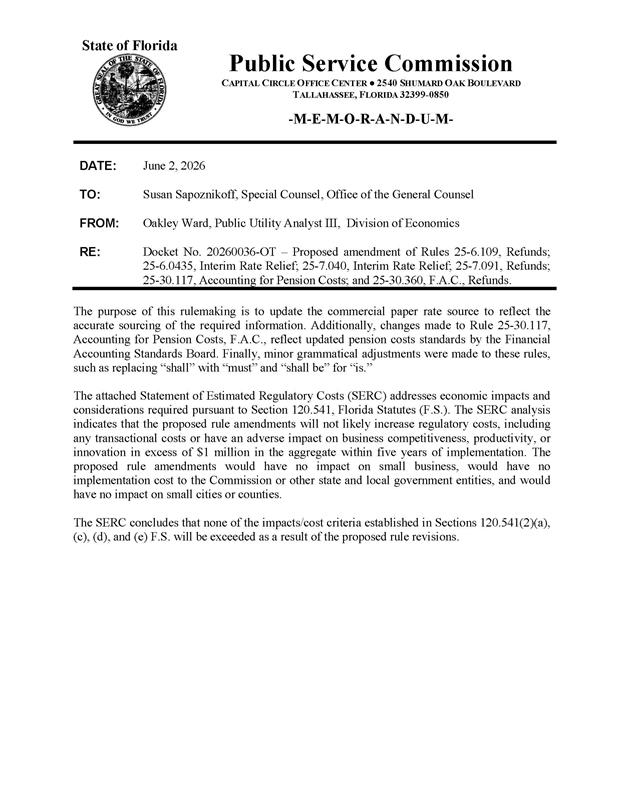
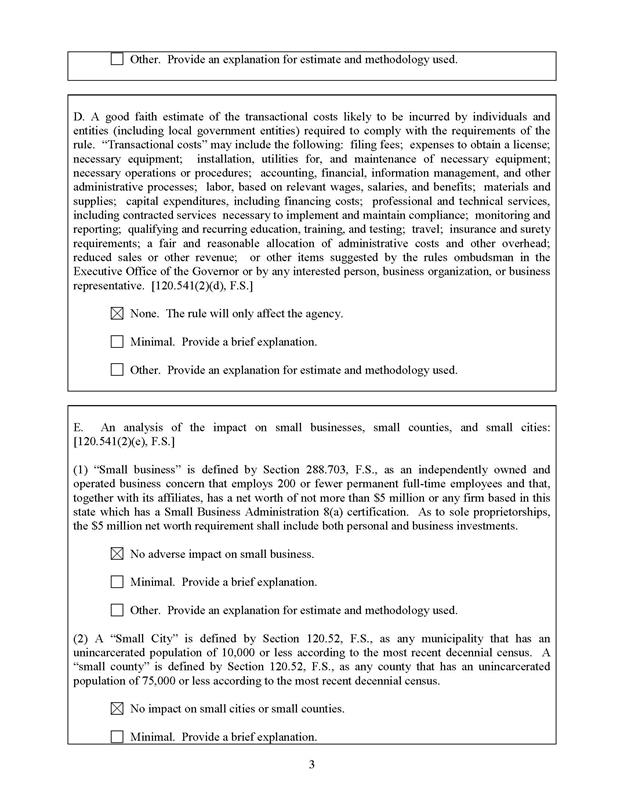
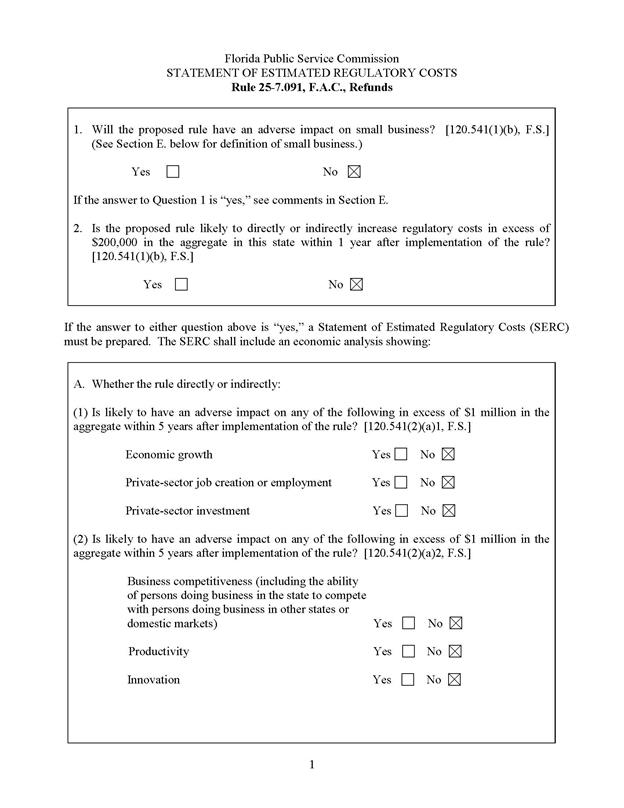
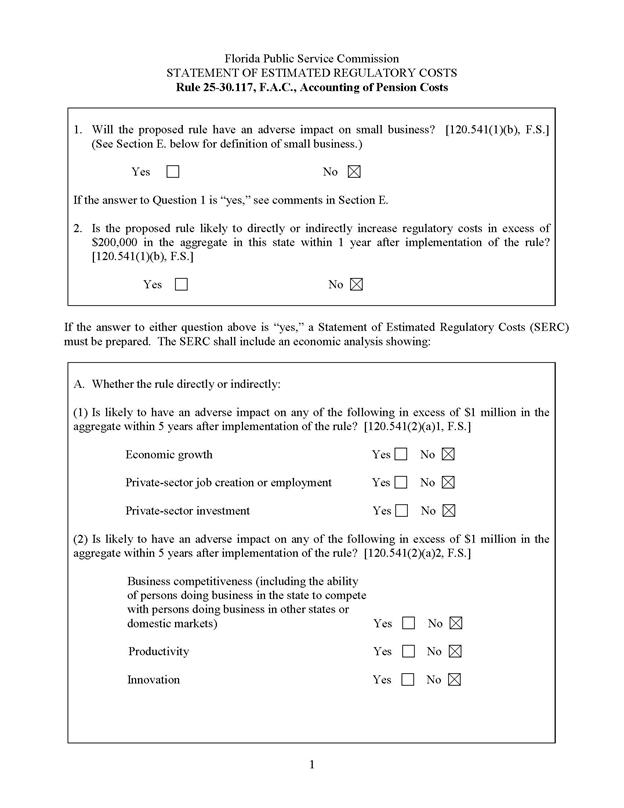
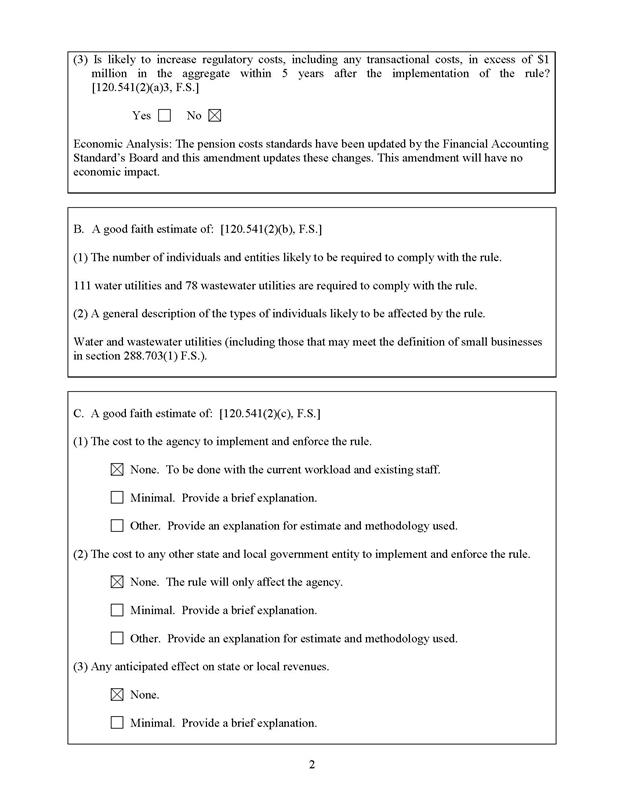
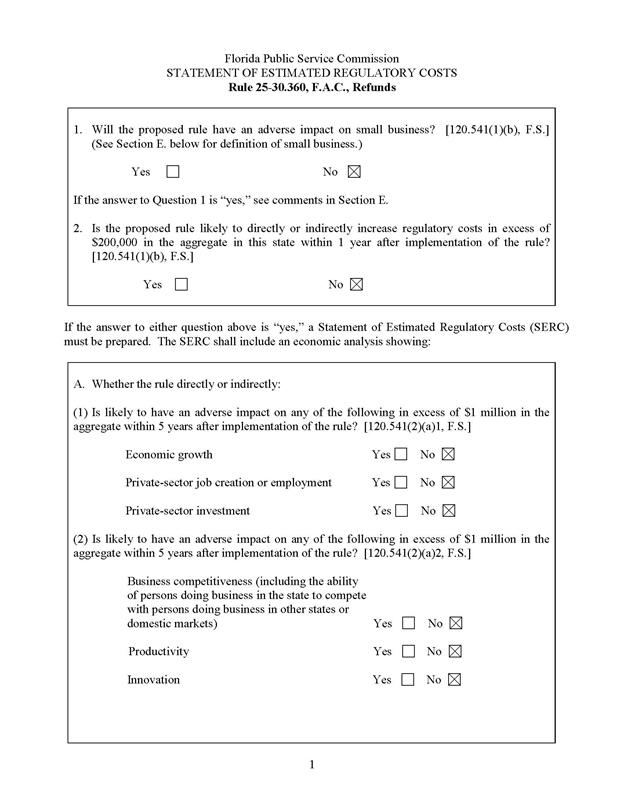
Statement of Estimated Regulatory Costs
Section
120.54(3)(b)1., F.S., encourages agencies to prepare a Statement of Estimated
Regulatory Costs (SERC) before the adoption, amendment, or repeal of any rule.
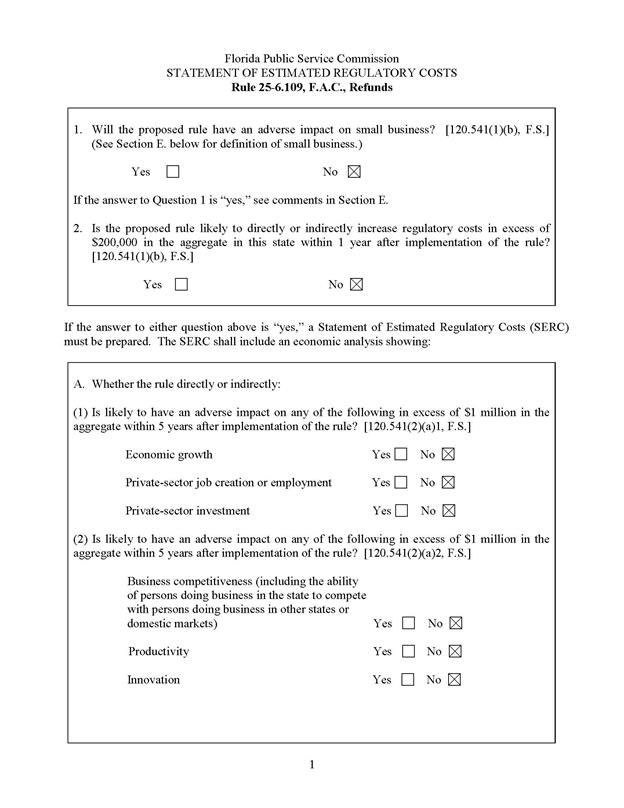
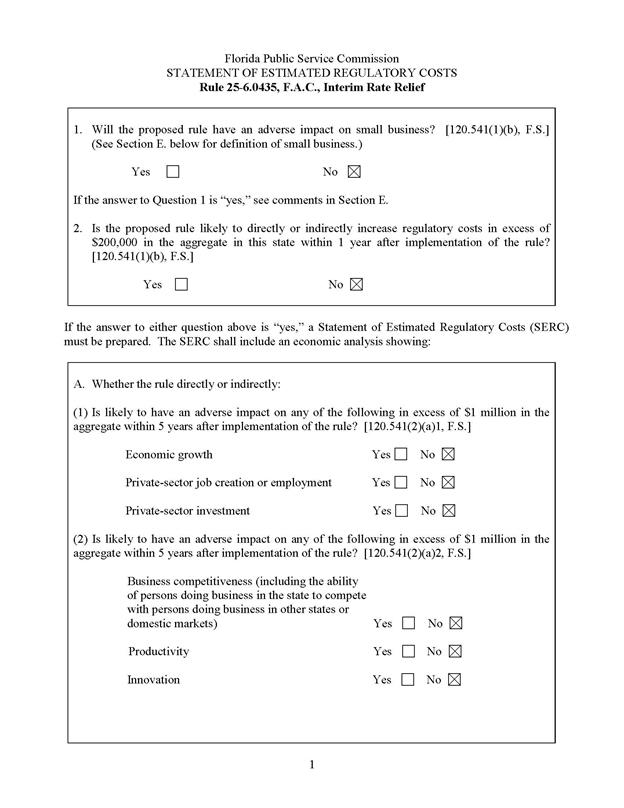
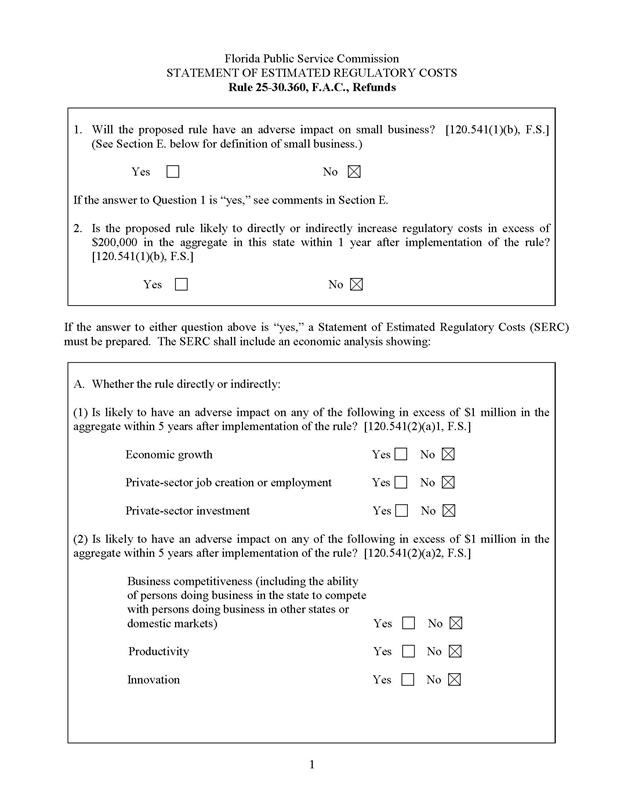
A SERC was prepared for each rule in this rulemaking and they are appended as
Attachment B. As required by Section 120.541(2)(a)1., F.S., the SERC analysis
includes whether the rule amendments are individually likely to have an adverse
impact on economic growth, private sector job creation or employment, or
private sector investment in excess of $1 million in the aggregate within five
years after implementation.
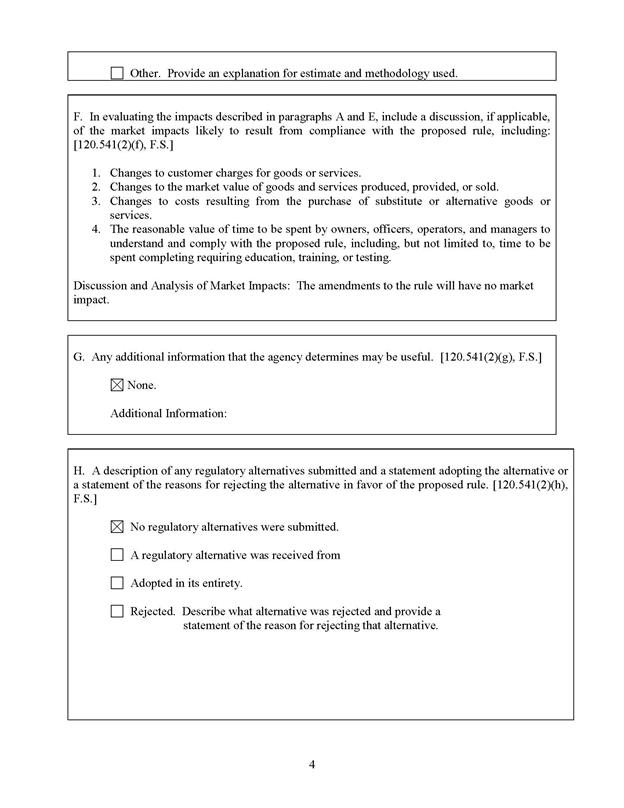
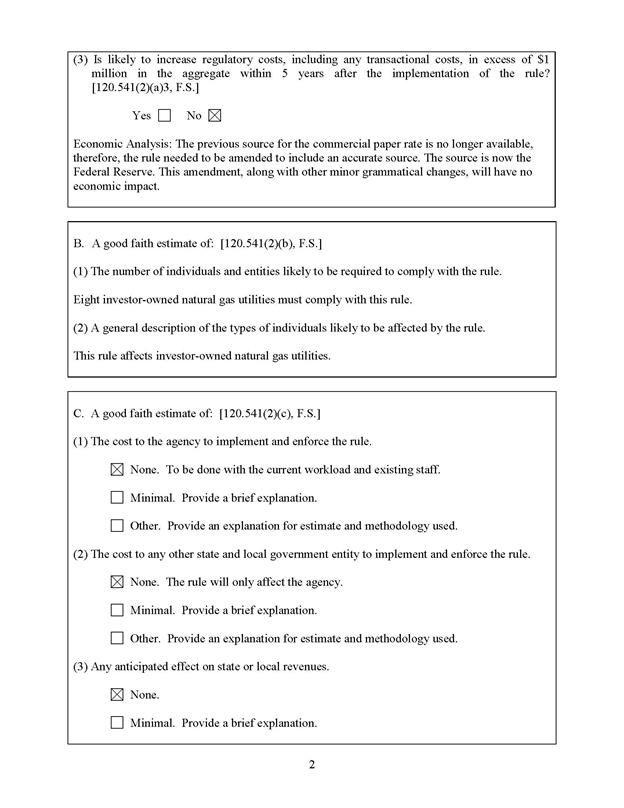
The SERCs
conclude that the amendments of any of the rules will not likely directly or
indirectly increase regulatory costs in excess of $200,000 in the aggregate in
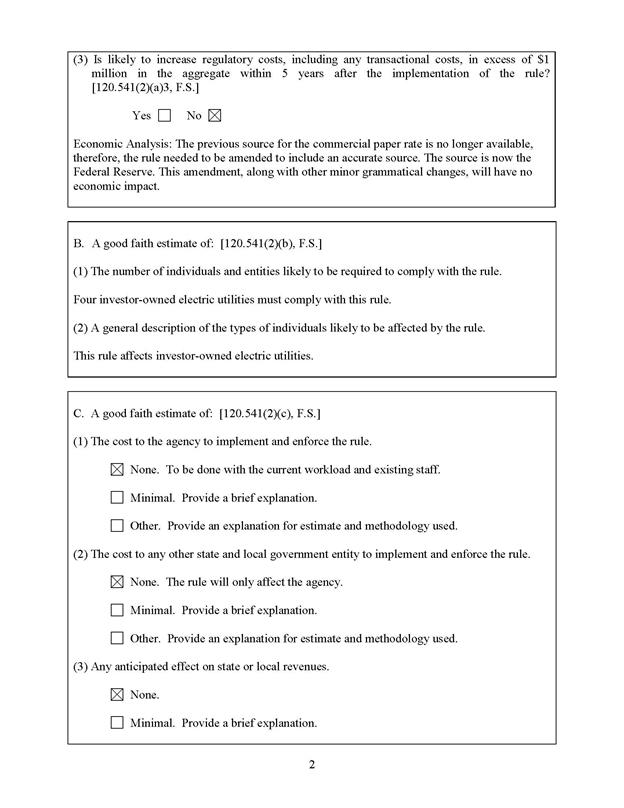
Florida within one year after implementation. Further, the SERCs conclude that
the rule amendments will likely not increase regulatory costs, including any
transactional costs, or have an adverse impact on business competitiveness,
productivity, or innovation, in excess of $1 million in the aggregate within
five years of implementation. Thus, pursuant to Section 120.541(3), F.S., none
of the rules require legislative ratification.
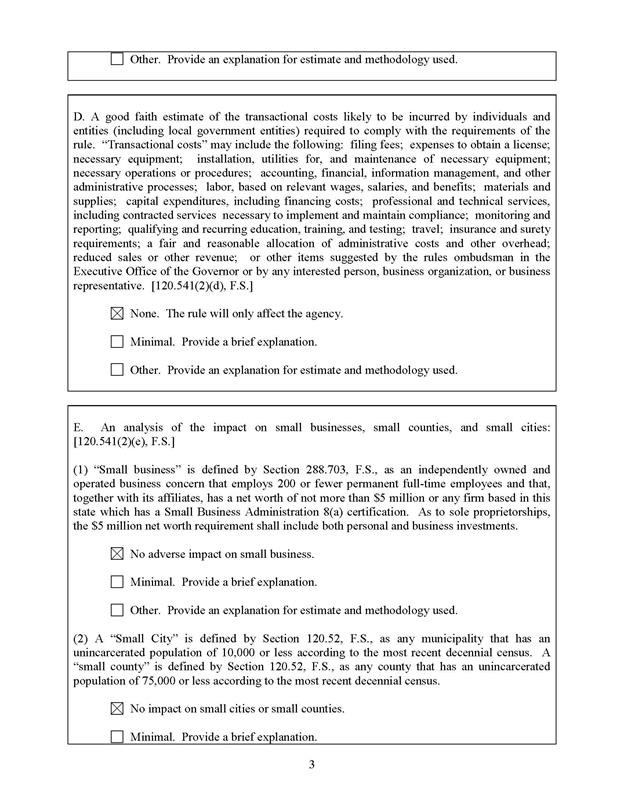
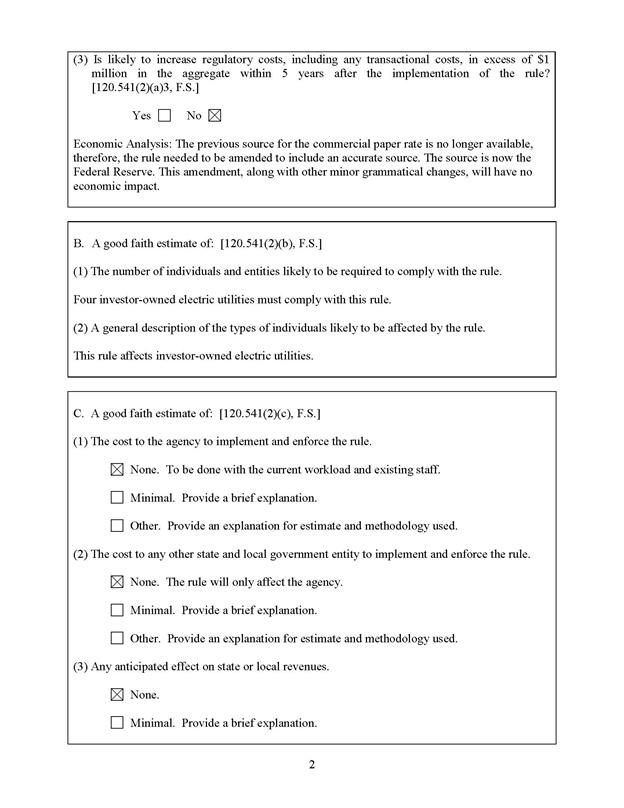
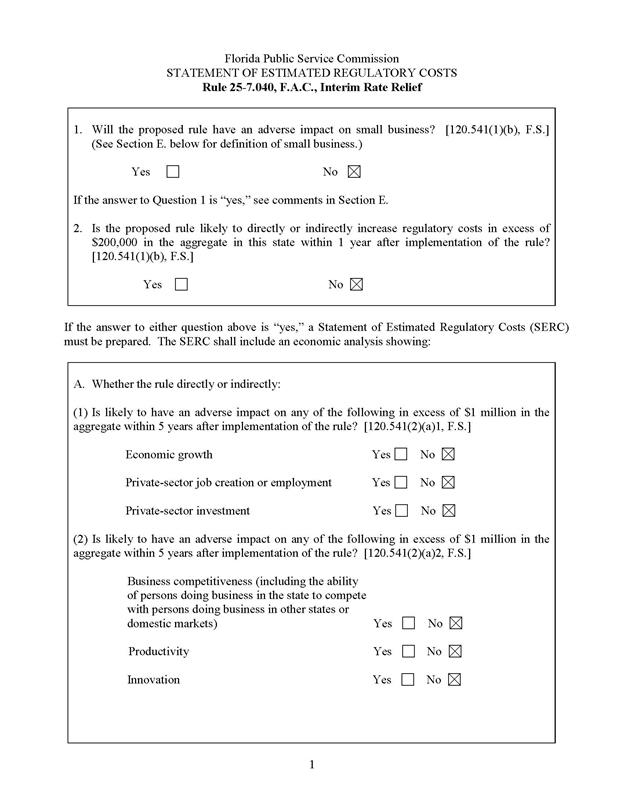
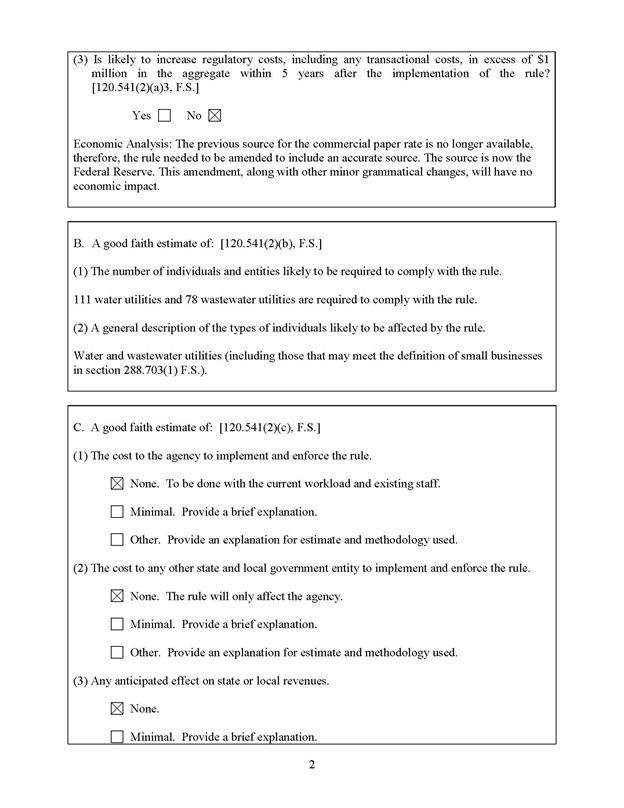
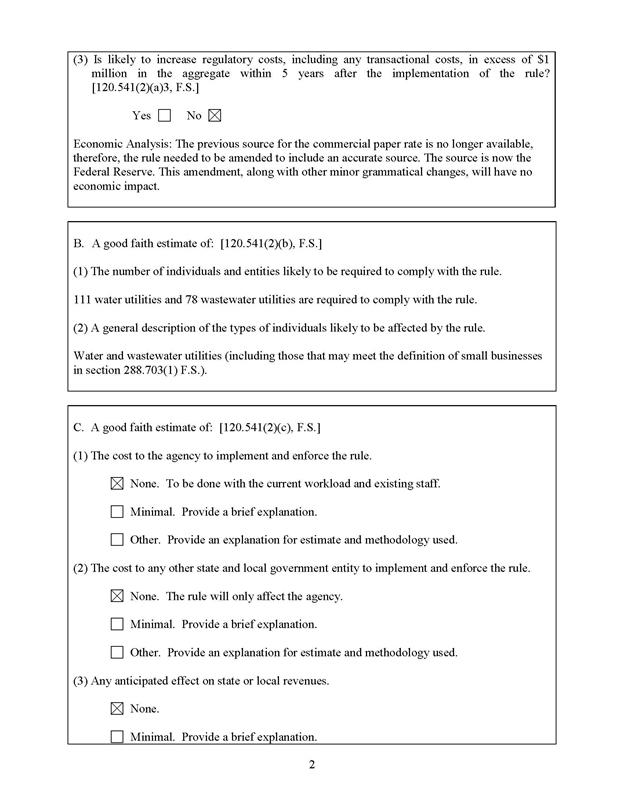
In addition,
the SERCs do not indicate that the amendment of any of the rules would have an
adverse impact on small businesses, would have any implementation or
enforcement costs on the Commission or any other state or local government
entity, or would have any impact on small cities or small counties. The SERCs
state that there will be no transactional costs likely to be incurred by
individuals and entities required to comply with the requirements. None of the
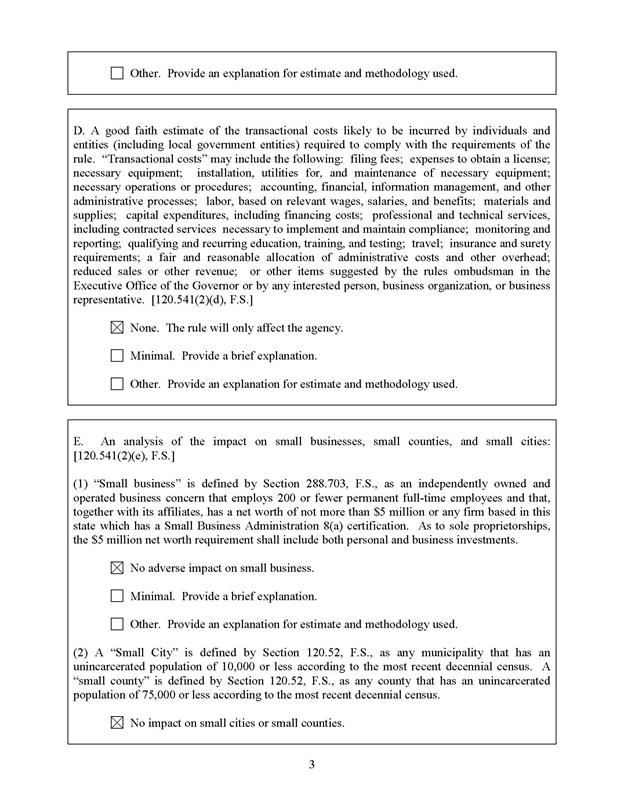
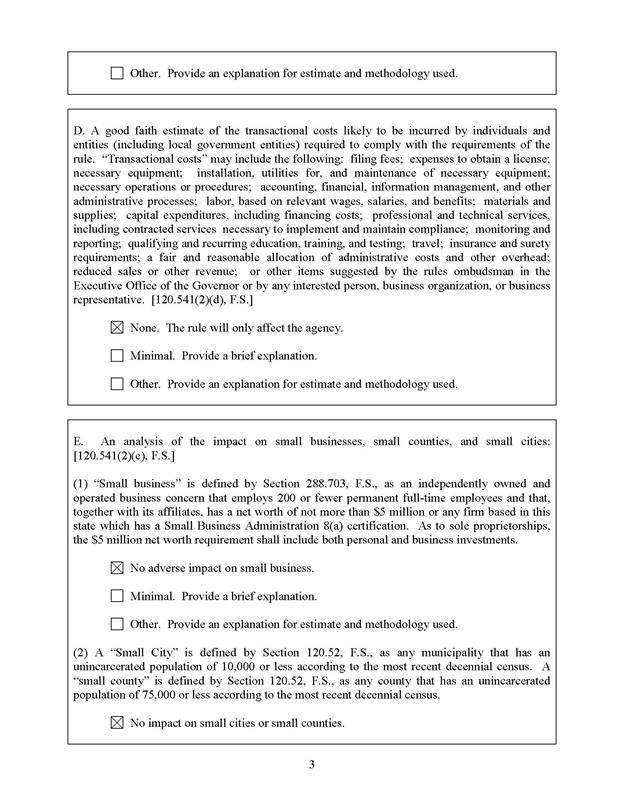
impact/cost criteria established in Section 120.541(2)(a), F.S., will be
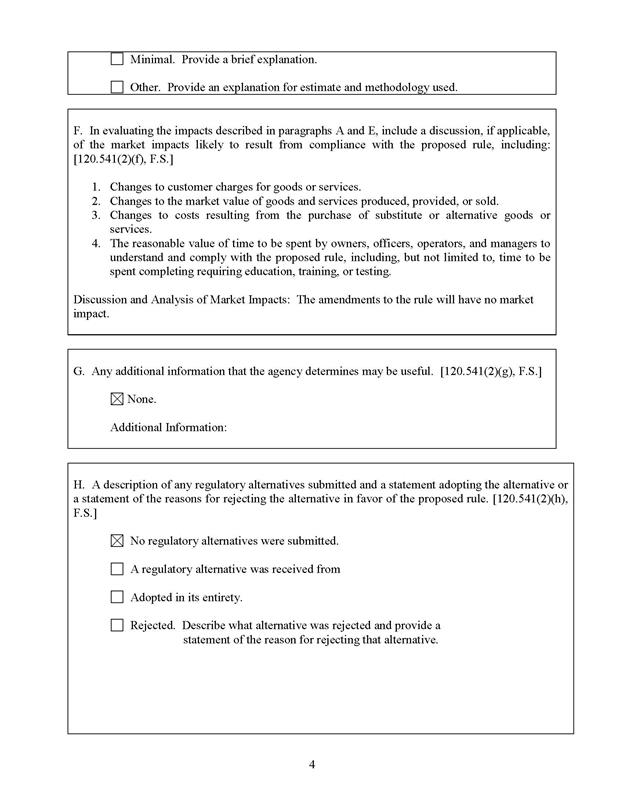
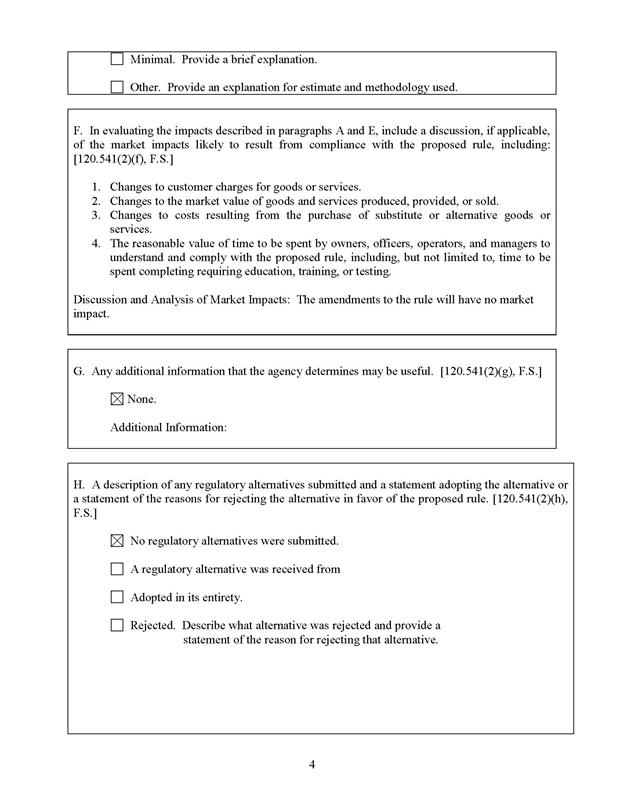
exceeded as a result of any of the rules. Finally, the SERCs indicate that
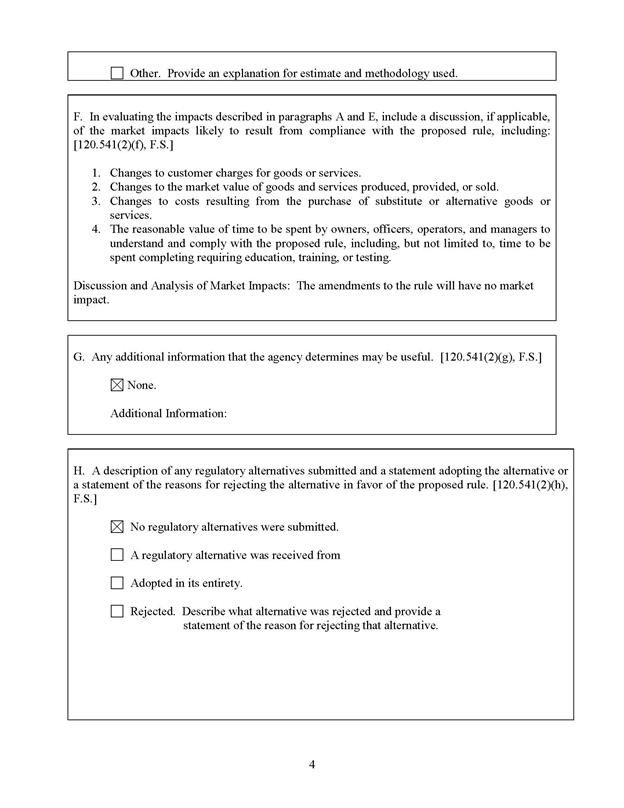
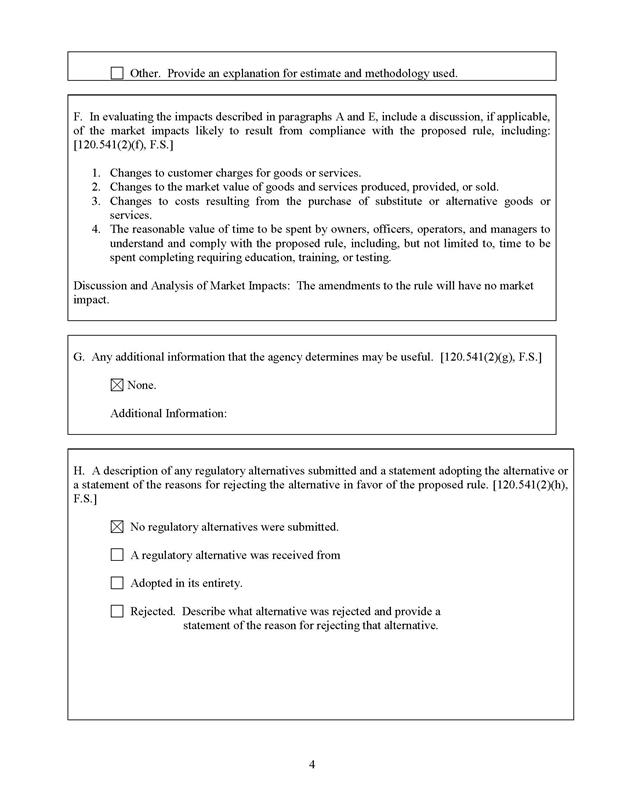
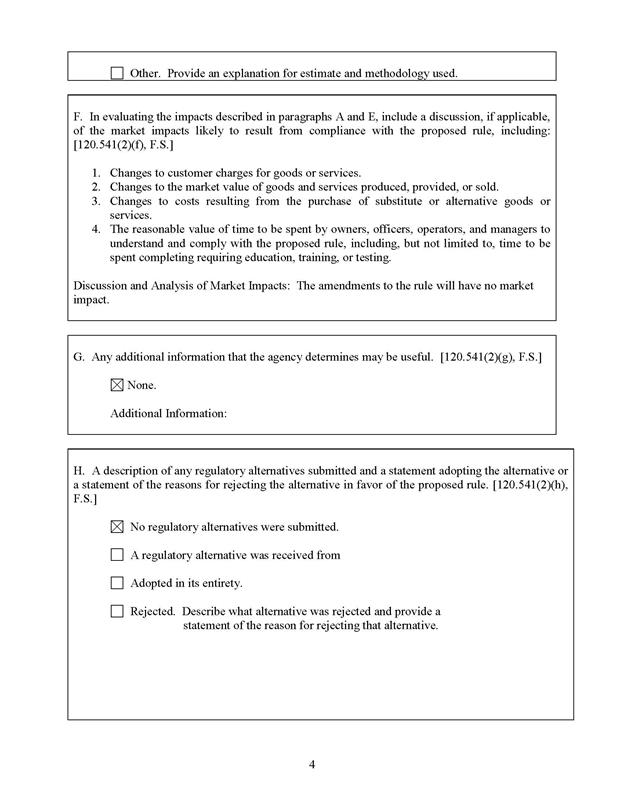
there are no market impacts likely to result from compliance with the proposed
rules.
Conclusion
Based on the
foregoing, staff recommends that the Commission propose the amendment of Rules 25-6.0435,
25-6.109, 25-7.040, 25-7.091, 25-30.117, and 25-30.360, F.A.C., as set forth in
Attachment A. Staff also recommends the Commission certify the rules as minor
violation rules.
Issue 2:
Should this docket be closed?
Recommendation:
Yes. If no requests for hearing are made or comments
from the Joint Administrative Procedures Committee (JAPC) are filed, and no
proposals for lower cost regulatory alternatives are submitted pursuant to
Section 120.541(1)(a), F.S., then the rules should be filed with the Department
of State for adoption and the docket should be closed. (Sapoznikoff)
Staff Analysis:
If no request for hearing is made or comments from
JAPC are filed, and no proposals for a lower cost regulatory alternatives are
submitted pursuant to Section 120.541(1)(a), F.S., then the rules should be
filed with the Department of State for adoption and the docket should be
closed.
25-6.0435 Interim Rate Relief.
(1) Each electric utility petitioning
for interim rate relief pursuant to Section 366.071, F.S., must shall
file the data required by paragraph 25-6.043(1)(a), F.A.C.
(2) The requested interim increase in
base rate revenues must shall be divided by interim test year
base rate revenues to derive a percentage increase factor. The percentage
increase factor must shall be applied uniformly to all existing
base rates and charges to derive the interim base rates and charges.
(3) Interim rate relief collected is
subject to refund pending final order in the permanent rate relief request.
Such increase is shall be subject to a corporate undertaking or
under bond as authorized by the Commission and any refund must shall
be made with an interest factor determined by using the AA non-financial
30-day commercial paper rate published by the Board of Governors of the
Federal Reserve System on its website for high-grade, unsecured notes,
sold through dealers by major corporations in multiples of $1,000, as regularly
published in the Wall Street Journal. The annual rate as published on the
first day of the current business month would be added to the rate as published
on the first day of the subsequent business month and halved to obtain the
simple average rate to be applied in that month. This rate of interest must
would be applied to the refund amount for that month. The amount of
interest calculated must would be added to the beginning balance
of the following month so as to accomplish the compounding of the
interest feature of the refund provision.
Rulemaking Authority
366.05(1) FS. Law Implemented 366.04(2)(f), 366.06, 366.071 FS. History–New
5-27-81, Formerly 25-6.435, Amended 2-12-04, _____.
25-6.109 Refunds.
(1) Applicability. With
the exception of deposit refunds and refunds associated with adjustment
factors, all refunds ordered by the Commission must shall be made
in accordance with the provisions of this Rule, unless otherwise ordered by the
Commission.
(2) Timing of Refunds.
Refunds must be made within ninety (90) days of the Commission’s order unless a
different time frame is prescribed by the Commission. Unless a stay has been
requested in writing and granted by the Commission, a motion for
reconsideration of an order requiring a refund will not delay the timing of the
refund. In the event that a stay is granted pending reconsideration, the timing
of the refund must shall commence from the date of the order
disposing of any motion for reconsideration. This rule does not authorize any
motion for reconsideration not otherwise authorized by Chapter 25-22, F.A.C.
(3) Basis of Refund. When
Where the refund is the result of a specific rate change, including
interim rate increases and the refund can be computed on a per customer basis,
that will be the basis of the refund. In such cases, refunds must may
be made by either recalculating the affected customer’s bill or by applying an
appropriate refund factor to the consumption used by the customer during the
refund period. However, when where the refund is not related to
specific rate changes, such as a refund for overearnings, the refund must
will be made to customers of record as of a date specified by the
Commission. In such case, refunds must shall be made on the basis
of consumption. Per customer refund refers to a refund to every customer
receiving service during the refund period. Customer of record refund refers to
a refund to every customer receiving service as of a date specified by the
Commission.
(4) Interest.
(a) When In
the case of refunds the Commission orders refunds to be made with
interest, the average monthly interest rate until the refund is posted to the
customer’s account must shall be based on the AA non-financial
thirty 30-day (30) day commercial paper rate published
by the Board of Governors of the Federal Reserve System on its website for
high grade, unsecured notes sold through dealers by major corporations in
multiples of $1,000 as regularly published in the Wall Street Journal.
(b) This average monthly
interest rate must shall be calculated for each month of the
refund period:
1. By adding the
published interest rate in effect for the last business day of the month prior
to each month of the refund period and the published rate in effect for the
last business day of each month of the refund period divided by twenty-four
(24) to obtain the average monthly interest rate;
2. The average monthly
interest rate for the month prior to distribution must shall be
the same as the last calculated average monthly interest rate.
(c) The average monthly
interest rate must shall be applied to the sum of the previous
month’s ending balance (including monthly interest accruals) and the current
month’s ending balance divided by two (2) to accomplish a compounding effect.
(d) Interest Multiplier.
When the refund is computed for each customer, an interest multiplier can
may be applied against the amount of each customer’s refund in lieu of a
monthly calculation of the interest for each customer. The interest multiplier must
shall be calculated by dividing the total amount refundable to all
customers, including interest, by the total amount of the refund, excluding
interest. For the purpose of calculating the interest multiplier, the utility
may, upon approval by the Commission, estimate the monthly refundable amount.
(e) Commission staff will
shall provide applicable interest rate figures and assistance in
calculations under this Rule upon request of the affected utility.
(5) Method of Refund
Distribution. For those customers still on the system, a credit must shall
be made on the bill. In the event the refund is for a greater amount than the
bill, the remainder of the credit must shall be carried forward
until the refund is completed. If the customer so requests, a check for any
negative balance must be sent to the customer within ten (10) days of the
request. For customers entitled to a refund but no longer on the system, the
company must shall mail a refund check to the last known billing
address, except that no refund for less than $1.00 will be made to these
customers.
(6) Security for Money
Collected Subject to Refund. In the case of money being collected subject to
refund, the money must shall be secured by a bond unless the
Commission specifically authorizes some other type of security such as placing
the money in escrow, approving a corporate undertaking, or providing a letter
of credit. The company Commission must may require the
company to provide a report by the 20th 10th of each month
indicating the monthly and total amount of money subject to refund as of the
end of the preceding month. The report must shall also indicate
the status of whatever security is being used to guarantee repayment of the
money.
(7) Refund Reports.
During the processing of the refund, monthly reports on the status of the
refund must shall be made by the 20th 10th of the
following month. In addition, a preliminary report must shall be
made within thirty (30) days after the date the refund is completed and again
90 days thereafter. A final report must shall be made after all
administrative aspects of the refund are completed. The above reports must
shall specify the following:
(a) The amount of money
to be refunded and how that amount was computed;
(b) The amount of money
actually refunded;
(c) The amount of any
unclaimed refunds; and
(d) The status of any
unclaimed amounts.
(8) With the last report
under subsection (7) of this rule, the company must shall suggest
a method for disposing of any unclaimed amounts. The Commission will shall
then order a method of disposing of the unclaimed funds.
Rulemaking Authority 350.127(2),
366.05(1) FS. Law Implemented 366.03, 366.04(1), (2)(f),
366.06(3), 366.07, 366.071 FS. History–New 8-18-83. Amended __________.
25-7.040
Interim Rate Relief.
(1) Each natural gas utility
petitioning for interim rate relief pursuant to Section 366.071, F.S., must
shall file the data required in paragraph 25-7.039(1)(a), F.A.C.
(2)(a) Interim rates must shall
apply across the board based on base rate revenues for the test period less
base gas revenue by rate schedule. The resulting dollar amount must shall
be divided by base rate revenues per rate schedule to determine the percent
increase applied to each rate schedule.
(b) In determining the interim
increase, the following data must shall be provided by rate
schedule: Therm sales; base rate revenue less base gas cost; base gas revenue;
total base rate revenue; purchased gas adjustment revenue; total revenue. The
interim increase must shall be shown by dollar amount and
percentage by rate schedule calculated in the following manner:
1. Required Interim Revenue Relief / (Base rate revenue – base gas cost) =
Percentage constant I.
Required Interim
Revenue Relief Across
the board
Base rate revenue = percentage
constant
less
base gas cost
2. Percentage constant * (Base rate revenue –
base gas cost) = Dollar increase to rate schedule II. Percentage Constant × Base rate Revenue less base gas cost = Dollar increase to rate schedule
3. Dollar increase / Total base rate revenue
= percent increase applied to rate schedule
III. Dollar Increase Percent
increase
Total
base rate applied
to
Revenue rate
schedule
(3) Interim rate relief collected is
subject to refund pending final order in the permanent rate relief request.
Such increase is shall be subject to a corporate undertaking or
under bond as authorized by the Commission and any refund must shall
be made with an interest factor determined by using the AA non-financial
30-day commercial paper rate published by the Board of Governors of the Federal
Reserve System on its website for highgrade, unsecured notes, sold
through dealers by major corporations in multiples of $1,000, as regularly
published in the Wall Street Journal. The annual rate as published on the
first day of the current business month must would be added to
the rate as published on the first day of the subsequent business month and
halved to obtain the simple average rate to be applied in that month. This rate
of interest must would be applied to the refund amount for that
month. The amount of interest calculated will be added to the beginning balance
of the following month so as to accomplish the compounding of the
interest feature of the refund provision.
Rulemaking Authority
366.05(1), 366.071 FS. Law Implemented 366.06(3), 366.071 FS. History–New
5-27-81, Formerly 25-7.40, Amended _____.
25-7.091
Refunds.
(1) Applicability. With the exception
of deposit refunds and refunds associated with adjustment factors, all refunds
ordered by the Commission must shall be made in accordance with
the provisions of this rule, unless otherwise ordered by the Commission.
(2) Timing of Refunds. Refunds must be
made within ninety (90) days of the Commission’s order unless a different time
frame is prescribed by the Commission. Unless a stay has been requested in
writing and granted by the Commission, a motion for reconsideration of an order
requiring a refund will not delay the timing of the refund. In the event that a
stay is granted pending reconsideration, the timing of the refund must shall
commence from the date of the order disposing of any motion for
reconsideration. This rule does not authorize any motion for reconsideration
not otherwise authorized by Chapter 25-22, F.A.C.
(3) Basis of Refund. When Where
the refund is the result of a specific rate change, including interim rate
cases and the refund can be computed on a per customer basis, that will be the
basis of the refund. However, when where the refund is not
related to specific rate changes, such as a refund for overearnings, the refund
must shall be made to customers of record as of a date specified
by the Commission. In such case, refunds must shall be made on
the basis of consumption. Per customer refund refers to a refund to every
customer receiving service during the refund period. Customer of record refund
refers to a refund to every customer receiving service as of a date specified
by the Commission.
(4) Interest.
(a) When In the case of
refunds which the Commission orders refunds to be made with
interest, the average monthly interest rate until the refund is posted to the
customer’s account must shall be based on the AA non-financial
thirty 30-day (30) day commercial paper rate published
by the Board of Governors of the Federal Reserve System on its website for
high grade, unsecured notes sold through dealers by major corporations in
multiples of $1,000 as regularly published in the Wall Street Journal.
(b) This average monthly interest rate must
shall be calculated for each month of the refund period:
1. By adding the published interest
rate in effect for the last business day of the month prior to each month the
refund period and the published rate in effect for the last business day of
each month of the refund period divided by twenty-four (24) to obtain the
average monthly interest rate;
2. The average monthly interest rate
for the month prior to distribution will shall be the same as the
last calculated average monthly interest rate.
(c) The average monthly interest rate must
be applied to the sum of the previous month’s ending balance (including monthly
interest accruals) and the current month’s ending balance divided by two (2) to
accomplish a compounding effect.
(d) Interest Multiplier. When the
refund is computed for each customer, an interest multiplier can may
be applied against the amount of each customer’s refund in lieu of a monthly
calculation of the interest for each customer. The interest multiplier must
shall be calculated by dividing the total amount refundable to all
customers, including interest, by the total amount of the refund, excluding
interest. For the purpose of calculating the interest multiplier, the utility
may, upon approval by the Commission, estimate the monthly refundable amount.
(e) Commission staff will shall
provide applicable interest rate figures and assistance in calculations under
this rule upon request of the affected utility.
(5) Method of Refund Distribution. For
those customers still on the system, a credit must shall be made
on the bill. In the event the refund is for a greater amount than the bill, the
remainder of the credit must shall be carried forward until the
refund is completed. If the customer so requests, a check for any negative
balance must be sent to the customer within ten (10) days of the request.
For customers entitled to a refund but no longer on the system,
the company must shall mail a refund check to the last known
billing address except that no refund for less than $1.00 will be made to these
customers.
(6) Security
for Money Collected Subject to Refund. In the case of money being collected
subject to refund, the money must shall be secured by a bond
unless the Commission specifically authorizes some other type of security such
as placing the money in escrow, approving a corporate undertaking, or providing
a letter of credit. The company Commission must may
require the company to provide a report by the 20th 10th of
each month indicating the monthly and total amount of money subject to refund
as of the end of the preceding month. The report must shall also
indicate the status of whatever security is being used to guarantee repayment
of the money.
(7) Refund Reports. During the
processing of the refund, monthly reports on the status of the refund must
shall be made by the 20th 10th of the following month. In
addition, a preliminary report must shall be made within thirty
(30) days after the date the refund is completed and again 90 days thereafter.
The above reports must shall specify the following:
(a) The amount of money to be refunded
and how that amount was computed;
(b) The amount of money actually
refunded;
(c) The amount of any unclaimed
refunds; and
(d) The status of any unclaimed
amounts.
(8) With the last report under
subsection (7) of this rule, the company must shall suggest a
method for disposing of any unclaimed amounts. The Commission will shall
then order a method of disposing of the unclaimed funds.
Rulemaking Authority
350.127(2) FS. Law Implemented 366.06(3), 366.071(2) FS. History–New 8-18-83,
Formerly 25-7.91. Amended _____.
25-30.117
Accounting for Pension Costs.
Any utility that has an established
defined benefit pension plan as defined by the Financial Accounting Standard’s
Board in the Accounting Standards Codification 715 (ASC 715), dated March
2017 Statement of Financial Accounting Standards No. 87, Employers’
Accounting for Pensions (SFAS 87), dated December, 1985, must shall
account for these costs pursuant to ASC 715, as well as Accounting Standards Update (ASU)
2017-07, dated December 15, 2018, and ASU 2018-14, dated August 2018,
SFAS 87 as they apply it applies to business enterprises
in general.
Rulemaking Authority
367.121 FS. Law Implemented 367.121 FS. History–New 11-30-93. Amended _____.
25-30.360
Refunds.
(1) Applicability. All refunds under
this chapter must shall be made in accordance with this rule,
unless another rule in this chapter specifically sets forth the procedure for
making refunds. The calculation for overbillings must shall be
pursuant to Rule 25-30.350, F.A.C., and disbursed pursuant to this rule.
(2) Timing of Refunds. Refunds must be
made within 90 days of the Commission’s order unless a different time frame is
prescribed by the Commission. A timely motion for reconsideration temporarily
stays the refund, pending the final order on the motion for reconsideration. In
the event of a stay pending reconsideration, the timing of the refund must
shall commence from the date of the order disposing of any motion for
reconsideration. This rule does not authorize any motion for reconsideration
not otherwise authorized by Chapter 25-22, F.A.C.
(3) Basis of Refund. When Where
the refund is the result of a specific rate change, including interim rate
increases, and the refund can be computed on a per customer basis, that will be
the basis of the refund. However, when where the refund is not
related to specific rate changes, such as a refund for overearnings, the refund
must shall be made to customers of record as of a date specified
by the Commission. In such case, refunds must shall be made on
the basis of usage. Per customer refund refers to a refund to every customer
receiving service during the refund period. Customer of record refund refers to
a refund to every customer receiving service as of a date specified by the
Commission.
(4) Interest.
(a) When In the case of
refunds which the Commission orders refunds to be made with interest,
the average monthly interest rate until refund is posted to the customer’s
account must shall be based on the AA non-financial 30-day
30 day commercial paper rate published by the Board of Governors of
the Federal Reserve System on its website for high grade, unsecured
notes sold through dealers by major corporations in multiples of $1,000 as
regularly published in the Wall Street Journal.
(b) This average monthly interest rate must
shall be calculated for each month of the refund period:
1. By adding the published interest
rate in effect for the last business day of the month prior to each month the
refund period and the published rate in effect for the last business day of
each month of the refund period divided by 24 to obtain the average monthly
interest rate;
2. The average monthly interest rate
for the month prior to distribution must shall be the same as the
last calculated average monthly interest rate.
(c) The average monthly interest rate must
shall be applied to the sum of the previous month’s ending balance
(including monthly interest accruals) and the current month’s ending balance
divided by 2 to accomplish a compounding effect.
(d) Interest Multiplier. When the
refund is computed for each customer, an interest multiplier can may
be applied against the amount of each customer’s refund in lieu of a monthly
calculation of the interest for each customer. The interest multiplier must shall be calculated by dividing
the total amount refundable to all customers, including interest, by the total
amount of the refund, excluding interest. For the purpose of calculating the
interest multiplier, the utility may, upon approval by the Commission, estimate
the monthly refundable amount.
(e) Commission staff will shall
provide applicable interest rate figures and assistance in calculations under
this rule upon request of the affected utility.
(5) Method of Refund Distribution. For
those customers still on the system, a credit must be made on the bill. In the
event the refund is for a greater amount than the bill, the remainder of the
credit must shall be carried forward until the refund is
completed. If the customer so requests, a check for any negative balance must
be sent to the customer within 10 days of the request. For customers entitled
to a refund but no longer on the system, the company must shall mail
a refund check to the last known billing address except that no refund for less
than $1.00 will be made to these customers.
(6) Security for Money Collected
Subject to Refund. In the case of money being collected subject to refund, the
money must be secured by a bond unless the Commission specifically authorizes
some other type of security such as placing the money in escrow, approving a
corporate undertaking, or providing a letter of credit. The company must
shall provide a report by the 20th of each month indicating the monthly
and total amount of money subject to refund as of the end of the preceding
month. The report must shall also indicate the status of whatever
security is being used to guarantee repayment of the money.
(7) Refund Reports. During the
processing of the refund, monthly reports on the status of the refund must be
made by the 20th of the following month. In addition, a preliminary report must
shall be made within 30 days after the date the refund is completed and
again 90 days thereafter. A final report must shall be made after
all administrative aspects of the refund are completed. The above reports must
specify the following:
(a) The amount of money to be refunded
and how that amount was computed;
(b) The amount of money actually
refunded;
(c) The amount of any unclaimed
refunds; and,
(d) The status of any unclaimed
amounts.
(8) Any unclaimed refunds must be
treated as cash contributions-in-aid-of-construction.
Rulemaking Authority
350.127(2), 367.121 FS. Law Implemented 367.081, 367.0814, 367.082(2) FS.
History–New 8-18-83, Formerly 25-10.76, 25-10.076, Amended 11-30-93, 11-25-19. Amended_________.