Case Background
The
Telecommunications Access System Act of 1991 (TASA) established a statewide
telecommunications relay system. Under TASA, the Florida Public Service
Commission (Commission) must establish, implement, promote, and oversee the
statewide telecommunications access system, which is intended to provide
telecommunications service for deaf, hard of hearing, or speech impaired
persons that is functionally equivalent to the service provided to hearing
persons. TASA provides for the purchase and distribution of specialized
telecommunications devices and specialized
communications technology as defined in Chapter 427, Florida Statutes
(F.S.).
The
telecommunications access system provides deaf or hard of hearing persons
access to basic telecommunications services by using a specialized
Communications Assistant that relays information between the deaf or hard of
hearing person and the other party to the call. The primary function of the
telecommunications access system is accomplished using a Telecommunications
Device for the Deaf (TDD). The person using the TDD types a message to the
Communications Assistant who in turn voices the message to the other party or
types the message to a Captioned Telephone that displays real-time captions of
the conversation.
In 2025, the
Legislature amended Sections 427.702 through 427.706, F.S. relating to TASA. These statutory changes added newly
defined specialized communications technology and requires the Commission to
set eligibility requirements for this distribution. Section 427.704(e), F.S.
mandates that the eligibility requirements be based on income qualifications of
no less than double, but no more than triple, the federal poverty level, or
participation in other state or federal programs based on income. The
Commission adopted rules setting these eligibility criteria, which became
effective on December 2, 2025. The eligibility requirements in the rule include
income of less than 250 percent of the federal poverty level, or participation
in the Supplemental Nutrition Assistance Program, Medicaid, Supplemental
Security Income, the Section 8 Housing Choice Voucher Program, or receipt of
either a Veterans Pension or Survivors Pension from the Department of Veterans
Affairs.
Florida
Telecommunications Relay, Inc. (FTRI), a nonprofit corporation formed by the
local exchange telephone companies, was selected by the Commission to serve as
the telecommunications access system administrator. FTRI is primarily
responsible for the purchase and distribution of specialized telecommunications
equipment and specialized communications technology. As part of this process,
FTRI contracts with other organizations to assist in the distribution of
equipment and provide customer training on the proper use of the equipment and
the relay service. FTRI also conducts marketing to raise awareness of available
equipment and relay service. Finally, FTRI pays the Telecommunications Relay
Service (TRS) provider, which is selected by the Commission through a request
for proposals process. The current TRS provider is T-Mobile USA, Inc.
(T-Mobile).
FTRI is funded
through the TRS surcharge, which local exchange telecommunications companies
are required to collect and remit to FTRI. The Commission has historically changed
the surcharge to meet FTRI’s budgetary needs. The monthly surcharge is
currently $0.08 per access line, for up to 25 lines per customer.
As part of its
oversight responsibilities of the telecommunications access system, the
Commission reviews and approves a budget submitted by FTRI on an annual basis.
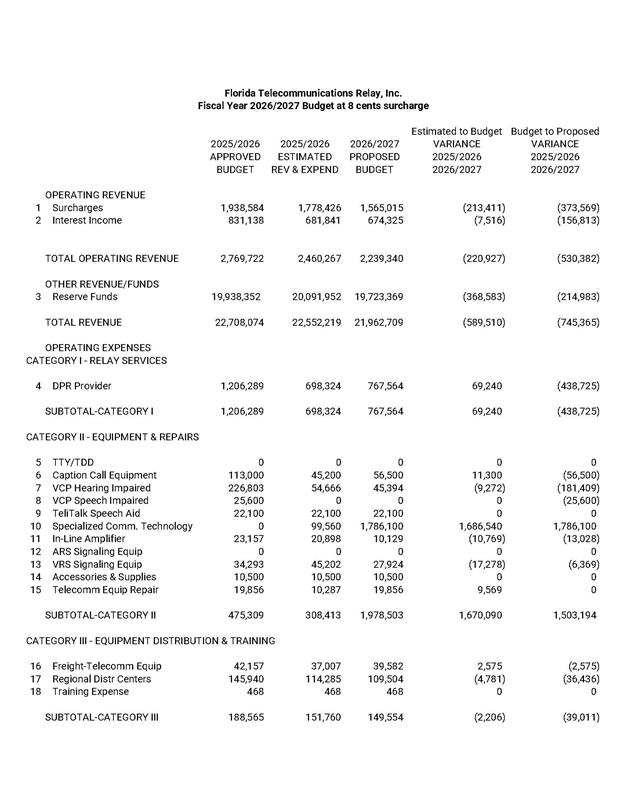
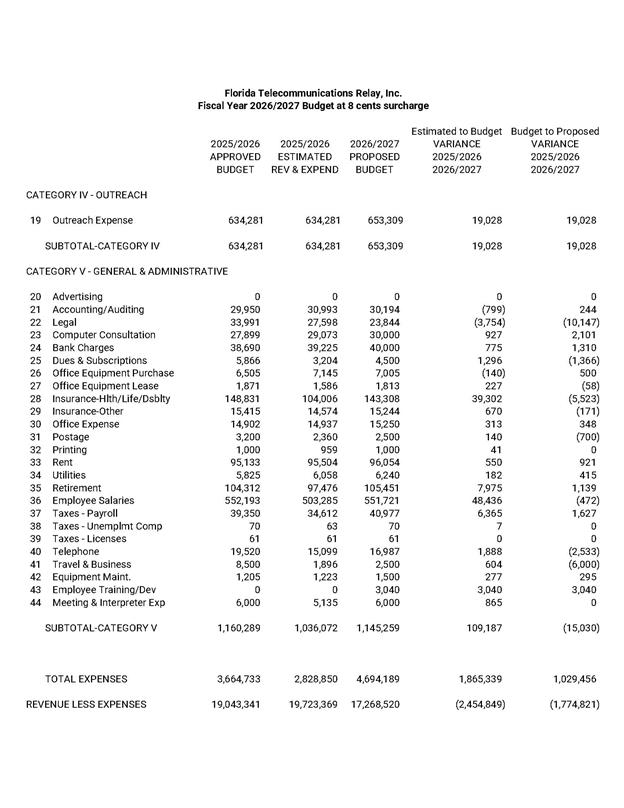
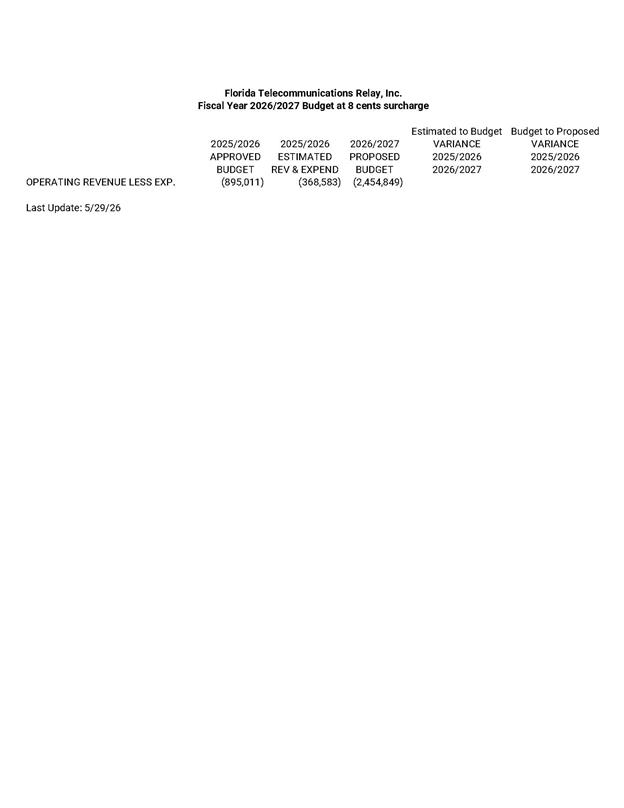
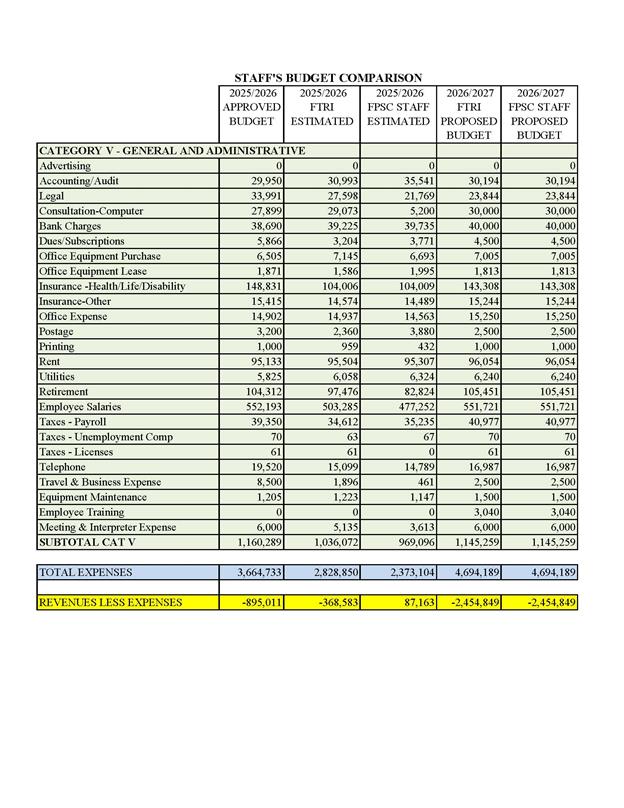
On March 16, 2026, FTRI submitted its Fiscal Year 2026/2027 budget. On May 29,
2026, FTRI submitted responses to staff’s first data request along with a
revised budget for the Commission’s consideration, which is included as
Attachment A. FTRI provided a comparison of its proposed budget to the
Commission-approved 2025/2026 budget, as well as its estimated revenue and
expenses for the current fiscal year. FTRI estimated its revenue and expenses
based on actual data from the first two quarters and estimated data for the
remainder of the year.
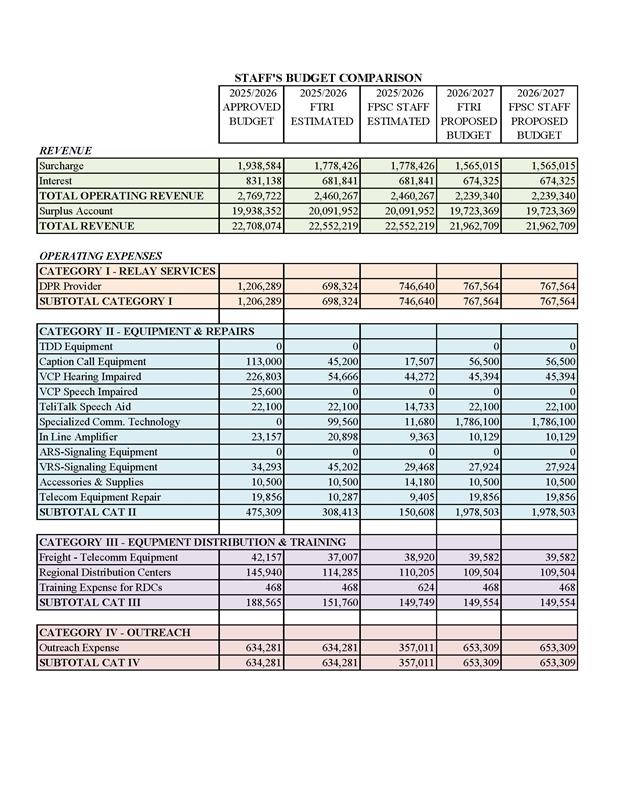
On May 29, 2026,
FTRI also filed third quarter financial information. With this updated
information, staff formulated an estimate of FTRI’s expenses for Fiscal Year
2025/2026, which is reflected in Attachment B.
This
recommendation addresses FTRI’s proposed budget and recommended TRS surcharge
for Fiscal Year 2026/2027. The TRS surcharge is the only rate the Commission
establishes for telecommunications companies. The Commission is vested with
jurisdiction over this matter pursuant to Chapter 427, F.S.
Discussion
of Issues
Issue 1:
Should the Commission approve FTRI’s proposed Fiscal
Year 2026/2027 budget as presented in Attachment A?
Recommendation:
Yes. Staff recommends the Commission approve FTRI’s
proposed budget expense of $4,694,189 for Fiscal Year 2026/2027, effective upon
issuance of the consummating order. Staff recommends the Commission allow FTRI
to transfer $2,454,849 from the Reserve Account to offset the projected revenue
shortfall. (Williams, Fogleman, Imig, Stiller)
Staff Analysis:
Traditional
Telecommunications Relay Service
Traditional TRS cost as approved
in the T-Mobile contract is currently $2.58 per session minute. T-Mobile’s
projections indicate traditional TRS minutes of use during Fiscal Year
2026/2027 will be 297,506. By comparison, T-Mobile’s
projections for traditional TRS minutes of use for Fiscal Year 2025/2026 was
467,554. Further, TRS usage totaled 510,081 actual minutes in Fiscal Year
2024/2025, representing a 14 percent decline from Fiscal Year 2023/2024 actual
minutes.
Based on continued advancements
in technology and the expansion of consumer choice, it is anticipated that TRS
minutes of use will continue to decline. It has been observed that traditional
TRS users are transitioning to the following services:
·
IP Relay
·
IP CTS
·
Wireless Service
Florida
Telecommunications Relay, Inc. Budget
Attachment
A reflects FTRI’s Fiscal Year 2026/2027 proposed budget filed with the
Commission, which was reviewed and adopted by FTRI’s Board of Directors. FTRI
proposed maintaining the current $.08 surcharge per access line, which would
result in total surcharge revenue of $1,565,015. FTRI projected $674,325 in
interest income during Fiscal Year 2026/2027 through investments in its
Investment Trust Money Market account and 3-month T-bills. As a result, FTRI’s
total operating revenue was estimated to be $2,239,340. FTRI’s proposed budget
projected total expenses of $4,694,189. Based on FTRI’s projected revenue and
expenses, it would need to transfer $2,454,849 from the Reserve Account to
offset the shortfall. FTRI has a Reserve Account of approximately $19,723,369 million.
Analysis
The two primary factors
contributing to FTRI’s proposed budget shortfall are continued declines in
access lines, upon which the surcharge is assessed, and the increase in Category
II - Equipment & Repairs expense related to distribution of specialized
communications technology. Proposed surcharge revenue is projected to decline
by $373,569 compared to last year’s approved budget because of continued
declines in access lines. Expenses related to the distribution of specialized
communications technology are projected to be $1,786,100.
Staff developed
an estimate of FTRI’s expenses for Fiscal Year 2025/2026, which is presented in
Attachment B. Staff used actual data from the first three quarters and took an
average of those three quarters to estimate the fourth. Staff’s estimates were
then used as one element in evaluating FTRI’s proposed budget, along with
analyzing past Commission-approved FTRI budgets to identify and evaluate
ongoing cost reduction measures.
Below is
staff’s review of selected items from FTRI’s proposed budget expenses by category.
Category
I – Relay Services
Category I captures TRS provider
expenses for traditional TRS currently provided by T-Mobile. The Commission and
FTRI have historically used the TRS provider’s minutes of use forecast to
develop the budget for this category.
Staff
recommends using T-Mobile’s forecasted 297,506 minutes of use to calculate the
TRS provider expense. At the contracted rate of $2.58 per minute, the proposed TRS
provider expense is $767,564.
Staff
recommends approval of $767,564 for relay services expense.
Category
II – Equipment & Repairs
Category
II expenses reflect the purchase of equipment to be distributed to clients and
the repairs that FTRI must make to keep the equipment in working order. FTRI
requested $1,978,503 for Fiscal Year 2026/2027, representing a $1,503,194
increase in expense from the current Commission-approved budget. The proposed
increase is largely attributed to planned distribution of newly defined specialized
communications technology authorized by amendments to Chapter 427, F.S., that
were enacted by the Legislature in 2025.
The
specialized communications technology line item proposes a $1,786,100 Fiscal Year
2026/2027 expenditure for iPhones, iPads, and ATOS electrolarynx devices. The
ATOS electrolarynx device is designed to assist persons with total
laryngectomy, which is the removal of the voice box to treat throat cancer. In
addition to standard eligibility criteria related to hearing loss and speech disability,
this equipment is only available to Florida residents whose income does not
exceed 250 percent of the federal poverty level, or who participate in other income-based
programs as described above.
FTRI’s Fiscal
Year 2026/2027 proposed budget estimate is based on current unit cost and
projected device distribution volumes, including assumptions on the size of the
addressable client base. The current projection includes 705 iPhone devices at
$1,620 per unit ($1,142,100), 470 large screen iPad devices at $1,300 per unit
($611,000), and 30 ATOS electrolarynx at $1,100 per unit, ($33,000).
In response to staff’s data request, FTRI indicated that
it relied on data from the Florida Coordinating Council for the Deaf and Hard
of Hearing (FCCDHH) and other reputable organizations to develop its demand
projections. FCCDHH is overseen by the Florida Department of Health. FTRI’s
projected number of units starts with the identification of 900,000 residents
who identify as Deaf, Hard of Hearing, or Speech Impaired, assumes that
approximately 29 percent meet the income requirements, and estimates that 3
percent of those do not already have access to a wireless device that meets
their needs. Applying FTRI’s logic yields 7,830 eligible Florida residents who
may apply for equipment in any given year. FTRI anticipates 15 percent of this
target population will submit a completed application in FY 2026/2027,
resulting in 1,175 Apple units being distributed. The projected quantity of ATOS
Emote devices to be distributed in Fiscal Year 2026/2027 is 30. This calculation
is based on 10,000 people in the US living with total laryngectomy and 6.9
percent of the US population living in Florida. This equates to 690 Florida
residents with total laryngectomy. Applying the same income assumptions as
other wireless device projections, 200 Florida residents would qualify in any
given year. Continuing with the conservative planning estimate of serving 15
percent of the target population, 30 units would be distributed in the upcoming
fiscal year.
According
to the 2025 FCCDHH Biennial Report, it is estimated that 3 to 4 million
Floridians have significant hearing loss. FTRI also reported that of those,
approximately 800,000 identify as Deaf or Hard of Hearing according to sources
such as the Florida Department of State DLIS Deaf Literacy Center. According to
the NIH National Institute on Deafness and Other Communication Disorders,
approximately 7.2 percent of US children ages 3-17 have a disorder related to
voice, speech, or language. Similarly, 7.6 percent of US adults report having a
voice problem that lasted longer than 12 months. Given Florida’s population,
this equates to over 1.7 million residents who have some form of speech-related
disability. For the purposes of this initial projection, FTRI used a conservative
estimate of approximately 100,000 residents who may identify as having a
qualifying speech impairment, including 690 with total laryngectomy.
FTRI projected that approximately 12 percent of Florida
residents live below the federal poverty level and 34 percent of households are
classified as asset limited, income constrained and employed. Eligibility
requirements are currently set at less than 250 percent of the federal poverty level
and, as a result, FTRI estimates that 29 percent would satisfy program
eligibility income requirements. Smartphones are common across income levels,
with access to at least one device ranging from 79–98 percent based on income.
Cellphone and Smartphone ownership for US adults with household income of $30,000-$69,900
is also 98 percent and 89 percent respectively. Considering these factors, FTRI
used a conservative estimate of 3 percent of Florida residents who may not
already have access to a wireless device that meets their needs.
In total,
FTRI projects 1,205 units to be distributed at a total cost of $1,786,100 for Fiscal
Year 2026/2027. Staff does not recommend an adjustment to FTRI’s projections
and budget request. However, given FTRI’s reliance on demand assumptions, along
with the potential for fraud, it is important that FTRI remain diligent. FTRI
states that clients are required to adhere to the Conditions of Acceptance regarding
the use of the devices. Condition of Acceptance five requires clients to return
devices when no longer needed. In addition, FTRI should require devices be
returned when clients no longer meet income or program participation requirements.
FTRI should also implement a practice to verify client income and program eligibility
when issuing replacement devices. Staff recommends the Commission order FTRI to
file monitoring reports on the distribution of iPhones and iPads as discussed
in Issue 2 of this recommendation.
Staff
recommends approval of $1,978,503 for equipment and repairs expense.
Category III – Equipment Distribution
& Training
Category
III reflects the cost of distributing equipment and training consumers in the
use of that equipment. FTRI’s proposed budget requests $149,554 for
distribution and training, which reflects a $39,011 decrease from the current
Commission-approved budget.
Expenses
related to Regional Distribution Centers (RDCs) are the largest component of
Category III expenses. FTRI’s proposed budget for RDCs is $109,504, which is $36,436
lower than the current Commission-approved budget. FTRI explained that some
RDCs have not fully recovered from the impact of the COVID-19 shutdown. FTRI
plans to continue exploring alternative partnerships to expand distribution
services for selected equipment. However, FTRI will distribute the newly
defined specialized communications technology devices using in-house resources
and does not currently plan to use third parties. Staff supports this approach
considering the challenges related to initial implementation.
Staff
recommends approval of FTRI’s proposed budget for Category III expenses of $149,554.
Category
IV – Outreach
Outreach
efforts are designed to promote FTRI’s equipment distribution services and to
raise awareness about TRS. FTRI’s proposed Fiscal Year 2026/2027 Outreach
budget increased by $19,028 over the 2025/2026 Commission-approved budget.
Factors
contributing to the increase in Outreach Expense include the hiring of a
Community Coordinator, travel expenses, and advertising price increases. FTRI
employs various forms of communication in its outreach strategy. FTRI plans to
expand outreach efforts, including continued advertising in newspapers using
free-standing insert ads (flyers) and television. Expanded promotion may have
additional value to inform qualifying relay customers about new types of
equipment that are available.
Staff
recommends approval of FTRI’s proposed budget of $653,309 for Outreach expenses.
Category
V – General & Administrative
Category V
reflects expenses associated with FTRI’s operations, such as office and furnishings,
employee compensation, contracted services (auditing, legal, IT consulting),
computers, and other operating expenses. FTRI is proposing $1,145,259 for
Fiscal Year 2026/2027, which represents a $15,030 decrease from the current
Commission-approved budget.
The amount
budgeted for Fiscal Year 2026/2027 Insurance-Health/Life/Disability account
shows a $39,302 increase from Fiscal Year 2025/2026 estimated expenditures. FTRI estimated a 10 percent increase in insurance premiums. It
based this increase in consultation with its insurance company, along with
historical costs over the past two years.
The
proposed Employee Salaries budget for Fiscal Year 2026/2027 is $551,721, which
is relatively unchanged from the 2025/2026 budget. Eight full-time employees were
budgeted for both Fiscal Years.
Staff
recommends approval of FTRI’s proposed budget of $1,145,259.
Revenue
Shortfall
If staff’s
recommendation is approved, FTRI’s Fiscal Year 2026/2027 budget will have a
shortfall of $2,454,849. As the Commission has approved in recent years, staff
believes it is appropriate to draw upon the Reserve Account to cover the
shortfall. FTRI’s Reserve Account is approximately $19,723,369 million.
Conclusion
Staff
recommends the Commission approve FTRI’s proposed budget expense of $4,694,189
for Fiscal Year 2026/2027, effective upon issuance of the consummating order.
Staff recommends the Commission allow FTRI to transfer $2,454,849 from the
Reserve Account to offset the projected revenue shortfall. (Williams, Fogleman, Imig, Stiller)
Issue 2:
Should the Commission order FTRI to file quarterly reports
for Fiscal Year 2026/2027 providing details on specialized communications
technology device distribution?
Recommendation:
Yes. Staff recommends the Commission order FTRI to
file quarterly reports for Fiscal Year 2026/2027 providing details on
specialized communications technology device distribution. (Williams, Fogleman,
Imig, Stiller)
Staff Analysis:
As discussed in Issue 1, based on FTRI’s reliance on
demand assumptions, along with the potential for fraud and abuse, it is
important that FTRI implement effective procedures. Staff presented questions to
FTRI during the initial analysis of operating procedures, cost, and assumptions
used to measure demand. Staff believes FTRI’s responses were reasonable. However,
continued monitoring will be needed to validate assumptions and to collect data
to address distribution issues should they arise.
Staff recommends the quarterly reports include the
following information regarding specialized communications technology devices:
1.
Number of devices ordered by type.
2.
Number of devices distributed by type.
3.
Number of devices in inventory by type.
4.
Number of devices reported lost by type.
5.
Number of devices reported stolen by type.
6.
Number of devices returned damaged by type.
7.
Number of devices refurbished and returned to clients by
type.
8.
Number returned by clients and taken out of service.
9.
Quarterly and year-to-date expenses.
10. Any
revisions to the methodology and/or assumptions used to identify the addressable
client base.
Staff will
evaluate the data throughout Fiscal Year 2026/2027 and make a recommendation on
the need to continue the quarterly reporting during the analysis of FTRI’s
Fiscal Year 2027/2028 budget filing.
Staff
recommends the Commission order FTRI to file quarterly reports for Fiscal Year
2026/2027 providing details on specialized communications technology device
distribution.
Issue 3:
Should the Commission maintain the current
Telecommunications Relay Service (TRS) surcharge of $0.08 per line, per month
for Fiscal Year 2026/2027?
Recommendation:
Yes. Staff recommends the Commission maintain the
current TRS surcharge of $0.08 per line, per month for Fiscal Year 2026/2027.
Staff recommends the Commission order all local exchange companies to continue
billing the $0.08 TRS surcharge for Fiscal Year 2026/2027. (Williams, Fogleman,
Imig, Stiller)
Staff Analysis:
FTRI has not requested a change in the TRS
surcharge. Staff would note that pursuant to the 2025
amendments to TASA, Section 427.704(4)(e), F.S., now prohibits the Commission
from increasing the surcharge when excess funds are available. Staff believes the current TRS surcharge of
$0.08 per line, per month is reasonable given the size of the Reserve Account
identified in Issue 1.
Issue 4:
Should this docket be closed?
Recommendation:
No. If no person whose substantial interests are
affected by the proposed agency action files a protest within 21 days of the
issuance of the order, this docket should be placed in monitoring status during
Fiscal Year 2026/2027 upon the issuance of a consummating order. (Imig,
Stiller)
Staff Analysis:
At the conclusion of the protest period, if no
protest is filed this docket should be placed in monitoring status upon the
issuance of a consummating order, for the purpose of receiving the quarterly reports regarding
specialized communications technology devices to be filed during Fiscal Year
2026/2027 as recommended in Issue 2.