Discussion
of Issues
Issue 1:
Should the incremental cost and capitalization
approach (ICCA) found in Rule 25-6.0143, Florida Administrative Code (F.A.C),
be used to determine the reasonable and prudent amounts to be included in the
restoration costs?
Recommendation:
Yes, the ICCA approach in Rule 25-6.0143, F.A.C.,
should be used to determine the reasonable and prudent amounts included in the
storm restoration costs. (Holloway)
Staff Analysis:
Rule 25-6.0143, F.A.C., requires the ICCA
methodology be used in determining the costs to be charged to cover storm
related damages. Therefore, the ICCA approach should be used to determine the
reasonable and prudent amounts included in the storm restoration costs.
Issue 2:
What is the reasonable and prudent amount of regular
payroll expense to be included in the total storm related restoration costs?
Recommendation:
The reasonable and prudent amount of payroll expense
to be included in the total storm restoration costs is $19.083 million.
(Holloway)
Staff Analysis:
Rule 25-6.0143(1)(e)8., F.A.C., states that
“overtime payroll and payroll related costs for the utility personnel included
in storm restoration activities” are allowed to be charged to the reserve under
the ICCA methodology. Staff believes that the full amounts calculated by FPL
are allowable under Rule 25-6.0143, F.A.C.
As stated in FPL witness Mohomed’s testimony, the Company
utilized multiple levels of review to ensure the reasonableness and prudence of
each cost associated with the Storms. In preparation for the incoming storms,
FPL sent email communications to all business units with pertinent information
regarding the listing of all applicable Work Breakdown Structures (WBSs) by
function and location, guidance on payroll, and guidance on the type of costs
eligible to be charged to storm WBSs. In order to ensure procedural compliance
and prudent spending for the duration of the storms, Finance Section Chiefs
were assigned to each staging area and processing site. Additionally, FPL’s
Human Resources Department was available at many sites to assist employees with
their timesheets. Further, FPL had a storm controllership performed by each
business unit, which was reviewed by FPL’s Accounting Department for
reasonableness, and for classifying and recording each cost into the
appropriate account: storm reserve, base Operations and Maintenance (O&M) expense,
capital, and below-the-line expense.
Witness
Mohomed testified that regular payroll and related payroll overheads for FPL
employees represent time spent in direct support of storm restoration and
exclude any bonuses and incentive compensation. The reasonable and prudent
regular payroll expenses for each storm are listed below.
Table 2-1
Regular Payroll Expense
|
Storm
|
Amount (Million)
|
|
Debby
|
$3.018
|
|
Helene
|
4.730
|
|
Milton
|
11.335
|
|
Total
|
$19.083 Million
|
Source: Exhibits AM-1, AM-2,
and AM-3
The Commission’s auditing staff
reviewed Deloitte’s work papers and found that the scope, procedures, and
conclusion were reasonable. The Company confirmed that costs and invoices for
Hurricanes Debby and Helene were handled in the same manner as Hurricane Milton,
which was the subject of the Deloitte audit. Therefore, staff recommends the
costs for all of the hurricanes are reasonable and prudent.
The reasonable and prudent amount of regular payroll
expense to be included in the total storm restoration costs is $19.083 million.
Issue
3:
What is
the reasonable and prudent amount of overtime payroll expense to be included in
the total storm related restoration costs?
Recommendation:
The reasonable and prudent amount of overtime
payroll expenses to be included in the total storm restoration costs is $44.762
million. (Holloway)
Staff Analysis:
As discussed in Issue 2, the Company utilized
multiple levels of review to ensure the reasonableness and prudence of each
cost associated with the Storms.
Witness Mohomed also testified that the overtime payroll
and related payroll tax overheads for FPL employees include time spent in
direct support of storm restoration. The reasonable and prudent overtime
payroll expenses for each storm are listed below.
Table 3-1
Overtime Payroll Expense
|
Storm
|
Amount (Million)
|
|
Debby
|
$8.650
|
|
Helene
|
11.174
|
|
Milton
|
24.938
|
|
Total
|
$44.762 Million
|
Source: Exhibits AM-1, AM-2, and AM-3
The Commission’s auditing staff
reviewed Deloitte’s work papers and found that the scope, procedures, and
conclusion were reasonable. The Company confirmed that costs and invoices for
Hurricanes Debby and Helene were handled in the same manner as Hurricane Milton,
which was the subject of the Deloitte audit.
Therefore, staff recommends the costs for all of the hurricanes are
reasonable and prudent.
The
reasonable and prudent amount of overtime payroll expense to be included in the
total storm restoration costs is $44.762 million.
Issue 4:
What is the reasonable and prudent amount of
contractor costs to be included in the total storm related restoration costs?
Recommendation:
The reasonable and prudent amount of contractor
costs to be included in total storm restoration costs is $624.764 million. (P.
Buys)
Staff Analysis: Per FPL witness Jarro,
contractor costs include costs related to external line contractors, mutual
assistance utilities, FPL embedded contractors, and contractors performing
overhead line patrols and environmental assessments. These costs also include
mobilization and de-mobilization costs.
Pursuant to Rule 25-6.0143(1)(e)1., F.A.C., contractor costs may be charged to
the storm reserve under the ICCA methodology. FPL witness Mohomed explained
that FPL determined the amount of non-incremental contractor costs by
calculating the prior three-year average for the months in which storm
restoration activities were incurred, and compared it to the actual contractor
costs incurred in the month in which storm restoration work was performed.
When asked why the contractor
costs were updated from the petition to witness
Mohomed’s testimony, FPL stated that the changes reflect the normal and
expected variances from the preliminary estimated costs to the final recorded
costs after completion of restoration, invoice review, cost validation, and
application of incremental costing and capitalization methodologies, as
required by Rule 25-6.0143, F.A.C. The
reasonable and prudent total contractor costs for each storm are listed below.
Table 4-1
Contractor Costs
|
Storm
|
Amount (Million)
|
|
Debby
|
$51.638
|
|
Helene
|
101.605
|
|
Milton
|
471.521
|
|
Total
|
$624.764 Million
|
Source: Exhibits AM-1, AM-2,
and AM-3
The Commission’s auditing staff
reviewed Deloitte’s work papers and found that the scope, procedures, and
conclusion were reasonable. The Company confirmed that costs and invoices for Hurricanes
Debby and Helene were handled in the same manner as Hurricane Milton, which was
the subject of the Deloitte audit. Therefore,
staff recommends the costs for all of the hurricanes are reasonable and
prudent.
The reasonable and prudent amount
of contractor costs to be included in total storm restoration costs is $624.764
million.
Issue 5:
What is the reasonable and prudent amount of line
clearing costs to be included in the total storm related restoration costs?
Recommendation:
The reasonable and prudent amount of line clearing
costs to be included in total storm restoration costs is $202.020 million. (P.
Buys)
Staff Analysis:
Per FPL witness Jarro, line
clearing costs consist of costs related to vegetation contractors, including
mobilization and de-mobilization costs.
FPL witness Mohomed explained that since FPL recovers all actual vegetation
costs through the Storm Protection Plan Cost Recovery Clause, an ICCA
adjustment under Rule 25-6.0143(1)(e)11., F.A.C., is not required. All
vegetation management costs charged to the storm accounts are considered
incremental.
When asked why the line clearing
costs were updated from the petition to witness Mohomed’s testimony, FPL stated
that the changes reflect the normal and expected variances from the preliminary
estimated costs to the final recorded costs after completion of restoration,
invoice review, cost validation, and applications of incremental costing and
capitalization methodologies, as required by Rule 25-6.0143, F.A.C. The
reasonable and prudent total line clearing costs for each storm are listed
below.
Table 5-1
Line Clearing Costs
|
Storm
|
Amount (Million)
|
|
Debby
|
$23.066
|
|
Helene
|
30.649
|
|
Milton
|
148.305
|
|
Total
|
$202.020 Million
|
Source: Exhibits AM-1, AM-2,
and AM-3
The Commission’s auditing staff
reviewed Deloitte’s work papers and found that the scope, procedures, and
conclusion were reasonable. The Company confirmed that costs and invoices for
Hurricanes Debby and Helene were handled in the same manner as Hurricane
Milton.
Therefore, staff recommends the costs for all of the hurricanes are reasonable
and prudent.
The reasonable and prudent amount of line clearing costs to
be included in total storm restoration costs is $202.020 million.
Issue 6:
What is the reasonable and prudent amount of vehicle
and fuel costs to be included in the total storm related restoration costs?
Recommendation:
The reasonable and prudent amount of vehicle and
fuel costs to be included in total storm restoration costs is $32.417 million.
(P. Buys)
Staff Analysis:
Per FPL witness Jarro,
vehicle and fuel costs include vehicle utilization and fuel costs for FPL and
contractor vehicles used during storm restoration efforts.
FPL witness Mohomed explained that all FPL-owned vehicle costs charged to the
storm reserve are considered non-incremental under the ICCA methodology.
Pursuant to Rule 25-6.0143(1)(e)9., F.A.C., fuel costs may be charged to the
storm reserve under the ICCA methodology. Witness Mohomed explained that FPL
determined the amount of non-incremental fuel costs by calculating the prior
three-year average for the months in which storm restoration activities were
incurred, and compared it to the actual fuel costs incurred in the month in
which storm restoration work was performed.
When asked why the vehicle and
fuel costs were updated from the petition to witness Mohomed’s testimony, FPL
stated that the changes reflect the normal and expected variances from the
preliminary estimated costs to the final recorded costs after completion of
restoration, invoice review, cost validation, and applications of incremental
costing and capitalization methodologies, as required by Rule 25-6.0143, F.A.C. The
reasonable and prudent total vehicle and fuel costs for each storm are listed below.
Table 6-1
Vehicle and Fuel Costs
|
Storm
|
Amount (Million)
|
|
Debby
|
$3.898
|
|
Helene
|
6.456
|
|
Milton
|
22.063
|
|
Total
|
$32.417 Million
|
Source: Exhibits AM-1, AM-2,
and AM-3
The Commission’s auditing staff
reviewed Deloitte’s work papers and found that the scope, procedures, and
conclusion were reasonable. The Company confirmed that costs and invoices for
Hurricanes Debby and Helene were handled in the same manner as Hurricane
Milton.
Therefore, staff recommends the costs for all of the hurricanes are reasonable
and prudent.
The reasonable and prudent amount
of vehicle and fuel costs to be included in total storm restoration costs is
$32.417 million.
Issue 7:
What is the reasonable and prudent amount of
materials and supplies expense to be included in the total storm related
restoration costs?
Recommendation:
The reasonable and prudent amount of materials and
supplies expense to be included in total storm restoration costs is $56.059
million. (P. Buys)
Staff Analysis:
Per FPL witness Jarro, materials
and supplies expenses include items such as wire, transformers, poles, and
other electrical equipment used during storm restoration efforts.
As shown on Exhibits AM-1 through AM-3, there were no ICCA adjustments found to
be made for materials and supplies costs.
When asked why the materials and
supplies costs were updated from the petition to witness Jarro’s testimony, FPL
stated that the changes reflect the normal and expected variances from the
preliminary estimated costs to the final recorded costs after completion of
restoration, invoice review, cost validation, and applications of incremental
costing and capitalization methodologies, as required by Rule 25-6.0143, F.A.C. The
reasonable and prudent total materials and supplies expenses for each storm are
listed below.
Table 7-1
Materials and Supplies Expense
|
Storm
|
Amount (Million)
|
|
Debby
|
$3.111
|
|
Helene
|
9.309
|
|
Milton
|
43.639
|
|
Total
|
$56.059 Million
|
Source: Exhibits AM-1, AM-2,
and AM-3
The Commission’s auditing staff
reviewed Deloitte’s work papers and found that the scope, procedures, and
conclusion were reasonable. The Company confirmed that costs and invoices for
Hurricanes Debby and Helene were handled in the same manner as Hurricane
Milton.
Therefore, staff recommends the costs for all of the hurricanes are reasonable
and prudent.
The reasonable and prudent amount
of materials and supplies expense to be included in total storm restoration
costs is $56.059 million.
Issue 8:
What is the reasonable and prudent amount of
logistics costs to be included in the total storm related restoration costs?
Recommendation:
The reasonable and prudent amount of logistics costs
to be included in total storm restoration costs is $182.369 million. (P. Buys)
Staff Analysis:
Per FPL witness Jarro,
logistics costs include costs related to staging and processing sites, meals,
lodging, buses, transportation, and rental equipment used by employees and
contractors during storm restoration efforts.
As shown on Exhibits AM-1 through AM-3, there were no ICCA adjustments found to
be made for logistics costs.
When asked why the logistics
costs were updated from the petition to witness Jarro’s testimony, FPL stated
that the changes reflect the normal and expected variances from the preliminary
estimated costs to the final recorded costs after completion of restoration,
invoice review, cost validation, and applications of incremental costing and
capitalization methodologies, as required by Rule 25-6.0143, F.A.C. The
reasonable and prudent total logistics costs for each storm are listed below.
Table 8-1
Logistics Costs
|
Storm
|
Amount (Million)
|
|
Debby
|
$11.889
|
|
Helene
|
25.771
|
|
Milton
|
144.709
|
|
Total
|
$182.369 Million
|
Source: Exhibits AM-1, AM-2,
and AM-3
The Commission’s auditing staff
reviewed Deloitte’s work papers and found that the scope, procedures, and
conclusion were reasonable. The Company confirmed that costs and invoices for
Hurricanes Debby and Helene were handled in the same manner as Hurricane
Milton.
Therefore, staff recommends the costs for all of the hurricanes are reasonable
and prudent.
The reasonable and prudent amount
of logistics costs to be included in total storm restoration costs is $182.369
million.
Issue 9:
What is the reasonable and prudent amount of other
costs to be included in the total storm related restoration costs?
Recommendation:
The reasonable and prudent amount of other costs to
be included in the total storm restoration costs is $14.742 million. (Holloway)
Staff Analysis:
As stated previously, the Company utilized multiple levels of review to
ensure the reasonableness and prudence of each cost associated with the Storms.
Witness Mohomed stated that other costs included payroll and related overhead
from affiliate personnel directly supporting storm restoration. Included in the
other cost category is the cost for assistance provided to employees during the
Storms labeled as employee assistance in the amounts of $58,000, $115,000, and
$362,000, for Hurricanes Debby, Helene, and Milton, respectively. These costs
are considered non-incremental under the ICCA methodology and the adjustments to
remove these costs from the recoverable storm costs are reflected in Exhibits
AM-1 through AM-3. The reasonable and prudent amount of other costs for each
storm are listed below.
Table 9-1
Other Costs
|
Storm
|
Amount (Million)
|
|
Debby
|
$1.910
|
|
Helene
|
3.227
|
|
Milton
|
9.605
|
|
Total
|
$14.742 Million
|
Source: Exhibits AM-1, AM-2,
and AM-3
The Commission’s auditing staff
reviewed Deloitte’s work papers and found that the scope, procedures, and
conclusion were reasonable. The Company confirmed that costs and invoices for
Hurricanes Debby and Helene were handled in the same manner as Hurricane
Milton. Therefore, staff recommends the costs for all of the hurricanes are
reasonable and prudent.
The reasonable and prudent amount
of other costs to be included in the total storm restoration costs is $14.742
million.
Issue 10:
What is the reasonable and prudent total amount of
costs to be included in the total storm related restoration costs?
Recommendation:
The reasonable and prudent amount of total expenses
to be included in the total storm restoration costs is $1,176 million ($1.176
billion). (Holloway)
Staff Analysis:
Based on staff’s recommendations in Issues 2 through 9, the reasonable
and prudent amounts of incurred storm restoration costs for each storm are
listed below.
Table 10-1
Total Expense
|
Storm
|
Amount (Million)
|
|
Debby
|
$107.180
|
|
Helene
|
192.922
|
|
Milton
|
876.115
|
|
Total
|
$1,176 Million
|
Source: Exhibits AM-1, AM-2, and AM-3
The
reasonable and prudent amount of total expenses to be included in the total
storm restoration costs is $1.176 billion.
Issue 11:
What is the reasonable and prudent amount of
storm-related costs that should be capitalized?
Recommendation:
The reasonable and prudent amount of storm-related
costs that should be capitalized is $131.091 million. (P. Buys)
Staff Analysis:
Pursuant to Rule 25-6.0143(1)(d), F.A.C., under the ICCA methodology,
capital expenditures for storm-related facility damage must exclude the normal
cost of removal, retirement, and replacement of those facilities in the absence
of a storm. FPL witness Mohomed testified that, after accounting for the above-mentioned
exclusion, FPL reclassified the remaining capitalizable amount by crediting FERC
Account 186, Miscellaneous Deferred Debits, and debiting FERC Account 107,
Construction Work in Progress.
When asked about the variance in total capitalizable costs from the
petition to witness Mohomed’s testimony, FPL stated that the difference was a
result of actual capitalizable costs differing from those originally estimated.
The reasonable and prudent total costs that should be capitalized for each
storm are listed below.
Table 11.1
Total Capitalizable Costs
|
Storm
|
Amount (Million)
|
|
Debby
|
$14.887
|
|
Helene
|
22.006
|
|
Milton
|
94.198
|
|
Total
|
$131.091 Million
|
Source: Exhibits AM-1, AM-2, and AM-3
The Commission’s auditing staff
reviewed Deloitte’s work papers and found that the scope, procedures, and
conclusion were reasonable. The Company confirmed that costs and invoices for
Hurricanes Debby and Helene were handled in the same manner as Hurricane
Milton.
Therefore, staff recommends the
costs that were capitalized for all of the hurricanes are reasonable and
prudent and the appropriate amount to capitalize is $131.091 million.
Issue 12:
What is the reasonable and prudent amount of
storm-related costs that should be ICCA non-incremental O&M adjustments?
Recommendation:
The reasonable and prudent amount of storm-related
costs that should be ICCA non-incremental O&M adjustments is $10.699
million. (Holloway)
Staff Analysis:
As stated in Rule 25-6.0143(1)(d), F.A.C.:
Under the ICCA
methodology, the costs charged to cover storm-related damages must exclude
those costs that normally would be charged to non-cost recovery clause
operating expenses in the absence of a storm. Under the ICCA methodology for
determining the allowable costs to be charged to cover storm-related damages,
the utility will be allowed to charge Account No. 228.1 costs that are
incremental to costs normally charged to non-costs recovery clause operating
expenses in the absence of a storm.
Witness Mohomed testified that
for regular payroll, overtime payroll, and contractors costs, the average of
the costs for the prior three years for the months in which storm restoration
activities were incurred, exceeded the costs charged to O&M in the months
in which restoration work was performed. Therefore, based on the ICCA
methodology, adjustments were made for the non-incremental amounts of the above
mentioned categories. Fuel costs charged during the storm restoration
activities were determined similarly. However, for Hurricanes Debby and Helene,
the fuel costs did not exceed fuel costs charged to O&M in the months in
which restoration work was performed. Therefore, based on the ICCA methodology,
fuel costs were considered incremental and no adjustment was needed. However,
as stated in response to staff’s fifth data request, the fuel costs for
Hurricane Milton exceeded the fuel costs charged to O&M for the prior three
years in the months which storm restoration activities incurred. Therefore, FPL
removed the non-incremental portion of the fuel cost associated with Hurricane
Milton.
Further, Witness Mohomed stated
that line clearing costs are recovered through the Storm Protection Plan Cost
Recovery Clause and therefore are considered incremental and do not require an
adjustment under Rule 25-6.0143(1)(e)(11), F.A.C. Additionally, witness Mohomed
verified that the vehicle utilization costs charged to the storm WBSs for FPL
owned vehicles would be considered non-incremental under the ICCA methodology.
The “other” category of storm restoration costs includes employee assistance
which is considered non-incremental under the ICCA methodology. Pursuant to
Rule 25-6.0143, F.A.C., the reasonable and prudent storm related costs that
should be ICCA non-incremental O&M adjustments are listed below.
Table 12-1
ICCA Adjustments
|
ICCA Adjustments
|
Hurricane Debby
|
Hurricane Helene
|
Hurricane Milton
|
|
Regular Payroll
|
$753,000
|
$698,000
|
$618,000
|
|
Overtime Payroll
|
142,000
|
210,000
|
44,000
|
|
Contractors
|
1,305,000
|
-
|
-
|
|
Vehicle Utilization
|
1,332,000
|
1,453,000
|
3,526,000
|
|
Fuel
|
-
|
-
|
82,000
|
|
Employee Assistance
|
58,000
|
115,000
|
362,000
|
|
Total
|
$3,591,000
|
$2,476,000
|
$4,632,000
|
Source: Exhibits AM-1, AM-2, and AM-3
The
Commission’s auditing staff reviewed Deloitte’s work papers and found that the
scope, procedures, and conclusion were reasonable. The Company confirmed that
costs and invoices for Hurricanes Debby and Helene were handled in the same
manner as Hurricane Milton. Therefore, staff believes the adjustments for
non-incremental costs are reasonable and prudent.
The reasonable and prudent amount of storm-related costs
that should be ICCA non-incremental O&M adjustments is $10.699 million.
Issue 13:
What is the reasonable and prudent amount of retail
recoverable storm costs?
Recommendation:
The reasonable and prudent amount of retail
recoverable storm costs is $1,125 million ($1.125 billion). (Holloway)
Staff Analysis:
Based upon the previously stated storm restoration costs categories and
adjustments, the reasonable and prudent retail recoverable storm costs are
listed below.
Table 13-1
Retail Recoverable Storm
Costs
|
Storm
|
Amount (Million)
|
|
Debby
|
$88.324
|
|
Helene
|
167.613
|
|
Milton
|
774.372
|
|
Storm Reserve Replenishment and
Interest
|
95.079
|
|
Total
|
$1,125 Million
|
Source: Exhibits AM-1, AM-2,
AM-3, and AM-4
The
reasonable and prudent amount of retail recoverable storm costs is $1,125
million ($1.125 billion).
Issue 14:
What is the amount that was recovered thorough the
storm cost recovery surcharge?
Recommendation:
The amount recovered through the storm cost
recovery surcharge is $1.205 billion. (Holloway)
Staff Analysis:
Based on FPL’s witness Anderson’s supplemental
testimony, FPL collected $1.205 billion through the storm restoration recovery
surcharge, during the recovery period of January 2025 through December 2025.
Issue 15:
If applicable, how should any under-recovery or
over-recovery be handled?
Recommendation:
Any under-recovery or over-recovery should be
recovered or refunded through an adjustment to the non-fuel energy charge. (Holloway)
Staff Analysis:
In FPL witness Mohomed’s testimony, the total
retail recoverable storm cost requested is $1.125 billion. In FPL witness
Anderson’s supplemental testimony, the reported amount recovered through the
storm cost recovery surcharge totals $1.205 billion. Therefore, the recovery of
the storm costs resulted in an over-recovery of approximately $80 million, plus
interest.
Any under- or over-recovery should be addressed through an
adjustment to the non-fuel energy charge. Interest should be applied to any
excess or shortfalls at the 30-day commercial paper rate, consistent with Rule
25-6.109, F.A.C. The true-up rates should be structured in a manner consistent
with the cost allocation methodology used for the interim storm charge rates
approved in this docket. FPL should apply
the true-up rates through the non-fuel energy charge on customers’ bills
beginning on cycle day 1 of the first month that is more than 30 days after
Commission approval.
Issue 16:
Should the Stipulations filed by OPC and FPL on June
18, 2026, be approved?
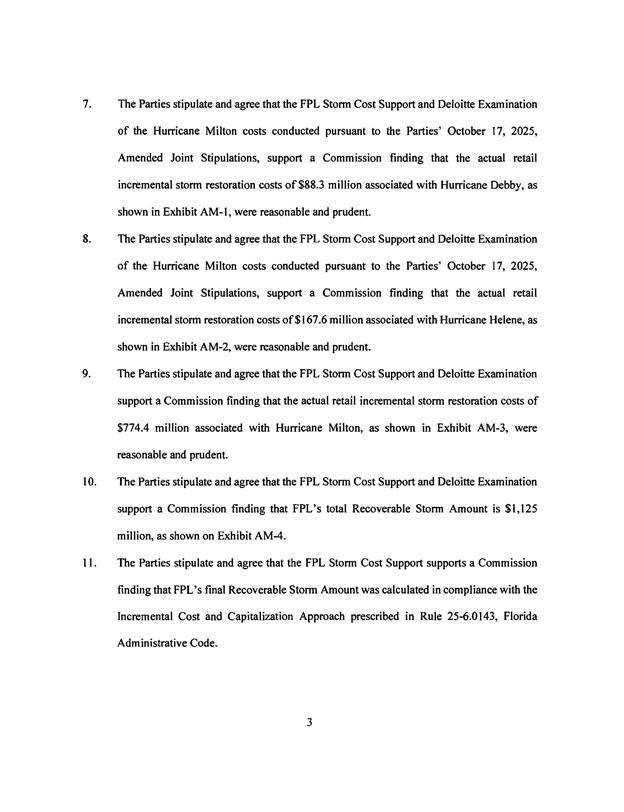
Recommendation:
Since the Stipulations are in agreement with
Commission staff’s recommendations with regard to Issue Nos. 1, 13, 14, and 15,
staff recommends that the Stipulations be approved if the Commission votes to
accept staff’s recommendations on those issues.
With regard to the FPL process issues, staff recommends that they be
approved. (Brownless)
Staff Analysis:
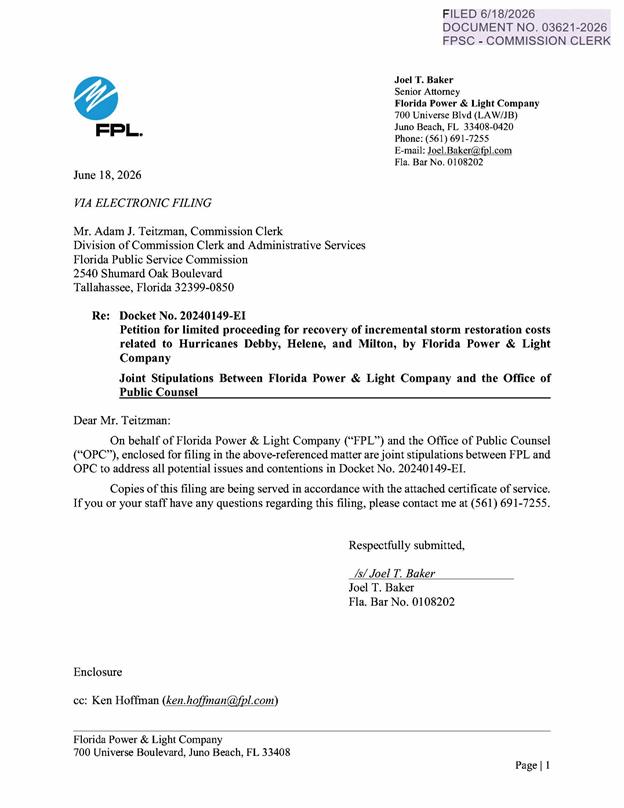
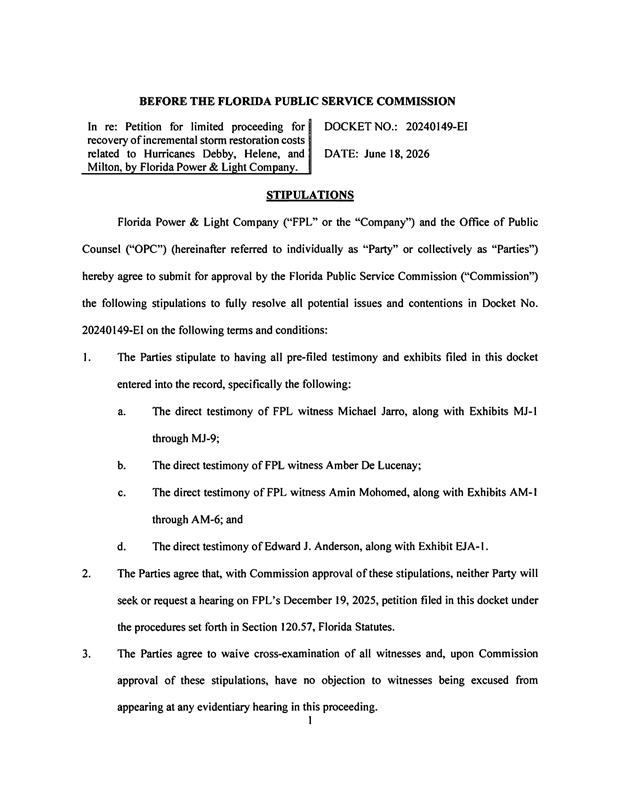
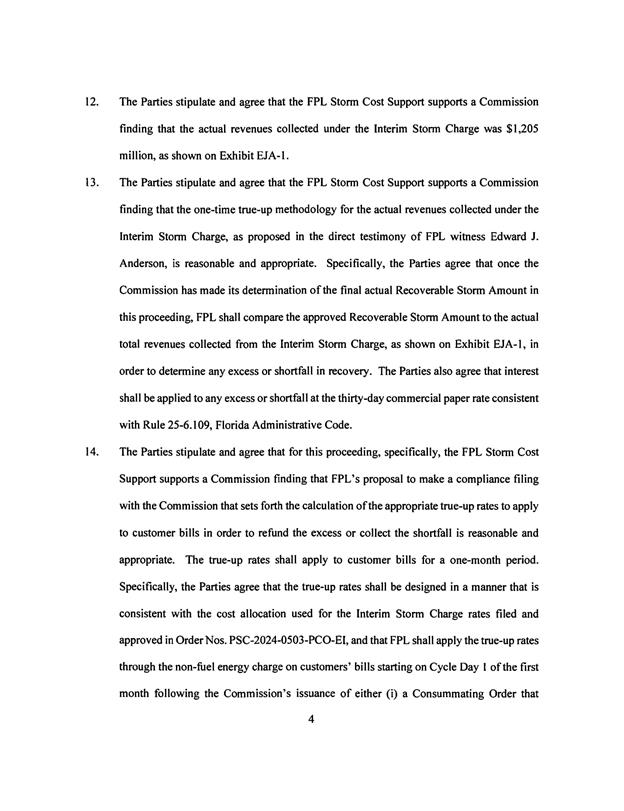
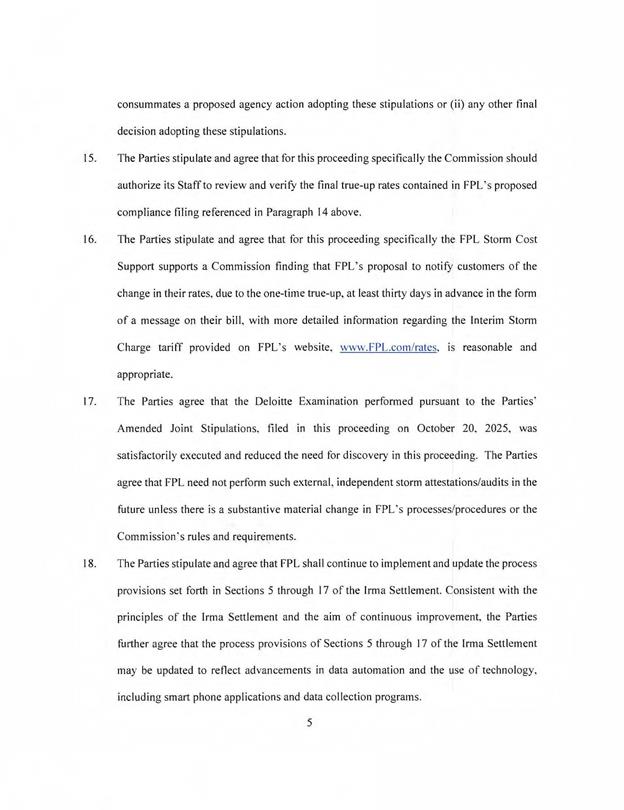
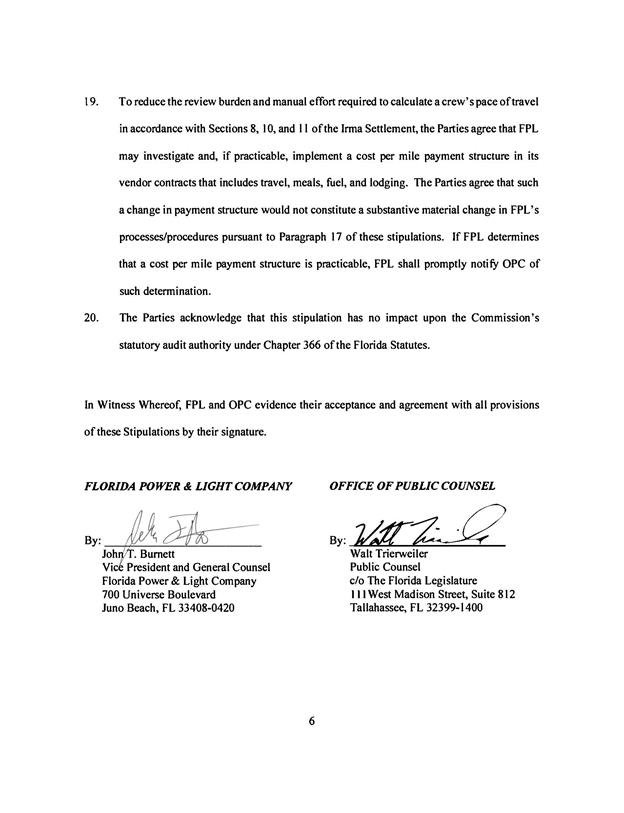
On June 18, 2026, FPL and OPC filed
Stipulations which addressed the following:
1) Procedural
issues regarding testimony, witness appearances, exhibits, and waiver of a request
for hearing if the Stipulations are approved.
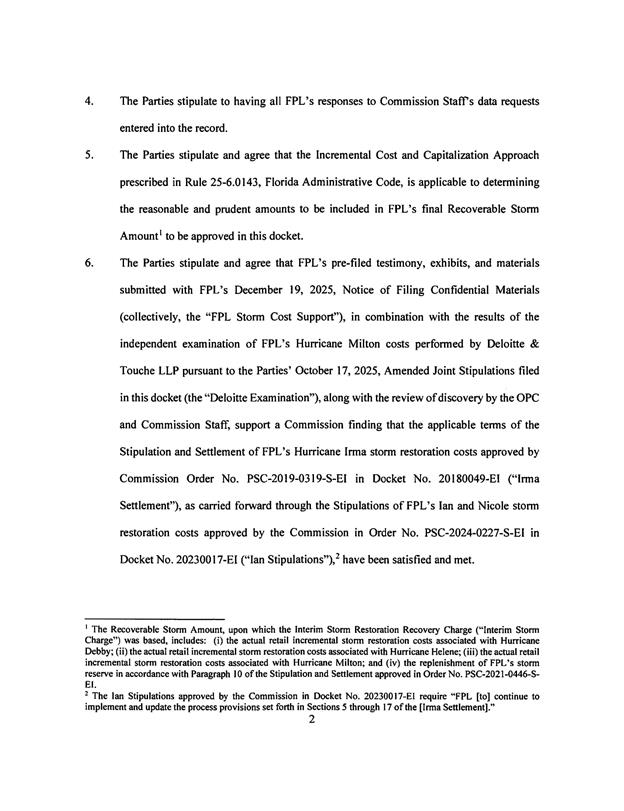
2) Compliance
with the terms of Order No. PSC-2019-0319-S-EI
(Irma Settlement) and Order No. PSC-2024-0227-S-EI (Ian
Stipulations). This conclusion is based
on the Deloitte independent evaluation of Hurricane Milton costs and evaluation
of discovery by OPC and Commission staff.
3) Restoration
costs for Hurricane Debby of $88.3 million; for Hurricane Helene of $167.6
million and Hurricane Milton of $774.4 million.
4) FPL’s
total retail recoverable storm costs of $1.125 billion.
5) Compliance
with the Incremental Cost and Capitalization Approach prescribed in Rule
25-6.0143, F.A.C.
6) Actual
revenues collected under the storm cost recovery surcharge is $1.205 billion.
7) Refund
of the storm cost surcharge over-recovery through the application of true-up rates administratively approved by
Commission staff consistent with the Commission vote for a one-month period
through the non-fuel energy charge starting on Cycle Day 1 after a final
decision adopting the Stipulations.
8) Notification
of the one-time true-up to customers at least thirty days prior the rate
change.
9) There
is no need for third party audits of storm costs in the future unless there is
a substantial and material change in FPL’s processes/procedures or the
Commission’s rules and requirements.
10) FPL will continue to implement and update the
process provisions of Sections 5 through 17 of the Irma Settlement. FPL may implement a cost per mile payment
structure in its contracts that includes travel, meals, fuel and lodging. FPL will notify OPC of implementation of the
cost per mile payment method.
11) OPC and FPL
agree that the Stipulations has no impact on the Commission’s statutory audit
authority.
The Stipulations’ terms can be sorted into five basic
areas: compliance with Rule 25-6.0143, F.A.C.; retail recoverable storm costs;
actual revenues collected pursuant to the storm cost recovery surcharge;
over-charge refund mechanism; and FPL’s processes. There is no provision in the Stipulations
that the Commission must accept all of the terms.
Rule 25-6.0143, F.A.C.
With regard to compliance with Rule 25-6.0143, F.A.C., as
discussed in Issue 1, staff agrees that Rule 25-6.0143’s ICCA approach should
be used to determine the reasonable and prudent amounts included in the storm
restoration costs.
Retail recoverable storm costs and actual revenues
collected
Staff also agrees, as discussed in Issues 13 and 14, that
the total retail recoverable storm costs for Hurricanes Debby, Helene and
Milton is $1.125 billion and that the actual revenues collected pursuant to the
storm cost recovery surcharge is $1.205 billion.
Over-charge refund mechanism
Staff further agrees, as discussed in Issue 15, that the
refund of over-recovered storm costs should be accomplished by an adjustment to
the non-fuel energy charge with interest applied to the excess at the 30-day
commercial paper rate. Staff also agrees
that the true-up rates through the non-fuel energy charge on customer’s bills
should begin on cycle day 1 of the first month that is more than 30 days after
Commission approval. Finally, staff
agrees that it should be given administrative leave to review and approve the
true-up rates that FPL will submit after the Commission’s decision in this case
becomes final.
FPL processes
The process issues agreed to by the parties appear to be
reasonable and practical modifications to the previous process and procedures
approved in the Irma Settlement and Ian
Stipulations. The agreement not to
request a third-party audit in the future is specifically binding on the
parties only, not the Commission.
Conclusion
Since the Stipulations are in agreement with Commission
staff’s recommendations with regard to Issue Nos. 1, 13, 14 and 15, staff
recommends that the Stipulations be approved if the Commission votes to accept
staff’s recommendation on those issues.
With regard to the FPL process issues, staff recommends that they be
approved.
Issue 17:
Should this docket be closed?
Recommendation:
If no timely protest is received to the proposed
agency action, a Consummating Order should be issued upon the expiration of the
protest period, and this docket should be closed. (Brownless)
Staff Analysis:
If no timely protest is received to the proposed
agency action, a Consummating Order should be issued upon the expiration of the
protest period, and this docket should be closed.