Discussion
of Issues
Issue 1:
Should the Commission approve DEF's proposed
underground residential distribution tariffs and associated charges?
Recommendation:
Yes. Staff believes DEF’s proposed
underground residential distribution tariffs as filed in the petition are
cost-based and comply with Rule 25-6.078 F.A.C. The Commission should approve
DEF’s proposed underground residential distribution tariffs and associated
charges as shown in Attachment A, effective on the date of the Commission vote.
(Nguyen)
Staff Analysis:
The URD tariffs provide charges for underground
service in new residential subdivisions and represent the additional costs, if
any, the utility incurs to provide underground service in place of overhead
service. The cost of standard overhead construction is recovered through base
rates from all ratepayers. In lieu of overhead construction, customers have the
option of requesting underground facilities. Any additional cost is paid by the
customer as a contribution-in-aid-of-construction (CIAC). Typically, the URD
customer is the developer of a subdivision.
In prior URD filings, three standard model subdivision
designs have been the basis upon which each IOU submits URD tariff changes for
Commission approval: low density where there are one or more but less than six
dwelling units per acre; high density where there are six or more dwelling
units per acre; and a high density subdivision, where dwelling units take
service at ganged meter pedestals (group of meters at the same physical
location). While actual construction may differ from the model subdivisions,
the model subdivisions are designed to reflect average overhead and underground
subdivisions. In this petition, DEF did not provide a submission for high
density ganged meter services, because DEF does not install services to ganged meter
pedestals any longer. In DEF’s 2024 settlement agreement, installation to
ganged meter pedestals was removed from Part 11.03 of the tariffs.
Costs for underground construction have historically been
higher than costs for standard overhead construction, and the additional cost
is paid by the customer as CIAC. However, DEF’s proposed URD differential
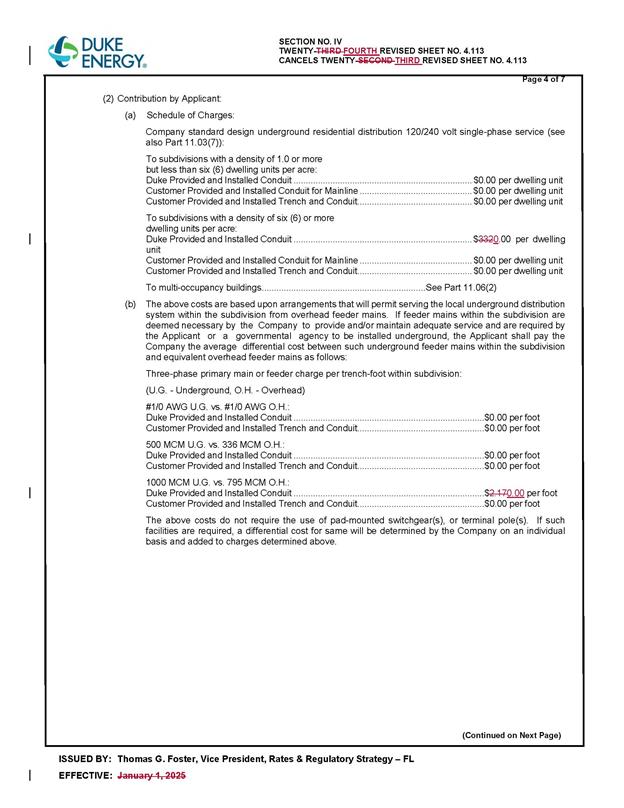
charges remain $0 per lot for the low density and high density subdivisions where
DEF is supplying and installing the conduit. For the high density subdivision
where DEF is supplying and installing the conduit, the proposed differential decreases
from the current $332 to $0 per lot. The decrease in the differential is
attributable to the net present value of life cycle operational costs including
storm restoration and pole attachment revenue causing an offset of any increase
in cost differential since the last URD was approved for DEF in 2023.
Table 1-1 below compares the current and proposed URD
differentials for the low density and high density
meter subdivisions for single-phase service as appears in Section IV, Part
11.03 of the current and proposed URD tariff. The charges shown are per-lot
charges. The proposed URD differential for the high density subdivision is decreasing
due to the impact from Hurricanes Idalia, Debby, Helene and Milton in 2023 and
2024. These storms impacted overhead facilities more than underground facilities
resulting in a 185 percent increase (from -$550 in 2023 to -$1565 in 2026) in
the credit toward the differential.
Table 1-1
Comparison of URD
Differential per Lot (Single-Phase Service)
|
Subdivision Designs
|
Current
URD Differential
|
Proposed
URD Differential
|
|
Low Density
|
$0
|
$0
|
|
High Density
|
$332
|
$0
|
Source:
Order No. PSC-2023-0255-TRF-EI (Current) and DEF’s 2026 Petition (Proposed).
The calculations of the proposed URD charges include: (1)
updated labor and material costs along with the associated loading factors and
(2) operational costs. The costs are discussed below.
Updated Labor and Material Costs
The installation costs of both overhead and underground
facilities include the labor and material costs to provide primary, secondary,
and service distribution lines, as well as transformers. The costs of poles are
specific to overhead service while the costs of trenching and backfilling are
specific to underground service. The utilities are required by Rule
25-6.078(5), F.A.C., to use current labor and material costs.
DEF’s labor costs for overhead and underground
construction are comprised of costs associated with work performed by both
in-house employees and outside contractors. DEF’s contracted labor rates are
based upon actual labor costs negotiated in bargaining unit contracts and labor
rates with contractors. Table 1-2 shown below compares total 2023 and 2026
labor and material costs per lot for the two subdivision designs.
Table 1-2
Labor and Material Costs Per
Lot for DEF Trench and Install Conduit
|
Subdivision Designs
|
2023 Costs
|
2026 Costs
|
Difference
|
|
Low Density
|
|
Underground Labor/Material Costs
|
$3,454
|
$3,506
|
$52
|
|
Overhead Labor/Material Costs
|
$2,749
|
$3,231
|
$482
|
|
Per Lot Differential
|
$705
|
$275
|
$(430)
|
|
High Density
|
|
Underground Labor/Material
Costs
|
$3,003
|
$3,553
|
$550
|
|
Overhead Labor/Material Costs
|
$2,121
|
$2,266
|
$145
|
|
Per Lot Differential
|
$882
|
$1,287
|
$405
|
Source: Order No. PSC-2023-0255-TRF-EI
(Current) and DEF’s 2026 Petition (Proposed).
As Table 1-2 shows, the majority of the proposed overhead
and underground total labor and material costs have increased since the current
URD charges were approved in 2023. As reflected, the 2026 costs for overhead
and underground labor and materials are higher for both subdivision designs,
although a greater increase has occurred for overhead, compared to underground.
In a data request response, DEF stated overhead costs have escalated more
rapidly than underground costs because underground costs have stabilized after
a large increase during the 2020 to 2023 time period.
Updated Operational Costs
Rule 25-6.078(4), F.A.C., requires that the differences in
net present value (NPV) of operational costs between overhead and underground
systems, including average historical storm restoration costs over the life of
the facilities, be included in the URD charge. The inclusion of the operational
cost is intended to capture longer term costs and benefits of undergrounding.
Operational costs include operations and maintenance costs
along with capital costs and represent the cost differential between
maintaining and operating an underground versus an overhead system over the
life of the facilities. The inclusion of the storm restoration cost in the URD
calculations lowers the differential, since an underground distribution system
generally incurs less damage than an overhead system as a result of a storm,
and therefore, incurs less restoration costs when compared to an overhead
system.
The utility used a 5-year average of historical,
operational costs (2020-2024) for its calculations in this docket. The
methodology used by DEF in this filing for calculating the NPV of operational
costs was approved in Order No. PSC-12-0348-TRF-EI.
Staff notes that operational costs may vary among IOUs due to multiple factors,
including differences in size of service territory, miles of coastline, regions
subject to extreme winds, age of the distribution system, or construction
standards.
Table 1-3 shown below presents information on costs that
are reflected in the URD tariffs for the two subdivision designs. The table
shows the result of adding the proposed 2026 overhead and underground labor and
materials cost differentials, as found in Table 1-2, and the NPV of operational
costs differentials, including storm costs, to calculate the proposed total
cost differential for each design. Note that the per lot differential costs
appearing in parentheses are negative values, indicating the overhead costs
exceed the underground costs.
Table 1-3
DEF Updated
Overhead/Underground Cost Differential
|
Subdivision Design
|
2026 Labor and Materials Differential
(A)
|
2026 NPV of Operational
Costs Differential
(B)
|
Total Cost Differential Supporting
Proposed URD
(C) = (A) + (B)
|
|
Low Density
|
$275
|
$(2,051)
|
$(1,776)
|
|
High Density
|
$1,287
|
$(1,565)
|
$(278)
|
Source: Exhibit C of DEF’s 2026
Petition.
Negative total cost differentials, as shown in Table 1-3
for both the low density and high density designs, result in the proposed URD
differential of $0, as shown in Table 1-1. For both designs, DEF’s positive
labor and material cost differential is completely offset by their negative NPV
of operational costs differential.
Other Proposed Tariff Changes
Tariff Sheet No. 4.113 of the utility’s proposed URD
tariff includes the per foot charge for three-phase primary main or feeder
mains that need to be installed underground. DEF states the cost for
underground feeders decreased approximately 3 percent while overhead feeder
costs increased by approximately 10 percent. The
net result of this was a decrease in the per foot differential for three-phase
primary main conduit provided and installed by DEF, which is proposed to change
from $2.17 per foot to $0.
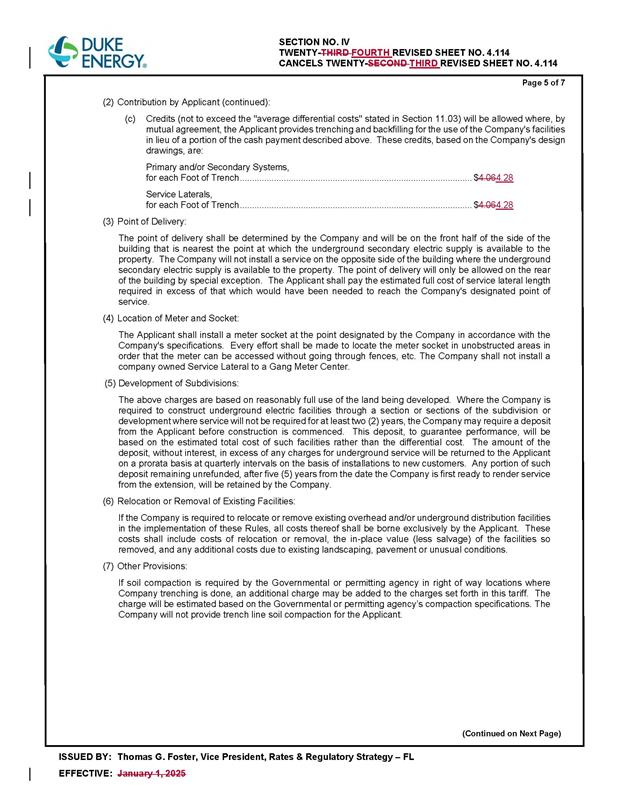
Tariff Sheet No. 4.114 of the utility’s proposed URD
tariff includes the credits per each foot of trench for applicant provided
trenching and backfilling for the use of the utility’s facilities in the case
of both service laterals and primary or secondary systems. Increasing labor and
material costs impacted the credits that are available to an applicant
(customer) when the applicant provides the trenching and backfill for both
primary and/or secondary systems and service laterals. Such credits are
proposed to increase from $4.06 to $4.28 per foot of trench.
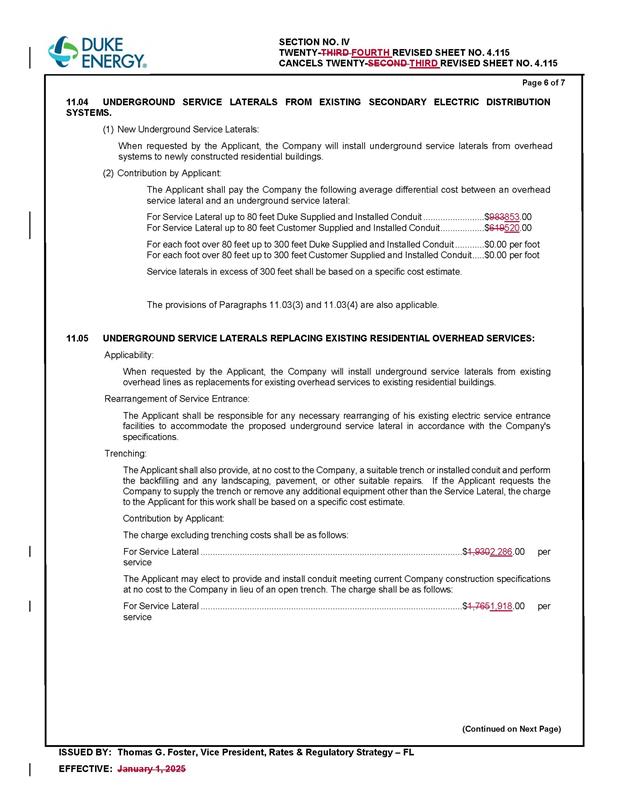
Section IV, Part 11.04 of the utility’s proposed URD
tariff includes the charge for underground service laterals from existing
secondary electric distribution systems. In the proposed URD tariff, there is a
requested decrease in the charge for DEF supplied and installed conduit
(service laterals, up to 80 feet) from $983 to $853. For customer supplied and
installed conduit, the proposed decrease is $619 to $520.
Section IV, Part 11.05 of the utility’s proposed URD
tariff includes the charge for underground service laterals replacing existing
residential overhead services. The costs for this service have increased
compared to costs approved in 2023. DEF states in response to Staff’s First Data
Request that the cost to remove the existing overhead service and the remaining
undepreciated value of the overhead service is higher.
DEF proposes to increase its charge for installed conduit service lateral from
$1,930 to $2,286 per service. The utility proposes to increase its customer
installed conduit service lateral from $1,765 to $1,918 per service.
Conclusion
Staff has reviewed DEF’s proposed underground distribution
tariffs and associated charges, its accompanying work papers, and the utility’s
responses to Staff’s Data Request. Based on this review, staff believes DEF’s proposed
underground residential distribution tariffs as filed in the petition are
cost-based and comply with Rule 25-6.078, F.A.C. The Commission should approve
DEF’s proposed underground residential distribution tariffs and associated
charges as shown in Attachment A, effective on the date of the Commission vote.
Issue 2:
Should this docket be closed?
Recommendation:
If Issue 1 is approved and a protest is filed within
21 days of the issuance of the order, the tariffs should remain in effect, with
any revenues held subject to refund, pending resolution of the protest. If no
timely protest is filed, this docket should be closed upon the issuance of a Consummating
Order. (Brownless)
Staff Analysis:
If Issue 1 is approved and a protest is filed within
21 days of the issuance of the order, the tariffs should remain in effect, with
any revenues held subject to refund, pending resolution of the protest. If no
timely protest is filed, this docket should be closed upon the issuance of a Consummating
Order.