Discussion
of Issues
Issue 1:
Should the Commission approve FPL's proposed URD
tariffs and associated charges?
Recommendation:
Yes. Staff believes FPL’s proposed URD tariffs and
associated charges as filed in the petition are cost-based and recommends
approval. The Commission should approve FPL’s proposed URD tariffs and
associated charges as shown in Attachment A, effective 30 days after the
Commission vote. (Ward)
Staff Analysis:
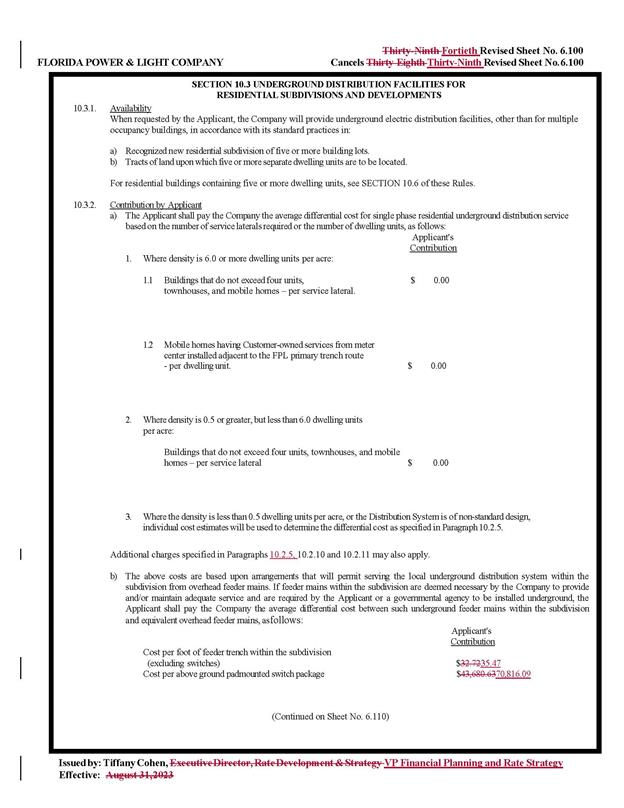
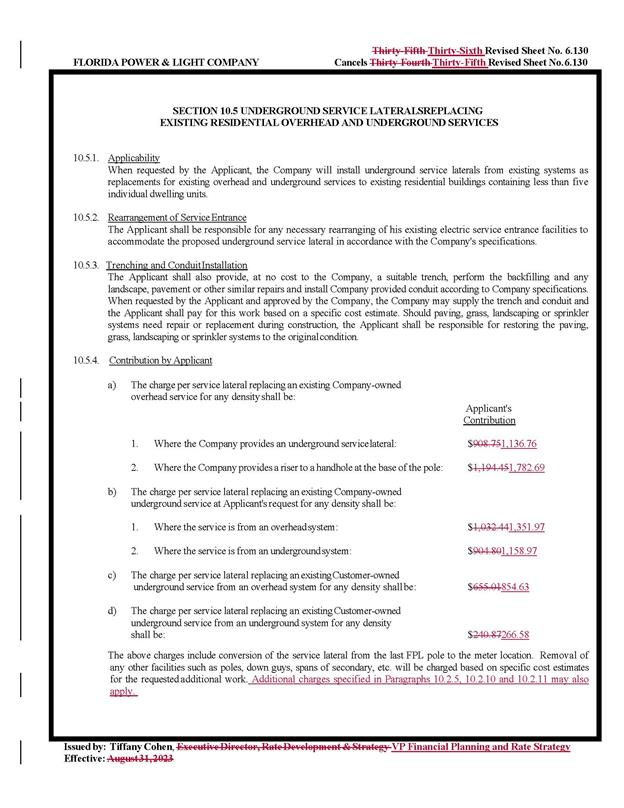
The URD tariffs provide standard charges for
underground service in new residential subdivisions and represent the
additional costs, if any, the utility incurs to provide underground service in
place of overhead service. The cost of standard overhead construction is
recovered through base rates from all ratepayers. In lieu of overhead
construction, customers have the option of requesting underground facilities.
Typically, the developer of a new residential subdivision would be the utility
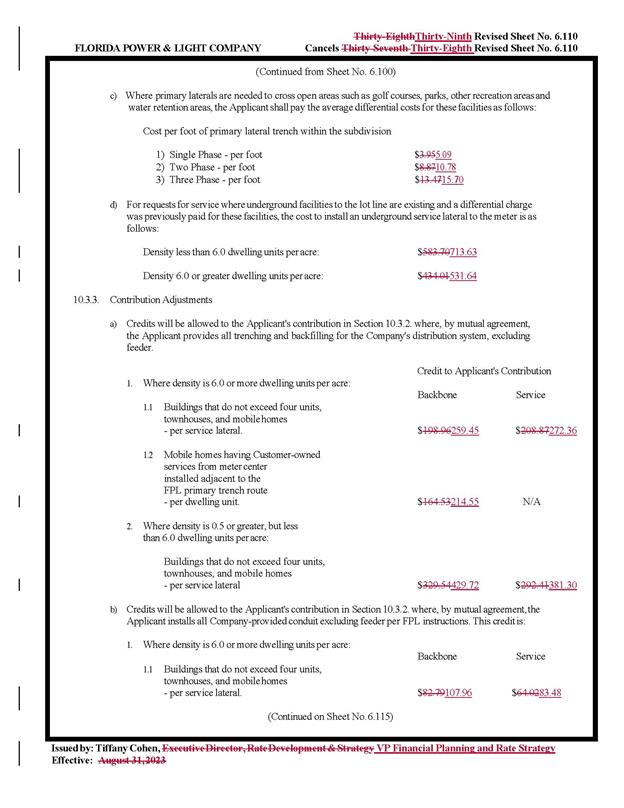
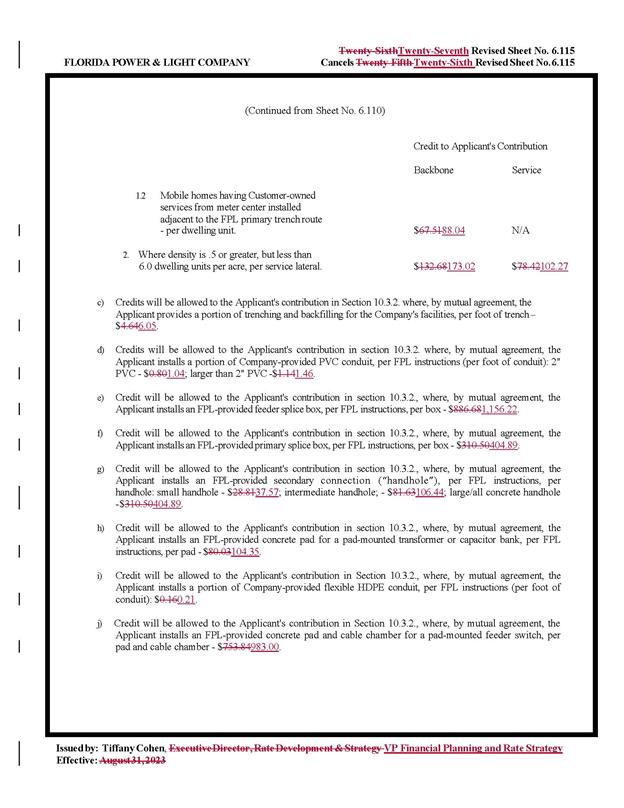
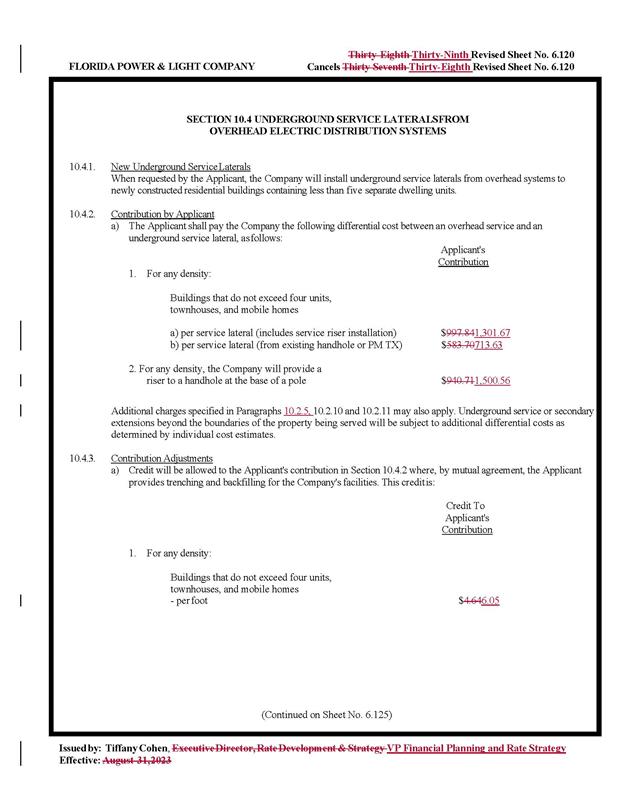
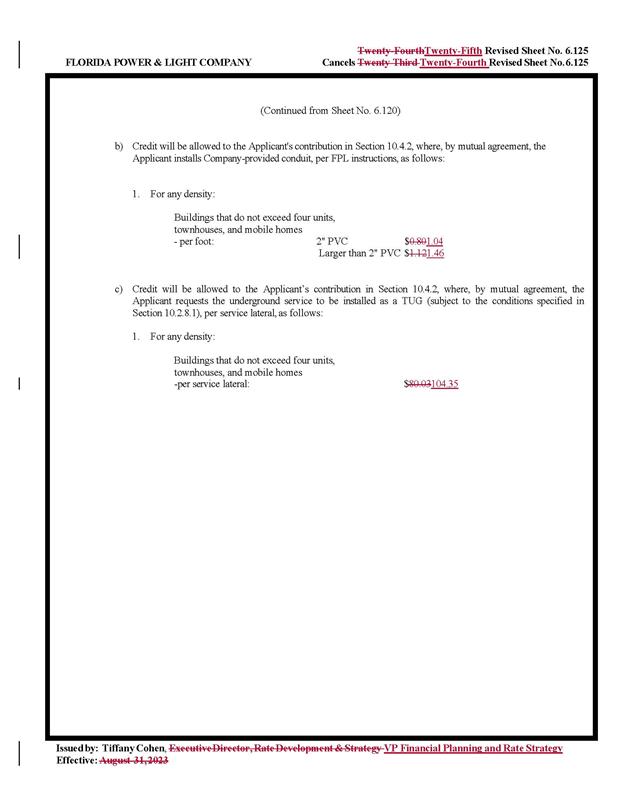
customer utilizing the URD tariffs. FPL’s proposed URD tariffs are provided on
pages 3 through 9 of Attachment A.
Traditionally, three standard model subdivision designs
have been the basis upon which each investor-owned utility submits URD tariff
changes for Commission approval: low density, high density, and a high density
subdivision where dwelling units take service at ganged meter pedestals (groups
of meters at the same physical location). Examples of this last subdivision
type include mobile home and recreational vehicle parks. While actual
construction may differ from the model subdivisions, the model subdivisions are
designed to reflect average overhead and underground subdivisions.
In its petition, the utility updated its cost calculations
and supporting documentation for the three subdivision models cost
differentials. The currently approved cost differentials are $0.00 for all
three subdivision models. As shown on Table 1-1, FPL's proposed URD
differential charges remain zero for all three subdivision models. A zero URD
differential charge is typically the result of the avoided storm restoration
costs associated with underground facilities, offsetting any higher labor and
material costs associated with underground construction.
Table 1-1
Comparison of Differential
per Service Lateral
|
Types of
Subdivision
|
Current URD Differential
|
Proposed URD Differential
|
|
Low Density
|
$0
|
$0
|
|
High Density
|
$0
|
$0
|
|
Meter Pedestal
|
$0
|
$0
|
Sources: 2023 Order and FPL’s 2026 filing.
Two primary factors impacted the calculation of FPL’s
proposed URD charges which are discussed in greater detail below: (1) updated
labor and material costs and (2) updated operational costs.
Updated Labor and Material Costs
The installation costs of both underground and overhead
facilities include the labor and material costs to provide primary, secondary,
and service distribution lines as well as transformers. The costs of poles are
specific to overhead service while the costs of trenching and backfilling are
specific to underground service. Table 1-2 compares the currently approved 2023
costs and 2026 costs for underground and overhead labor and material for the
three subdivision models.
Table 1-2
Labor and Material Costs
|
Low Density
|
2023 Costs
|
2026 Costs
|
Difference
|
|
Underground Labor/Material Costs
|
$3,452.54
|
$4,654.62
|
$1,202.08
|
|
Overhead Labor/Material Costs
|
$2,543.92
|
$3,561.73
|
$1,017.81
|
|
Per Service Lateral Differential
|
$908.62
|
$1,092.89
|
$184.27
|
|
High Density
|
|
Underground Labor/Material Costs
|
$2,317.97
|
$3,079.53
|
$761.56
|
|
Overhead Labor/Material Costs
|
$1,921.50
|
$2,424.31
|
$502.81
|
|
Per Service Lateral Differential
|
$396.47
|
$655.22
|
$258.75
|
|
Meter Pedestal
|
|
Underground Labor/Material Costs
|
$1,485.47
|
$2,045.92
|
$560.45
|
|
Overhead Labor/Material Costs
|
$1,533.74
|
$1,924.96
|
$391.22
|
|
Per Service Lateral Differential
|
($48.27)
|
$120.96
|
$169.23
|
Sources: 2023 Order and FPL’s 2026 filing.
While both overhead and underground labor and material
costs increased, underground costs increased at a higher rate, resulting in an
increase in the differential. In response to staff’s data request, response no.
1, the utility explained that the higher overhead and underground construction
costs are primarily driven by increased material costs and underground labor
increasing more than overhead labor.
Updated Operational Costs
Rule 25-6.078(4), F.A.C., provides that the differences in
net present value of operational costs between overhead and underground
systems, including average historical storm restoration costs over the life of
the facilities, be included in the URD charge. Operational costs include
operations and maintenance costs and capital costs. The inclusion of the
operational costs is intended to capture longer term costs and benefits of
undergrounding. In response to staff’s data request, FPL stated that the
current URD petition incorporates costs from hurricane events Idalia, Debby,
Helene, and Milton. FPL’s methodology to calculate the operational costs was
approved in Order No. PSC-08-0774-TRF-EI and remains the same in the instant
docket.
Table 1-3 presents the pre-operational (shown in Table
1-2), non-storm operational, and the avoided storm restoration cost
differentials between overhead and underground systems. The proposed
differential is $0 when the calculation results in a negative number.
Table 1-3
Components of the URD
Charges
|
Type of Subdivision
|
Pre-Operational
Costs (A)
|
Non-Storm
Operational Costs (B)
|
Avoided Storm Costs
(C)
|
Proposed URD
Differentials (A)+(B)+(C)
|
|
Low Density
|
$1,092.89
|
($1,757)
|
($1,236)
|
$0
|
|
High Density
|
$655.22
|
($1,491)
|
($1,236)
|
$0
|
|
Meter Pedestal
|
$120.96
|
($1,491)
|
($1,236)
|
$0
|
Source: FPL’s 2026 filing.
Conclusion
Staff has reviewed FPL’s proposed changes to its URD
tariffs and associated charges, the accompanying work papers, and responses to
staff’s data request. Staff believes FPL’s proposed URD tariffs and associated
charges as filed in the petition are cost-based and recommends approval of the
tariffs shown in Attachment A. Staff recommends that the tariffs be made
effective 30 days after the Commission vote.
Issue 2:
Should the Commission approve FPL's proposed UCD
tariffs and associated charges?
Recommendation:
Yes. The Commission should approve FPL’s proposed
UCD tariffs and associated charges as shown in Attachment A, effective 30 days
after the Commission vote. Staff reviewed FPL’s supporting documentation for
the UCD charges and believes the charges are cost based and reasonable. (Ward)
Staff Analysis:
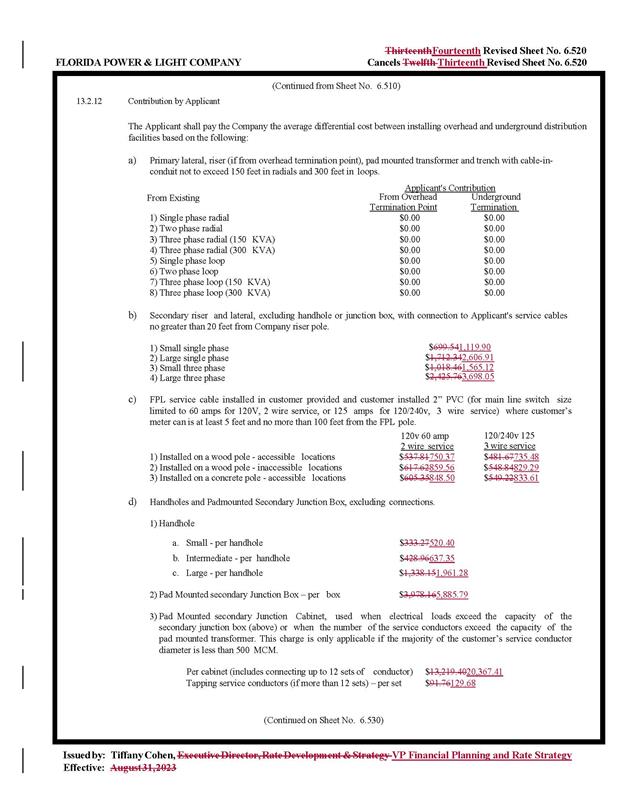
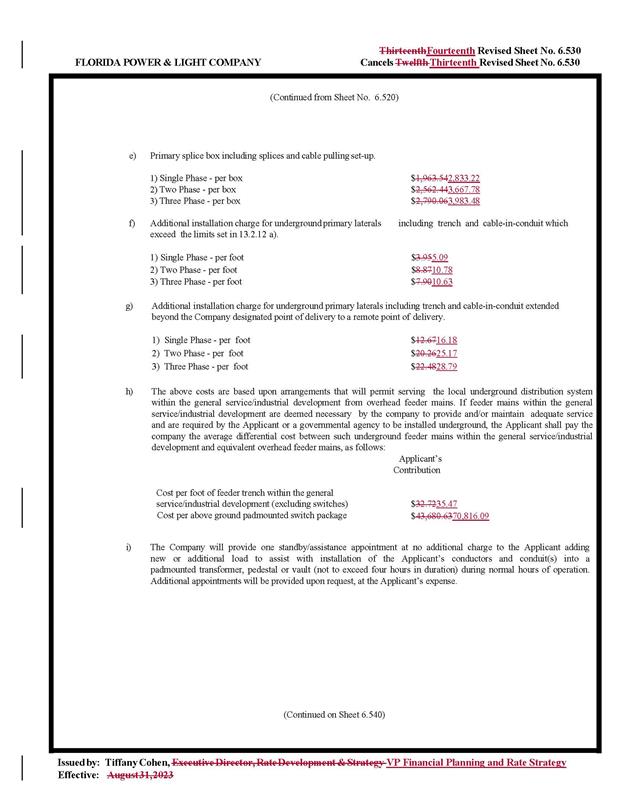
Utilities are not required to file UCD tariffs
pursuant to Rule 25-6.078, F.A.C.; however, as in prior URD petitions, FPL
included proposed UCD tariffs in its petition. The UCD tariffs apply to small
commercial or industrial customers (applicant) that request the installation of
underground electric distribution facilities for a new building. The requested
underground distribution facilities consist of underground service conductors,
placed in conduit, and associated equipment that is installed from overhead
feeder mains (or an overhead termination point) to the designed point of
delivery (where the utility’s wires are connected to those of the customer).
FPL’s proposed UCD tariffs are provided on pages 18 through 20 of Attachment A.
The UCD charges represent the differential costs for
underground commercial facilities and their equivalent overhead design. The
calculations provided by FPL in its petition employ FPL's standard engineering
design criteria and are based on actual 2025 labor and material costs. Unlike
the URD calculations, the UCD calculations do not include long term operational
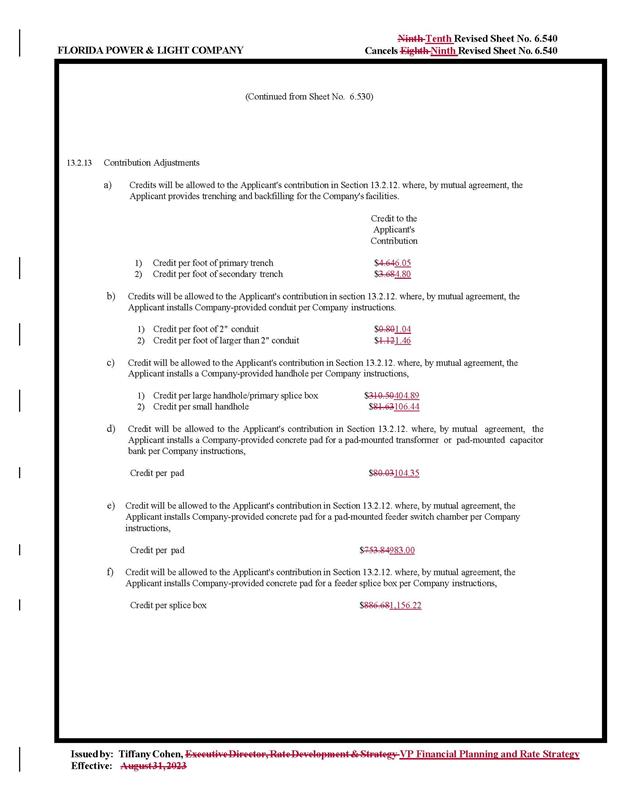
and avoided storm restoration costs. In addition, the UCD tariffs provide
credits that apply if the applicant provides trenching, backfilling, or
installs FPL provided conduit or a concrete pad for a pad-mounted transformer.
Staff reviewed FPL’s supporting documentation for the UCD
charges and believes the charges are cost based and reasonable. Staff
recommends that the UCD tariffs and associated charges be approved, effective
30 days after the Commission vote.
Issue 3:
Should the Commission approve FPL’s proposed CIAC
tariffs?
Recommendation:
Yes. Staff reviewed FPL’s proposed modifications to
its CIAC tariffs and believes that the modifications provide better clarity and
transparency for its customers. The Commission should approve FPL’s proposed
CIAC tariffs, effective 30 days after the Commission vote. (Ward)
Staff Analysis:
Rule 25-6.064, F.A.C., provides the standard
calculation for the CIAC to be paid by a customer. Under this formula, a
customer’s CIAC is intended to cover the non-economic portion of that
customer’s requested new or upgraded facilities. The non-economic portion of a
customer’s requested new or upgraded facilities refers to the portion of the
project cost not expected to be recovered from the customer’s estimated
incremental base revenues recovered during the four years following the in-service
date. The purpose of CIAC is to protect the general body of ratepayers from
subsidizing customer-specific facilities that will not pay for themselves
through the requesting customer’s own base revenues within that four-year
period.
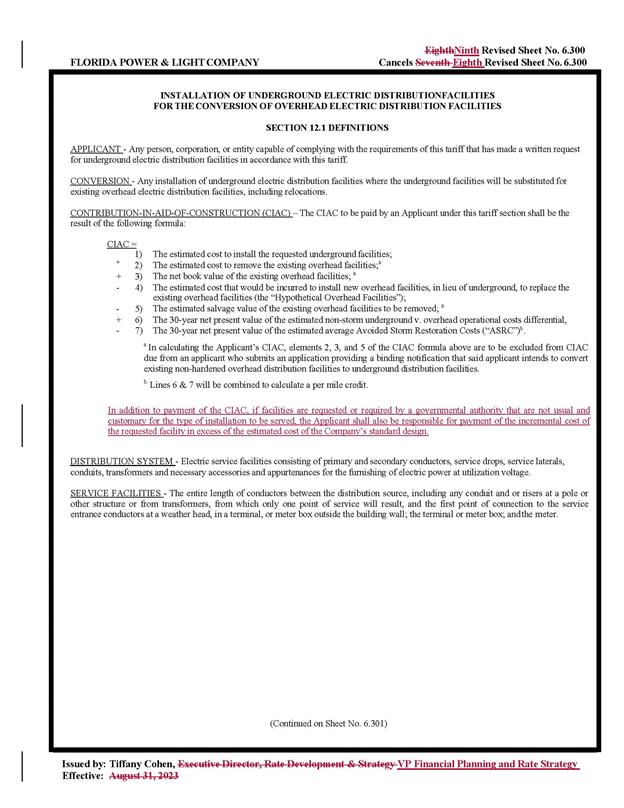
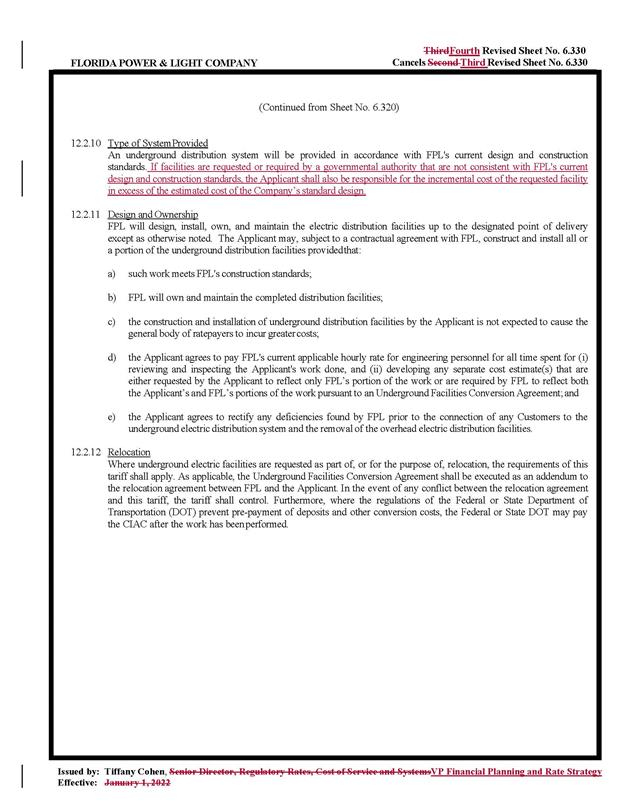
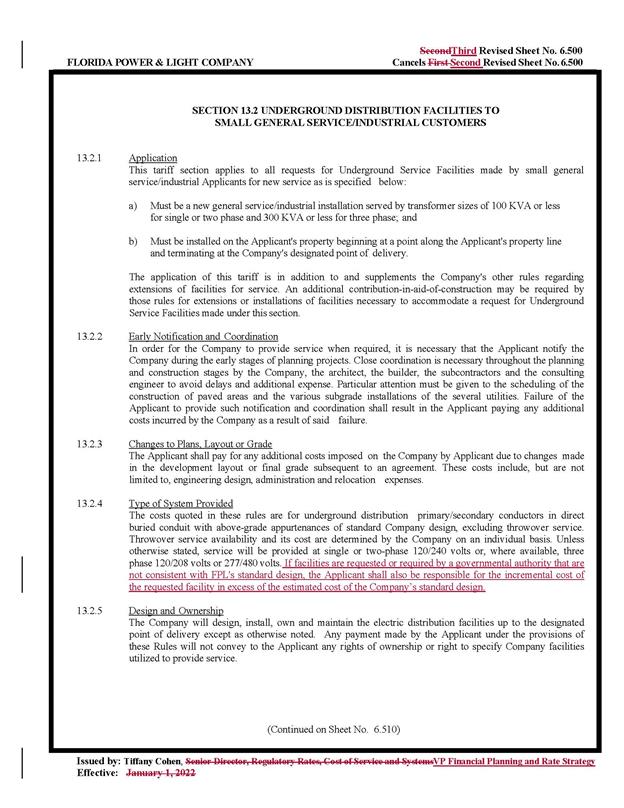
CIAC Tariff Modifications
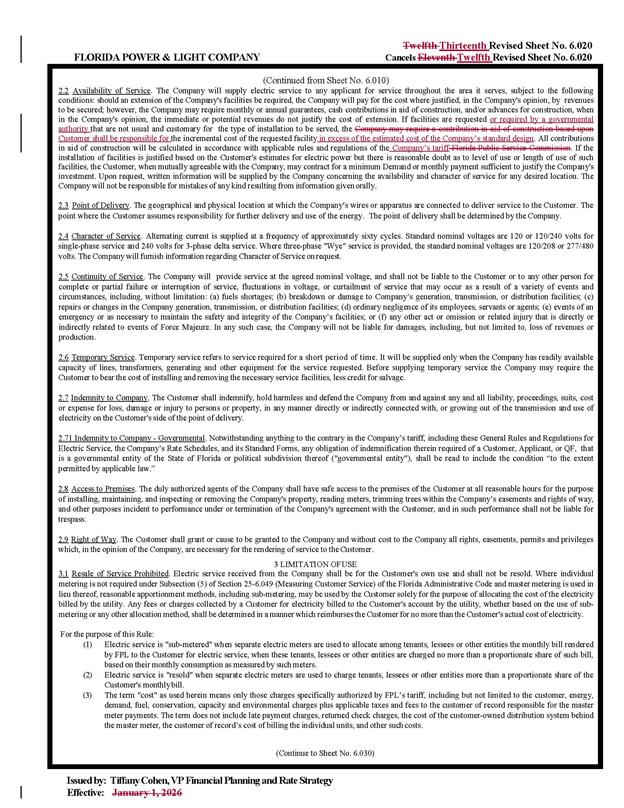
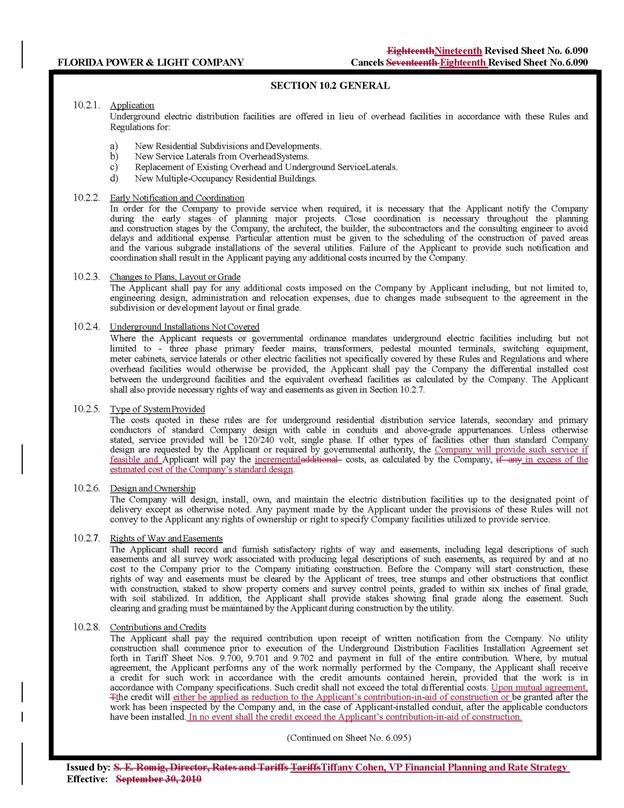
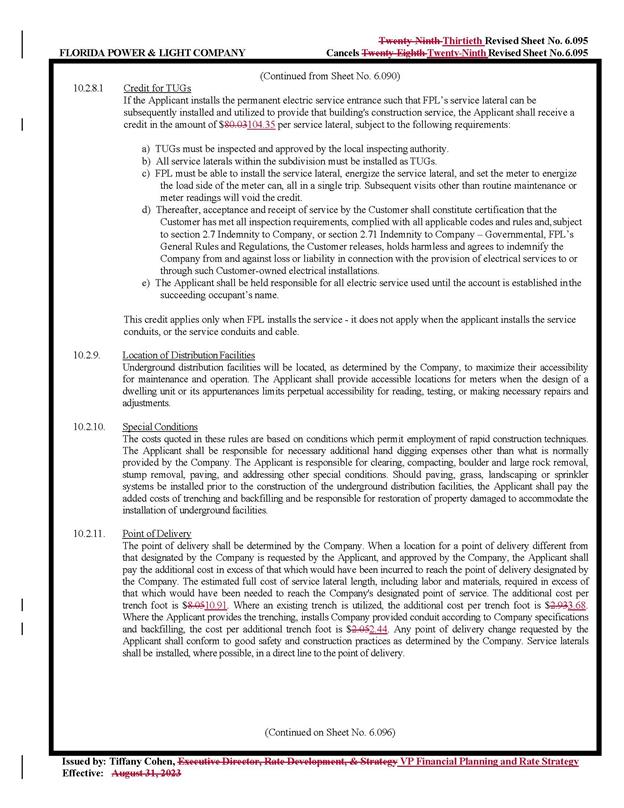
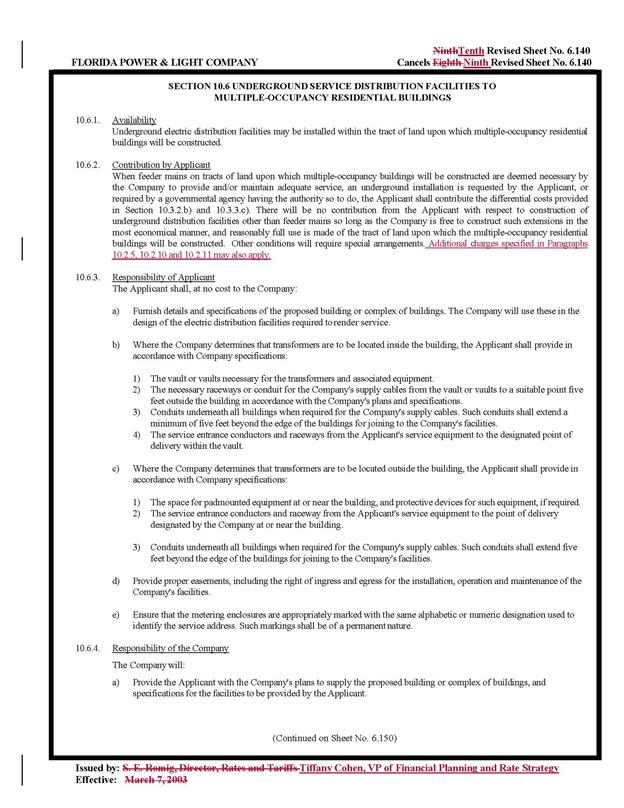
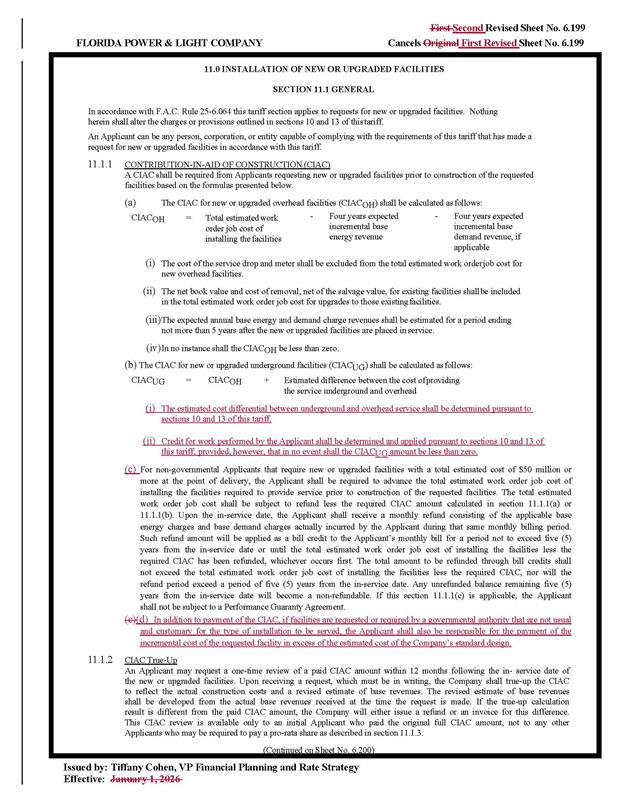
In its petition, FPL stated that it is seeking Commission
approval to modify its CIAC tariff provisions to more clearly state that, in
addition to payment of the required CIAC, if facilities are requested or
required by a governmental authority that are not usual and customary for the
type of installation to be served, the customer shall also be responsible for
the payment of the incremental cost of the requested facility in excess of the
estimated cost of the utility’s standard design. FPL is proposing to
incorporate this clarifying language into Tariff Sheet Numbers 6.020, 6.090,
6.100, 6.120, 6.130, 6.140, 6.199, 6.300, 6.330, and 6.500. FPL affirmed in its
petition that this clarification will not change or otherwise modify FPL’s
current CIAC calculation or application, but rather provides greater clarity to
all customers seeking new or expanded service and mitigates potential confusion
regarding cost responsibility for non-standard designs and facilities. These
tariffs are provided on pages 1, 2, 4, 7, 9, 10, 11, 13, 15, and 16 of
Attachment A, respectively.
Additionally, FPL is seeking approval of a revision to
Tariff Sheet No. 6.020 to clarify that all CIAC shall be calculated pursuant to
the rules and regulations of FPL’s Commission-approved tariffs. FPL asserts
that this proposed modification to Tariff Sheet No. 6.020 will better reflect
and remove ambiguity regarding the application of all FPL’s Commission-approved
tariffs when determining a customer’s CIAC.
FPL is also seeking approval of a revision to Tariff Sheet
No. 6.199 to provide greater guidance on the overhead to underground
differential and credits used to calculate the CIAC for customers requesting
underground service. Specifically, FPL is proposing to add language that
clarifies to customers that the estimated differential cost and available
credits for underground service are to be determined pursuant to the
Commission-approved URD and UCD tariffs, and that in no event shall the CIAC
for underground service be less than zero. FPL stated that this language is
consistent with its current practice and is meant to provide better guidance to
customers seeking underground service.
Next, FPL is seeking Commission approval to revise Tariff
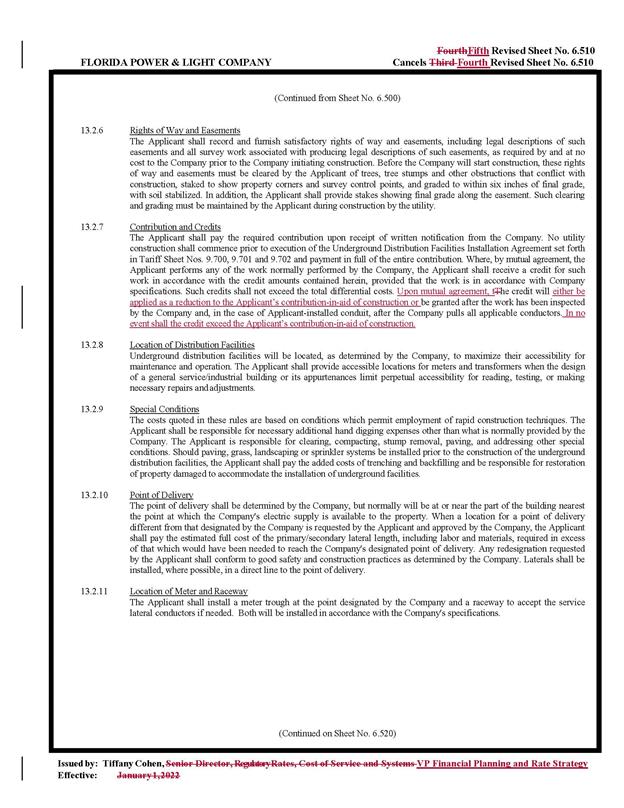
Sheet Nos. 6.090 and 6.510 to clarify that credits received by an applicant for
the underground work the applicant performs shall, upon mutual agreement, be
applied either as a reduction to the applicant’s CIAC or granted after the
applicant’s work is completed, but in no event shall the credit exceed the CIAC
amount due from the applicant. The utility stated that this clarification
better reflects its current practice and preferences. Tariff Sheet No. 6.510 is
provided on page 17 of Attachment A.
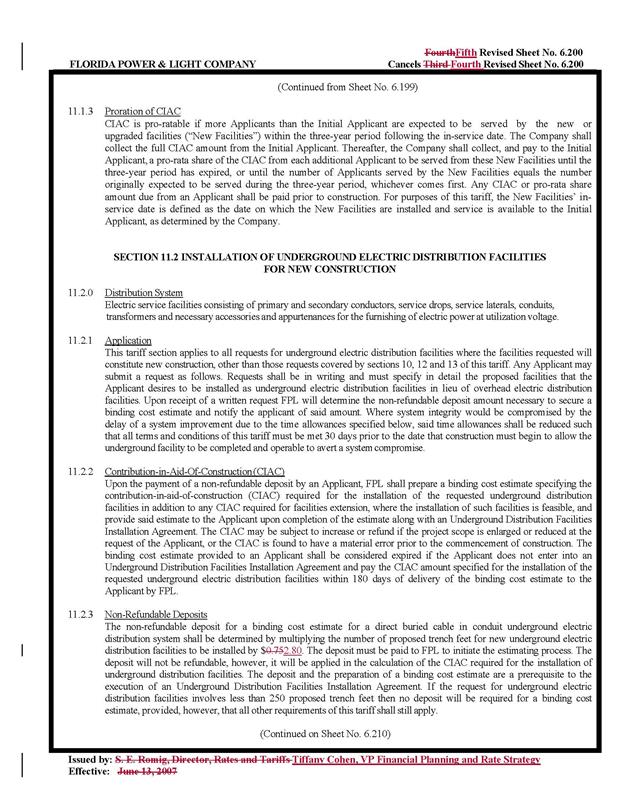
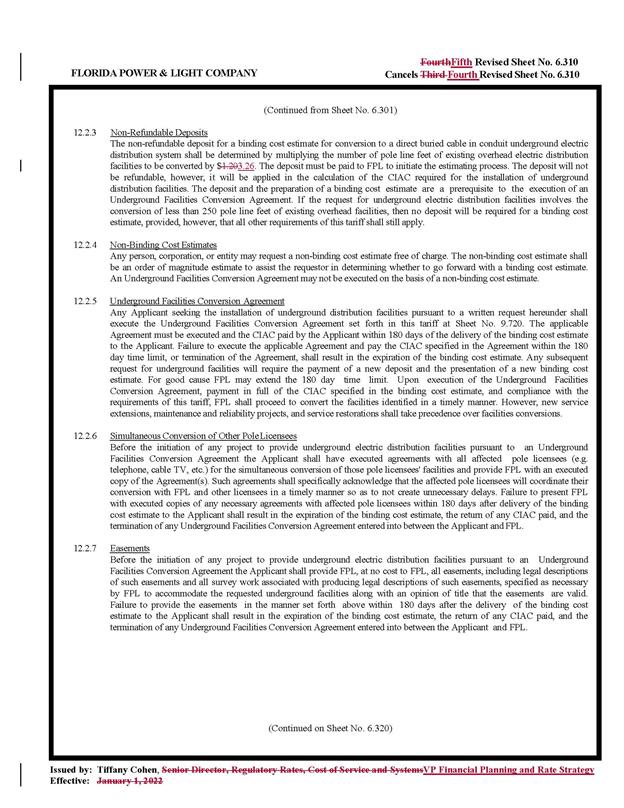
Finally, FPL is seeking Commission approval to update the
deposit amounts required for a binding cost estimate under URD Tariff Sheet No.
6.200 and UCD Tariff Sheet No. 6.310. FPL stated that this update is
appropriate to better reflect current costs for preparing a cost estimate for
an applicant requesting underground service pursuant to the URD and UCD tariffs
and to mitigate the potential risk of subsidization by the general body of
ratepayers. Tariff Sheet Nos. 6.200 and 6.310 are provided on pages 12 and 14
of Attachment A, respectively.
In response to staff’s data request, response no. 9, FPL
affirmed that the purpose of the proposed CIAC tariff revisions is to provide
better transparency and clarity to customers or applicants requesting new or
extended service. FPL additionally confirmed that the proposed changes are
already in effect and in practice.
Conclusion
Staff reviewed FPL’s proposed modifications to its CIAC
tariff and believes that the modifications provide better clarity and
transparency for its customers. Staff recommends approval of the proposed CIAC
tariff modifications, effective 30 days after the Commission vote.
Issue 4:
Should this docket be closed?
Recommendation:
If a protest is filed within 21 days of the issuance
of the order, the tariffs should remain in effect, with any revenues held
subject to refund, pending resolution of the protest. If no timely protest is
filed, this docket should be closed upon the issuance of a consummating order.
(Thompson)
Staff Analysis:
If a protest is filed within 21 days of the issuance
of the order, the tariffs should remain in effect, with any revenues held
subject to refund, pending resolution of the protest. If no timely protest is
filed, this docket should be closed upon the issuance of a consummating order.