Case Background
On April 1, 2026,
Tampa Electric Company (TECO or utility) filed a petition for approval of
revisions to its Underground Residential Distribution (URD) tariffs and
associated charges. These tariffs represent the additional costs, if any, TECO
incurs to provide underground service in place of overhead service in new
residential subdivisions. TECO’s current URD charges were approved in Order No.
PSC-2023-0211-TRF-EI (2023 Order). The proposed URD tariffs are attached to
the recommendation as Attachment A.
The petition was filed pursuant to Rule 25-6.078(3),
Florida Administrative Code (F.A.C.), which states, in part, “If the cost
differential as calculated in Form PSC 1031 (08/20) varies from the
Commission-approved differential by plus or minus 10 percent or more, the
utility shall file a written policy and supporting data and analyses as
prescribed in subsections (1), (4) and (5) of this rule on or before April 1 of
the following year; however, each utility shall file a written policy and
supporting data and analyses at least once every 3 years.”
The ten percent threshold outlined by the rule has not
been met or exceeded since TECO’s last URD tariff filing.
Because it has been three years since TECO last updated its URD tariff, TECO
filed updated URD tariff sheets in the subject docket.
The Commission suspended the proposed tariffs by Order No.
PSC-2026-0158-PCO-EI, issued May 19, 2026, to allow staff sufficient time to
analyze the utility’s filing, pursuant to Section 366.06(3), Florida Statutes
(F.S.). Staff issued one data request to the utility on June 12, 2026, for
which response was provided on June 26, 2026.
The Commission has jurisdiction over this matter pursuant to Sections 366.03,
366.04, 366.05, and 366.06, F.S.
Discussion
of Issues
Issue 1:
Should the Commission approve TECO's proposed
underground residential distribution tariffs and associated charges?
Recommendation:
Yes, the Commission should approve TECO’s proposed underground
residential distribution tariffs and associated charges, effective on the date
of the Commission vote. The proposed URD charges are cost-based and staff
recommends approval
of the tariffs shown in Attachment A. (P. Kelley)
Staff Analysis:
Rule 25-6.078 F.A.C, defines investor-owned
utilities’ (IOU) responsibilities for filing updated URD tariffs. The URD
tariffs provide standard charges for underground service in new residential
subdivisions and represent the additional costs, if any, the utility incurs to
provide underground service in place of overhead service. The cost of standard
overhead construction is recovered through base rates from all ratepayers. In
lieu of overhead construction, customers have the option of requesting
underground facilities. Typically, the developer of a new residential
subdivision would be the utility customer utilizing the URD tariffs.
In its petition, the utility updated its cost calculations
and supporting documentation for its low-density and high-density per lot
service lateral cost differentials. The currently approved high-density cost
differential is $0.00 and the currently approved low-density cost differential
is $0.00. The utility’s calculations demonstrate that the per lot
undergrounding differential for high-density and low-density subdivisions
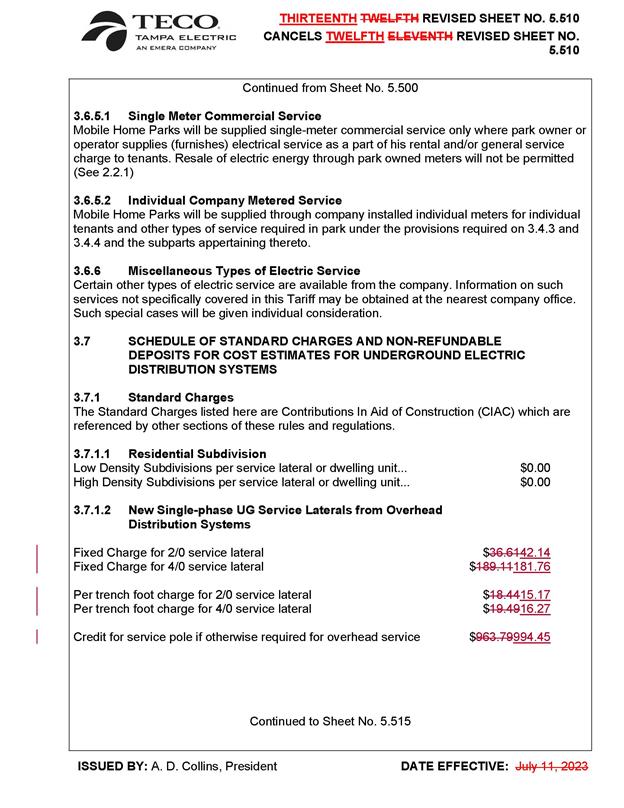
should remain $0.00. TECO proposes that the URD surcharge remain at $0.00 per
lot, as discussed in paragraphs 9 and 14 of the petition. TECO also proposes
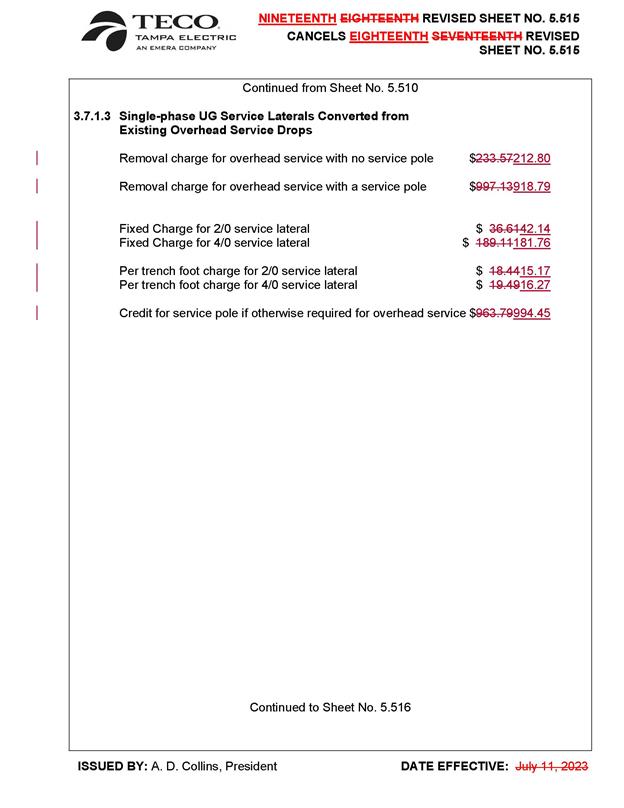
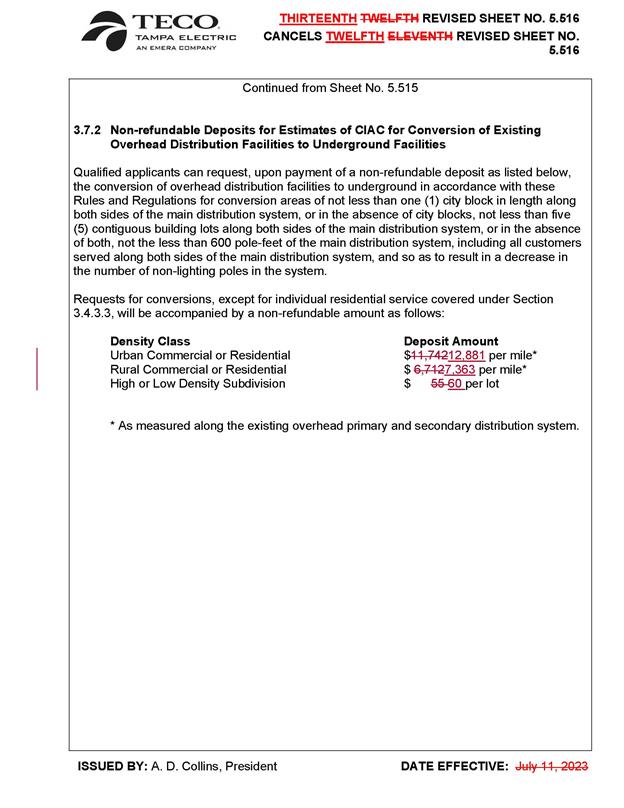
modifications to several other charges and non-refundable deposits for
underground service, as shown in Exhibit B to the petition.
While labor and material costs have increased since TECO’s
2023 URD filing, the main reason for the low and high density underground differential
remaining at zero is increasing operational costs for overhead and decreasing
operational costs for underground, as discussed further below. A lower, or
zero, URD differential charge is typically the result of the avoided storm
restoration costs associated with underground facilities, offsetting any higher
labor and material costs associated with underground construction
Table 1-1
Comparison of URD
Differential per Lot
|
|
Current Differential
|
Proposed Differential
|
|
Low-density
|
$0
|
$0
|
|
High-density
|
$0
|
$0
|
Source: 2023 Order and TECO’s 2026 filing.
Two primary factors impacted the calculation of TECO’s
proposed URD charges which are discussed in greater detail below: (1) updated
labor and material costs and (2) updated operational costs.
Updated Labor and Material Costs
The installation costs of both underground and overhead
facilities include the labor and material costs to provide primary, secondary,
and service distribution lines as well as transformers. The costs of poles are
specific to overhead service while the costs of trenching and backfilling are
specific to underground service. Table 1-2 compares the currently approved 2023
costs and 2026 costs for underground and overhead labor and material for the
two subdivision models.
Table 1-2
Labor and Material Costs per
Lot
|
|
2023 Costs
|
2026 Costs
|
Difference
|
|
Low-density
|
|
|
|
|
Underground labor/material costs
|
$4,108
|
$4,034
|
$(74)
|
|
Overhead labor/material costs
|
$1,797
|
$1,974
|
$177
|
|
Per lot differential
|
$2,310
|
$2,060
|
$(250)
|
|
High-density
|
|
|
|
|
Underground labor/material costs
|
$3,052
|
$2,956
|
$(96)
|
|
Overhead labor/material costs.
|
$1,413
|
$1,547
|
$134
|
|
Per lot differential
|
$1,639
|
$1,409
|
$(230)
|
Source: 2023 Order and TECO’s 2026 filing.
While overhead labor and material
costs increased, underground labor and material costs decreased, resulting in a
decrease in the differential. The utility states that the reasons for the decrease
in labor and material costs for undergrounding is due to and expansion of the
utility work force, increased availability of qualified contractor partners,
and advancements in horizontal directional drilling equipment that allows for
smaller crew sizes. While the reasons for overhead increasing is due to increased
demand for transmission and distribution equipment due to load growth,
renewable energy expansion, data center development, and grid modernization and
hardening initiatives that has placed upward pressure on material and equipment
prices.
Updated Operational Costs
Rule 25-6.078(4), F.A.C.,
provides that the differences in net present value (NPV) of operational costs
between overhead and underground systems, including average historical storm
restoration costs over the life of the facilities, be included in the URD
charge. Operational costs include operations and maintenance (O&M) costs
and capital costs. The inclusion of the operational costs is intended to
capture longer term costs and benefits of undergrounding.
In the current URD petition, TECO
used actual costs from storms that impacted TECO’s service area between 2023
and 2025. This resulted in the average annual storm costs being $139,613,926
over the 3-year period. TECO stated that based on impacts and data from
Hurricanes Idalia, Debby, Helene, and Milton, the utility updated the
allocation factors to attribute 99 percent of the storm costs to overhead and 1
percent to underground.
Therefore $138,217,786 (99 percent of the total $139,613,926 storm costs)
represents the avoided overhead storm restoration costs when facilities are
placed underground.
Table 1-3
NPV of Operational Costs
Differential per Lot
|
|
2023 Calculation
|
2026 Calculation
|
Difference
|
|
Low-density
|
|
|
|
|
Underground NPV- Operational
Costs
|
$2,571
|
$1,657
|
$(914)
|
|
Overhead NPV- Operational Costs
|
$4,928
|
$5,507
|
$579
|
|
Per lot Differential
|
$(2,358)
|
$(3,849)
|
$(1,491)
|
|
High-density
|
|
|
|
|
Underground NPV- Operational
Costs
|
$1,208
|
$786
|
$(422)
|
|
Overhead NPV- Operational Costs
|
$3,656
|
$4,065
|
$409
|
|
Per lot Differential
|
$(2,449)
|
$(3,279)
|
$(830)
|
Source:
2023 Order and TECO’s 2026 filing.
As shown above, the overhead
operational costs are greater than underground, resulting in operational
savings from undergrounding. The NPV differential of operational costs,
including avoided storm restoration costs, increased in both low-density and
high-density subdivision models, resulting in an increase in the NPV
operational cost credit.
To illustrate the calculation for
the low-density subdivision URD charge, the 2026 labor and material costs
differential is $2,060 (Table 1-2). Subtracting the NPV of operational costs
differential of $3,849 (Table 1-3) results in a negative $1,789 URD
differential. Since the tariffed URD charge cannot be a negative, it is set at
$0.
Other Proposed Tariff Changes
TECO’s proposed URD tariffs also
include standard charges for the installation and trenching of underground
service laterals from overhead distribution, underground service laterals
converted from existing overhead service drops, and non-refundable deposits for
cost estimates for the conversion of existing overhead distribution facilities
to underground facilities. If a customer requests an underground service
lateral, the tariff includes a credit to the customer for avoiding a pole that
is otherwise required for overhead service. The charges have been updated to
reflect current material and labor costs.
Conclusion
Staff has
reviewed TECO’s proposed changes to its URD tariffs and associated charges, the
accompanying work papers, and responses to staff’s data request. Staff believes
TECO’s proposed URD tariffs and associated charges as filed in the petition are
cost-based and recommends approval of the tariffs shown in Attachment A. These
tariffs should become effective on the date of the Commission vote.
Issue 2:
Should this docket be closed?
Recommendation:
If Issue 1 is approved and a protest is filed within
21 days of the issuance of the order, the tariffs should remain in effect, with
any revenues held subject to refund, pending resolution of the protest. If no
timely protest is filed, this docket should be closed upon the issuance of a
Consummating Order. (Farooqi)
Staff Analysis:
If Issue 1 is approved and a protest is filed within
21 days of the issuance of the order, the tariffs should remain in effect, with
any revenues held subject to refund, pending resolution of the protest. If no
timely protest is filed, this docket should be closed upon the issuance of a
Consummating Order.