Case Background
Rule 25-14.004, Florida
Administrative Code (F.A.C.), Effect of Parent Debt on Federal Corporate Income
Tax, addresses how the Commission assesses the income tax expense of a
regulated entity that is a subsidiary company that files a consolidated tax
return with a parent company. This rule applies to all regulated industries. When
the regulated utility is a subsidiary of one or more parent companies, application
of the current rule reduces the income tax expense of the regulated utility by the
income tax effect of any debt the parent company has invested in the equity of
the regulated subsidiary. There is a rebuttable presumption that a parent
company’s investment in any subsidiary or in its own operations shall be
considered to have been made in the same ratios as exist in the parent’s
overall capital structure.
History of the Rule
Prior
to adoption of the rule, when the regulated utility was a subsidiary that filed
a consolidated income tax return with one or more parent companies, the
Commission typically used only the subsidiary’s income (subsidiary approach),
rather than the combined income reflected on the consolidated return
(consolidated approach), to determine the tax amount to be used in ratemaking.
That policy was challenged by the Office of Public Counsel (OPC) in Citizens of Fla. v. Hawkins,
356 So. 2d 254 (Fla. 1978). In Hawkins,
the Court found that there was insufficient record evidence to support the
subsidiary approach and that the evidence in the record supported the
consolidated approach as being more accurate. Id. at 259-260 (citations omitted). Subsequently, the Commission
adopted Rule 25-14.004, F.A.C., in 1983,
which reflected the consolidated approach.
The
rule was challenged and upheld as a valid exercise of legal authority in General Tele. Co. of Fla. v. Fla. Pub. Serv.
Comm’n, 446 So. 2d 1063 (Fla. 1984). However, as discussed further below, General Telephone
was not a substantive endorsement of the consolidated approach over the
subsidiary approach. Rather, the Court only evaluated whether the rule was
“reasonably related to the purposes of the enabling legislation, and . . . not
arbitrary or capricious.” General Tele.,
446 So. 2d at 1067 (citations omitted). Neither Hawkins nor General Telephone
require the Commission to use the consolidated approach nor preclude the
Commission from using a different methodology.
In
1988, the Commission considered whether the rule was necessary or whether the
litigation process would resolve the tax matter, and whether the rule should be
repealed. The staff recommendation provided argument both in support of the
current rule and also in support of its repeal.
The Commission did not affirmatively reject repeal of the rule. Rather, the
Commission order simply stated, “[w]e do not wish to revisit the rule at this
time.”[2]
This Rulemaking Proceeding
In
2023, staff initiated rulemaking,
this time to amend the rule rather than repeal it. A staff rule development workshop
was held in August 2023. Representatives of OPC, American
Water Works Corporation (AWWC), Duke Energy Florida LLC (DEF), Florida Power
& Light Company (FPL), Florida City Gas (FCG), Florida Public Utilities
Company (FPUC), People’s Gas System, Inc. (PGS), and Tampa Electric Company
(TECO) attended the workshop, and all submitted post-workshop comments.
Thereafter, the matter was presented at an Agenda Conference on March 5, 2024.
Following
presentation of the matter at the March 5, 2024, Agenda conference, the
Commission deferred ruling to allow more time to consider the matter. The
matter was then placed on the July 9, 2024, Agenda Conference schedule.
Following that presentation, the Commission again deferred ruling and requested
“concrete numbers” about “the difference between sticking with the current rule
and moving forward with this proposed rule . . . to compare those two.”
To obtain that information, the Commission requested that a Commission workshop
be scheduled.
The
Notice of Development of Rulemaking appeared in the April 2, 2026, edition of
the Florida Administrative Register, Volume 52, Number 64, which notice
scheduled a Commission workshop for April 22, 2026.
Staff issued data requests to the utilities to determine whether the rule
applies to them and, if so, how the recommended amendments to the rule would
impact customer rates.
A
Commission rule development workshop was held on April 22, 2026. Representatives
of OPC, AWWC, DEF, FCG, FPL, FPUC, Florida Rising, Inc. (Florida Rising), PGS, Sunshine
Water Services Company (Sunshine), and TECO, attended the workshop. OPC
submitted comments in advance of the workshop. OPC, DEF, and Florida Rising
also made formal presentations at the workshop. Following the workshop, all
stakeholders who attended the workshop submitted post-workshop comments.
This
recommendation addresses whether the Commission should propose the amendment of
Rule 25-14.004, F.A.C. The Commission has jurisdiction pursuant to Sections
120.54 and 350.127(2), Florida Statutes (F.S.).
Regardless
of the Commission’s determination in this docket, this rule will be reviewed in
the 2026-2027 rule review cycle, as required by Section 120.5435, F.S., and the
Commission’s Regulatory Plan.
Discussion
of Issues
Issue 1:
Should the Commission propose the amendment of Rule
25-14-004, F.A.C., Effect of Parent Debt on Federal Corporate Income Tax?
Recommendation:
Yes. The Commission should propose the amendment of
Rule 25-14.004, F.A.C., as set forth in Attachment A. The Commission should also
certify the rule as a minor violation rule. However, if the Commission decides
not to propose the amendment of this rule, a Notice of Withdrawal should be
filed in the Florida Administrative Register pursuant to Section 120.54(3)(d)2,
F.S. (Sapoznikoff, Cicchetti, Guffey)
Staff Analysis:
Two workshops were held concerning
the proposed amendments to Rule 25-14.004, F.A.C. The workshops and the comments
filed in response to those workshops revealed significant disagreement among
stakeholders regarding whether any amendment to the rule is warranted.
Workshop Comments
OPC
and Florida Rising oppose amending the rule. AWWC, FPL, DEF, TECO, PGS, FCG,
and FPUC support staff’s recommended amendments to the rule.
OPC
OPC
argues no amendments to the rule are needed, as the rule in its current state
is not outdated and still addresses modern issues related to parent companies
investing tax deductible debt in regulated utilities. In addition, OPC contends
the current rule does not deprive shareholders of earning their authorized
return, nor is there any evidence that it cools investments in Florida
utilities. Instead, OPC states that the rule helps protect customers from
overpaying an equity return on debt. OPC alleges that the justifications for
the amendments recommended by staff are “sophistry” - deceptive, seemingly
plausible reasoning that is unsound. In effect, OPC states the current rule
acts as an affiliate transaction adjustment that allows the Commission to
adjust excessive costs on the books of a regulated utility based on an affiliate
relationship and protects customers
by ensuring that they do not pay an equity return (and the associated income
taxes) on debt that is disguised as equity. OPC
emphasizes that the fact that the Federal Energy Regulatory Commission (FERC)
and other states do not use the consolidated approach like the Commission is
not a compelling reason to amend the current rule. OPC argues that FERC's
retreat from the consolidated approach was more to address concerns that losses
incurred by nonregulated pipeline affiliates were being used to reduce the
income tax expense of the regulated pipeline subsidiary, even though those
affiliates were not engaged in regulated activities. OPC notes this is not an
issue before the Commission. Finally, OPC asserts that the rebuttable
presumption contained in the rule provides enough flexibility to keep the rule
relevant to current conditions.
Florida Rising
Florida
Rising also opposes amending the rule. Florida Rising asserts that the
recommended amendments would raise energy bills for investor-owned utility
customers and how the rule is currently written does not have a negative impact
on returns on equity or investments in Florida. Florida Rising stresses there
is no evidence that the current rule prevents utilities from recovering their
costs of service or earning a fair return. It further asserts that the current
rule protects customers by allowing the federal tax deductions available to the
parent company to be imputed to the subsidiary utility, resulting in lower
rates. Florida Rising states that the recommended amendments not only would
raise energy bills, but also would broaden the gap between shareholder profits
and cost of service. It also challenges the assertion that amending the rule
would decrease the need for utilities to come in for more frequent rate cases. In
addition, Florida Rising argues the current rule is not a pure double leverage
rule and noted that the Florida Supreme Court has affirmed the current rule.
AWWC
AWWC supports amending the rule; however, it does not believe
anything precludes nor requires the amendment. AWWC believes a utility should
be regulated on a stand-alone basis. Contrary to OPC’s allegations, AWWC
asserts that the stand-alone approach provides customer protection because it
prevents the regulated utility from subsidizing or being subsidized by
non-regulated investments. AWWC does not believe the current rule results in a
textbook double leverage adjustment as seen in other states, but now rejected. AWWC
believes the current rule is a backdoor approach to double leverage. However,
it states that the rule changes the actual income tax determination and
artificially lowers the return on equity (ROE), making it very difficult for
the utility to earn the authorized rate of return. AWWC opined that while the
parent debt adjustment may appear to lower rates in the short term, in the long
run it increases rates through higher overall cost of capital. AWWC asserts
that the current rule artificially reduces ROE, potentially leading to a higher
cost of debt, which ultimately leads to a higher weighted average cost of
capital and eventually higher rates for customers. AWWC indicates that this
rule is one of the reasons it does not operate in Florida and that the rule
chases capital away.
FPL
FPL
supports amending the rule. Specifically, FPL contends the current rule is not
in line with the stand-alone approach to utility ratemaking. FPL asserts most
regulatory bodies in the United States, including the FERC, have adopted the
stand-alone approach, demonstrating that it is a well-recognized and legally
supported ratemaking methodology. FPL notes the Florida Supreme Court in
Hawkins and General Telephone affirmed
the Commission’s broad discretion to amend Rule 25-14.004 and that neither case
requires the Commission to retain the rule in its current state. FPL criticizes
the current iteration of the rule, stating it reduces income tax expenses based
on a parent level expense that is not included in the utility’s jurisdictional
cost of service.
FPL disagrees with OPC’s and Florida Rising’s
contentions that issues concerning affiliate-transaction protections for
customers, furthering customer affordability, possible capital market harm,
amendments making the parent debt adjustment easier to calculate, and
protections provided by the rule’s rebuttable presumption are relevant
considerations for the Commission when looking at staff’s recommended amendments.
FPL instead urges the Commission to focus on whether the current rule properly
measures a utility’s income tax expense for ratemaking purposes. FPL also
disagrees with OPC’s assertion that a hearing under Section 120.54(3)(c)2, F.S.,
is needed for staff’s recommended rule amendments. Specifically, FPL believes
that OPC’s request to use discovery to obtain information is unwarranted at
this point in the rulemaking process. FPL noted that staff’s recommended
amendments to the rule would not affect its customer’s bills, as the rule is
not applicable to FPL at this time, and it is not currently required to make a
parent debt adjustment to the calculation of its income tax expense or revenue
requirements.
DEF
DEF
also supports amending the rule. DEF argues that the double leverage issue the
current rule attempts to address is no longer a regulatory concern, as modern
utility operations now use stand-alone financing, transparent capital
structures, and independent credit profiles. DEF further states the current
rule is based on a rebuttable presumption that parent investments are made in
proportion to the parent's overall capital structure, but in practice, parent
level debt is often used for nonregulated or nonutility purposes. DEF also
asserts that the current rule reduces a utility’s ability to recover its cost
of service and earn its authorized return on equity, in addition to causing
artificially high debt ratios. DEF contends the Commission possesses other,
more flexible tools, such as interest reconciliation adjustments, that help
address issues related to affiliate transactions, capital structure, and tax
expense. DEF points out that other jurisdictions, such as the FERC, have moved
away from rules like the consolidated approach towards a stand-alone approach
for utility income tax calculations. Lastly, if the Commission decides to not
propose staff’s recommended amendments, DEF requests that the mathematical
formula in section (4) of the rule be amended to include retained earnings in
the parent’s common equity. In its response to staff’s data request, DEF
indicated that the customer rate impact of the approximately $7.4 million parent
debt adjustment is a savings of approximately $0.25 per month,
but that the adjustment results in a revenue requirement impact of $10 million
grossed up for taxes. DEF asserts that if the Commission proposes staff’s
recommended amendments to the rule, the result would be a $0.25 monthly
increase to each customer bill.
TECO and PGS
TECO
and PGS filed joint comments supporting staff’s recommended amendments to the rule.
They contend that the recommended amendments would better reflect a regulated
utility’s stand-alone income tax expense for ratemaking and earnings
surveillance reporting. TECO notes that in its 2024 rate case, it made a parent
debt adjustment of approximately $12.9 million, which reduced monthly bills of
TECO residential customers using 1,000 kWh by $1.12 and reduced the bills of
small commercial non-demand customers using 1,250 kWh by $1.41. However, in its response to staff’s data request, it indicated that
in that rate case the parent debt adjustment “had an earnings impact equivalent
to reducing the return on equity by 30 basis points in the test year,” which
may accelerate the company’s need for rate relief. For PGS’s 2025 rate
case, the parent debt adjustment of approximately $2.97 million reduced monthly
residential customer bills with an average usage of 21 therms by $0.46 and the
monthly bill for a GS-1 commercial customers with an average usage of 400
therms by $0.72. In its response to staff’s data request, it indicated that in
that rate case the parent debt adjustment “had an earnings impact equivalent to
reducing the return on equity by 21 basis points in the test year,” which may
accelerate the company’s need for rate relief.
FCG and FPUC
FCG and FPUC filed joint comments in support of staff’s
recommended amendments to the rule. They
also allege the recommended amendments would more accurately reflect a
regulated utility’s stand-alone income tax expense for ratemaking and earnings
surveillance reporting purposes. FCG and FPUC indicate that staff’s recommended
amendments to the rule would not impact their customers’ bills, as the current rule
is not applicable to their companies. In their response to staff’s data request,
FCG and FPUC explained that although they file consolidated tax returns with
their parent companies, the rule is not applicable to them at this time, as
both rely on parent companies to provide all their capital in their last rate
cases.
Staff’s Analysis and Conclusions
Preliminarily,
it is important to note that nothing compels the Commission to amend Rule
25-14.004, F.A.C., and nothing requires it to remain as is. The current rule
was validly promulgated in 1984 pursuant to the statutory authority delegated
to the Commission by the Legislature and within the Commission’s broad
discretion. As reflected above, OPC and Florida Rising urge the Commission not
to amend the rule as the recommended amendments will increase rates and the
existing rule offers a rebuttable presumption that provides utilities with
flexibility.
Nonetheless,
for the reasons stated below staff recommends amending the rule to reflect a
change in Commission policy on how to determine the income tax expense of a
regulated utility that is a subsidiary of one or more parent companies. Under
the current rule, there is a parent debt adjustment in which the tax benefits
associated with the parent company’s interest expense are attributed to the
subsidiary utility. Staff believes this impedes recovery of the actual income
tax expense and artificially lowers utility rates. Under
staff’s recommended amendments to Rule 25-14.004, F.A.C., only the interest
expense inherent in the capital structure of the regulated utility would be
used to compute income tax expense, rather than reducing the tax expense in
accordance with the parent’s capital structure. This
policy is referred to as the stand-alone approach. The stand-alone approach
sets utility rates as if the subsidiary utility were an independent entity.
With
regard to income tax expense, the stand-alone approach ensures that the revenue
requirement is based upon operations of the regulated utility and that the tax
benefits associated with the debt are both an expense of the regulated utility
and borne by that utility’s customers. The stand-alone approach is different
from the current rule in that by not considering the income of the parent
company invested in the subsidiary there are no cross-subsidies between
regulated and non-regulated operations, which contributes to a more accurate
picture of the utility’s financial health.
Chapter
366, F.S., requires the Commission to determine, in a rate proceeding, a
utility’s cost-based revenue requirement and to establish rates that are fair,
just, reasonable and compensatory. That not only means that
customers should only pay for their actual cost of service, but also that
utilities should be allowed to recover their actual revenue requirements. By
imputing a parent’s debt, the current rule has the effect of artificially lowering
the revenue requirement and placing downward pressure on rates. All other
things being equal, this can have the effect of increasing the frequency of
requests for adjustments to rates. The current rule is the only instance in
which the Commission does not use actual cost of service in determining revenue
requirements and setting rates.
Additionally,
staff notes that the recommended amendments would align the rule with the
current national standard.[9] FERC uses the stand-alone
approach reflected in the recommended amendments to the rule.[10] Moreover, based on staff’s
research, while other states may make adjustments for consolidated tax savings,
Florida is the only state that requires including the income tax benefit of
parent debt in the calculation of the subsidiary’s income tax expense and applies that adjustment to all types of
regulated utilities.
As
reflected in the responses to the data requests, workshop comments, and
post-workshop comments, the utilities
indicate that the recommended amendments to the rule would affect their
customers’ bills as follows:
·
DEF advises that as part of
the global settlement of its 2024 rate case, it agreed to include a $7.4
million parent debt adjustment ($10 million revenue requirement impact) pursuant
to the current rule. DEF calculates that adjustment resulted in an average
monthly bill reduction of approximately $0.25. DEF acknowledges
that the recommended amendments eliminating the parent debt adjustment would
increase customer rates.
·
TECO advises that in its 2024
rate case, under the current rule the company made a parent debt adjustment of
$12.9 million. For the average residential customers (using 1,000 kWh per
month), application of the current rule reduced the bill by $1.12. For the average
small commercial non-demand customer’s (using 1,250 kWh per month), application
of the current rule reduced the bill by $1.41. TECO acknowledges that the
recommended amendments eliminating the parent debt adjustment would increase
customer rates.
·
PGS advises that in its 2025
rate case, under the current rule the company made a parent debt adjustment of
$2.967 million. For the average residential customers (using 21 therms),
application of the current rule reduced the monthly bill by $0.46. For the average
GS-1 commercial customer (using 400 therms), application of the current rule
reduced the monthly bill by $0.72.
·
FPL, FCG, and FPUC advise
that the recommended amendments to the rule would have no impact on their
customers’ bills because the rule does not apply to their corporate structure.
·
Sunshine responded to the
data request, but did not file post workshop comments. In its response to the
data request, Sunshine advises that the rule does not apply to it and that the
recommended amendments would have no impact on its customers’ rates.
In
addition, TECO and PGS addressed the earnings impact equivalent of the parent
debt adjustment. For TECO the parent debt adjustment under the current rule
reduced its return on equity by 30 basis points in the test year. For PGS,
application of the rule had an earning impact equivalent to 21 basis points of
the return on equity in the test year. DEF did not provide that information
However, staff calculates that amount to be 8.3 basis points.
The
amounts of recent parent debt adjustments and the impact of those adjustments
on customer bills and return on equity are summarized in the table below.
Impact
of Parent Debt Adjustment in Last Rate Case
|
Utility
|
Parent Debt
Adjustment
|
Bill Impact
with Parent Debt
Adjustment
|
Bill Impact
without Parent Debt
Adjustment
|
Return on Equity
Earnings Impact
Equivalent
(Basis Points)
|
|
DEF
|
$7.4 million
|
($0.25)
|
$0.25
|
8.3 bps.
|
|
TECO
|
$12.9 million
|
($1.12)
|
$1.12
|
30 bps.
|
|
PGS
|
$2.967 million
|
($0.46)
|
$0.46
|
21 bps.
|
|
FPL
|
N/A
|
$0
|
$0
|
N/A
|
|
FCG
|
N/A
|
$0
|
$0
|
N/A
|
|
FPUC
|
N/A
|
$0
|
$0
|
N/A
|
|
Sunshine Water
|
N/A
|
$0
|
$0
|
N/A
|
|
St. James Island
|
N/A
|
$0
|
$0
|
N/A
|
|
CSWR-Florida
|
N/A
|
$0
|
$0
|
N/A
|
|
WMSI
|
N/A
|
$0
|
$0
|
N/A
|
Sources:
Responses to staff data requests and staff calculations.
In
totality, the utilities indicate that all things being equal the recommended
amendments would raise rates by the same dollar amounts that had been reduced
by the parent debt adjustment. DEF advises the recommended amendments would add
$0.25 to the average monthly bill. TECO indicates the
recommended amendments would add $1.12 to the average monthly residential bill and
$1.41 to the average monthly small commercial non-demand customer’s bill. PGS
states the recommended amendments would add $0.46 to the average monthly
residential bill and $0.72 to the average GS-1 commercial customer bill.
Florida Rising agrees that moving forward with the recommended amendments would
result in a bill impact of a similar magnitude as had been saved with
application of the parent debt adjustment.
For
the policy reasons stated above and noting the utilities have indicated they
support the recommended amendments, staff recommends that the Commission change
its policy by amending the rule.
However,
again, nothing compels amendment of the rule, and nothing requires it remain as
is. Rule 25-14.004, F.A.C., is a validly promulgated rule, the adoption of
which in 1984 was within the statutory authority delegated to the Commission by
the Legislature and within the Commission’s broad ratemaking discretion. While
the Commission could have made a different policy choice in promulgating this
rule, and while there may be policy arguments for amending the rule, nothing
requires the Commission to propose amendment of the rule. OPC and Florida
Rising assert that the existing rule protects against affiliate transaction
abuse and moderates rates for consumers. The utilities acknowledge that the
recommended amendments to the rule will increase rates as argued by OPC and
Florida Rising but assert that the amendments allow them to recover an actual
cost of service. If the Commission decides not to propose the amendment of this
rule, a Notice of Withdrawal must be filed in the Florida Administrative
Register pursuant to Section 120.54(3)(d)2, F.S.
As
discussed above, regardless of the Commission’s determination in this docket,
Section 120.5435, F.S., and the Commission’s Regulatory Plan, require this rule
to be reviewed in the 2026-2027 rule review cycle.
Recommended Amendments to the Rule
If
the Commission finds that the rule should be amended to reflect the policy
changes discussed above, staff recommends amendment of the rule rule’s title,
initial paragraph, subsections (1) through (4), and the addition of subsection
(5) to reflect the change in the process of making tax determinations from
incorporating parent debt to only using the tax expense of the regulated
utility. The following is a detailed discussion of staff’s recommended
amendments as reflected in Attachment A.
Rule Title
Rule 25-14.004, F.A.C., is currently titled “Effect of Parent Debt
on the Federal Corporate Income Tax.” Staff recommends the Commission amend the
title of the rule to accurately reflect the rule’s content. The recommended
amendment of the rule title is “Determination of Total Corporate Income Tax”
because the recommended amendments change the policy for making tax
determinations from incorporating parent debt to only using the tax expense of
the regulated utility.
Initial Paragraph
The
initial paragraph of the current rule is unnumbered and requires that when a
regulated utility is a subsidiary of one or more parent companies and files a
consolidated tax return with a parent company, the subsidiary’s income tax must
be adjusted to reflect the income tax expense of the parent debt that may be
invested in the equity of the subsidiary. Under the current rule, the tax
benefits associated with the parent company’s interest expense are attributed
to the subsidiary utility. Under the recommended amendments to Rule 25-14.004,
F.A.C., the Commission would use only the interest expense
inherent in the capital structure of the regulated utility to compute income
tax expense, rather than reducing the tax expense in accordance with the
parent’s capital structure. The recommended amendments to the unnumbered
introductory paragraph require that the income tax expense of a regulated
utility be determined using only its income, regardless of any
parent-subsidiary relationship that may exist.
Subsection (1)
Subsection
(1) of the current rule addresses how to calculate the income tax effect of the
parent’s debt when there is only one parent company.
As
parent debt is not a consideration in the recommended amendments, the
recommended amendment of subsection (1) deletes the prior language in its
entirety. In its place, the recommended rule language of subsection (1) sets
forth the method of determining state corporate current income tax of the
regulated, subsidiary utility. This amount is calculated by
multiplying the regulated utility’s state taxable income before state and
federal income taxes by Florida’s corporate income tax rate, plus or minus any
applicable tax adjustments or credits in accordance with applicable state
income tax laws and regulations.
Subsection (2)
Subsection
(2) of the current rule addresses how to calculate the income tax effect of the
parent’s debt when there is more than one parent company.
As
parent debt is not a consideration in the recommended amendments, the
recommended amendment of subsection (2) deletes the prior language in its
entirety. In its place, the recommended rule language of subsection (2) sets
forth the method of determining the federal taxable income of the regulated,
subsidiary utility after state corporate income tax. This amount is calculated
by deducting the state corporate income tax amount calculated pursuant to the
recommended amendment of subsection (1) from the regulated utility’s federal
income before taxes.
Subsection (3)
Subsection
(3) of the current rule addresses what is included in the capital structure of
the parent and notes that it is a rebuttable presumption that “a parent’s
investment in any subsidiary or in its own operations shall be considered to
have been made in the same ratios as exist in the parent’s overall capital structure.”
As
parent debt is not a consideration in the recommended amendments, the
recommended amendment of subsection (3) deletes the prior language in its
entirety. In its place, the recommended rule language of subsection (3) sets
forth the method of determining the federal current corporate income tax of the
regulated, subsidiary utility. This amount is calculated by multiplying the
federal taxable income after state taxes (which amount was calculated
pursuant to the recommended amendment of subsection (2)), by the federal
corporate income tax rate, plus or minus any applicable tax adjustments
or credits in accordance with applicable federal income tax laws and
regulations.
Subsection (4)
Subsection
(4) of the current rule addresses how to calculate the parent debt adjustment
using debt ratio and debt cost of the parent, the statutory tax rate applicable
to the consolidated entity, and the equity dollars of the regulated subsidiary,
excluding its retained earnings.
As
parent debt is not a consideration in the recommended amendments, the
recommended amendment of subsection (4) deletes the prior language in its
entirety. In its place, the recommended rule language of subsection (4)
clarifies that applicable temporary adjustments to taxable income multiplied by
the respective federal and state corporate income tax rates, plus or minus any
applicable tax adjustments or credits in accordance with applicable federal and
state income tax laws and regulation, shall be used in determining federal and
state income tax expenses for the regulated utility.
Subsection (5)
The
current version of the rule does not contain a subsection (5). The recommended
amendment of the rule adds subsection (5), which states that total income tax
expense for the regulated utility will be determined by adding the amounts
calculated pursuant to the recommended amendments of subsections (1), (3), and
(4) of the rule.
Minor Violation Rule Certification
Pursuant
to Section 120.695, F.S., for each rule filed for adoption, the agency head
shall certify whether any part of the rule is designated as a rule the
violation of which would be a minor violation. Rule 25-14.004, F.A.C., is
currently listed as a minor violation rule by the Commission. This rule is a
minor violation rule because the violation of this rule would not result in
economic or physical harm to a person, cause an adverse effect on the public
health, safety, or welfare, or create a significant threat of such harm.
Violations of Rule 25-14.004, F.A.C., with the recommended amendments would
continue to be minor violations. Therefore, for the purposes of filing the
proposed amended rule for adoption with the Department of State, staff
recommends that the Commission certify Rule 25-14.004, F.A.C., as a minor
violation rule.
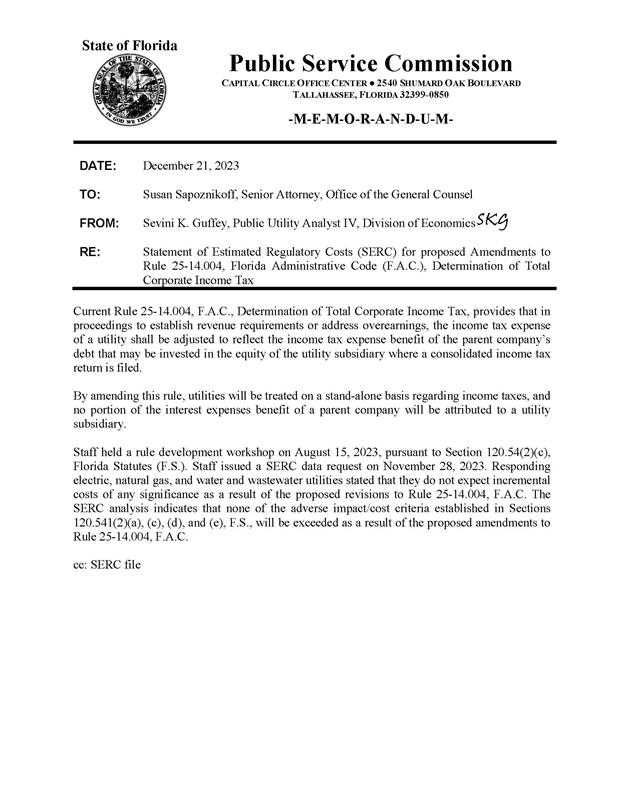
Statement of Estimated Regulatory Costs
Section
120.54(3)(b)1., F.S., encourages agencies to prepare a Statement of Estimated
Regulatory Costs (SERC) before the adoption, amendment, or repeal of any rule.
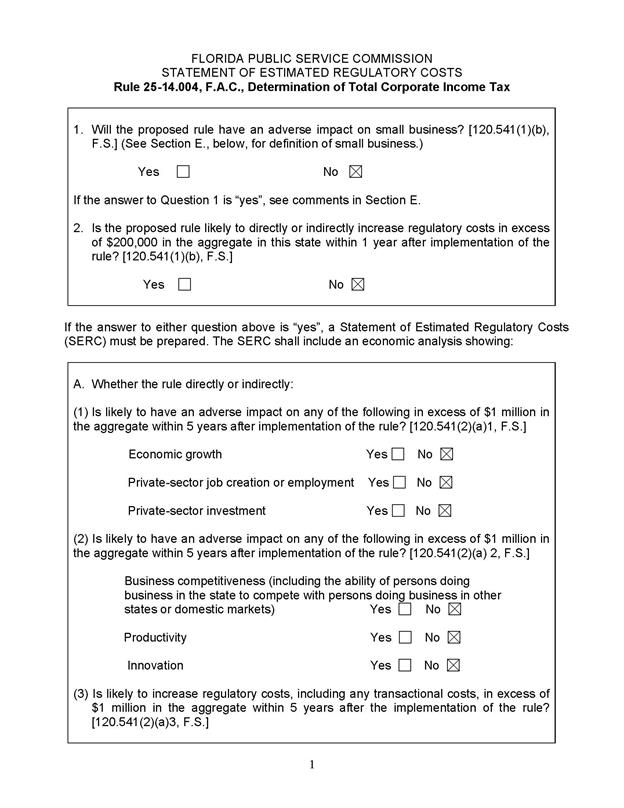
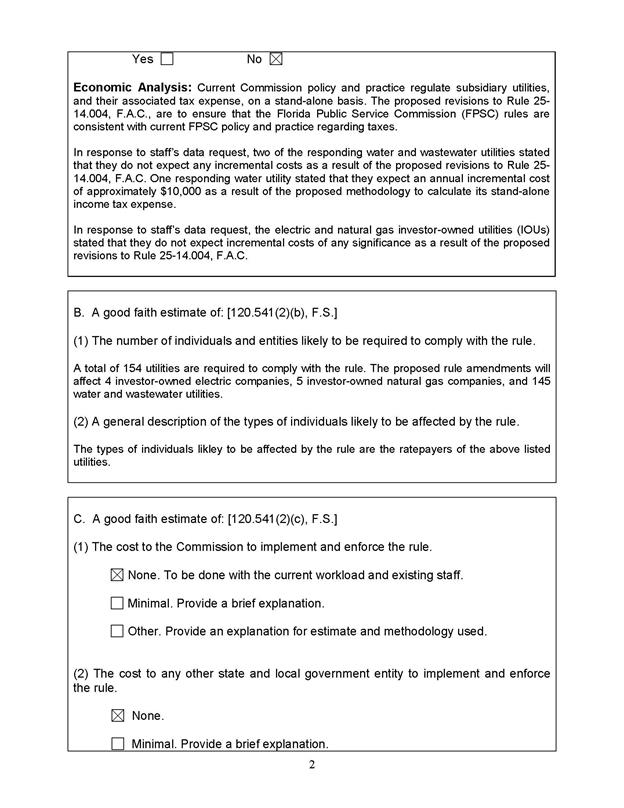
A SERC was prepared for this rulemaking and is appended as Attachment B. As
required by Section 120.541(2)(a)1., F.S., the SERC analysis includes whether
the rule amendments are likely to have an adverse impact on economic growth,
private sector job creation or employment, or private sector investment in
excess of $1 million in the aggregate within five years after implementation.
None of the impact/cost criteria will be exceeded as a result of the
recommended amendments.
The
SERC concludes that the amendments to the rule will likely not directly or
indirectly increase regulatory costs in excess of $200,000 in the aggregate in
Florida within one year after implementation. Further, the SERC concludes that
the recommended rule amendments will not likely increase regulatory costs,
including any transactional costs, or have an adverse impact on business
competitiveness, productivity, or innovation, in excess of $1 million in the
aggregate within five years of implementation. Thus, pursuant to Section
120.541(3), F.S., the recommended amendment of the rule does not require
legislative ratification.
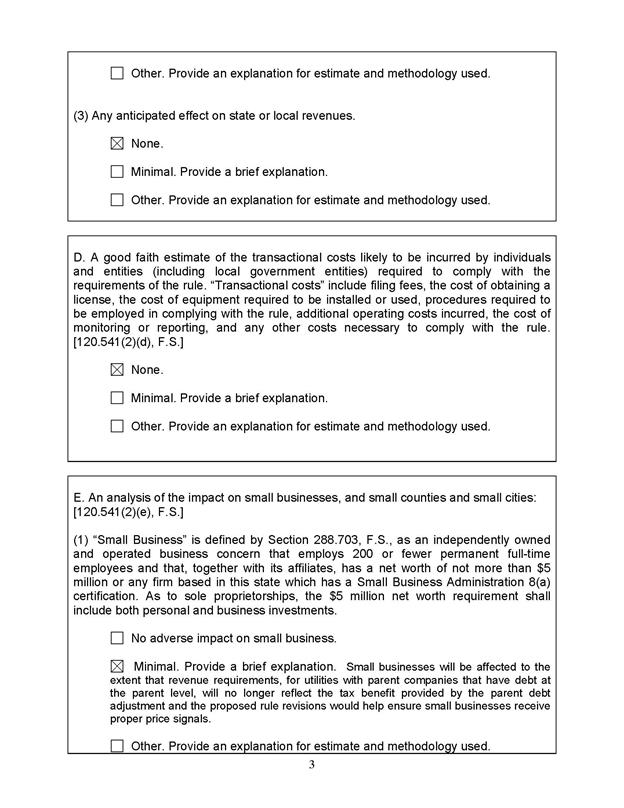
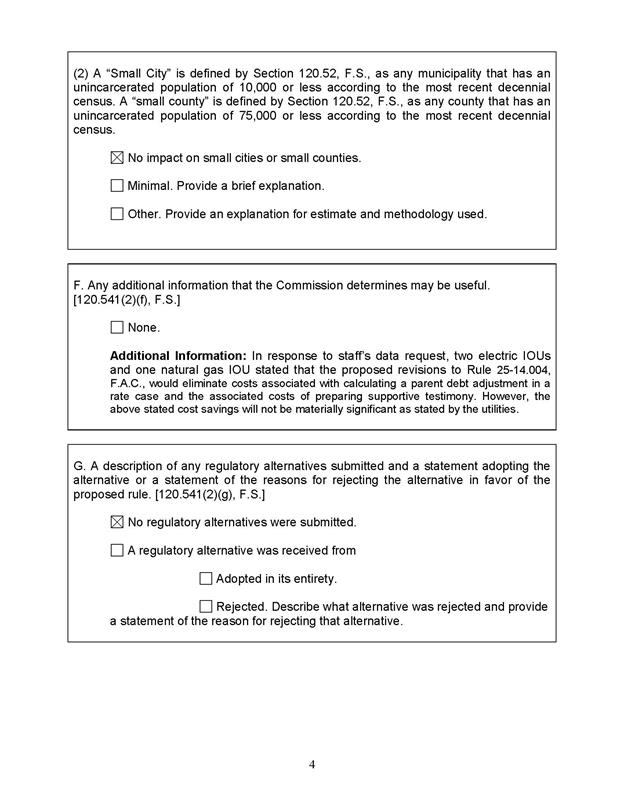
In
addition, the SERC states that the recommended amendments to the rule would
have no impact on small businesses, would have no implementation or enforcement
costs on the Commission or any other state or local government entity, and
would have no impact on small cities or small counties. The SERC states that
there will be no transactional costs likely to be incurred by individuals and
entities required to comply with the requirements.
Conclusion
The Commission should propose the amendment of
Rule 25-14.004, F.A.C., as set forth in Attachment A. Staff also recommends
that the Commission certify the rule as a minor violation rule. However, if the
Commission decides not to propose the amendment of this rule, a Notice of
Withdrawal must be filed in the Florida Administrative Register pursuant to
Section 120.54(3)(d)2, F.S.
Issue 2:
Should this docket be closed?
Recommendation:
Yes. If no requests for hearing or comments from the
Joint Administrative Procedures Committee (JAPC) are filed, and no proposal for
a lower cost regulatory alternative is submitted, the rule may be filed with
the Department of State for adoption, and the docket should be closed.
(Sapoznikoff)
Staff Analysis:
If no
requests for hearing or JAPC comments are filed, and no proposal for a lower
cost regulatory alternative is submitted pursuant to Section 120.541(1)(a),
F.S., the rule may be filed with the Department of State for adoption, and the
docket should be closed.