Case Background
In 2025, the Legislature
amended Chapter 120, Florida Statutes (F.S.), to require agencies to review all
its rules over a five-year period. This recommendation addresses Rule 25-6.049,
Florida Administrative Code (F.A.C.), Measuring Customer Service, which rule
was identified in the Commission’s rule review as a rule needing amendment.
Purpose of the Rule
Rule 25-6.049,
F.A.C., addresses when facilities may be master metered and implements Sections
366.05(1), 366.06(1), 366.81, and 366.82, F.S. Section 366.05(1), F.S., grants
the Commission the authority to prescribe rate classifications, and service
rules and regulations, to be observed by the investor-owned electric utilities.
Sections 366.81 and 366.82, F.S., are known collectively as the Florida Energy
Efficiency and Conservation Act (FEECA) and direct the Commission to adopt
goals and approve plans related to the conservation of electric energy.
Rule 25-6.049, F.A.C., addresses how a
utility meters a customer to determine energy consumption for billing and load
determinations. Generally individual metering, in which each individual unit is
metered, is required. However, the rule has exceptions for certain types of
units (such as hotels, certain types of group-living facilities, mobile
home/recreational vehicle parks, marinas, and condominiums) that set forth
criteria under which those accommodations may be master metered. Under master metering,
the rooms in the facility are not individually metered. Rather, the facility
receives one bill, and the facility manager monitors and controls energy usage.
Individual electric metering is typically billed at a residential rate. In
contrast, master metering usage is measured using a single, utility-owned meter
and billed at a commercial rate..
The purpose of
Rule 25-6.049, F.A.C., is to implement the Florida Energy Efficiency and Conservation
Act (FEECA) and encourage customers to conserve electricity. As this
Commission has noted, “when unit owners are responsible for paying for their
actual consumption, they are more likely to conserve to minimize their bills.” Typically,
the requirement that individual occupancy units be individually metered serves
the conservation goals of FEECA because if unit owners are responsible for
costs based on their actual electricity consumption, they are more likely to
conserve energy in order to minimize the cost of energy. However, in situations
in which the people occupying the residential units don’t see a direct
financial impact for the energy they consume, such as hotels or rental
condominium units, individual metering defeats the purpose of the statute. This
is the reason for the exceptions to individual metering contained in Rule
25-6.049, F.A.C. In such situations, the property manager, who has
responsibility for cost control, can most effectively implement conservation measures
to reduce the overall electricity consumption of the facility.
History of the Rule
This rule is the subject of frequent requests for rule
waivers under Section 120.542, F.S., which have typically been granted by the
Commission. In several dockets, the waiver was requested because the
declaration of condominium did not specify the number of units required to be
used solely for short-term rentals, as required by the rule. In
those cases, the Commission approved waivers even though the pleadings
indicated that the percentage of units used as short-term rentals was as low as
72 percent. In
another case, the Commission approved a rule waiver even though the declaration
of condominium only required 77 percent of the units to be used as short-term
rentals, not
the 95 percent required by the rule. Additionally, most requests for rule
waivers for condominiums were filed by “hotel-condos,” which are not addressed
by the current rule’s classifications of “hotel” or “condominium.”
Procedural Matters
The
Commission’s Notices of Development of Rulemaking were published in Volume 52,
Number 57, of the Florida Administrative Register on March 24, 2026. No one
requested a workshop regarding the draft rule language and no workshop was held.
However, comments were submitted on behalf of mobile home and recreational
vehicle parks and marinas, which comments have been incorporated into the
recommended amendments.
This recommendation addresses whether the Commission
should propose the amendment of Rule 25-6.049, F.A.C. The Commission has
jurisdiction pursuant to Section 120.54, 350.127(2), and 366.05(1), F.S.
Discussion
of Issues
Issue 1:
Should the Commission propose the amendment of Rule
25-6.049, F.A.C., Measuring Customer Service?
Recommendation:
Yes. The Commission should propose the amendment of Rule
25-6.049, F.A.C., Measuring Customer Service, as set forth in Attachment
A. The Commission should also certify the rule as a minor violation rule.
(Sapoznikoff, Hampson, Guffey)
Staff Analysis:
The purpose of this rulemaking is to amend Rule
25-6.049, F.A.C., Measuring Customer Service, to
update and clarify the rule to reflect current practice and use. Staff
recommends the Commission should propose the amendment of Rule 25-6.049,
F.A.C., as set forth in Attachment A.
Staff recommends amending this rule to clarify the rule
language. The existing rule alternately uses the terms “permanent residency”
and “permanent occupancy,” yet both are undefined. The recommended amendments
add a definition for the term “permanent occupancy” and eliminate the use of
the term “permanent residency.” The rule also eliminates the use of the phrase “overnight
occupancy,” which had been defined as “a short term such as per day or per
week,” but which allowed anything less than the undefined “permanent
residency.” Rule waivers had allowed stays of almost one month to be considered
“overnight occupancy.” Staff’s recommended amendments incorporate the transient
occupancy standards set forth by Florida’s Department of Business and
Professional Regulation (DBPR) in lieu of “overnight occupancy.”
As mentioned above, this rule was
the subject of frequent requests for rule waivers under Section 120.542, F.S.,
which were typically granted by the Commission. The basis for most of the rule
waiver requests was the disparate treatment of certain facilities by the Commission,
as compared to how DBPR regulates those facilities. The purpose of the
recommended amendments is to more closely align how the Commission groups these
facilities with how they are grouped by DBPR. Staff believes the recommended
changes comport with the intent of the Commission’s legislative authority for
the rule.
The current rule separates hotels and condominiums into
two different categories and with two different standards. Hotels are allowed
to master meter. Condominiums may master meter only if certain criteria are
met. First, the condominium must operate under a level of control comparable to
that of a hotel. Second,
the declaration of condominium must specify that at least 95 percent of the
units are used for short-term rentals.
However, over time, new construction/management designs
for condominiums were created (such as “hotel-condos”), which configurations
are not addressed by the Commission’s current rule, but which are addressed by
DBPR standards. The requests for rule waivers alleged that DBPR licensed “hotel-condo”
facilities as hotels (which are allowed to master meter) and that the
Commission’s rule caused substantial hardship or violated principles of
fairness by requiring condominiums to individually meter. Staff’s recommended
amendments address those situations in two ways.
First, most requests for rule
waivers for condominiums were filed by “hotel-condos,” which are not addressed
by the current rule. Based on the fact patterns submitted in the rule
waiver requests, the rule waivers were granted because these facilities operated
more like hotels than condominiums. Staff’s recommended amendments eliminate
reference to “hotels, motels, and similar facilities” and instead allow master
metering for facilities that are considered “transient public lodging
establishments” as defined by Section 509.0139(4)(a)1., F.S.,
and are classified as such in Section 509.242, F.S.
This change encompasses hotel-condos which comprised the bulk of the rule
waiver requests.
In addition, other requests for rule waivers by
condominiums focused on the percentage of units designated as short-term
rentals and whether the declaration of condominium listed that percentage.
Staff’s recommended amendments lower the percentage from 95 percent to 75
percent to reflect the amount that had been allowed in rule waivers and
eliminate the requirement that the percentage be listed in the declaration of
condominium, provided that those units satisfy the “vacation rental” standard
set forth in Section 509.242(c), F.S.
Finally, while not the subject of rule waivers requests, staff’s
recommended amendments eliminate specific reference to “separate, specially
designated areas” of trailer, mobile home and recreational vehicle parks, and
marinas, and instead allow master metering for facilities at which permanent
occupancy is not established. These recommended amendments are in response to
comments submitted on behalf of mobile home and
recreational vehicle parks, and marinas, and reflect current industry
practice for these types of moveable living units.
Minor
Violation Rule Certification
Pursuant
to Section 120.695, F.S., for each rule filed for adoption, the agency head
shall certify whether any part of a rule is designated as a rule the violation
of which would be a minor violation. Under Section 120.695(2)(b), F.S., a
violation of a rule is minor if it does not result in economic or physical harm
to a person or adversely affect the public health, safety, or welfare or create
a significant threat of such harm. Rule 25-6.049,
F.A.C., is currently listed as minor violation rules, and
staff recommends that it should remain listed as a minor violation rule by the
Commission. This rule is a minor violation rule because the violation of it
would not result in economic or physical harm to a person, cause an adverse
effect on the public health, safety, or welfare, or create a significant threat
of such harm. Therefore, for the purposes of filing the rule for adoption with
the Department of State, staff recommends that the Commission certify Rule 25-6.049,
F.A.C., as a minor violation rule.
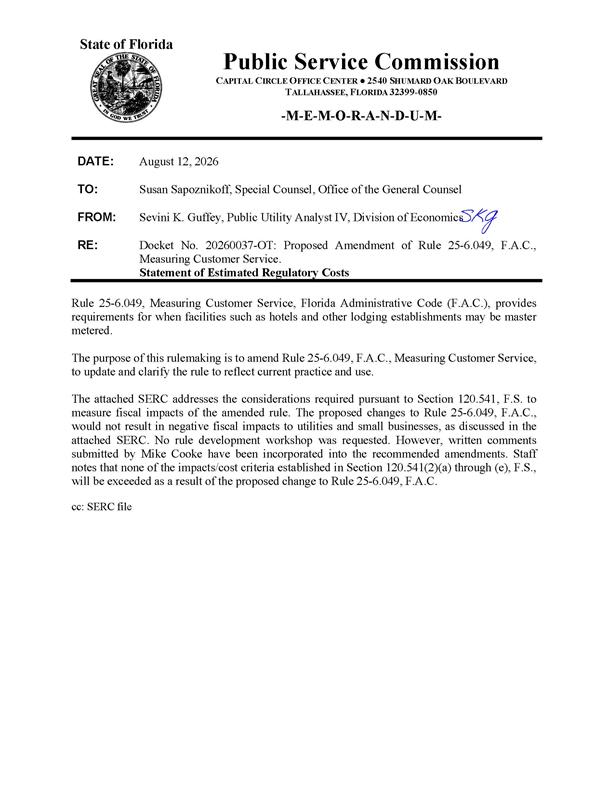
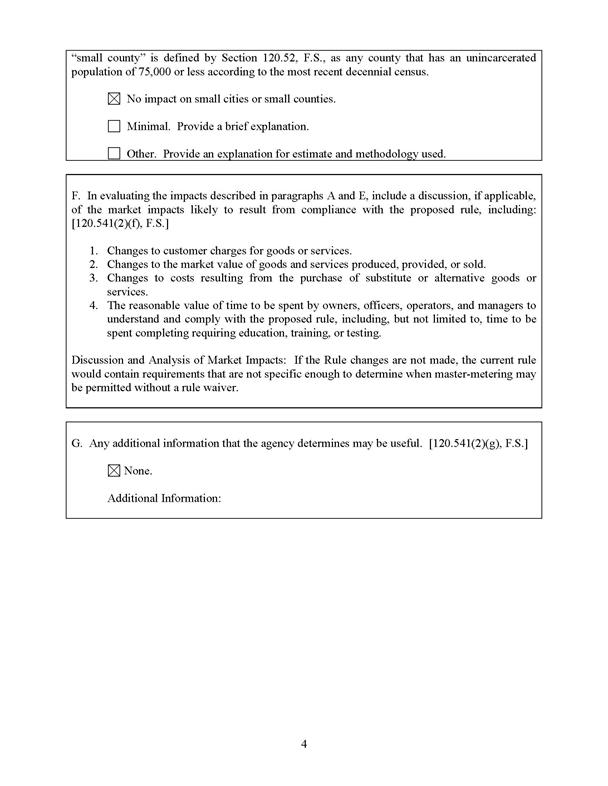
Statement of Estimated Regulatory Costs
Section
120.54(3)(b)1., F.S., encourages agencies to prepare a Statement of Estimated
Regulatory Costs (SERC) before the adoption, amendment, or repeal of any rule.
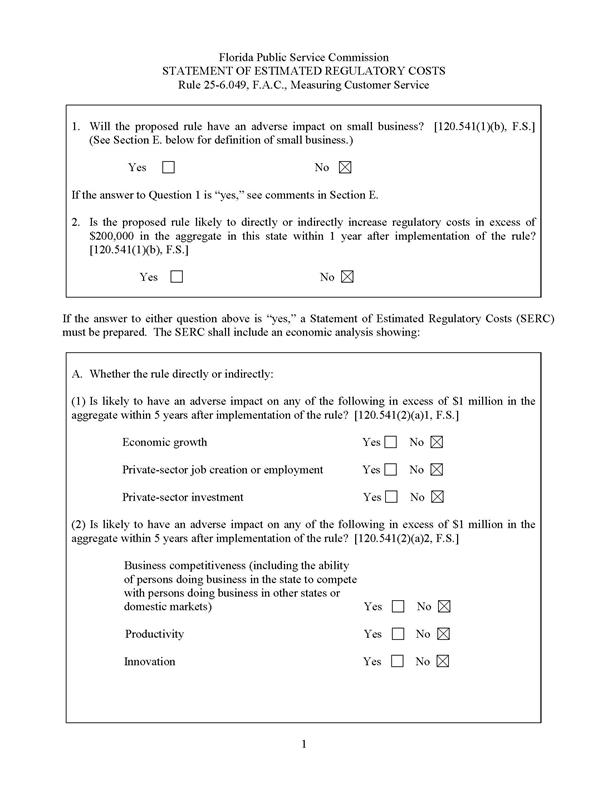
A SERC was prepared for this rule and is appended as Attachment B. As required
by Section 120.541(2)(a)1., F.S., the SERC analysis includes whether the rule
is likely to have an adverse impact on economic growth, private sector job
creation or employment, or private sector investment in excess of $1 million in
the aggregate within five years after implementation.
The
SERC concludes that the recommended rule amendments are not likely directly or
indirectly to increase regulatory costs in excess of $200,000 in the aggregate
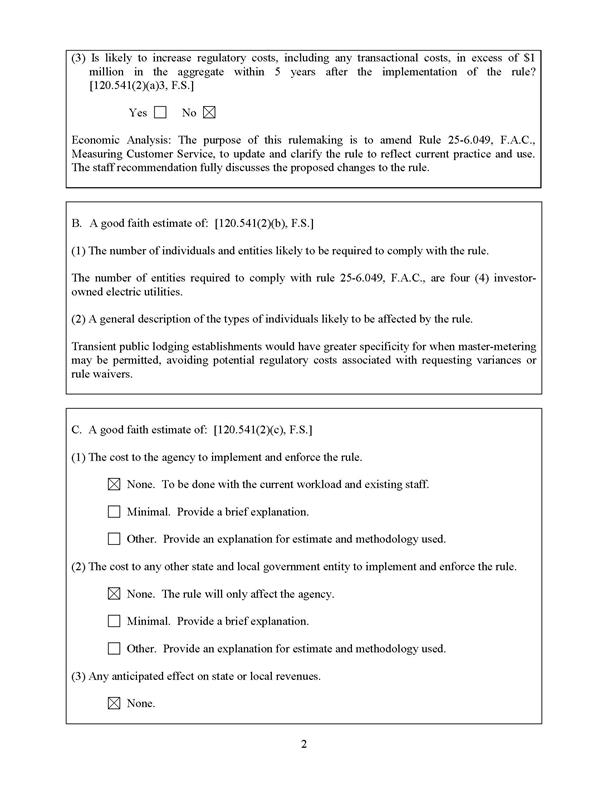
in Florida within one year after implementation. Further, the SERC concludes
that the recommended rule amendments will not likely increase regulatory costs,
including any transactional costs, or have an adverse impact on business
competitiveness, productivity, or innovation, in excess of $1 million in the
aggregate within five years of implementation. Thus, pursuant to Section
120.541(3), F.S., the rule does not require legislative ratification.
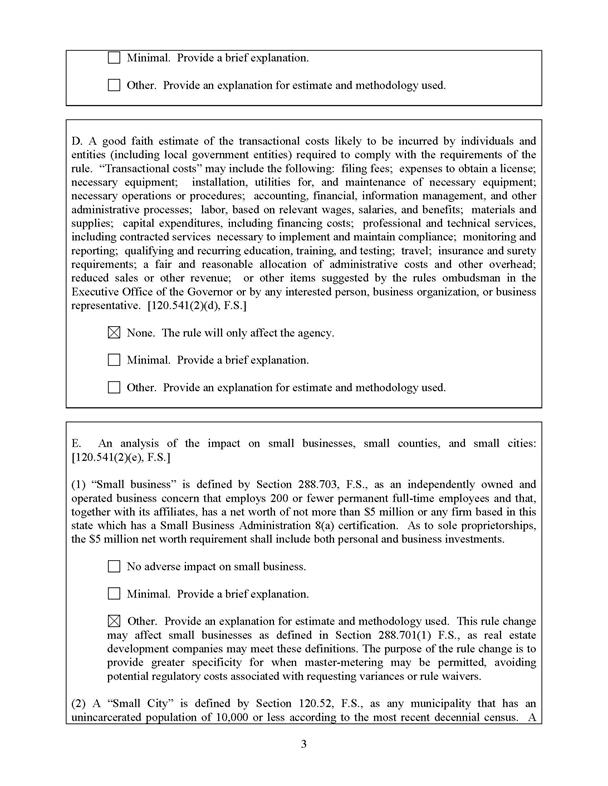
In
addition, the SERC indicates that the rule would have no adverse impact on
small businesses, would have no implementation or enforcement costs on the
Commission or any other state or local government entity, and would have no
impact on small cities or small counties. The SERC states that there will be no
transactional costs likely to be incurred by individuals and entities required
to comply with the rule requirements. None of the impact/cost criteria
established in Section 120.541(2)(a), F.S., will be exceeded as a result of this
rule. Finally, the SERC indicates that there are no market impacts likely to
result from compliance with the recommended rule amendments.
Conclusion
Based
on the foregoing, staff recommends that the Commission should propose the
amendment of Rule 25-6.049, F.A.C., as set forth in Attachment
A. Staff also recommends the Commission certify the rule as a minor violation
rule.
Issue 2:
Should this docket be closed?
Recommendation:
Yes. If no requests for hearing are made or comments
from the Joint Administrative Procedures Committee (JAPC) are filed, and no
proposals for lower cost regulatory alternatives are submitted pursuant to
Section 120.541(1)(a), F.S., the rule should be filed for adoption with the
Department of State, and the docket should be closed. (Sapoznikoff)
Staff Analysis:
If no request for hearing is made or comments
from JAPC are filed, and no proposals for a lower cost regulatory alternatives
are submitted pursuant to Section 120.541(1)(a), F.S., the rule should be filed
for adoption with the Department of State, and the docket should be closed.
25-6.049 Measuring Customer Service.
(1) All energy sold to customers shall be
measured by commercially acceptable measuring devices owned and maintained by
the utility, except where it is impractical to meter loads, such as street
lighting, temporary or special installations, in which case the consumption may
be calculated, or billed on demand or connected load rate or as provided in the
utility’s filed tariff.
(2) When there is more than one meter at a
location, the metering equipment shall be so tagged or plainly marked as to
indicate the circuit metered. Where similar types of meters record different
quantities, (kilowatt-hours and reactive power, for example), metering
equipment shall be tagged or plainly marked to indicate what the meters are
recording.
(3) Meters which are not direct reading
shall have the multiplier plainly marked on the meter. All charts taken from
recording meters shall be marked with the date of the record, the meter number,
customer, and chart multiplier. The register ratio shall be marked on all meter
registers. The watt-hour constant for the meter itself shall be placed on all
watt-hour meters.
(4) Metering equipment shall not be set
“fast” or “slow” to compensate for supply transformer or line losses.
(5) Individual electric metering by the
utility shall be required for each separate occupancy unit of new commercial
establishments, residential buildings, condominiums, cooperatives, marinas, and
trailer, mobile home and recreational vehicle parks. However, individual
metering shall not be required for any such occupancy unit for which a
construction permit was issued before, and which has received master-metered
service continuously since January 1, 1981. In addition, individual electric
meters shall not be required:
(a) In those portions of a commercial
establishment where the floor space dimensions or physical configuration of the
units are subject to alteration, as evidenced by non-structural element
partition walls, unless the utility determines that adequate provisions can be
made to modify the metering to accurately reflect such alterations;
(b) For electricity used in central
heating, ventilating and air conditioning systems, or electric back up service
to storage heating and cooling systems;
(c) For electricity used in
specialized-use housing accommodations such as hospitals, nursing homes, living
facilities located on the same premises as, and operated in conjunction with, a
nursing home or other health care facility providing at least the same level
and types of services as a nursing home, convalescent homes, facilities
certificated under Chapter 651, F.S., college dormitories, convents, sorority
houses, fraternity houses, and similar facilities;
(d) For transient public lodging
establishments as defined by Section 509.013, F.S., and classified as such
in Section 509.242, F.S. such as hotels, motels, and similar facilities
which are rented, leased, or otherwise provided to guests by an operator
providing overnight occupancy as defined in paragraph (8)(b);
(e) For separate, specially-designated
areas of for overnight occupancy, as defined in paragraph (8)(b), at
trailer, mobile home and recreational vehicle parks and marinas at which
where permanent occupancy, as define in subsection (8) of this rule
residency is not established;
(f) For new and existing time-share plans,
provided that all of the occupancy units which are served by the master meter
or meters are committed to a time-share plan as defined in Chapter 721, F.S.,
and none of the occupancy units are used for permanent occupancy.
(g) For condominiums that meet the
following criteria:
1. The declaration of condominium
requires that Aat least 75 95 percent of the
units are classified as a “vacation rental” under Section 509.242, F.S. used
solely for overnight occupancy as defined in paragraph (8)(b) of this rule;
2. A registration desk, lobby and central
telephone switchboard are maintained; and
3. A record is kept for each unit showing
each check-in and check-out date for the unit, and the name(s) of the
individual(s) registered to occupy the unit between each check-in and check-out
date.
(6) Master-metered condominiums.
(a) Initial Qualifications – In addition
to the criteria in paragraph (5)(g), in order to initially qualify for
master-metered service, the owner or developer of the condominium, the
condominium association, or the customer must attest to the utility that the
criteria in paragraph (5)(g) and in this subsection have been met, and that any
cost of future conversion to individual metering will be the responsibility of
the customer, consistent with subsection (7) of this rule. Upon request and
reasonable notice by the utility, the utility shall be allowed to inspect the
condominium to collect evidence needed to determine whether the condominium complies
is in compliance with this rule.
If the criteria in paragraph (5)(g) and in this subsection are not met,
then the utility shall not provide master-metered service to the condominium.
(b) Ongoing Compliance – The customer
shall attest annually, in writing, to the utility that the condominium meets
the criteria for master metering in paragraph (5)(g). The utility shall
establish the date that annual compliance materials are due based on its
determination of the date that the criteria in paragraphs (5)(g) and (6)(a)
were initially satisfied, and shall inform the customer of that date before
the first annual notice is due. The customer shall notify the utility within 10
days if, at any time, the condominium ceases to meet the requirements in
paragraph (5)(g).
(c) Upon request and reasonable notice by
the utility, the utility shall be allowed to inspect the condominium to collect
evidence needed to determine whether the condominium complies is in
compliance with this rule.
(d) Failure to Comply – If a condominium
is master metered under the exemption in this rule and subsequently fails to meet
the criteria contained in paragraph (5)(g), or the customer fails to make the
annual attestation required by paragraph (6)(b), then the utility shall
promptly notify the customer that the condominium is no longer eligible for
master-metered service. If the customer does not respond with clear evidence to
the contrary within 30 days of receiving the notice, the customer shall
individually meter the condominium units within six months following the date
on the notice. During this six-month six month period, the
utility shall not discontinue service based on failure to comply with this
rule. Thereafter, the provisions of Rule 25-6.105, F.A.C., apply.
(7) When a structure or building is
converted from individual metering to master metering, or from master metering
to individual metering, the customer shall be responsible for the costs
incurred by the utility for the conversion. These costs shall include, but not
be limited to, any remaining undepreciated cost of any existing distribution
equipment which is removed or transferred to the ownership of the customer,
plus the cost of removal or relocation of any distribution equipment, less the
salvage value of any removed equipment.
(8) For purposes of this rule permanent
occupancy means habitation for more than 180 days during any consecutive
12-month period.:
(a) “Occupancy unit” means that portion of
any commercial establishment, single and multi-unit residential building, or
trailer, mobile home or recreational vehicle park, or marina which is set apart
from the rest of such facility by clearly determinable boundaries as described
in the rental, lease, or ownership agreement for such unit.
(b) “Overnight Occupancy” means use of an
occupancy unit for a short term such as per day or per week where permanent residency
is not established.
(9)(a) Where individual metering is not
required under subsection (5) and master metering is used in lieu thereof,
reasonable apportionment methods, including sub-metering may be used by the
customer of record or the owner of such facility solely for the purpose of
allocating the cost of the electricity billed by the utility. The term “cost”
as used herein means only those charges specifically authorized by the electric
utility’s tariff, including but not limited to the customer, energy, demand,
fuel, conservation, capacity and environmental charges made by the electric
utility plus applicable taxes and fees to the customer of record responsible
for the master meter payments. The term does not include late payment charges,
returned check charges, the cost of the customer-owned distribution system
behind the master meter, the customer of record’s cost of billing the
individual units, and other such costs.
(b) Any fees or charges collected by a
customer of record for electricity billed to the customer’s account by the
utility, whether based on the use of sub-metering or any other allocation
method, shall be determined in a manner which reimburses the customer of record
for no more than the customer’s actual cost of electricity.
(c) Each utility shall develop a standard
policy governing the provisions of sub-metering as provided for herein. Such
policy shall be filed by each utility as part of its tariffs. The policy shall
have uniform application and shall be nondiscriminatory.
Rulemaking Authority 350.127(2),
366.05(1) FS. Law Implemented 366.05(1), 366.06(1), 366.81, 366.82 FS.
History–New 7-29-69, Amended 11-26-80, 12-23-82, 12-28-83, Formerly 25-6.49,
Amended 7-14-87, 10-5-88, 3-23-97, 10-10-06, _______.