Case Background
Natural gas is
delivered to Florida through four Federal Energy Regulatory Commission (FERC)
regulated interstate transmission pipelines: Florida Gas Transmission Company
(FGT), Gulfstream Natural Gas System, Southern Natural Gas, and Gulf South
Pipeline. The gas entering Florida is delivered to new or repowered electric
generating facilities, large industrial customers, municipally operated
systems, and investor-owned local distribution companies (LDCs). Pipeline
laterals connect the transmission pipelines to the gas consumers.
The Natural Gas
Transmission Pipeline Intrastate Regulatory Act (Act), codified at Sections
368.101–368.112, Florida Statutes (F.S.), was adopted by the Florida
Legislature in 1992 in conjunction with the Natural Gas Transmission Pipeline
Siting Act (Pipeline Siting Act), codified at Sections 403.9401–403.9425, F.S.
At the time of enactment, these laws contemplated the filing of a proposal for
a major gas pipeline (Sunshine Pipeline Partners) that would serve LDCs and
major electric power generators in Florida and would be regulated by the Florida
Public Service Commission (Commission) rather than FERC. The U.S. Natural Gas
Act enables an intrastate pipeline company to be exempt from FERC jurisdiction
under what is known as “the Hinshaw Amendment.” The Hinshaw Amendment,
contained in Section 1(c) of the U.S. Natural Gas Act, codified at 15 U.S.C. §
717(c), exempts from FERC regulation intrastate pipelines that operate
exclusively in one state and with rates and services regulated by the state.
Payment of regulatory assessment fees to cover the cost of regulation and
jurisdiction over pipeline safety is also provided for in Chapter 368, F.S.
On June 8, 2026,
Coastal Connect Services, LLC (CCS), filed a petition for approval of a natural
gas pipeline transmission tariff and a firm transportation service agreement. On
September 3, 2026, CCS refiled its petition to ensure confidential information in
the transportation service agreement was properly redacted. CCS is a limited
liability company formed under Texas law and registered to do business in
Florida in accordance with Section 607.1505, F.S. Consistent with the definition
of “natural gas transmission company” in Section 368.103(4), F.S., CCS does not
own or operate any facilities used primarily for the local distribution of
natural gas or that are subject to the jurisdiction of FERC under the U.S.
Natural Gas Act, 15 U.S.C. §§ 717 et seq. Additionally, CCS is not a
municipality or any agency thereof or a special district created by special act
to distribute natural gas.
In its petition,
CCS stated that the reason it is requesting approval of a natural gas pipeline
transmission tariff is to fill a specific need for the safe, timely, and
efficient delivery of natural gas. Specifically, CCS seeks to provide firm
transmission service to Space Exploration Technologies Company (SpaceX). CCS is
a subsidiary of SpaceX. SpaceX operates facilities on Cape Canaveral in Brevard
County where it launches a variety of materials and humans into space for
multiple customers, including the U.S. Department of Defense. CCS stated in its
petition that as SpaceX’s operations continue to grow, it has a growing need
for significant supplies of natural gas, which it liquifies for use as rocket
fuel. In response to staff’s First Data Request, CCS stated that SpaceX
currently receives its natural gas shipments by truck, and that hundreds of
truckloads of liquified natural gas are required per launch. A nearby pipeline
operated by Florida City Gas (FCG) was initially identified by SpaceX as a
potential option for service. In response to staff’s First Data Request, however,
CCS stated that this pipeline does not connect to the required delivery points
for SpaceX, and is inadequate for the volumes, variability, reliability, and
timing needed. Additionally, the terms, timing, and costs for FCG construction
of improvements did not meet the needs and specifications required by
SpaceX.
There are three
earlier instances of the Commission approving intrastate pipeline tariffs for
the following operators: Five Flags Pipeline Company,[1] Peninsula Pipeline Company, Inc.
(Peninsula),[2] and SeaCoast Gas Transmission, LLC.[3] If CCS’s petition is approved, CCS would
own the anticipated pipeline facilities and serve as the transportation service
provider. CCS’s capacity is presently contemplated to be fully obligated. This
means that CCS’s first customer, SpaceX, would
contract for all of the contemplated capacity on the new pipeline facilities.
In accordance with Section 368.105(6), F.S., CCS is not required to provide other
entities access to the facilities if all capacity is used. The proposed tariff
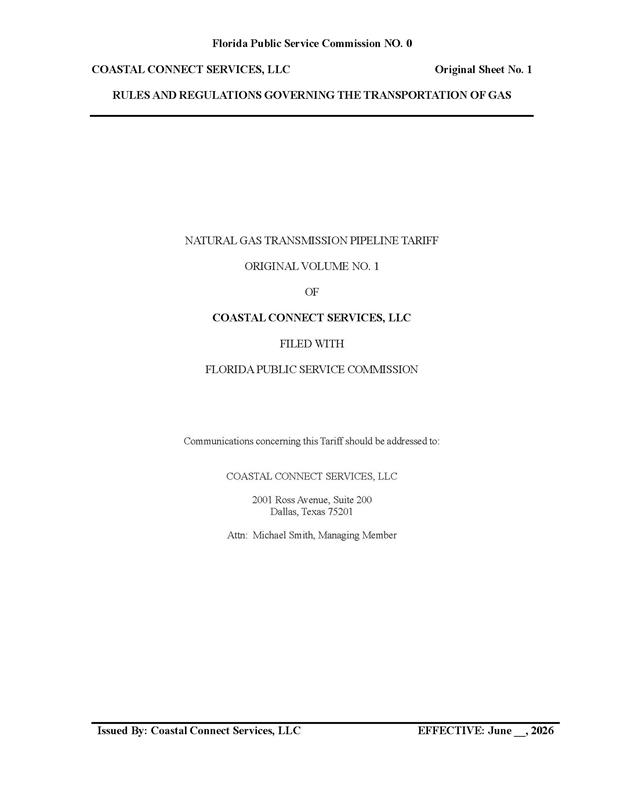
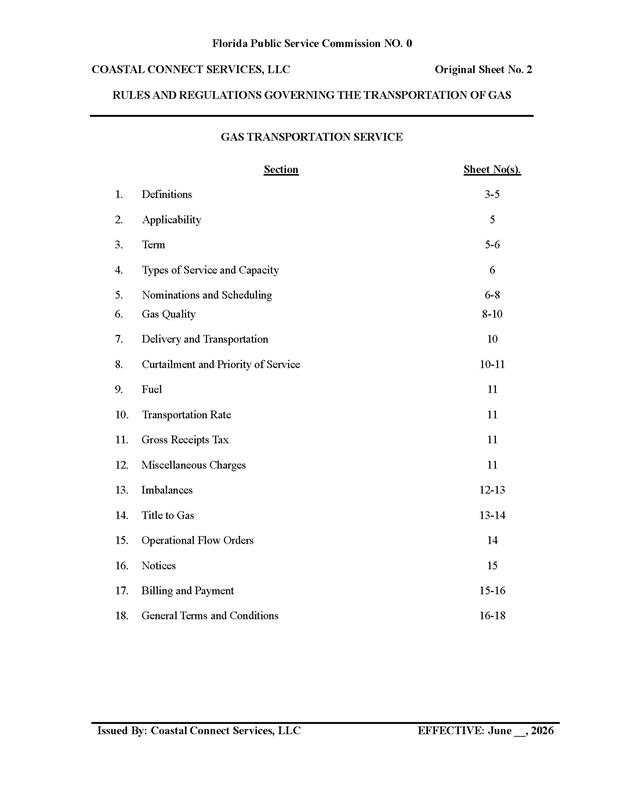
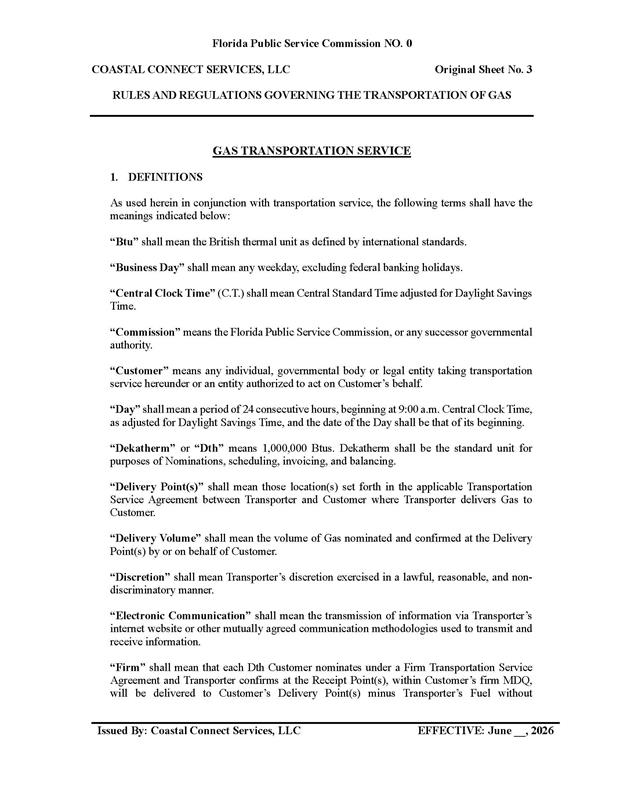
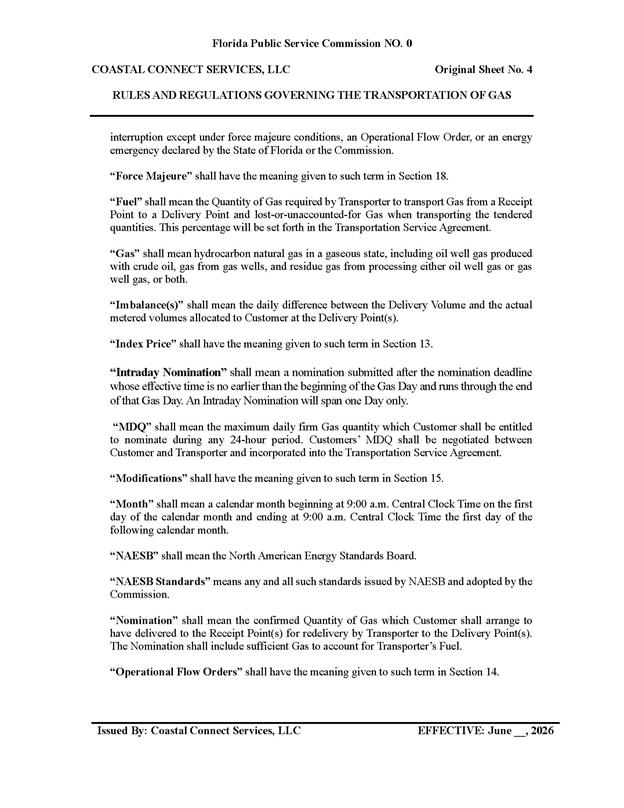
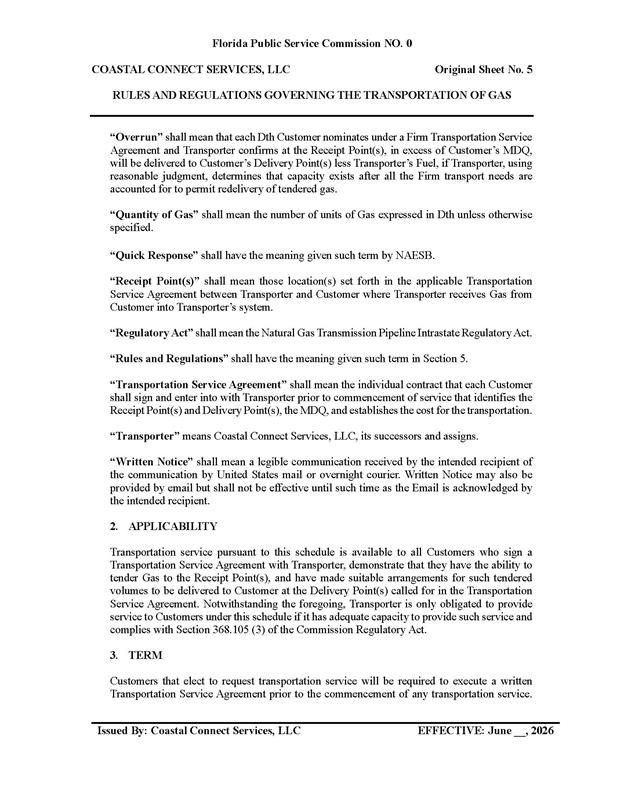
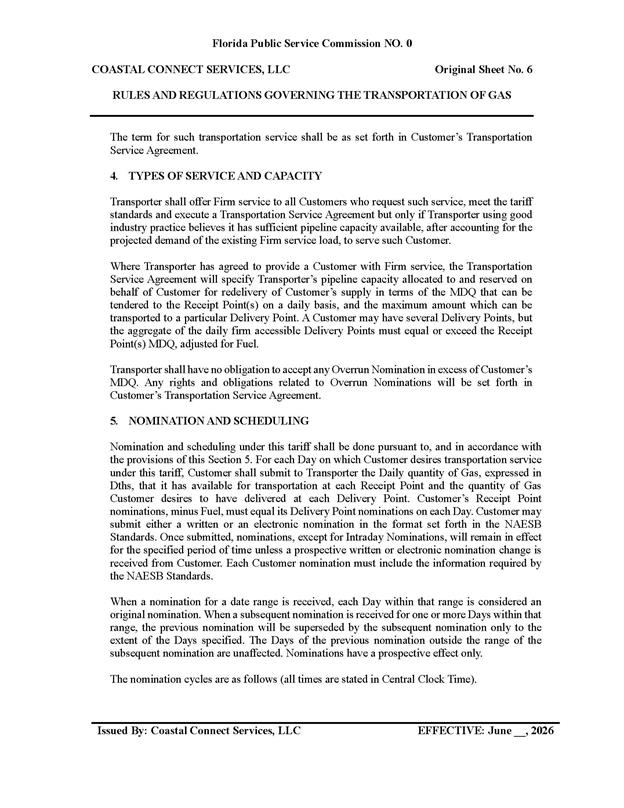
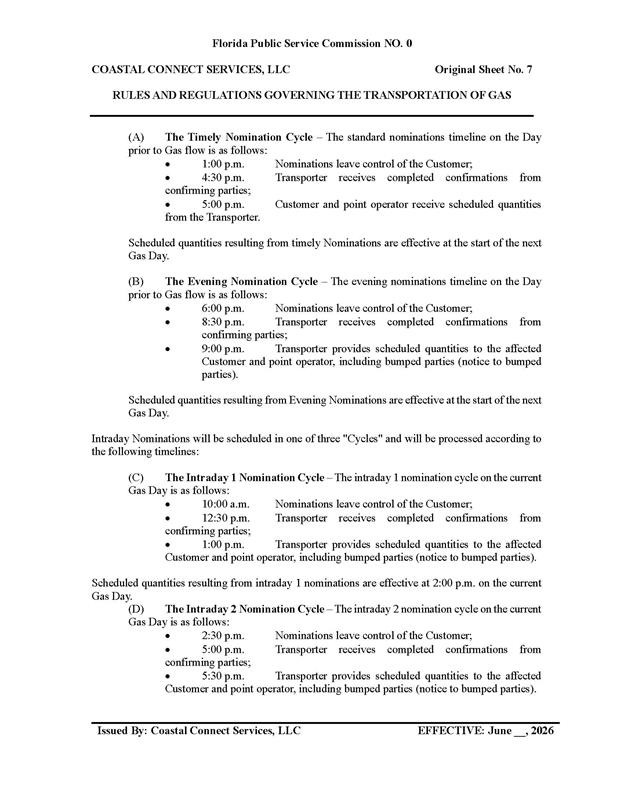
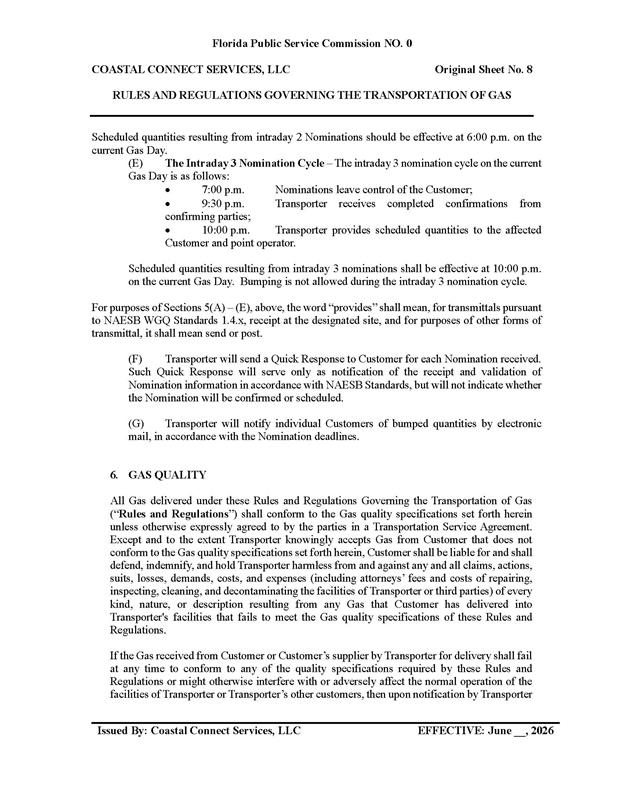
is contained in Attachment A to this recommendation.
On July 2, 2026,
FCG requested that the Commission Clerk add FCG to the docket as an interested
person. In its letter, FCG alleged that it has a substantial interest in this
docket. Specifically, FCG stated that it has a substantial interest in ensuring
the Commission’s actions in this docket do not: harm FCG, its ratepayers, and
the competitive market for natural gas in Florida; lead to “cherry picking” of
FCG’s customers; lead to uneconomic duplication of FCG’s facilities and other
territorial disputes; impede FCG’s ability to serve its customers; or foster
potential risks that threaten the integrity and safety of FCG’s distribution
system in the area. On August 28, 2026, FCG filed a motion for leave to
intervene. CCS filed a response in opposition on September 4, 2026. Then on
September 14, 2026, FCG filed a motion for leave to file a reply. On September
18, 2026, CCS filed a response in opposition to FCG’s motion for leave to file
a reply.
By Order No.
PSC-2026-0290-PCO-GU, the Commission suspended CCS’s proposed tariff pending
the Commission’s decision on CCS’s petition.[4] Staff issued four data requests for which
responses were received on July 10, 2026, July 27, 2026, August 17, 2026, and
September 22, 2026, respectively. The Commission has jurisdiction over this
matter pursuant to Sections 368.104 and 368.105, F.S.
Discussion
of Issues
Issue 1:
What action, if any, should the Commission take
regarding Florida City Gas’s Motion for Leave to Intervene?
Recommendation:
None. The Motion for Leave to Intervene is premature
because of this docket’s current procedural posture. Only after the Commission
votes and an order is rendered can a substantially affected person file a
petition requesting an administrative hearing regarding that proposed agency
action. And until and unless the proposed agency action order is protested,
there is no pending administrative proceeding in which a substantially affected
person may petition to intervene. However, at the Agenda Conference, the
Commission may permit FCG an opportunity to be heard in its capacity as an
interested person. (Marquez, Stiller)
Staff Analysis:
FCG filed a Motion for Leave to Intervene on August
28, 2026. FCG asserts that it is a natural gas local distribution company (LDC)
subject to the Commission’s public utility jurisdiction under Chapter 366,
F.S., providing gas to the Cape Canaveral area in the immediate vicinity of
where CCS proposes to locate and operate its pipeline. FCG alleges that it anticipates
further expansion in the Cape Canaveral area, including additional delivery
points that could be used to serve SpaceX. FCG argues that if CCS’s petition is
granted, the investment FCG has already made in the Cape Canaveral spaceport
area could be at risk of being stranded.
On September 4, 2026, CCS filed a Response in Opposition
to FCG’s Motion to Intervene. In it, CCS argues that FCG does not satisfy the
two-prong standing test set forth in Agrico Chemical Co. v. Department of
Environmental Regulation, 406 So. 2d 478, 481–82 (Fla. 2d DCA 1981). Agrico
requires an intervenor to show that (1) they will suffer injury in fact that is
of sufficient immediacy to entitle them to a Section 120.57, F.S., hearing; and
(2) the substantial injury is of a type or nature that the proceeding is
designed to protect.[5]
On September 14, 2026, FCG filed a Motion for Leave to
File a Reply to CCS’s Response in Opposition to FCG’s Motion to Intervene. On
September 18, 2026, CCS filed a Response in Opposition to FCG’s Motion for Leave
to File a Reply to CCS’s Response in Opposition to the Motion for Leave to Intervene.
This docket involves a tariff and, accordingly, its
procedural posture is akin to a proposed agency action docket. There is
currently no decision which could determine a person’s substantial interests
within the meaning of Section 120.569(1), F.S. No hearing is scheduled. The
Commission is engaged in free-form agency action in making a preliminary
decision based on the information and documentation available. Only after the
Commission votes and an order is rendered can a substantially affected person
file a petition requesting an administrative hearing regarding that proposed
agency action. And until and unless the proposed agency action order is
protested, there is no pending administrative proceeding in which a
substantially affected person may intervene.[6]
The Commission’s order will provide notice of the point of entry for persons
whose substantial interests are affected to protest. If a timely and legally
sufficient protest is received, then other substantially affected persons may
file to intervene.
FCG’s motion and CCS’s response address the merits of
whether FCG has standing to intervene and, ultimately, challenge proposed
agency action by the Commission. However, because the Commission has not
proposed agency action and there is no pending proceeding, staff believes that
FCG’s Motion for Leave to Intervene is premature and not ripe for review.
Conclusion
The Motion for Leave to Intervene is premature because of
this docket’s current procedural posture. However, at the Agenda Conference,
the Commission may permit FCG an opportunity to be heard in its capacity as an
interested person.
Issue 2:
Should the Commission approve Coastal Connect
Services, LLC’s natural gas pipeline transmission company tariff?
Recommendation:
Yes, the proposed tariff should be approved pursuant
to Chapter 368, F.S. Upon the issuance of the consummating order in this docket,
CCS should begin to pay regulatory assessment fees, as required by Rule
25-7.101, Florida Administrative Code (F.A.C.). CCS should also file Annual
Reports as required by Rule 25-7.100, F.A.C. Within 30 days after executing a
transportation service agreement, CCS and the customer should file an affidavit
with the Commission, as required by Section 368.105(3), F.S. Upon request by
the Commission, CCS should make available its negotiated Transportation Service
Agreements. (Ward)
Staff Analysis:
CCS proposes to construct and maintain pipeline
facilities that would provide firm transportation service of customer-owned gas
from the FGT interstate transmission pipeline to customers. The proposed
pipeline is a 32.4 mile, 16-inch steel natural gas transmission pipeline, to be
located entirely within Brevard County.
CCS would not engage in the sale of gas, and title of the gas transported on
CCS’s pipelines would not at any point transfer to CCS. A customer who chooses
CCS to transport its gas would be required by CCS to enter into a
Transportation Service Agreement with CCS.
In response to staff’s First Data Request, CCS stated that
SpaceX contacted Chesapeake Utilities Corporation to explore different options
for pipeline expansion by FCG or Peninsula. Additionally, in a confidential
process, SpaceX contacted several different pipeline companies regarding the
potential construction of an appropriate natural gas transportation pipeline.
After exploring multiple options, based on the location, cost, timeliness,
route, safety, operational, tax, and service issues, SpaceX made the business
decision to utilize a newly created affiliate—CCS.
Currently, pipeline laterals can be constructed by the
customer itself, an interstate pipeline, or an LDC. Customers would continue to
be able to choose their pipeline provider. CCS would operate as an additional
transmission pipeline provider. In addition to constructing and maintaining the
pipeline facilities, CCS would be responsible for providing administrative
services related to the transportation of gas from the interconnection with the
transmission pipeline to the point(s) of delivery (interconnection between CCS
and the customer).
Regulatory Authority
The Act provides the Commission with a different level of
regulatory authority than it exercises over LDCs or investor-owned electric utilities
under Chapter 366, F.S. Section 368.105(3), F.S., allows rates charged by a
natural gas transmission company to be deemed just and reasonable without
explicit Commission approval if the rates meet certain conditions, as listed
below. Section 368.105(3), F.S., states:
Rates charged or offered to be charged by any natural
gas transmission company for transactions with other natural gas transmission
companies, transportation customers, and industrial, power plant, and other
similar large-volume contract customers, but excluding direct sales-for-resale
to gas distribution utilities at city gates, unless suspended and modified
pursuant to this subsection, are deemed to be just and reasonable and approved
by the [C]ommission, if both the natural gas transmission company and the
customer file an affidavit with the [C]ommission that:
(a)
Neither the natural gas transmission company nor the
customer had an unfair advantage during the negotiations;
(b)
The rates are substantially the same as rates between
the natural gas transmission company and two or more of those customers under
the same or similar conditions of service; or
(c)
Competition does or did exist either with another
natural gas transmission company, another supplier of natural gas, or with
supplier of an alternative form of energy.
Section 368.105(3), F.S., thus contemplates that gas
transportation service provided by an intrastate pipeline is based on
negotiated agreements that reflect market conditions and the specific needs of
the customer. The agreement negotiated between SpaceX and CCS is discussed
below in Issue 3.
CCS would only provide transportation service and would
not engage in the retail sale of natural gas. Title of the gas transported on
CCS’s facilities would belong to the customer. The customer would be responsible
for purchasing its own gas supplies. Section 368.105(6), F.S., further requires
that rates must not be unduly discriminatory, and they must be compensatory.
The statute also requires the Commission to resolve any disputes between the
natural gas transmission company and a person desiring transmission access.
In Order No. PSC-06-0023-DS-GP, the Commission discussed certain
policy considerations whereby a transmission pipeline’s projects should not
lead to:
·
less investment in the LDC’s facilities or
stranded costs;
·
“cherry picking” of the LDC’s large industrial
customers;
·
territorial disputes; or
·
unfair competition with other transmission
providers.
Staff believes those policy considerations are persuasive
here because they were primarily intended to ensure that a transmission
pipeline, such as CCS, would not serve a customer within the existing service
territory of an LDC, without first obtaining Commission approval, in order to
protect the general body of LDC ratepayers. If an LDC loses a large customer to
CCS, this could potentially shift costs to the LDC’s remaining ratepayers. CCS’s
proposed tariff, as supplemented in response to staff’s Fourth Data Request, addresses
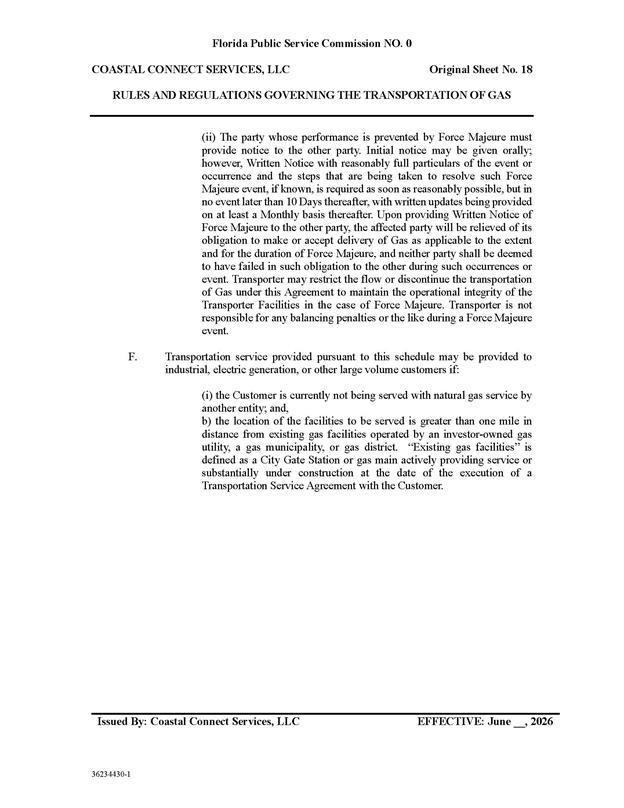
the concerns set out in Order No. PSC-06-0023-DS-GP. Under its tariff, CCS can
construct facilities to provide transportation service to industrial, electric
generation, or other large-volume customers if: the customer is not currently
being served with gas service by another entity; and, the location of the
facilities to be served is greater than one mile from existing gas facilities
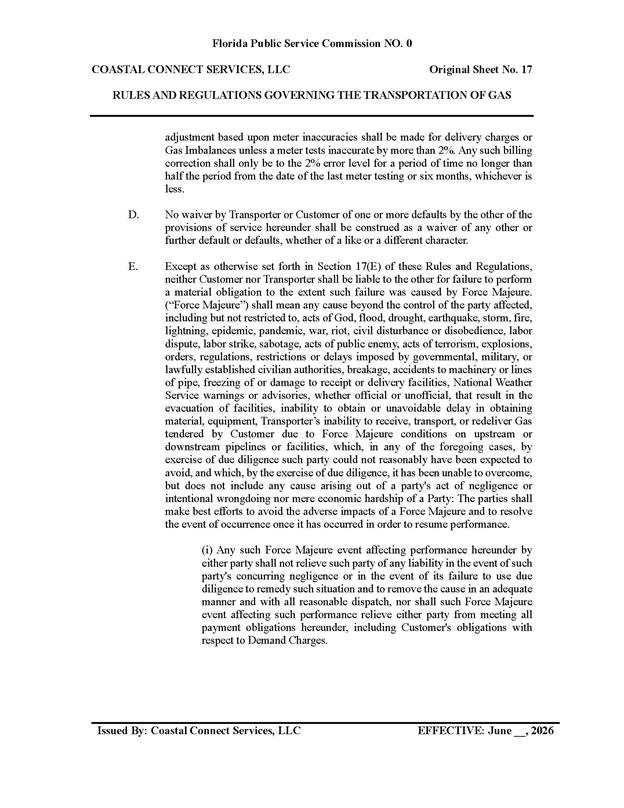
operated by an investor-owned gas utility, a gas municipality, or gas district.
“Existing gas facilities” is defined as a City Gate Station or gas main
actively providing service or substantially under construction at the date of
the execution of a Transportation Service Agreement with the customer. Staff
believes that a one-mile buffer zone appears reasonably calculated to reduce
the likelihood of territorial disputes. Additionally, by preventing CCS from
serving current customers in the existing service territory of an LDC, without
prior Commission approval, the likelihood of “cherry picking” customers or
stranded costs is also reduced. Finally, natural gas transportation service
companies are permitted to connect with other FERC-regulated interstate pipelines
or Commission-regulated intrastate pipelines to provide transportation service
to an LDC.
Proposed Tariff
CCS’s proposed tariff would allow CCS to construct and own
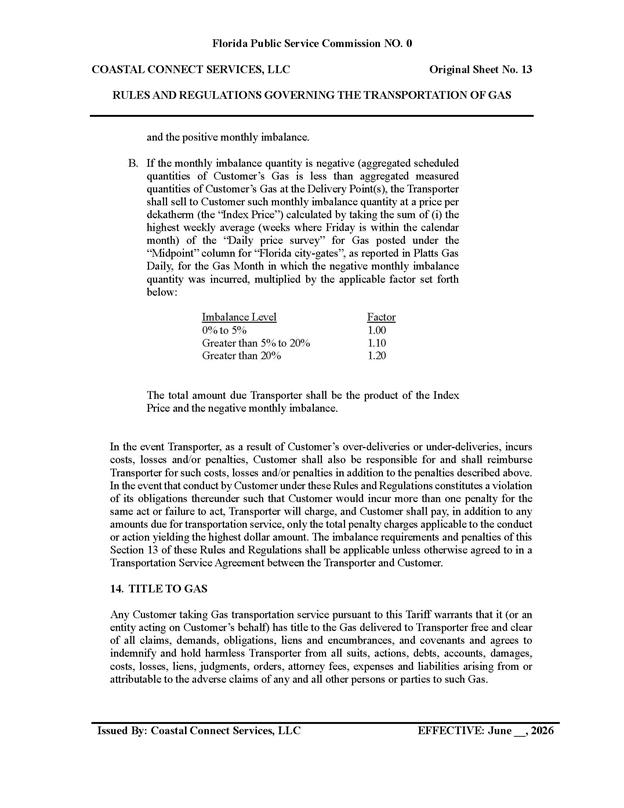
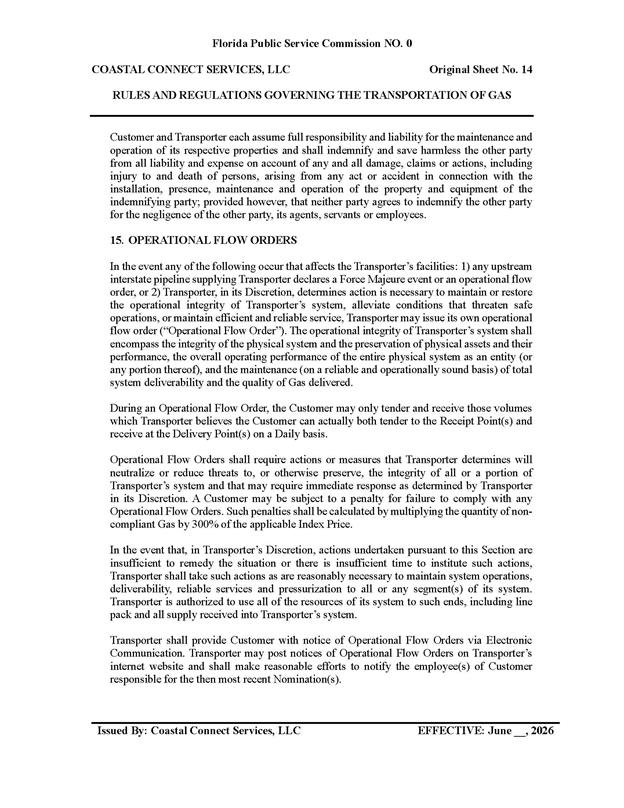
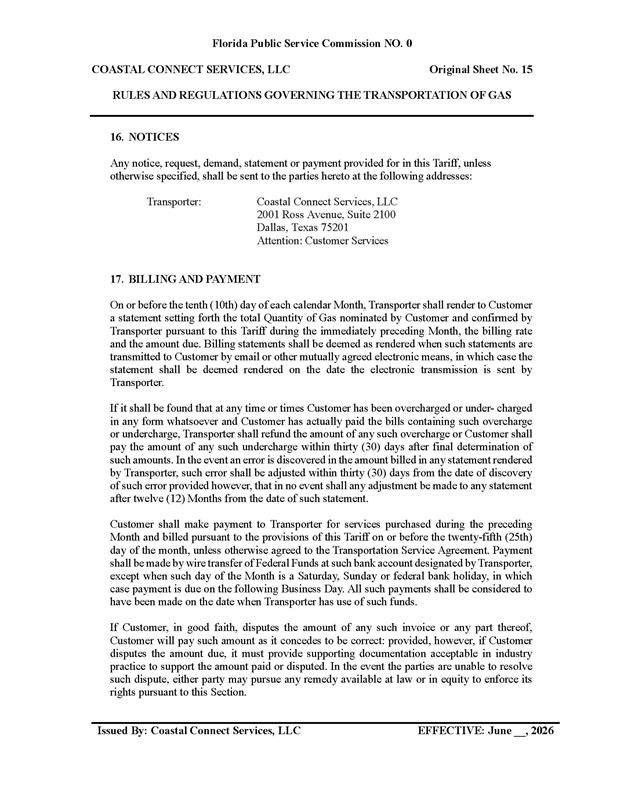
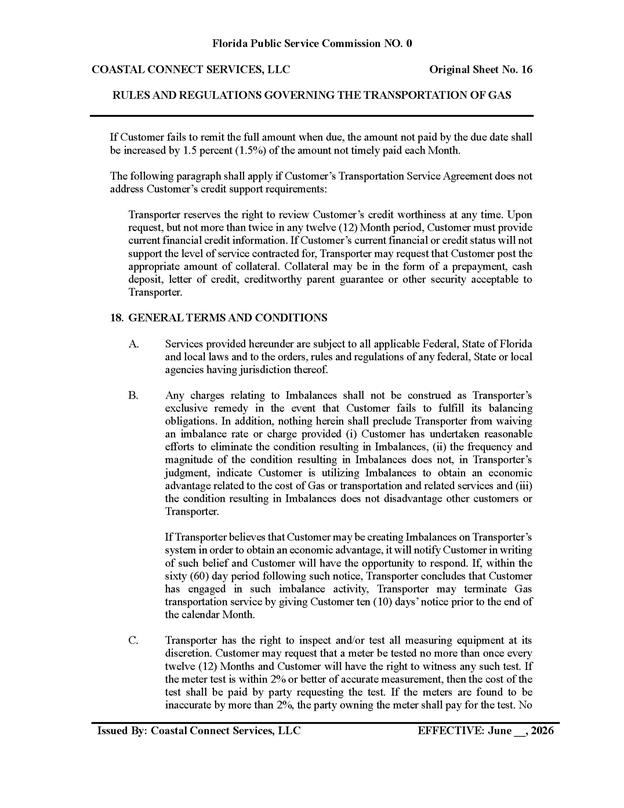
natural gas transmission pipelines and engage in the business of transporting
gas in Florida. The proposed tariff generally follows the template of the other
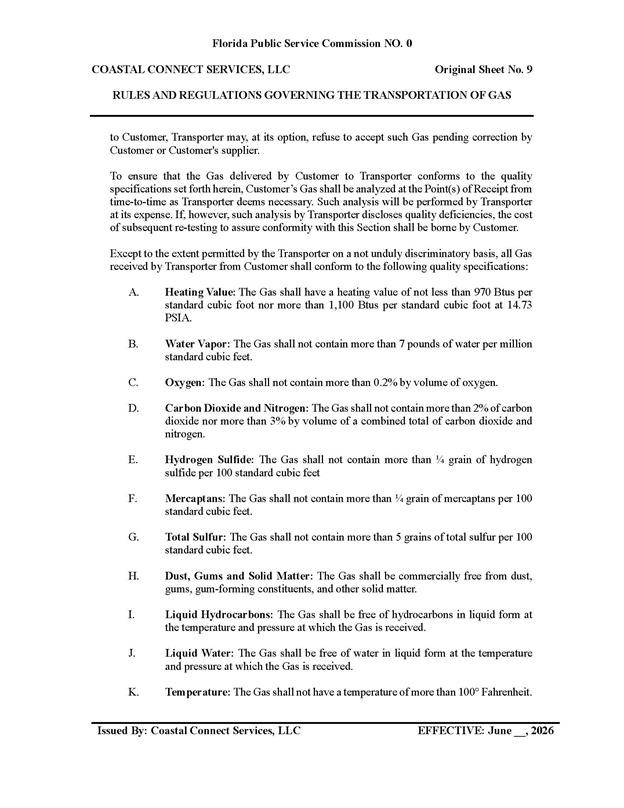
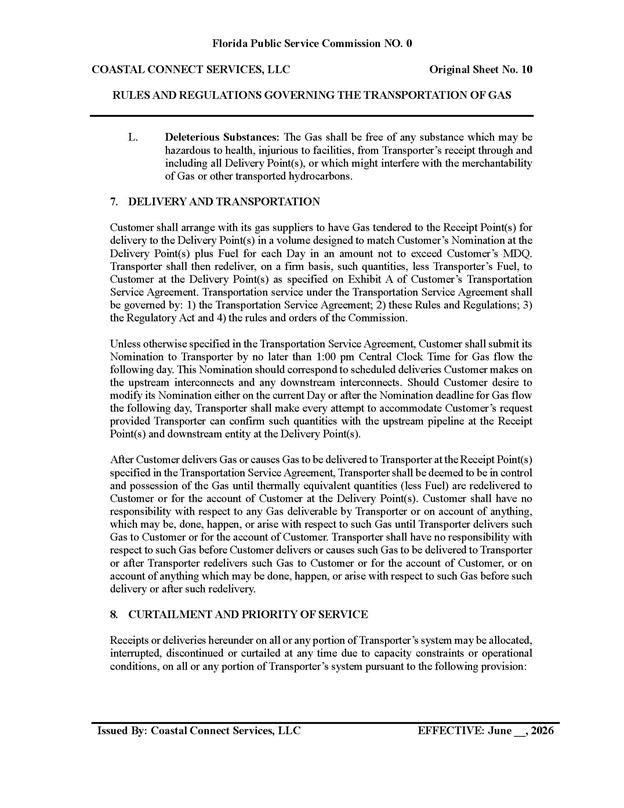
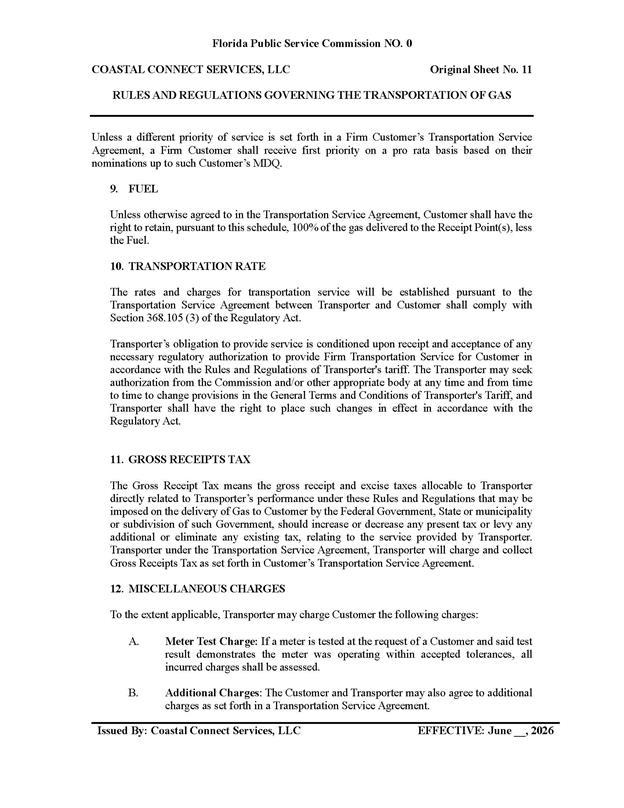
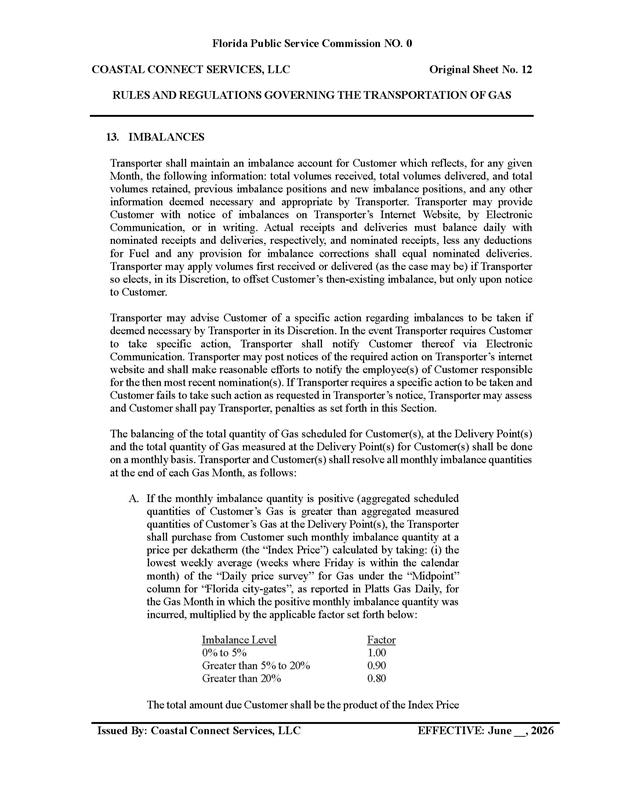
natural gas transmission companies in Florida. CCS’s proposed tariff includes
the rules and standard forms necessary to operate a natural gas transmission
pipeline system. The tariff contemplates that CCS will operate consistent with
the North American Energy Standards Board standards as it pertains to
nominations, scheduling, operational order notices and requirements, Delivery
Point measurement data and gas quality standards, among other items. A customer
who chooses CCS to transport its gas is required to enter into a Transportation
Service Agreement. Although the tariff does not include rates and charges,
those will be negotiated individually with each customer pursuant to Section
368.105(3), F.S.
Conclusion
CCS’s proposed tariffs are reasonable and meet the
requirements of Chapter 368, F.S. Within 30 days after executing a
Transportation Service Agreement, CCS and the customer should file an affidavit
with the Commission as required by Section 368.105(3), F.S. Upon the issuance
of the consummating order in this docket, CCS should pay regulatory assessment
fees as required by Rule 25-7.101, F.A.C. The Rule currently states that the
regulatory assessment fee for natural gas transmission companies shall be 0.25
percent annually of the company’s gross operating revenue. CCS should also file
annual reports as required by Rule 25-7.100, F.A.C. Upon request by the
Commission, CCS should make available its negotiated Transportation Service
Agreements. Staff envisions that obtaining copies of the agreements will only
be necessary in the event of a customer complaint.
Issue 3:
What action, if any, should the Commission take regarding
Coastal Connect Services, LLC’s proposed Firm Transportation Service Agreement?
Recommendation:
None. Staff believes that because CCS and SpaceX
filed affidavits that satisfy the requirements of Section 368.105(3), F.S., the
rates contained in the Firm Transportation Service Agreement are deemed to be
just and reasonable and approved by the Commission by operation of law.
Therefore, staff recommends that no action by the Commission is needed at this
time. (Marquez, Stiller, Ward)
Staff Analysis:
Pursuant to Section 368.105(3), F.S., rates charged
or offered to be charged by a natural gas transmission company for transactions
with large-volume contract customers may be deemed just and reasonable without
explicit Commission approval. Specifically, Section 368.105(3), F.S., provides
that such rates “are deemed to be just and reasonable and approved by the
[C]ommission, if both the natural gas transmission company and the customer
file an affidavit” affirming that at least one of the conditions in Subsections
(a)–(c) is met. Those conditions are that:
(a)
Neither the natural gas transmission company nor the
customer had an unfair advantage during the negotiations;
(b)
The rates are substantially the same as rates between
the natural gas transmission company and two or more of those customers under
the same or similar conditions of service; or
(c)
Competition does or did exist either with another
natural gas transmission company, another supplier of natural gas, or with
supplier of an alternative form of energy.
In this case, CCS submitted a proposed Firm Transportation
Service Agreement with SpaceX for Commission approval. The definition of the
word “rate” in Section 368.103(6), F.S., includes any terms and conditions, or
contracts related to the transmission or sales service of a natural gas
transmission company. Thus, the contractual terms contained in the Firm
Transportation Service Agreement fall under the applicable definition of
“rate.” In response to staff’s Third Data Request, CCS and SpaceX produced affidavits
affirming that (1) neither CCS nor SpaceX had an unfair advantage during the
negotiations, and (2) there is no other natural gas transmission company,
supplier of natural gas, or supplier of an alternative form of energy presently
able to serve the SpaceX facilities at Cape Canaveral.[9]
Staff believes these attestations satisfy the criteria contained in Section
368.105(3)(a) and (c), F.S., respectively. Thus, the Firm Transportation
Service Agreement is deemed to be just and reasonable by operation of law and
no action by the Commission is needed at this time.
Conclusion
Staff believes that because CCS and SpaceX filed
affidavits that satisfy the requirements of Section 368.105(3), F.S., the rates
contained in the Firm Transportation Service Agreement are deemed to be just
and reasonable and approved by the Commission by operation of law. Therefore,
staff recommends that no action by the Commission is needed at this time.
Issue 4:
Should this docket be closed?
Recommendation:
If a protest is filed within
21 days of the issuance of the order by a person whose substantial interests
are affected, the tariff should remain in effect, with any revenues held
subject to refund, pending resolution of the protest. If no timely protest is
filed, this docket should be closed upon the issuance of a consummating order.
(Marquez, Stiller)
Staff Analysis:
If a protest is filed within 21 days of the issuance
of the order by a person whose substantial interests are affected, the tariff
should remain in effect, with any revenues held subject to refund, pending
resolution of the protest. If no timely protest is filed, this docket should be
closed upon the issuance of a consummating order.