Discussion
of Issues
Issue 1:
Is the quality of service provided by Buttonwood Bay
satisfactory?
Recommendation:
No. While Buttonwood Bay’s water product is in
compliance with the rules and regulations of the Florida Department of
Environmental Protection (DEP), staff recommends that the Utility’s attempts to
address customer satisfaction have not been adequate based on the
recordkeeping, reporting, and communications of the Utility. Staff recommends
the quality of service be considered unsatisfactory, return on equity be
reduced by 50 basis points, and the Utility be required to file a plan
outlining how it will improve its recordkeeping and customer communications
within 30 days of the Order becoming final. (Davis)
Staff Analysis:
Pursuant to Section 367.081(2)(a)(l), F.S., and Rule
25-30.433(1), Florida Administrative Code (F.A.C.), in water and wastewater
rate cases, the Commission shall determine the overall quality of service
provided by the Utility. This determination is made from an evaluation of the
quality of the Utility’s product (water) and the Utility’s attempt to address
customer satisfaction (water and wastewater). The rule further states that the
most recent chemical analyses for the water system, outstanding citations,
violations, and consent orders on file with the DEP and the county health
department, and any DEP and county health department officials’ testimony
concerning quality of service shall be considered. In addition, any customer
testimony, comments, or complaints received by the Commission are also
reviewed. The operating condition of the water and wastewater systems is
addressed in Issue 2.
Quality of the Utility’s Product
In evaluation of Buttonwood Bay’s water product quality,
staff reviewed the Utility’s compliance with the DEP’s primary and secondary
drinking water standards. Primary standards protect public health while
secondary standards regulate contaminants that may impact the taste, odor, and
color of drinking water. Staff reviewed the DEP’s triennial Safe Drinking Water
chemical analyses of samples taken on March 27, 2024, and the Utility was
determined to be in-compliance with DEP standards except for the secondary
standard of color, which exhibited a color level of 31 color units (CU). The
Maximum Contaminant Level (MCL) for color is 15 CU. As a result, the DEP
ordered the Utility to conduct additional quarterly testing and also initiated
an investigation to determine the possible source(s) of discoloration. The
investigation identified several potential sources, including the filters and a
galvanized steel/cast iron pipe used for chlorine injection. The Utility
recently replaced the filters in January 2024, but had been operating them for
four years past their replacement schedule. Its next quarterly test, conducted
on May 23, 2024, had a CU of 16, still exceeding the MCL, but improved from the
prior test results. Subsequently, the Utility indicated that it adjusted
operations and switched the filter types in an attempt to address the issue.
The next testing on August 18, 2024, resulted in a CU sample of 5, which is below
DEP’s MCL. The subsequent tests in November 2024 and January 2025 also resulted
in CU samples of 5.
Staff also reviewed the DEP’s last Sanitary Survey Report
dated December 30, 2024, in which there were no chemical or bacteriological
exceedances noted for the previous 12 months, except the previously noted
secondary standard for color. In the Utility's last Consumer Confidence Report
dated June 24, 2024, no violations of contaminant levels were noted for the
testing period.
The Utility’s Attempt to Address Customer
Satisfaction
Staff reviewed the complaints filed in the Commission’s
Consumer Activity Tracking System (CATS), received by the Utility, and filed
with the DEP for the test year and four years prior. There were no complaints
filed in CATS or with the Utility during this period. The DEP recorded six
complaints during this analyzed time period, all of which pertained to water
color and/or odor, with one in 2020 and five in 2024. The first complaint,
dated September 9, 2020, reported black, rusty water. The DEP investigated the
complaint but found no violation. The DEP reported receiving four complaints
regarding color and odor in February, March, and June 2024, which coincides
with the CU MCLs discussed above. An additional complaint was filed on
September 11, 2024, regarding color and odor, following the compliant CU
results discussed above. The DEP issued Compliance Assistance Letters, one
dated May 20, 2024, for color, and another on September 18, 2024, for odor. In
its response, the Utility states it resolved these issues with the filter media
replacement for both the color and odor concerns. There appears to be no
further DEP action regarding these complaints.
Staff held a Customer Meeting on July 16, 2026, where
eleven customers provided comments. The comments included the frequency of boil
water notices (BWNs), water line breaks, and service interruptions, missing or
inadequate communication from the Utility regarding these events, the state of
the water infrastructure, and concerns regarding the impact of the proposed
rate increase. Customers also voiced concerns regarding the amount of
unaccounted for water calculated in the Staff Report. In addition, as of
September 1, 2026, 262 written comments were filed in the docket. For
reference, the Utility serves approximately 955 water customers and 939
wastewater customers.
Table 1-1 shows a total of 668 comments (provided verbally
at the customer meeting and written via the docket file) over six main
categories. A single customer comment was counted in multiple categories if it
addressed multiple issues. The majority of the comments expressed concern with
the overall rate increase and quality of service. The quality of service
comments identified issues with water discoloration, foul odor, and unpleasant
taste. However, there were a number of comments expressing concerns regarding
the frequency of outages and lack of communications to the customers from the Utility.
The Other category captured all other concerns, such as low or no water
pressure, required irrigation and pressure washing by the associated
development, unmetered water use, and damaged property such as fixtures or
appliances.
Table 1-1
Number of Comments Received,
Organized by Category and Source
|
Comment Category
|
Verbal Comments
|
Written Comments
|
Total*
|
|
Quality of Service
|
8
|
206
|
214
|
|
Outages and/or BWNs
|
4
|
62
|
66
|
|
Improper Billing
|
7
|
21
|
28
|
|
Meter Concerns
|
4
|
6
|
10
|
|
Rate Increase Concerns
|
11
|
221
|
232
|
|
Other
|
8
|
110
|
118
|
|
Total
|
42
|
626
|
668
|
*A
single customer comment could be counted multiple times if it is associated
with multiple categories.
As discussed above, the quality of service category in
Table 1-1 is primarily associated with water product quality, due to a
combination of color, odor, or taste concerns. The Utility attempted to address
the concerns regarding color and odor by adjusting its operations and changing
the type of filters used. The Utility also proposed a pro forma project as part
of the instant docket to again replace the filters (discussed further in Issue
4), but the project was delayed until 2027 and therefore not recommended by
staff for cost recovery as part of this rate case. Regarding the wastewater
system, customers also complained about odor associated with lift stations and
the central sewer plant. As discussed in Issue 4, the Utility requested several
pro forma projects associated with its wastewater facilities, some of which
concern odor.
Staff further investigated the Utility’s service
interruptions due to the customers’ concerns identified above. Pursuant to Rule
25-30.251, F.A.C., the Utility is required to maintain a record of all
interruptions in service which affect 10 percent or more of its customers and
to notify the Commission of the interruptions. The rule further states the Utility
must provide the cause of the interruption, the date, time, duration, remedy,
and steps taken to prevent reoccurrence. In response to staff’s eighth data
request, the Utility provided service interruption data for the period 2020
through 2025.
According to the Utility’s data, complete system outages impacting all the
customers happened once in 2021 and 2022, five times in 2023, twice in 2024,
and once in 2025. Events classified as community-wide or system-wide, including
planned system shutdowns and power or electrical failures at water treatment
plants, would exceed the Rule’s designated threshold. Localized line breaks
affecting a single street or a restricted number of lots and residences do not
meet the Rule’s criteria and would not need to be reported. Overall, there were
at least 15 instances between 2020 and 2025 that the Utility should have
informed the Commission of, but did not do so. Subsequent to staff’s data
request, the Utility stated it has now established a protocol to comply with
Rule 25-30.251(2), F.A.C.
Staff also investigated the reported customer concerns
regarding the Utility’s communication with its customers. Customer comments
suggested that customers were directed to the associated community’s main
office, rather than the Utility directly. The Utility indicated that it handles
after-hours emergencies through a 24-hour on-call service operated by its
contractor, U.S. Water. Standard business-hour inquiries are logged by the main
office and systematically routed through the Utility’s management and
operational chain of command including the Office Administrator, Water System
Manager, Water Treatment Plant Operator, and Maintenance Staff. As noted above,
the Utility stated it had received no complaints during the test year or four
prior years. However, customers reported difficulties reaching the Utility to
relay concerns, indicating a potential communication breakdown. Rule 25-30.130,
F.A.C., requires the Utility to maintain records of all complaints for a
minimum of five years. Pursuant to Rule 25-30.355, F.A.C., a complaint is
defined as an objection made to a Utility by a customer. Staff recommends that
the Utility record information required by Rule 25-30.130 F.A.C., for all
customer complaints regardless of whether the complaints were received from the
end-use customer directly or indirectly through the associated community or
system operators.
As shown in Table 1-1, meter accuracy concerns were also
raised by some customers. Rule 25-30.265, F.A.C., outlines the intervals that
utilities must inspect and test their customer meters, with a maximum interval
of 8 to 10 years between tests for commonly used residential meter sizes. In
response to staff’s data request asking for information regarding customer
meter testing, the Utility responded only with meter testing information
regarding its own Utility flow meters that are associated with the wells and
effluent and used only for reporting to DEP and the water management district,
not any customer meters used for billing referenced by the Rules in the data
request. The Utility also stated it received no requests for customer meter
testing during the period 2020 through 2025.
Staff recommends that the Utility begin conducting regular customer meter
testing at the required intervals stated in Rule 25-30.265, F.A.C., and
maintain records as required by Rule 25-30.267, F.A.C.
Managerial Concerns
In response to a staff data request addressing the
customer comments made at the customer meeting and the 257 comments filed in
the docket as of the July 16, 2026, the Utility stated that no customers appeared
to offer comments at the customer meeting and the Utility was unaware of any
customer comments filed in the docket, and therefore no action was required on
behalf of the Utility. The Utility did note that it engaged in capital
investments regarding its filters in 2024 to resolve DEP complaints, and stated
it was committed to address customer concerns promptly.
However, staff notes that the Utility did include expenses associated with both
attending the customer meeting, along with follow-up discussions, and reviewing
customer complaints in its requested rate case expenses. While
representatives may have indeed attended the virtual customer meeting, the Utility’s
inaccurate recordkeeping of no customers comments at the meeting indicates
there is room for improvement as there were customer comments, as discussed
above, from both the customer meeting and docket file.
Overall, staff’s review of the Utility’s attempt to
address customer satisfaction demonstrates that while the Utility did respond
to formal DEP complaints regarding color and odor, there were DEP deficiencies
related to poor recordkeeping and reporting by Utility management. For example,
on December 30, 2024, the Utility received a Compliance Assistance Letter from
the DEP based on its December 12, 2024 sanitary survey, which among other
factors included deficiencies for failure to provide records for its flow meter
calibration, to update the Utility’s Lead and Copper sampling plan, and to
maintain an emergency plan on site. While these and other noted deficiencies
were resolved by January 22, 2025, and the water treatment plant returned to
compliance, it is indicative of the type of recordkeeping discrepancies seen
above regarding service interruptions, complaints, and meter testing records. Additionally,
in Issue 3, staff discusses the Utility’s recordkeeping as it relates to
Excessive Unaccounted for Water (EUW), as it appears the Utility is not keeping
full record of water used for other purposes. Such actions can negatively impact
the customer service provided by Buttonwood Bay. Therefore, staff recommends
that Buttonwood Bay’s quality of service be considered unsatisfactory, and the
return on equity should be reduced by 50 basis points as a penalty until the Utility
demonstrates its quality of service has improved in a future proceeding.
In addition, the Utility should be required to submit,
within 30 days of the Commission’s Order becoming final, a plan describing how
it will accomplish the following to remedy some of the recordkeeping and
communication issues addressed above:
1.
Regarding service interruptions, the Utility must
report service interruptions of more than ten percent of connections, both for
the initial filing that an interruption has occurred and the supplemental filing
with complete details after service has been restored, pursuant to Rule
25-30.251, F.A.C. As required by the Rule, the Utility must also record the
required supplemental details for each, including the cause, remedy, and steps
taken to prevent recurrence of service interruptions.
2.
Regarding customer communications, the Utility must
document and maintain records of all customer complaints whether received
directly from the customer or indirectly through any other source, including
the associated community, pursuant to Rule 25-30.130, F.A.C. In addition, when
the Utility provides acknowledgement and responses to a complaint pursuant to
Rule 25-30.355, F.A.C., it should do so to the original customer who provided
the complaint, even if it was indirectly provided to the Utility by any other
source.
3.
Regarding meter testing, the Utility must begin
conducting regular meter testing at the required intervals pursuant to Rule
25-30.265, F.A.C. Additionally, the Utility must perform meter tests upon
customer request and keep and maintain records of all tests performed. As part
of this requirement, staff recommends the Utility submit information within 30
days of the Commission’s final order in this docket regarding the meter testing
program, including the representative sample size and timing for each class of
meter.
4.
Regarding recordkeeping of the Utility’s water uses,
the Utility is responsible for maintaining its records with respect to water
uses and also accurately reporting this information in its Annual Report
pursuant to Rule 25-30.110, F.A.C. As discussed in Issue 3, the Utility was
unable to accurately present the amounts of water used for flushing to be
considered in the EUW calculation, when prompted by staff. Therefore, as part
of this requirement, staff recommends that the Utility explain how it intends
to improve its recordkeeping practices with respect to measuring water for
flushing to ensure that such uses are accurately documented and reported in its
annual reports and other filings.
Conclusion
While Buttonwood Bay’s water product is in compliance with
the rules and regulations of the DEP, staff recommends that the Utility’s
attempts to address customer satisfaction have not been adequate based on the
recordkeeping, reporting, and communications of the Utility. Staff recommends
the quality of service be considered unsatisfactory, return on equity be
reduced by 50 basis points, and the Utility be required
to file a plan outlining how it will improve its recordkeeping and customer
communications within 30 days of the Order becoming final.
Issue 2:
Are the infrastructure and operating conditions of Buttonwood
Bay’s water and wastewater system in compliance with DEP regulations?
Recommendation:
Yes. Buttonwood Bay’s water and wastewater systems are
in compliance with DEP regulations, with the exception of the wastewater system’s
permit which is currently subject to a DEP Administrative Order until the plant
achieves full compliance with the DEP’s standards for effluent quality related
to nitrogen and phosphorus by March 1, 2027. (Davis)
Staff Analysis:
Rule 25-30.225(2), F.A.C., requires each water and
wastewater Utility to maintain and operate its plant and facilities by
employing qualified operators in accordance with the rules of the DEP. Rule
25-30.433(2), F.A.C., requires consideration of whether the infrastructure and
operating conditions of the plant and facilities are in compliance with Rule
25-30.225, F.A.C. In making this determination, the Commission must consider
testimony of the DEP and county health department officials, sanitary surveys for
water and compliance evaluations for wastewater systems, citations, violations
and consent orders issued to the Utility, customer testimony, comments,
complaints, and Utility testimony and responses to the aforementioned items.
Water System Operating Conditions
Buttonwood Bay’s water system has a permitted capacity of
542,000 gallons per day. The system consists of two 8-inch diameter wells, two
15,000-gallon hydropneumatic storage tanks, and one 107,000-gallon above-ground
water storage tank. The pumping capacity of both Well No. 1 and No. 2 are 450
gallons per minute (gpm).
Groundwater is treated through hypochlorination prior to distribution. The DEP
conducted an inspection of Buttonwood Bay’s water treatment plant (WTP) on
December 12, 2024. The resulting Sanitary Survey Report indicated seven issues
classified as minor, including missing documentation for flow meter calibration
and emergency response plans and leaks from one of the pumps and ground storage
tank, all of which were corrected by February 24, 2025. Consequently, the WTP
is in compliance with the DEP’s rules and regulations.
Wastewater System Operating Conditions
The Buttonwood Bay wastewater treatment facility operates
with an existing permitted capacity of 0.098 million gallons per day. Staff
reviewed the Utility’s last DEP Compliance Evaluation Inspection report, dated
April 18, 2024. The DEP noted fifteen deficiencies, including permitting and
documentation concerns, wastewater treatment plant (WWTP) operational issues,
and effluent quality concerns. The DEP determined that all non-compliance items
identified at the time of the inspection have been corrected and deemed the Utility
to be in compliance as of July 24, 2024.
Regarding effluent quality, on October 3, 2024, the DEP
attached Administrative Order AO-014348-018-SD to the facility's approved
operating permit, citing a lack of compliance with the Lake Okeechobee Basin's Total Nitrogen and Total Phosphorus discharge
standards. To resolve these deficiencies, the Utility has partnered with
third-party engineering firm Kimley Horn to design and execute the necessary
physical upgrades to the facility to meet the Total Nitrogen and Total
Phosphorus discharge standards. While foundational steps like effluent sampling
and securing a licensed engineer have been completed, critical engineering
actions remain in progress. Ultimately, the Utility anticipates a total capital
investment of approximately $250,000 to finalize the upgrades and achieve full
regulatory compliance by the final March 1, 2027 operational deadline. As
discussed in Issue 4, the Utility requested pro forma projects associated these
upgrades, but staff is not recommending approval of these projects at this time
as they are outside of the pro forma time period and minimal cost data was
provided.
Conclusion
Buttonwood Bay’s water and wastewater systems are in
compliance with DEP regulations, with the exception of the wastewater system’s
permit which is currently subject to a DEP Administrative Order until the plant
achieves full compliance with the DEP’s standards for effluent quality related
to nitrogen and phosphorus by March 1, 2027.
Issue 3:
What are the used and useful (U&U) percentages
of Buttonwood Bay’s water treatment plant (WTP) and water storage, wastewater
treatment plant (WWTP), water distribution, and wastewater collection systems?
Recommendation:
Buttonwood Bay’s WTP, water storage, water
distribution system, WWTP, and wastewater collection system should all be
considered 100 percent used and useful. An 18.03 percent adjustment should be
made to reduce the operating expenses for chemicals and purchased power for EUW;
and, consistent with Issue 1, the Utility should be required to file a plan,
within 30 days of the Commission’s Order
becoming final, outlining how it will improve its recordkeeping as it relates
to flushing and EUW. (Davis)
Staff Analysis:
As stated in Issue 2, Buttonwood Bay’s water system
is served by two 8-inch diameter wells. The pumping capacity of both Well No. 1
and No. 2 is 450 gpm. The Utility is permitted by the DEP to treat 542,000
gallons per day. The water distribution system is composed of approximately
35,676 feet of 2-inch to 8-inch polyvinyl chloride pipe.
Excessive Unaccounted for Water
Rule 25-30.4325, F.A.C., provides factors to be considered
in determining whether adjustments to operating expenses are necessary for EUW.
EUW is defined as “unaccounted for water in excess of 10 percent of the amount
produced.” Unaccounted for water is all water that is not sold, metered, or
accounted for in the records of the Utility.
EUW is calculated by subtracting both the gallons sold to
customers and the gallons used for other services such as line flushing, from
the total gallons pumped and purchased for the test year, and dividing by the
sum of the gallons pumped and purchased. The amount in excess of 10 percent, if
any, is the EUW percentage.
A review of Buttonwood Bay’s 2024 monthly operating
reports on file with the DEP shows the Utility produced 74,350,000 gallons of
water during the test year. In response to staff’s data requests, the Utility
indicated that it purchased no water from other utilities. While the Utility
reported no Utility usage in its annual reports, in response to staff’s data
requests, the Utility identified Utility usage for backwashing of 1,837,000
gallons, and known water loss from line breaks estimated at 36,930 gallons
during the test year.
However, the Utility reported various amounts of water for flushing, ranging
from 57,960 gallons based on metering, 463,014 gallons based on quarterly
hydrant and flushing logs, and 4,508,928 gallons based on estimated flushing
durations. Staff
included the 463,014 gallon value for flushing because the Utility provided
supporting documentation. An examination of the Utility’s billing records
indicated 51,174,962 gallons of treated water were sold to its customers. The
calculation (74,350,000 + 0 – 51,174,962 – 1,837,000 – 36,930 –
463,014)/(74,350,000 + 0) results in 28.03 percent unaccounted for water. The
Rule allows a 10 percent margin; therefore, there is 18.03 percent EUW.
Staff believes that the Utility’s EUW may be attributable,
at least in part, to deficiencies in the Utility’s recordkeeping regarding
water flushing. Accordingly, as stated in Issue 1, staff recommends that the Utility
be required to file, within 30 days of the Commission’s Order becoming final, a
plan explaining how it intends to improve its recordkeeping practices with
respect to flushing, including measures to ensure that such uses are accurately
documented and reported in its annual reports and other filings.
Infiltration and Inflow
Rule 25-30.432, F.A.C., provides that in determining the
amount of U&U plant, the Commission will consider I&I. Excessive
I&I is a calculation that is based on a comparison of the allowable
wastewater treated to the actual amount of wastewater treated. Allowable
treated wastewater was calculated as 50,155,719 gallons, and the actual amount
of the wastewater treated was 14,253,000 gallons. The actual amount does not
exceed the allowable amount, therefore there is no excessive I&I and no
adjustment to operating expenses is necessary.
Used and Useful Percentages
Rules 25-30.432 and 25-30.4325, F.A.C., address the method
by which the U&U percentage of water and wastewater systems are determined.
The Commission has not previously established the used and useful percentages
for the Utility. Rule 25-30.4325(4), F.A.C., states that a water treatment
system is considered 100 percent U&U if the service territory the system is
designed to serve is built out and there is no apparent potential for expansion
of the service territory. Based on staff’s investigation, the Utility’s service
area appears to be built out, therefore the WTP, water storage, water
distribution system should be considered 100 percent U&U.
Similarly, Rule 25-30.432, F.A.C., for wastewater systems
allows the Commission to consider other factors, including the extent to which
the area served is built out. As noted above, the Utility’s service area
appears to be built out, therefore the WWTP and wastewater collection system
should be considered 100 percent U&U.
Conclusion
Buttonwood Bay’s WTP, water storage, water distribution
system, WWTP, and wastewater collection system should all be considered 100
percent used and useful. An 18.03 percent adjustment should be made to reduce
the operating expenses for chemicals and purchased power for EUW; and,
consistent with Issue 1, the Utility should be required to file a plan,
within 30 days of the Commission’s Order
becoming final, outlining how it will improve its recordkeeping as it relates
to flushing and EUW.
Issue 4:
What is the appropriate average test year rate base
for Buttonwood Bay?
Recommendation:
The appropriate average test
year rate base for Buttonwood Bay is $737,375 for water and $541,094 for
wastewater. (Worrall, Davis)
Staff Analysis:
The
appropriate components of the Utility’s rate base include Utility plant in
service (UPIS), land and land rights, accumulated depreciation,
contributions-in-aid of construction (CIAC), accumulated amortization of CIAC,
capital recovery, accumulated amortization of capital recovery, and working
capital. Staff selected the test year ended December 31, 2024, for this rate
case. A summary of each component and the recommended adjustments are discussed
below.
Pro
Forma Plant Additions
When evaluating a
utility’s request for pro forma plant additions, staff requests the Utility
provide, among other things the: (1) need; (2) reasonableness; (3) cost; (4)
in-service date(s); and (5) alternatives, as each item relates to each project.
Additionally, it is Commission practice for staff to evaluate whether a minimum
of three bids were solicited for each project or the Utility’s reasoning as to
why three could not be obtained. During the course of the rate case, the Utility
proposed a total of 13 pro forma projects.
Pro
Forma Projects Recommended for Approval
Based on a review
of the information provided by the Utility for each project, staff recommends
approval of the five pro forma projects listed in Table 4-1. Each recommended projected
is described in more detail below. The Utility classified all five as
emergencies, and therefore, did not seek three bids in each instance.
Table 4-1
Staff Recommended Pro Forma Projects
|
#
|
Project Name
|
In-Service Date
|
Account
Number
|
Installed
Cost
|
Retirement
|
|
1
|
Diffuser in
Stillwell
|
10/07/2025
|
380
|
$1,983
|
$1,487
|
|
2
|
New Triplex
Skimmer
|
09/29/2025
|
380
|
11,643
|
8,732
|
|
3
|
New Surface
Aerator Motor
|
09/26/2025
|
380
|
9,371
|
7,028
|
|
4
|
New Surge Tank
Air Line and Diffuser
|
01/30/2026
|
380
|
18,606
|
13,955
|
|
5
|
Surge Tank
Electrical Control Panel
|
12/24/2025
|
380
|
6,280
|
4,710
|
|
|
Total
|
|
|
$141,611
|
$106,209
|
Source: Utility’s
responses to staff’s data requests.
Project
1: Install Diffuser in Stillwell
Project 1 is the
replacement of a diffuser in the bottom of the stillwell in the wastewater
plant. The new diffuser was installed on the waterline to accelerate waste
breakdown and control odor. In response to staff’s data requests, the Utility
labeled this project an emergency because its failure would impede operation of
the WWTP. However, even with this classification, two bids were provided, one
dated July 2024 and the other undated. Of the two bids provided, the Utility
selected the lowest bid. Staff agrees that without the diffuser, the Utility’s
ability to control odor and operate the WWTP efficiently would be impacted, and
emergency replacement was prudent. An invoice dated October 31, 2025, was
provided for $1,983 for work completed on October 7, 2025. Based on this review, staff recommends
approval of the pro forma project.
Project
2: Install New Triplex Skimmer
Project 2 is the
replacement of a skimmer to assist with removing debris from the WWTP that will
not settle. The Utility reported it was necessary as the existing equipment was
approaching failure due to mechanical wear and corrosion. In response to
staff’s data requests, the Utility labeled this project an emergency because
its failure would impede operation of the WWTP. However, even with this
classification, two bids were provided, one dated July 2024 and the other
undated. Of the two bids provided, the Utility selected the lowest bid. Staff
agrees that without a skimmer, the WWTP would experience a buildup of floating
material that would impact its efficiency, and emergency replacement was
prudent. An invoice was provided for $11,643 for work completed on September
29, 2025. Based on this review, staff recommends
approval of the pro forma project.
Project
3: Install New Surface Aerator Motor
Project 3 is the
replacement of the surface aerator motor. The Utility reported it was necessary
as the existing surface aerator motor failed. In response to staff’s data
requests, the Utility labeled this project an emergency, as the component is
necessary for proper operation of the WWTP, and provided a single estimate,
dated July 29, 2025. Staff agrees that without surface aeration, the WWTP would
not function properly, and emergency replacement was prudent. An invoice was
provided for $9,371 for work completed on September 26, 2025. Based on this review, staff recommends
approval of the pro forma project.
Project
4: Install New Surge Tank Air Line and Diffuser
Project 4 is the
replacement of a surge tank air line and diffuser. The Utility reported it was
necessary as the existing diffuser was not operating properly and experiencing
fouling and clogging. In response to staff’s data requests, the Utility labeled
this project an emergency, as it is necessary for proper operation of the WWTP.
Staff agrees that without aeration from the air line, the WWTP would not
function properly, and emergency replacement was prudent. An invoice was
provided for $18,606 for work completed on January 30, 2026. Based on this review, staff recommends
approval of the pro forma project.
Project
5: Install New Surge Tank Electrical Control Panel
Project 5 is
replacing the electrical control panel for the surge tank. The replacement was
driven by environmental degradation, mechanical failure, and regulatory
obsolescence. In response to staff’s data requests, the Utility labeled this
project an emergency, as it was necessary to operate the associated equipment.
Staff agrees that without a control panel, the associated equipment would not
function as needed for proper operation of the WWTP, and emergency replacement
was prudent. An invoice for $6,280 was provided for work completed on December
24, 2025. Based on this review, staff recommends
approval of the pro forma project.
Excluded
Pro Forma Projects
Of the 13 pro
forma projects proposed by the Utility, staff recommends rejecting the
remaining eight projects due to withdrawal, untimeliness, or lack of supporting
cost data. The Utility voluntarily withdrew one project, WTP electrical
upgrades estimated at $80,000, as it was no longer necessary. Staff did not
consider three additional projects as they were outside of the 24 month period following
the end of the test year, no longer period was requested under 367.081(2)(a)2.,
F.S., and minimal cost data was provided. These projects were: (1) a new
generator for the WTP estimated at $180,000 to $300,000; (2) new filter media
for the WTP estimated at $80,000 to $90,000; and, (3) environmental upgrades
for the WWTP estimated at $250,000. The remaining four projects are discussed
in more detail below. While staff recognizes there may be a need for the
following four projects, the Utility failed to provide the appropriate
supporting information when prompted and, therefore, staff does not believe it
is appropriate to include them in rate base at this time.
High
Service Pump (WTP)
In the Utility’s
response to staff’s first data request, filed on January 9, 2026, the Utility
requested cost recovery estimated at $12,000 for replacing the existing high
service pump at the WTP because the current high service pump is failing. In a subsequent data response, dated July
17, 2026, the Utility provided a revised estimate of $13,000, a statement they
were still gathering bids, and an estimated in-service date of October 1, 2026. While staff agrees that there is a need to
timely replace failing equipment, the Utility did not provide adequate
information regarding the project to demonstrate it could meet the given
in-service date, nor any documentation supporting the costs to be included in
rate base. Therefore, staff does not recommend approving this project at this
time.
New
Control Room (WTP)
Requested as part
of the Utility’s application filed October 3, 2025, this project involves
replacing the old control room containing the high service pumps which the Utility
indicated was necessary due to leaks, wood rot, and collapsing floors, with an
estimated cost of $62,319. In a subsequent data request response dated
July 17, 2026, the Utility provided a revised estimated cost of $61,407, and
stated they sought bids from four vendors but only received one bid, which was
ultimately selected, with an estimated in-service date of November 20, 2025. While staff agrees that there is a need for
the project based upon the described conditions of the original facility, the Utility
did not provide any supporting documentation for the costs to be included in
rate base, such as an invoice. Therefore, staff does not recommend approving
this project at this time.
Install
New Blower (WWTP)
Requested as part
of the Utility’s application filed October 3, 2025, this project involves
replacement of the blower at the wastewater treatment plant due to the failure
of the original blower, and was estimated to cost $9,251. The Utility provided multiple in-service
dates for the project, including both August 29, 2025, and October 9, 2025. The Utility classified it as an emergency,
and states it only sought a single bidder, and provided an estimate to staff,
dated August 8, 2025. While staff agrees that there is a need to
timely replace failing equipment, the Utility did not provide adequate
information regarding the project to demonstrate the in-service date, nor any
documentation supporting the costs to be included in rate base, such as an
invoice. Therefore, staff does not recommend approving this project at this
time.
Install
RAS WAS Splitter Box (WWTP)
Requested as part
of the Utility’s application filed October 3, 2025, this project involves
replacement of the splitter box at the wastewater treatment plant due to the
failure of the existing splitter box, estimated at $10,070. The Utility provided multiple in-service
dates for the project, including both October 9, 2025, and November 10, 2025. While the Utility classified it as an
emergency, it stated that it sought two bids and selected the lowest one, and
provided only one bid to staff, dated July 23, 2025. While staff agrees that there is a need to
timely replace failing equipment, the Utility did not provide adequate
information regarding the project to demonstrate the in-service date, nor any
documentation supporting the costs to be included in rate base, such as an
invoice. Therefore, staff does not recommend approving this project at this
time.
Utility
Plant in Service
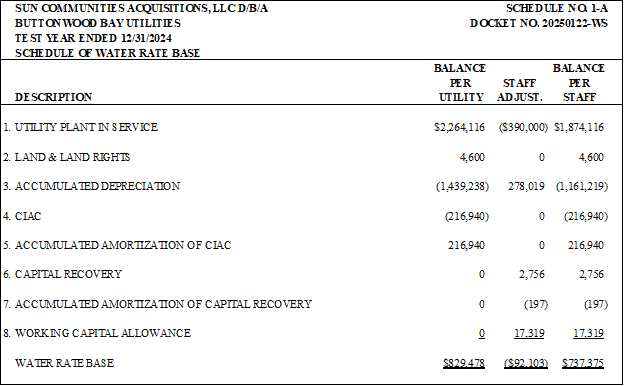
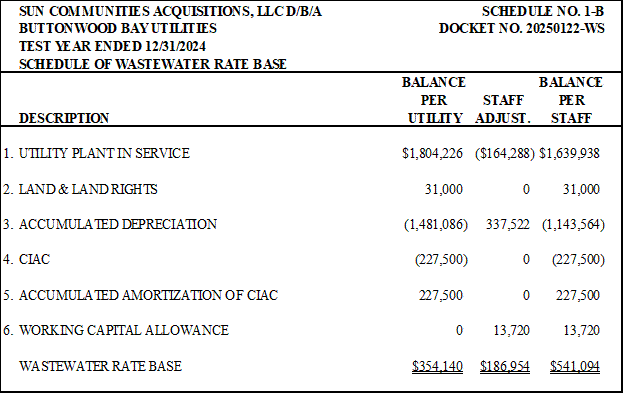
The
Utility recorded UPIS of $2,264,116 for water and $1,804,226 for wastewater.
The Utility could not provide a ledger or invoices from December 31, 2002, to
December 31, 2016. Staff determined Buttonwood Bay’s UPIS by using the Utility’s
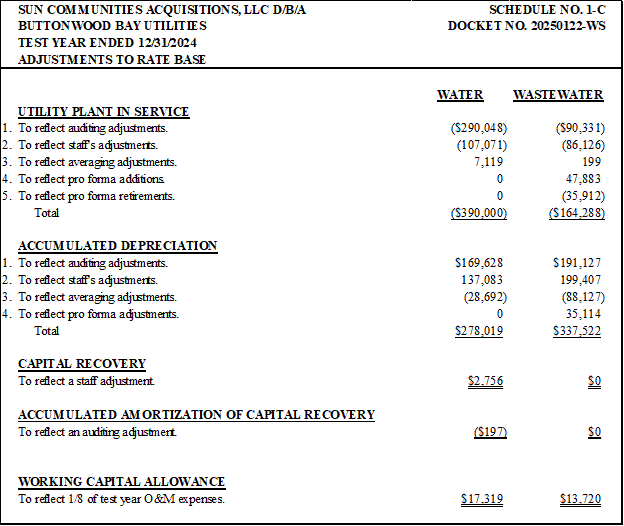
last Commission order and by reviewing available invoices and annual reports.[30] Several discrepancies were noted, thus
audit staff decreased UPIS for water by $290,048 and wastewater by $90,331 to
adjust for improper classification of additions.
The
Utility only made six retirements from December 31, 2003, to December 31, 2024.
Staff decreased UPIS by $107,071 for water and $86,126 for wastewater to
reflect the appropriate retirement of assets. In addition, staff increased UPIS
for water by $7,119 and wastewater by $199 to reflect averaging adjustments. Lastly,
staff increased wastewater UPIS by $47,883 to reflect pro forma additions, but
further decreased this amount by $35,912 to reflect pro forma retirements.
Staff’s
adjustments to UPIS result in a net decrease of $390,000 for water and a net
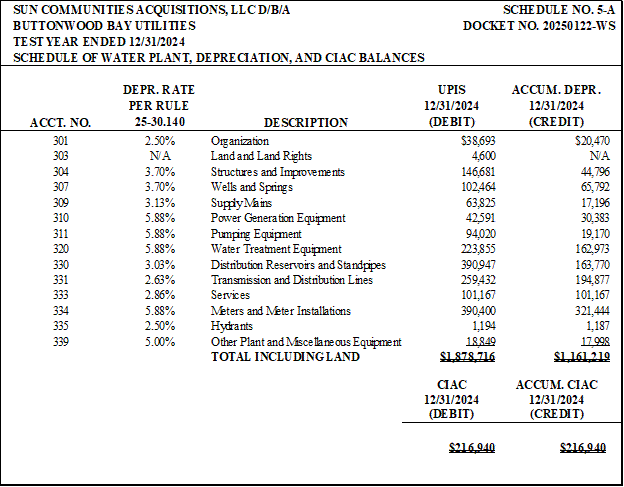
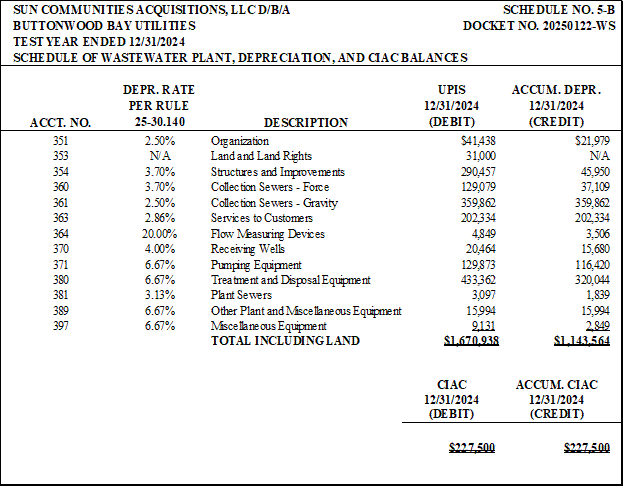
decrease of $164,288 for wastewater. Therefore, staff recommends a water UPIS
balance of $1,874,116 and a wastewater UPIS balance of $1,639,938.
Capped
Retirement
In general, it is Commission practice to use
the 75 percent of plant addition methodology to estimate the retirement amount
of assets being replaced when the original cost is unknown. In this case, the Utility
did not record retirements for certain accounts in prior years. As a result,
application of the 75 percent retirement methodology would result in an overall
negative plant balance. Therefore, staff has capped the retirement amount at
the plant balance for one account in the relevant years. This methodology was
utilized in Docket No. 20160101-WS and was approved by Order No.
PSC-2017-0361-FOF-WS.[31] In that order, the Commission found that:
“the amount of retirement to plant in service and accumulated depreciation
reflected in the adjusted test year shall be calculated based on either the 75
percent methodology . . . or on the actual balance in the impacted plant in
service account . . . if that balance would be negative as a result of the 75
percent methodology.”[32]
Due to the capped retirement, staff
identified Account 311 – Pumping Equipment, as having a total of $2,756 of
remaining undepreciated plant balance. Staff believes that this remaining
balance should be recovered as amortization expense over a seven-year period.
Although Rule 25-30.433(10), F.A.C., outlines the formula for determining the
appropriate amortization period for forced abandonment or the prudent
retirement of plant assets prior to the end of their depreciable life, an
alternate amortization period is permitted under the rule. Thus, staff
recommends an amortization period of seven years. This seven-year period
results in an annual amortization expense of $394. Therefore, staff recommends
capital recovery of $2,756 over a seven-year amortization period. The
associated annual amortization expense is $394.
Land
and Land Rights
The
Utility recorded a test year land and land rights balances of $4,600 for water
and $31,000 for wastewater. Staff made no adjustments to this amount and
therefore, recommends land and land rights balances of $4,600 for water and
$31,000 for wastewater.
Used
and Useful
As discussed in Issue 3, the Utility’s systems
are considered 100 percent
U&U. Therefore, no U&U adjustment is necessary.
Accumulated
Depreciation
The
Utility recorded $1,439,238 of accumulated depreciation for water and
$1,481,086 for wastewater. Audit staff decreased these amounts by $169,628 for water
and $191,127 for wastewater to reflect corrections to UPIS and the application
of the correct depreciation rates per Rule 25-30.140, F.A.C. Staff further
decreased these amounts by $190,363 for water and $107,734 for wastewater to
reflect the appropriate retirement of assets and updated depreciation expense
associated with plant retirements recognized outside the test year. Technical
staff increased accumulated depreciation for water by $53,280, and decreased
wastewater by $91,673 resulting from its recalculation of depreciation
activity. Additionally, staff increased these amounts by $28,692 for water and
$88,127 for wastewater to reflect averaging adjustments. Lastly, staff
decreased this amount by $35,114 for wastewater to reflect pro forma additions
and retirements.
Staff’s
adjustments to accumulated depreciation result in a net decrease of $278,019
for water and $337,522 for wastewater. Therefore, staff recommends an average
accumulated depreciation balance of $1,161,219 for water and $1,143,564 for
wastewater.
Contributions
in Aid of Construction (CIAC)
The
Utility recorded a CIAC balance of $216,940 for water and $227,500 for
wastewater. Staff made no adjustments to CIAC for water or wastewater.
Therefore, staff recommends a CIAC balance of $216,940 for water and $227,500
for wastewater.
Accumulated
Amortization of CIAC
The
Utility recorded an accumulated amortization of CIAC balance of $216,940 for
water and $227,500 for wastewater. Staff made no adjustments to accumulated
amortization of CIAC for water or wastewater. Therefore, staff recommends an
accumulated amortization of CIAC balance of $216,940 for water and $227,500 for
wastewater.
Accumulated
Amortization of Capital Recovery
As
a result of capped retirement, staff increased accumulated amortization of
capital recovery by $197 to reflect an averaging adjustment. Therefore, staff
recommends an accumulated amortization balance of $197.
Working
Capital Allowance
Working
capital is defined as the short-term investor-supplied funds that are necessary
to meet operating expenses. Consistent with Rule 25-30.433(3), F.A.C., and Commission
practice, staff used the one-eighth operation and maintenance (O&M) expense
(less rate case expense) formula for calculating the working capital allowance.[33] As such, staff removed the rate case
expense of $2,234 for water and $2,201 for wastewater. This resulted in an
adjusted O&M expense balance of $138,551 for water and $109,761 for
wastewater. Applying this formula, staff recommends a working capital allowance
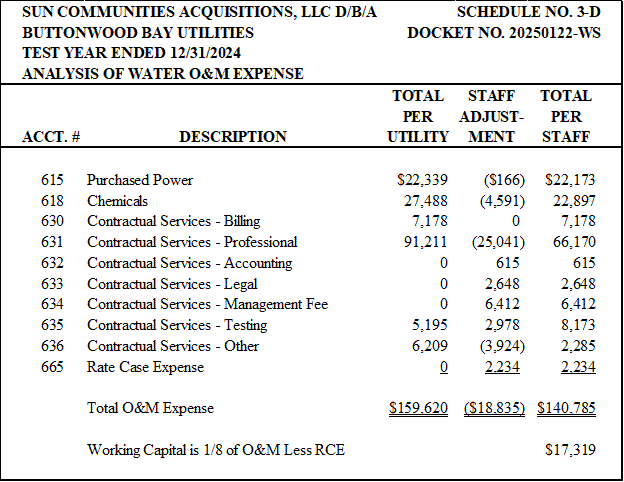
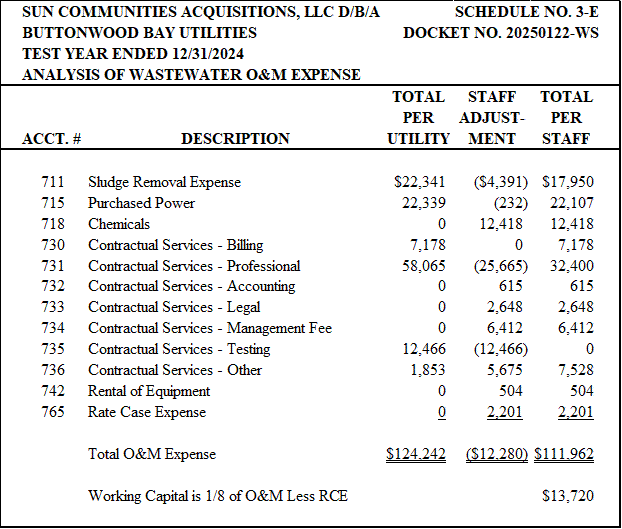
of $17,319 for water and $13,720 for wastewater.
Rate
Base Summary
Based on the
foregoing, staff recommends an appropriate average test year rate base of $737,375
for water and $541,094 for wastewater. Rate base is shown in Schedule Nos. 1-A
and 1-B. The related adjustments are shown on Schedule No. 1-C. Plant,
depreciation, and CIAC balances are shown in Schedule Nos. 5-A and 5-B.
Issue 5:
What is the appropriate return on equity and overall
rate of return for Buttonwood Bay?
Recommendation:
The appropriate return on equity (ROE) is 8.58
percent with a range of 7.58 percent to 9.58 percent. The appropriate overall
rate of return is 8.58 percent. (Worrall)
Staff Analysis:
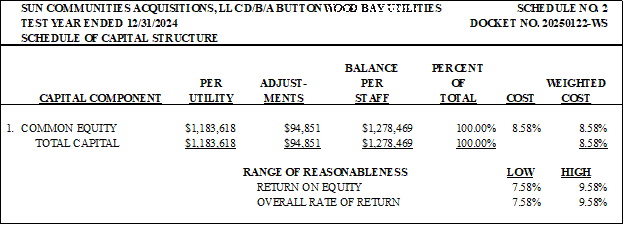
The Utility’s
capital structure consists entirely of common equity. The Utility’s capital
structure has been reconciled with staff’s recommended rate base. The
appropriate ROE is 8.58 percent based on the Commission-approved leverage
formula currently in effect.[34] Staff
recommends an ROE of 8.58 percent with a range of 7.58 percent to 9.58 percent,
and an overall rate of return of 8.58 percent. The ROE and overall rate of
return are equal, as shown on Schedule No. 2.
Staff
recommends a 50-basis-point penalty be assessed to Buttonwood Bay’s ROE as
discussed in Issue 1. This 50-basis-point penalty would reduce the Utility’s
return on rate base by $3,687 for water and $2,706 for wastewater. This
translates to a $3,861 reduction to the Utility’s water revenue requirement and
a $2,833 reduction to its wastewater revenue requirement. These penalties are
pending the Commission’s decision and are not currently included in the revenue
requirement.
Issue 6:
What are the appropriate amount of test year
operating revenues for Buttonwood Bay’s water and wastewater system?
Recommendation:
The appropriate test year
operating revenues for Buttonwood Bay are $183,124
for the water system and $157,265 for the wastewater system. (Sibley)
Staff Analysis:
The Utility recorded test
year operating revenues of $154,284 for water and $133,036 for wastewater. The Utility
did not record any miscellaneous revenues during the test year. Staff’s review
of the Commission audit indicated that the Utility’s billing register contained
several inaccuracies during the test year. For water and wastewater, the Utility
incorrectly undercharged its customers a base facility charge of $10.28 for
water service and $10.61 for wastewater service. The Utility’s general ledger included
duplicate bills for its residential wastewater customers. Staff removed 36
duplicate bills and adjusted the billing determinants. Furthermore, the Utility
did not account for any of its general service customers. However, based on
staff’s investigation, the Utility’s site map indicated several amenities
(pool, rec hall, community center, etc.) which appeared to be general service
customers within the service territory. Therefore, per staff’s request, the Utility
submitted additional billing determinants for the general service customers.
Buttonwood
Bay’s service territory contains a mobile home area and RV park. The RV park
consists of vacant sites for rental, vacation rentals of preexisting structure,
and permanently affixed park models owned by the resort. According to the Utility,
the majority of the RV sites are occupied on an annual or seasonal basis and a
portion are transient in nature. The transient sites are occupied for brief
periods by customers who rotate on a regular basis. The billing analysis
prepared by the staff auditor included customers of the RV park. The billing
analysis is used to determine what residential usage would be affected by an
increase in price and subject to repression. Due to the transient nature of the
RV park, staff believes that a rate increase would have no impact on usage. As
a result, the occupants of the RV park should be treated as general service
customers and not be included in the residential billing analysis.
After
the customer meeting, staff determined that all of the billing information may
not have been provided for the RV park. Staff sent a data request regarding the
RV park. In response to staff’s data request, the Utility provided billing
determinants for approximately 530 RV sites, which includes the park model,
transient customers, and vacation rentals billing determinants. The Utility’s
revised consumption for the RV park was presented as total consumption, on a per
site basis, for the test year. A review of the audit indicated that although
some of the RV sites were vacant during the year, staff believes it is
appropriate to annualize the bills for RV customers. According to the Utility,
a majority of the sites were either occupied most of the time or there are customers
who are considered rolling annual. Because water is available on demand, staff
recommends that the RV bills be annualized to reflect the appropriate number of
bills during the test year. This results in a total of 6,360 bills (530 x 12)
for RV water and wastewater.
Finally, the Utility was
approved for a price index rate adjustment outside of the test year effective
June 16, 2025. Therefore, staff annualized test year operating revenues by
applying the adjusted number of billing determinants to the rates effective
June 16, 2025. As a result, staff determined test year service revenues should
be $183,124, which is an increase of $28,840 ($183,124 - $154,284) and $157,265
for wastewater, which is an increase of $24,229 ($157,265 - $133,036).
Based on the above, the
appropriate test year operating revenues for Buttonwood Bay are $183,124 for
the water system and $157,265 for the wastewater system.
Issue 7:
What is the appropriate amount of operating expenses
for Buttonwood Bay?
Recommendation:
The appropriate amount of operating expense for Buttonwood
Bay is $223,621 for water and $158,692 for wastewater. (Worrall)
Staff Analysis:
The Utility recorded an
operating expense of $247,983 for water and $200,766 for wastewater. The test year expenses have been reviewed by staff, including invoices
and other supporting documentation. Staff has made several adjustments to the Utility’s
operating expenses as described below.
Operation and Maintenance Expenses
Sludge Removal Expense (711)
The Utility
recorded sludge removal expense of $22,341. Audit staff reclassified $3,435 of
these expenses to Account 736 – Contractual Services – Other, $453 to Account
718 – Chemicals Expense, and $504 to Account 742 – Rental of Equipment. Staff’s
adjustments result in a net decrease of $4,391. Therefore, staff recommends a
sludge removal expense of $17,950.
Purchased Power (615/715)
The Utility
recorded a purchased power expense of $22,339 for water and $22,339 for
wastewater. During the audit, the Utility could only provide power bills for
2023. Audit staff increased the water expense by $4,499 and decreased the
wastewater expense by $2,694 to reflect the proper purchased power expense
allocations using the 2023 bills that were provided. However, in response to
staff’s first data request, the Utility provided its 2024 purchased power
expenses.[35] Based on the
documentation, staff increased the water expense by $212 and increased the
wastewater expense by $2,462 to reflect the 2024 amounts.
As discussed in Issue
3, EUW is 18.03 percent. Based on staff’s calculations, the application of EUW
decreases purchased power expense for water by $4,877.
Staff’s
adjustments result in a net decrease of $166 to water and a net decrease of
$232 for wastewater. Therefore, staff recommends a purchased power expense of
$21,173 for water and $22,107 for wastewater.
Chemicals Expense (618/718)
The Utility
recorded a chemicals expense of $27,488 for water and $0 for wastewater. Audit
staff decreased the water expense by $1,951 and increased the wastewater
expense by $1,951 to reflect the proper allocation of costs. Audit staff also
reclassified $12,410 from Account 735 – Contractual Services – Testing,
resulting in an increase of $2,396 for water and $10,014 for wastewater. In
addition, audit staff increased wastewater chemicals expense by $453 to reflect
the reclassification of expenses from Account 711 – Sludge Removal expense.
As discussed in Issue 3, EUW is 18.03 percent. Based on staff’s
calculations, the application of EUW decreases water chemicals expense by $5,036.
Staff’s
adjustments result in a net decrease of $4,591 to water and a net increase of
$12,418 to wastewater. Therefore, staff recommends a chemicals expense of $22,897
for water and $12,418 for wastewater.
Contractual Services – Billing (630/730)
The Utility
recorded contractual services – billing expense of $7,178 for water and $7,178
for wastewater. Staff made no adjustments and therefore, staff recommends
contractual services – billing expense of $7,178 for water and $7,178 for
wastewater.
Contractual Services – Professional (631/731)
The Utility recorded
contractual services – professional expense of $91,211 for water and $58,065
for wastewater. Audit staff adjusted this expense to reflect several
reclassifications. For water, audit staff reclassified $2,853 to Account 635 –
Contractual Services – Testing. For water and wastewater, audit staff
reclassified $13,660 to Accounts 633 – Contractual Services – Legal and 733 –
Contractual Services – Legal, and $12,825 to Accounts 634 – Contractual
Services – Management Fees and 734 – Contractual Services – Management Fees.
Audit staff also reclassified $3,799 from Account 636 – Contractual Services –
Other to the water expense. For wastewater, audit staff reclassified $2,186 to
Account 736 – Contractual Services – Other.
Staff further
increased this account by $498 for both water and wastewater to reflect pro
forma operator costs. In addition, the wastewater expense was increased by
$2,508 to reflect a pro forma expense for the amortization of Hurricane Milton
storm costs over a five-year period. Staff reviewed supporting documentation
provided in response to staff’s second data request and confirmed these costs.[36]
Staff’s
adjustments result in a net decrease of $25,041 to water and $25,665 to
wastewater. Therefore, staff recommends a contractual services – professional
expense of $66,170 for water and $32,400 for wastewater.
Contractual Services – Accounting (632/732)
The Utility did
not record any expense for contractual services – accounting. Staff increased
the expense for both water and wastewater by $615 to reflect pro forma expenses
for Milian, Swain, & Associates, Inc. accounting services to assist with National
Association of Regulatory Utility Commissioners Uniform System of Accounts (NARUC
USOA) compliance matters. Staff reviewed invoices provided in response to
staff’s second data request and confirmed these expenses.[37]
Therefore, staff recommends contractual services – accounting expense of $615
for both water and wastewater.
Contractual Services – Legal (633/733)
The Utility did
not record any expense for contractual services – legal. Audit staff
reclassified $13,660 from Accounts 631 – Contractual Services – Professional
and 731 – Contractual Services – Professional, resulting in an increase of
$6,830 for both water and wastewater. Additionally, staff decreased the expense
for both water and wastewater by $4,182 to reflect the removal of legal
expenses related to the Utility’s 2023 SARC, based on supporting documentation
provided in response to staff’s third data request.[38]
Therefore, staff recommends a contractual services – legal expense of $2,648
for both water and wastewater.
Contractual Services – Management Fees (634/734)
The Utility did
not record any expense for contractual services – management fees. Audit staff increased
the expense for both water and wastewater by $6,412 to reflect reclassification
of $12,825 in expense from Accounts 631 – Contractual Services – Professional
and 731 – Contractual Services – Professional. Therefore, staff recommends a
contractual services – management fees expense of $6,412 for both water and
wastewater.
Contractual Services – Testing (635/735)
The Utility
recorded contractual services – testing expense of $5,195 for water and $12,466
for wastewater. Audit staff increased the water expense by $2,853 after
reclassifying expense from Account 631 – Contractual Services – Professional.
Audit staff also increased the water expense by $125 after reclassifying
expense from Account 636 – Contractual Services – Other. Audit staff decreased
the wastewater expense by $12,410 after reclassifying $2,396 to Account 618 and
$10,014 to Account 718 – Chemicals Expense. Audit staff decreased wastewater
expense by $55 after reclassifying an expense to Account 736 – Contractual
Services – Other. Staff’s adjustments result in a net increase of $2,978 for
water and a net decrease of $12,466 for wastewater. Therefore, staff recommends
a contractual services – testing expense of $8,173 for water and zero expense
for wastewater.
Contractual Services – Other (636/736)
The Utility
recorded contractual services – other expense of $6,209 for water and $1,853
for wastewater. Audit staff decreased the water expense by $3,799 and $125, and
reclassified these expenses to Account 631 – Contractual Services – Professional
and Account 635 – Contractual Services – Testing, respectively. Audit staff
increased the wastewater expense by $3,435 and $2,240 after reclassifying from
Account 711 – Sludge Removal Expense and Account 731 – Contractual Services –
Professional, respectively. Staff’s adjustments result in a net decrease of
$3,924 for water and a net increase of $5,675 for wastewater. Therefore, staff
recommends a contractual services – other expense of $2,285 for water and $7,528
for wastewater.
Rental of Equipment (742)
The Utility did
not record any expense for rental of equipment. Audit staff increased this
amount by $504 to reflect the reclassification of expense from Account 711 –
Sludge Removal Expense. Therefore, staff recommends a rental of equipment
expense of $504 for wastewater.
Rate Case Expense (665/765)
The Utility did
not record any rate case expense for this docket. The Utility is
required by Rule 25-22.0407, F.A.C., to mail notices of the rate case overview,
final rates, and four-year rate reduction. Staff calculated noticing costs to
be $3,448. Staff calculated the distance from the Utility
representative’s office in Sebring, Florida, to Tallahassee as 325 miles. Based
on the 2026 Internal Revenue Service (IRS) business mileage rate of $0.76,
staff calculated round trip travel and lodging expense to the Commission
Conference of $694. Additionally, the Utility paid a filing fee, of $1,000 for
water and $1,000 for wastewater.
Under
Section 367.0814(3), F.S., the Commission may grant rate case expense for
attorney fees or fees of other outside consultants after the initial staff
report. On September 1, 2026, the Utility provided documentation to support
additional rate case expenses, including legal expenses and consulting fees
incurred to date and estimated through the end of the PAA process.[39]
Staff
reviewed the supporting documentation and found that the requested attorney
hourly rate of $695 is approximately 24 percent higher than the $560 hourly
rate recently approved by the Commission for Jones Walker-associated legal fees
in the GCP Plantation, Gulfstream, Water Oak, and Sunlake SARC proceedings
involving Sun Communities.[40]
Staff is not
aware of the Commission approving a $695 hourly rate for attorneys in any SARC
proceeding. Staff believes the most appropriate comparison is the $560 hourly
rate recently approved for Jones Walker in the GCP Plantation, Gulfstream,
Water Oak, and Sunlake SARC proceedings involving Sun Communities. Therefore,
staff recommends limiting the recoverable attorney hourly rate for the
Buttonwood Bay SARC to $560 as to maintain consistency with the Commission’s
previously approved rates for proceedings involving Sun Communities. This
results in a reduction of $2,363.
Staff recommends a total rate
case expense, consisting of noticing costs, consulting fees, travel, lodging
expenses, and filing fees of $8,937 for water and $8,804 for wastewater, which
amortized over four years is $2,234 for water and $2,201 for wastewater.
Therefore, staff recommends total annual rate case expense of $2,234 for water
and $2,201 for wastewater.
Bad Debt (670/770)
The Utility did not record any
bad debt for water or wastewater. In its three most recent Annual Reports
(2022, 2023, 2024), the Utility reported bad debt expenses of $0 in all three
years. In response to staff’s second data request, the Utility confirmed that
this reporting is accurate and reflects its accounting records.[41]
Therefore, staff recommends a bad debt expense of zero for both water and
wastewater.
Operation
and Maintenance Expense Summary
The Utility
recorded test year O&M expenses of $159,620 for water and $124,242 for
wastewater. Based on the above adjustments, staff recommends that O&M
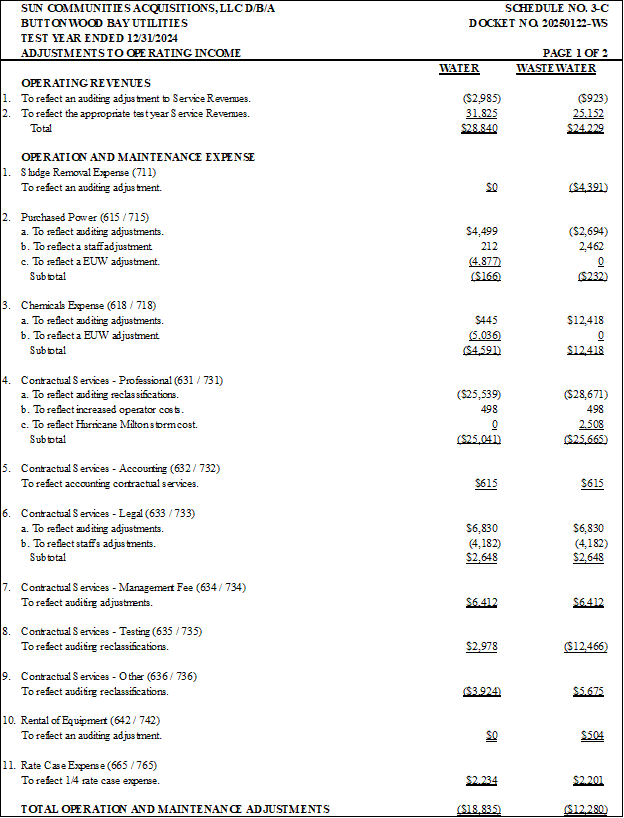
expenses be decreased by $18,835 for water and $12,280 for wastewater.
This results in a total O&M expense of $140,785 for water and $111,962 for
wastewater. Staff’s recommended adjustments to O&M are shown on Schedule
No. 3-D and Schedule No. 3-E, respectively.
Depreciation
Expense
The Utility
recorded depreciation expense of $77,651 for water and $66,768 for wastewater.
Based on the depreciation rates prescribed in Rule 25-30,140, F.A.C., audit
staff increased this amount by $2,048 for water and decreased it by $43,613 for
wastewater to reflect changes to UPIS. Staff decreased this amount by $26,124
for water and decreased this amount by $3,243 for wastewater to reflect the
retirements made to UPIS and the application of the appropriate depreciation
rates pursuant to Rule 25-30.140, F.A.C. Technical staff increased water
depreciation expense by $14,928, and wastewater by $9,751 resulting from its
recalculation of depreciation activity. In addition, staff increased
depreciation expense by $798 for wastewater to reflect pro forma additions and
retirements.
Staff’s
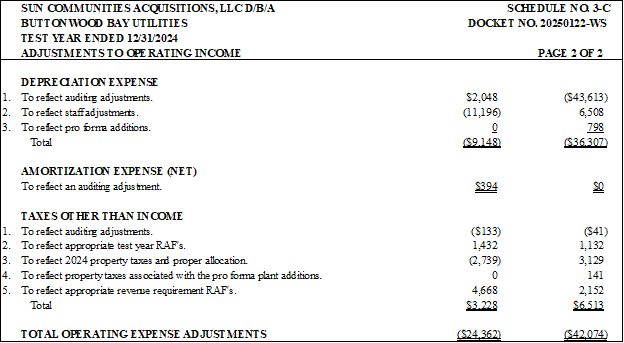
adjustments to depreciation expense result in a net decrease of $9,148 for
water and $36,307 for wastewater. Therefore, staff recommends depreciation
expense of $68,503 for water and $30,461 for wastewater.
Capital
Recovery Amortization Expense
As discussed in Issue 4, staff
recommends a capital recovery schedule of $2,756 for water over a seven-year
amortization period. The corresponding annual amortization expense is $394 for
water.
Taxes Other
Than Income (TOTI)
The Utility recorded TOTI of $10,712 for water and $9,756 for
wastewater. Audit staff decreased these amounts by $133 for water and $41 for
wastewater to reflect adjustments made to Regulatory Assessment Fees (RAFs)
based on an audit revenue adjustment. Staff decreased property taxes for water
by $2,739 and increased property taxes for wastewater by $3,129 to reflect 2024
property taxes as well as proper allocation between the two systems based on
land percentage. Staff further increased TOTI by $141 for wastewater to reflect
property taxes associated with pro forma plant additions.
Based on
revenues discussed in Issue 6, TOTI should be increased by $1,432 for water and
$1,132 for wastewater to reflect a RAF rate of 4.5 percent
applied to the adjustment in revenues.
As discussed
in Issue 9, staff recommends revenues be increased by $103,727 for water and $47,826
for wastewater to reflect the change in revenue required to cover expenses and
allow an opportunity to earn the recommended rate of return. As a result, TOTI
should be increased by $4,668 for water and $2,152 for wastewater to reflect
RAFs of 4.5 percent of the change in revenues. Staff’s adjustments result in a
net increase of $3,228 for water and $6,513 for wastewater. Therefore, staff
recommends TOTI of $13,939 for water and $16,269 for wastewater.
Operating
Expense Summary
The Utility
recorded operating expenses of $247,983 for water and $200,766 for wastewater.
Staff’s net adjustments result in a decrease of $24,362 for water and $42,074
for wastewater. The application of staff’s recommended adjustments to the Utility’s
operating expense results in a total operating expense of $223,621 for water
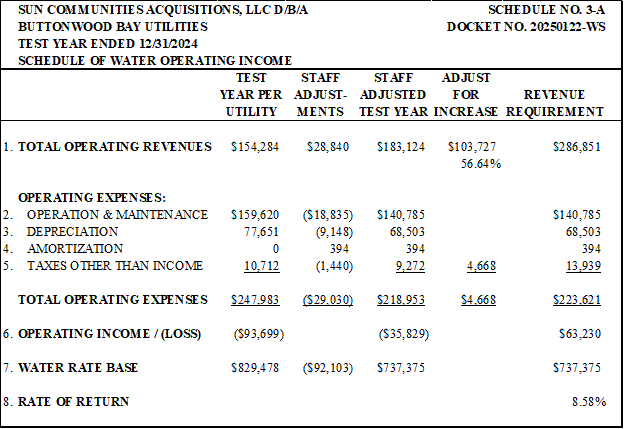
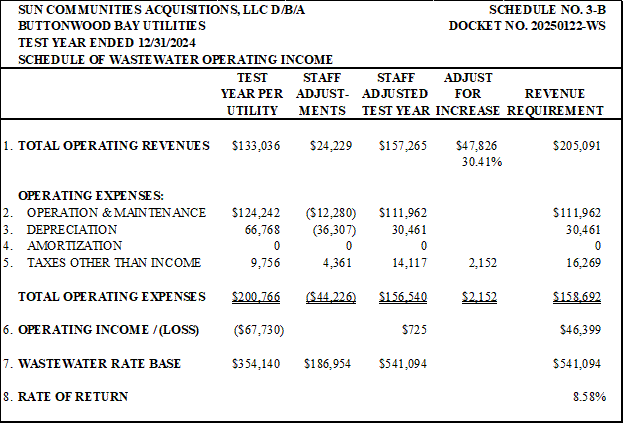
and $158,692 for wastewater. Operating expenses are shown on Schedule Nos. 3-A
and 3-B, and the related adjustments are shown on Schedule No. 3-C.
Issue 8:
Does Buttonwood Bay meet the criteria for
application of the operating ratio methodology?
Recommendation:
No, Buttonwood Bay does not meet the criteria for
application of the operating ratio methodology for calculating the revenue
requirement. (Worrall)
Staff Analysis:
Rule
25-30.4575(2), F.A.C., indicates that in rate cases processed under Rule
25-30.455, F.A.C., the Commission will use the operating ratio methodology to
establish the Utility’s revenue requirement when its rate base is not greater
than 125 percent of O&M expenses, less regulatory Commission expense, and
the use of the operating ratio methodology does not change the Utility’s
qualification for a SARC.
With respect
to Buttonwood Bay, staff has recommended a rate base of $737,375 for water and $541,094
for wastewater. After removal of rate case expense, staff calculated an
adjusted O&M expense of $138,551 for water and $109,761 for wastewater.
Based on staff’s recommended amounts, the Utility’s water rate base is 532.21
percent of its adjusted O&M expense and its wastewater rate base is 492.98
percent of its adjusted O&M expense. Based on these results, the Utility
does not qualify for application of the operating ratio methodology.
Issue 9:
What is the appropriate revenue requirement for Buttonwood
Bay?
Recommendation:
The appropriate revenue requirement is $286,851 for
water and $205,091 for wastewater, resulting in an annual increase of $103,727
(56.64 percent) for water and $47,826 (30.41 percent) for wastewater. (Worrall)
Staff Analysis:
Buttonwood Bay should be
allowed an annual increase of $103,727 (56.64 percent) for water and $47,826 (30.41
percent) for wastewater. This should allow the Utility the opportunity to
recover expenses and earn an 8.58 percent return on its rate base. The
calculations of revenue requirement are shown on Table 9-1 and Table 9-2 below.[42]
Table 9-1
Water Revenue
Requirement
|
Water Rate Base
|
$737,375
|
|
Rate of Return
|
× 8.58%
|
|
Return On Rate Base
|
$63,230
|
|
Water O&M Expense
|
140,785
|
|
Depreciation Expense
|
68,503
|
|
Amortization
|
394
|
|
Taxes Other Than Income
|
13,939
|
|
Revenue Requirement
|
$286,851
|
|
Less Test Year Revenues
|
$183,124
|
|
Annual Increase / (Decrease)
|
$103,727
|
|
Percent Increase / (Decrease)
|
56.64%
|
Source: Staff calculations.
Table 9-2
Wastewater Revenue
Requirement
|
Wastewater Rate Base
|
$541,094
|
|
Rate of Return
|
× 8.58%
|
|
Return on Rate Base
|
$46,399
|
|
Wastewater O&M Expense
|
111,962
|
|
Depreciation Expense
|
30,461
|
|
Taxes Other Than Income
|
16,269
|
|
Revenue Requirement
|
$205,091
|
|
Less Test Year Revenues
|
$157,265
|
|
Annual Increase / (Decrease)
|
$47,826
|
|
Percent Increase / (Decrease)
|
30.41%
|
Source: Staff calculations.
Issue 10:
What are the appropriate rate structure and rates
for Buttonwood Bay’s water and wastewater system?
Recommendation:
The recommended rate structure and monthly water and
wastewater rates are shown on Schedule Nos. 4-A and 4B. The approved rates
should be effective for service rendered on or after the stamped approval date
on the tariff sheets pursuant to Rule 25-30.475(1), F.A.C. In addition, the
approved rates should not be implemented until staff has approved the proposed
customer notice and the notice has been received by the customers. The Utility
should provide proof of the date notice was given within 10 days of the date of
the notice. (Sibley)
Staff Analysis:
Water Rates
Buttonwood
Bay is located in Highlands County within the SWFWMD. As mentioned in Issue 6, during the test year, the residential
and RV billing data was commingled, which is not appropriate due to RV
customers being considered general service. Therefore, staff revised the
residential billing analysis to reflect the removal of the RV billing
determinants. Based on staff’s revised residential billing analysis,
the Utility provides service to approximately 400 residential customers.
According to the billing data 8.75 percent of the residential bills during the
test year had zero gallons, which signifies a non-seasonal customer base. The
average water demand is 8,674 gallons per month. The Utility provided updated billing determinants for the RV park. Based on the
Utility’s updated billing determinants, there are approximately 530 RV sites,
which is comprised of transient customers as well as vacation rentals. The
Utility’s current rate structure for the water
system consists of a base facility charge (BFC) and a uniform gallonage charge
for residential and general service.
Staff
performed an analysis of the Utility’s billing data in order to evaluate the
appropriate rate structure for the residential water customers. The goal of the
evaluation was to select the rate design parameters that: (1) produce the
recommended revenue requirement; (2) equitably distribute cost recovery among
the Utility’s customers; (3) establish the appropriate discretionary usage
threshold for restricting repression; and (4) implement, where appropriate,
water conserving rate structures consistent with Commission practice.
The Utility’s
current BFC allocation is 67 percent. Staff recommends that the BFC allocation be
reduced from 67 percent to 40 percent. Staff’s recommended BFC allocation of 40
percent will allow the Utility to maintain revenue stability and target
customers that are using a higher level of usage, while minimizing the rate
impact at non-discretionary levels of consumption. The average people per
household served by the water system is 2.16;
therefore, based on the number of people per household, 50 gallons per day per
person, and the number of days per month, the non-discretionary usage threshold
should be 4,000 gallons per month.
Staff’s review of the billing data indicates that discretionary usage above
4,000 gallons represents approximately 66 percent of the bills, which accounts
for approximately 64 percent of water demand. This indicates that there is high
discretionary usage above 4,000 gallons.
Due to
the high discretionary usage in this case, staff recommends a BFC and a
three-tier inclining block rate structure, which includes separate gallonage
charges for non-discretionary and discretionary usage for residential water
customers. The rate blocks are: (1) 0 – 4,000 gallons; 2) 4,000 – 10,000
gallons; and 3) over 10,000 gallons per month.
Staff’s recommended rate structure sends the appropriate pricing signals
because it targets customers with high consumption levels and also minimizes
price increases for customers at non-discretionary levels. Furthermore, the
third tier provides an additional pricing signal to customers using in excess
of 10,000 gallons per month. General service customers should be billed a BFC
and a gallonage charge.
Based
on staff’s recommended revenue increase of 56.64 percent, which excludes
miscellaneous revenues, the residential consumption can be expected to decline
by 12,140,000 gallons, resulting in anticipated average residential demand of 6,144
gallons per month. Staff recommends a 29.2 percent reduction in test year
residential gallons for rate setting purposes. As a result, the corresponding
reductions are $5,260 for purchased power expense, $5,432 for chemical expense,
and $504 for RAFs to reflect the anticipated repression, which results in a post-repression revenue requirement of $275,655.
Wastewater Rates
As mentioned in issue 6, during the
test year the residential and RV billing were
commingled. Staff removed all RV billing determinants from the residential
billing analysis and reclassified the RV customers as general service. Based on
staff’s revised residential billing analysis, the Utility
provides wastewater service to approximately 400 residential customers, 530 RV sites which include transient customers as well as
vacation rentals, and 9 general service customers. Currently,
the wastewater rate structure for residential customers consists of a monthly
uniform BFC for all meter sizes and gallonage charge with an 6,000 gallonage
cap. The general service customers are billed a BFC and a gallonage charge.
Staff performed an analysis of the Utility’s
billing data in order to evaluate various BFC cost recovery percentages and
gallonage caps for the residential wastewater customers. The goal of the
evaluation was to select the rate design parameters that: 1) produce the
recommended revenue requirement; 2) equitably distribute cost recovery among
the Utility’s customers; and 3) implement a gallonage cap that considers
approximately the amount of water that may return to the wastewater system.
Currently the Utility’s BFC allocation is approximately 79
percent of the wastewater revenue. Consistent with Commission practice, staff
recommends 50 percent of the wastewater revenue to the BFC due to the capital
intensive nature of wastewater plants. The Utility’s current wastewater
gallonage cap is set at 6,000 gallons per month, which represents 49.92 percent
of the gallons. The wastewater gallonage cap recognizes that not all water used
by the residential customers is returned to the wastewater system. It is
Commission practice to set the wastewater cap at approximately 80 percent of
residential water sold, which typically results in gallonage caps of 6,000,
8,000, or 10,000. Based on staff’s review of the billing analysis, 80.89
percent of the gallons are captured at the 13,000 consumption level. This is
higher than what the Commission has set for wastewater gallonage caps in the
past. Therefore, staff recommends that the wastewater gallonage cap should be
changed to 10,000 gallons. Staff also recommends that the general service
gallonage charge be changed to be 1.2 times greater than the residential
gallonage charge, which is consistent with Commission practice.
In addition, based on the expected reduction in water
demand described above, staff recommends that a repression adjustment also be
made for wastewater. Because wastewater rates are calculated based on
customers’ water demand, if those customers’ water demand is expected to
decline, then the billing determinants used to calculate wastewater rates
should also be adjusted. Based on the billing analysis for the wastewater
system, staff recommends that a repression adjustment of 4,234,315 gallons to
reflect the anticipated reduction in water demand be used to calculate
wastewater rates. Staff recommends a 14.36 percent reduction in total
residential consumption and corresponding reductions of $2,578 for sludge
removal, $3,174 for purchased power, $1,783 for chemicals and $339 for RAFs to
reflect the anticipated repression, which results in a post repression revenue
requirement of $197,217.
Conclusion
The recommended rate structures
and monthly water and wastewater rates are shown on Schedule Nos. 4-A and 4-B.
The Utility should file revised tariff sheets and a proposed customer notice to
reflect the Commission-approved rates. The approved rates should be effective
for service rendered on or after the stamped approval date on the tariff sheets
pursuant to Rule 25-30.475(1), F.A.C. In addition, the approved rates should
not be implemented until staff has approved the proposed customer notice and
the notice has been received by the customers. The Utility should provide proof
of the date notice was given within 10 days of the date of the notice.
Issue 11:
Should Buttonwood Bay’s miscellaneous service
charges be revised to conform to Rule 25-30.460, F.A.C.?
Recommendation:
Yes. Staff recommends that the miscellaneous service charges be revised to comply with Rule 25-30.460, F.A.C. The Utility
should be required to file a proposed customer notice to reflect the
Commission-approved charges. The approved charge should be effective on or
after the stamped approval date on the tariff sheet pursuant to Rule
25-30.475(2), F.A.C. In addition, the approved charge should not be implemented
until staff has approved the proposed customer notice and the notice has been
received by customers. The Utility should provide proof of the date notice was
given by affidavit no less than 10 days after the date of notice.
(Sibley)
Staff Analysis:
In
its application, the Utility did not request to revise its existing
miscellaneous service charges. Section 367.091, F.S., authorizes the Commission
to establish, increase, or change a rate or charge other than monthly rates or
service availability charges. Currently, Buttonwood Bay has an initial
connection charge, a normal reconnection charge, and a violation reconnection
charge of $15. The Utility also has a premises visit charge (in lieu of
disconnection) of $10. Rule 25-30.460, F.A.C., does not allow for initial
connection and normal reconnection charges. The definitions for initial
connection charges and normal reconnection charges were subsumed into the
definition of the premises visit charge. Therefore, staff recommends that the
initial and reconnection charges be removed. Since the premises visit now
entails a broader range of tasks, staff recommends the premises visit charge
reflect the amount of the higher initial connection charge of $15. Therefore,
the premises visit charge should be $15. Staff recommends that the definition
for the premises visit charge be updated to comply with Rule 25-30.460, F.A.C.
Based on the above, Staff recommends that the miscellaneous
service charges be revised to comply with Rule 25-30.460, F.A.C. The Utility
should be required to file a proposed customer notice to reflect the
Commission-approved charges. The approved charge should be effective on or
after the stamped approval date on the tariff sheet pursuant to Rule
25-30.475(2), F.A.C. In addition, the approved charge should not be implemented
until staff has approved the proposed customer notice and the notice has been
received by customers. The Utility should provide proof of the date notice was
given by affidavit no less than 10 days after the date of notice.
Issue 12:
Should Buttonwood Bay’s service availability charges
be revised?
Recommendation:
Yes. The Utility’s existing system capacity charges
for water and wastewater should be discontinued. Staff recommends that the
existing meter installation charges remain in effect. The Utility
should file a revised tariff sheet to reflect the Commission-approved charges.
The approved charges shall be effective for connections made on or after the
stamped approval date on the tariff sheet. In addition, the approved charges
should not be implemented until staff has approved the proposed customer notice
and the notice has been received by property owners who requested service
beginning 12 months prior to the establishment of this docket. The Utility
shall provide proof of noticing within 10 days of rendering the approved
notice. (Sibley)
Staff Analysis:
The Commission approved
Buttonwood Bay’s existing service availability charges in a transfer and
certificate docket in 2003.
The service availability charges consist of a system capacity charge of $600
and meter installation charges of $70 for a 5/8 inch X 3/4 inch meter size and
actual costs for all other meter sizes. The system capacity charge for wastewater
is $875. A system capacity charge is a single service availability charge that
includes the cost of both plant and lines. For a Utility that receives donated
lines from a developer, an individual customer connecting to those lines should
only be responsible for a service availability charge that reflects plant
costs. Therefore, separate charges are typically developed to reflect the
customer’s share of plant costs (plant capacity charges) and the cost of lines
in lieu of donated lines (main extension charges).
Rule 25-30.580, F.A.C.,
establishes guidelines for designing service availability charges. Pursuant to
the rule, the maximum amount of CIAC, net of amortization, should not exceed 75
percent of the total original cost, net of accumulated depreciation, of the Utility’s
facilities and plant when the facilities and plant are at their designed
capacity. The minimum amount of CIAC should not be less than the percentage of
such facilities and plant that is represented by the water transmission and
distribution system and sewage collection systems. The contribution levels are
zero percent for water and wastewater, respectively. In addition, Buttonwood
Bay is completely built out and there is no potential for expansion of the
service territory. Therefore, no main extension charge or plant capacity charge
should be implemented in this case. Staff recommends Buttonwood Bay’s system
capacity charge for both water and wastewater be discontinued. Staff also
recommends that the meter installation charges remain unchanged.
Staff recommends that the Utility’s
existing system capacity charges for water and wastewater should be
discontinued. Staff recommends that the existing meter installation charges
remain in effect. The Utility should file a revised tariff
sheet to reflect the Commission-approved charges. The approved charges shall be
effective for connections made on or after the stamped approval date on the
tariff sheet. In addition, the approved charges should not be implemented until
staff has approved the proposed customer notice and the notice has been
received by property owners who requested service beginning 12 months prior to
the establishment of this docket. The Utility shall provide proof of noticing
within 10 days of rendering the approved notice.
Issue 13:
What is the appropriate amount by which rates should
be reduced four years after the published effective date to reflect the removal
of the amortized rate case expense?
Recommendation:
The rates should be reduced, as shown on Schedule Nos.
4-A and 4-B, to remove rate case expense grossed-up for RAFs and amortized over
a four-year period. Pursuant to Section 367.081(8), F.S., the decrease in rates
should become effective immediately following the expiration of the rate case
expense recovery period. Buttonwood Bay should be required to file revised
tariffs and a proposed customer notice setting forth the lower rates and
rationale no later than one month prior to the effective date of the new rates.
If the Utility files revised tariffs reflecting this reduction in conjunction
with a price index or pass-through rate adjustment, separate data should be
filed for the price index and/or pass-through increase and the reduction in the
rates due to the amortized rate case expense. (Worrall)
Staff Analysis:
Section 367.081, F.S.,
requires that the rates be reduced immediately following the expiration of the
four-year period by the amount of the rate case expense previously included in
rates. The reduction will reflect the removal of revenue associated with the
amortization of rate case expense and the gross-up for RAFs. This results in a
reduction of $2,340 for water and $2,305 for wastewater.
Staff recommends that the rates
be reduced, as shown on Schedule Nos. 4-A and 4-B, to remove rate case expense
grossed-up for RAFs and amortized over a four-year period. Pursuant to Section
367.081(8), F.S., the decrease in rates should become effective immediately
following the expiration of the rate case expense recovery period. Buttonwood
Bay should be required to file revised tariffs and a proposed customer notice
setting forth the lower rates and rationale no later than one month prior to
the effective date of the new rates. If the Utility files revised tariffs
reflecting this reduction in conjunction with a price index, or pass-through
rate adjustment, separate data should be filed for the price index and/or
pass-through increase and the reduction in the rates due to the amortized rate
case expense.
Issue 14:
Should the recommended rates be approved for
Buttonwood Bay on temporary basis, subject to refund with interest, in the
event of a protest filed by a party other than the Utility?
Recommendation:
Yes. Pursuant to Section 367.0814(7), F.S., the
recommended rates should be approved for the Utility on a temporary basis,
subject to refund with interest, in the event of a protest filed by a party
other than the Utility. Buttonwood Bay should file revised tariff sheets and a
proposed customer notice reflecting the Commission-approved rates. The approved
rates should be effective for services rendered on or after the stamped
approval date on the tariff sheet, pursuant to Rule 25-30.475(1), F.A.C. In
addition, the temporary rates should not be implemented until staff has
approved the proposed notice, and the notice has been received by the
customers. Further, prior to implementing any temporary rates, the Utility
should provide appropriate financial security.
If the recommended rates are approved on a
temporary basis, the rates collected by the Utility should be subject to the
refund provisions discussed below in the staff analysis. In addition, after the
increased rates are in effect, pursuant to Rule 25-30.360(6), F.A.C., the Utility
should file reports with the Commission’s Office of Commission Clerk no later
than the 20th of each month indicating both the current monthly and total
amount subject to refund at the end of the preceding month. The report filed
should also indicate the status of the security being used to guarantee
repayment of any potential refund. (Worrall)
Staff Analysis:
This
recommendation proposes an increase in rates. A timely protest might delay a
rate increase resulting in an unrecoverable loss of revenue to the Utility.
Therefore, pursuant to Section 367.0814(7), F.S., in the event of a protest
filed by a party other than the Utility, staff recommends that the proposed
rates be approved on a temporary basis. Buttonwood Bay should file revised
tariff sheets and a proposed customer notice reflecting the Commission-approved
rates. The approved rates should be effective for service rendered on or after
the stamped approval date on the tariff sheet, pursuant to Rule 25-30.475(1),
F.A.C. In addition, the temporary rates should not be implemented until staff
has approved the proposed notice, and it has been received by the customers.
The additional revenue produced by staff’s recommended rates and collected by
the Utility should be subject to the refund provisions discussed below.
Buttonwood
Bay should be authorized to initiate the temporary rates upon staff’s approval
of an appropriate security for the potential refund and cost of the proposed
customer notice. Security should be in the form of either a bond or letter of
credit in the amount of $70,843 for water and $32,664 for wastewater. Alternatively,
the Utility may establish an escrow agreement with an independent financial
institution.
If the Utility
chooses a bond for securing the potential refund, the bond should contain
wording to the effect that it will be terminated only under the following
conditions:
1. The Commission approves the rate
increase; or,
2. If the Commission denies the increase,
the Utility shall refund the amount collected that is attributable to the
increase.
If the Utility
chooses a letter of credit for securing the potential refund, the letter of
credit should contain the following conditions:
1. The letter of credit is irrevocable for
the period it is in effect.
2. The letter of credit will be in effect
until a final Commission order is rendered, either approving or denying the
rate increase.
If security
is provided through an escrow agreement, the following conditions should be
part of the agreement:
1. The Commission Clerk, or his or her
designee, must be a signatory to the escrow agreement.
2. No monies in the escrow account may be
withdrawn by the Utility without the prior written authorization of the
Commission Clerk, or his or her designee.
3. The escrow account shall be an interest
bearing account.
4. If a refund to the customers is
required, all interest earned by the escrow account shall be distributed to the
customers.
5. If a refund to the customers is not
required, the interest earned by the escrow account shall revert to the Utility.
6. All information on the escrow account
shall be available from the holder of the escrow account to a Commission
representative at all times.
7. The amount of revenue subject to refund
shall be deposited in the escrow account within seven days of receipt.
8. This escrow account is established by
the direction of the Florida Public Service Commission for the purpose(s) set
forth in its order requiring such account. Pursuant to Cosentino v. Elson, 263
So. 2d 253 (Fla. 3d DCA 1972), escrow accounts are not subject to garnishments.
9. The account must specify by whom and on
whose behalf such monies were paid.
In no
instance should the maintenance and administrative costs associated with the
refund be borne by the customers. These costs are the responsibility of, and
should be borne by, the Utility. Irrespective of the form of security chosen by
the Utility, an account of all monies received as a result of the rate increase
should be maintained by the Utility. If a refund is ultimately required, it
should be paid with interest calculated pursuant to Rule 25-30.360(4), F.A.C.
The Utility
should maintain a record of the amount of the bond, and the amount of revenues
that are subject to refund. In addition, after the increased rates are in
effect, pursuant to Rule 25-30.360(6), F.A.C., the Utility should file reports
with the Commission Clerk’s office no later than the 20th of every month
indicating the monthly and total amount of money subject to refund at the end
of the preceding month. The report filed should also indicate the status of the
security being used to guarantee repayment of any potential refund.
Issue 15:
Should Buttonwood Bay be required to notify the
Commission within 90 days of an effective order finalizing this docket, that it
has adjusted its books for all the applicable NARUC USOA?
Recommendation:
Yes. Buttonwood Bay should be required to notify the
Commission, in writing, that it has adjusted its books in accordance with the
Commission’s decision. The Utility should submit a letter within 90 days of the
Commission’s final order in this docket, confirming that the adjustments to all
applicable NARUC USOA primary accounts have been made to the Utility’s books
and records. In the event the Utility needs additional time to complete the
adjustments, a notice providing good cause should be filed not less than seven
days prior to the deadline requesting an extension. Upon providing a notice of
good cause, staff should be given administrative authority to grant an
extension of up to 60 days. (Worrall)
Staff Analysis:
Buttonwood
Bay should be required to notify the Commission, in writing, that it has
adjusted its books in accordance with the Commission’s decision. The Utility
should submit a letter within 90 days of the Commission’s final order in this
docket, confirming that the adjustments to all applicable NARUC USOA primary
accounts have been made to the Utility’s books and records. In the event the Utility
needs additional time to complete the adjustments, a notice providing good
cause should be filed not less than seven days prior to the deadline requesting
an extension. Upon providing a notice of good cause, staff should be given
administrative authority to grant an extension of up to 60 days.
Issue 16:
Should this docket be closed?
Recommendation:
No. If no person whose substantial interests are
affected by the proposed agency action files a protest within 21 days of the
issuance of the order, a consummating order should be issued. The docket should
remain open for staff’s verification that the revised tariff sheets and
customer notice have been filed by the Utility and approved by staff, and that
the required plan outlining how the Utility will improve its recordkeeping and
customer communications within 30 days of the Order becoming final has been filed
and approved by staff. (Sparks)
Staff Analysis:
No. If no person whose substantial interests are
affected by the proposed agency action files a protest within 21 days of the
issuance of the order, a consummating order should be issued. The docket should
remain open for staff’s verification that the revised tariff sheets and
customer notice have been filed by the Utility and approved by staff, and that
the required plan outlining how the Utility will improve its recordkeeping and
customer communications within 30 days of the Order becoming final has been
filed and approved by staff.