Case Background
North Florida
Community Water Services (NFCWS or Utility) is a Class B water and wastewater
utility serving in Alachua, Duval, Franklin, Leon, Okaloosa, and Washington
Counties. According to the Utility’s 2025 annual report the Utility provides
water service to 2,337 residential and 56 general service customers. NFCWS’ rates were last amended by a price
index in 2026.
On August 31,
2026, NFCWS filed an application for approval of a tariff amendment to
implement a backflow prevention device test charge, meter tampering charge, and
investigation of meter tampering charge. In response to staff’s request, on
September 16, 2026, the Utility filed its cost justification.
This
recommendation addresses the Utility’s request to charge for testing backflow
prevention devices, establish an investigation of meter tampering charge, and meter
tampering charge, which includes tariff sheets reflecting the requested
charges. Furthermore, the Utility provided a proposed tariff reflecting the Department
Environmental Protection (DEP) annual backflow prevention testing requirements.
The Commission has jurisdiction over this matter pursuant to Sections 367.081
and 367.091, Florida Statutes (F.S.).
Discussion
of Issues
Issue 1:
Should the Commission approve NFCWS’ proposed tariff
sheets to implement a backflow prevention device charge and the backflow
prevention testing requirements?
Recommendation:
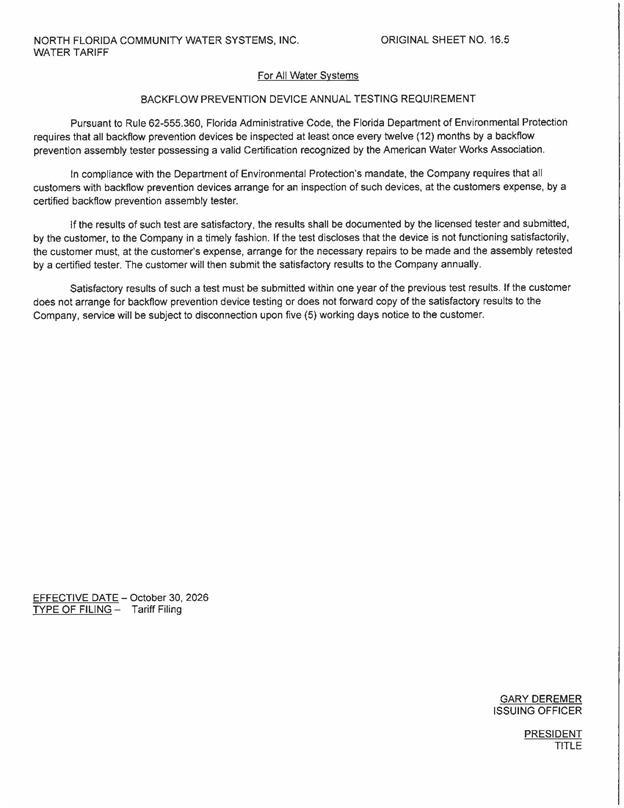
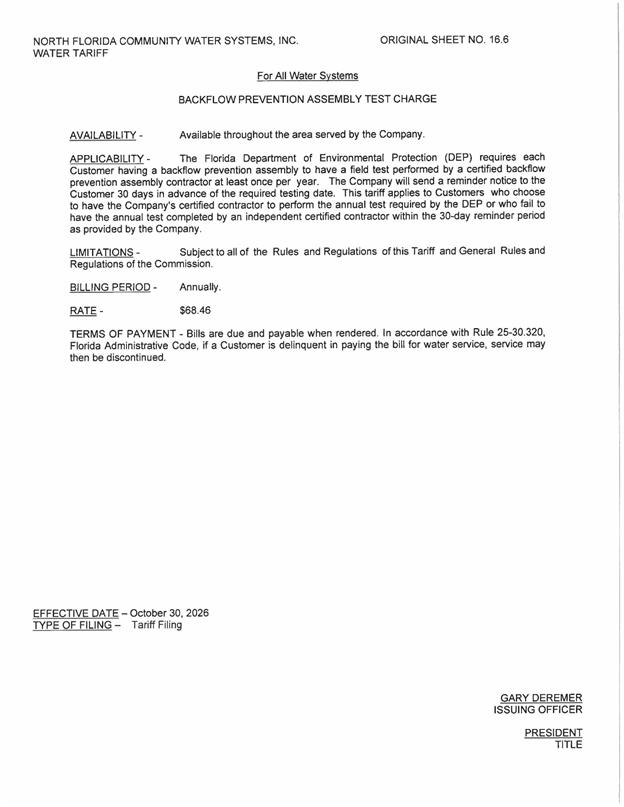
Yes. NFCWS’ proposed tariff sheets, Original Sheet
No. 16.5 and Original Sheet No. 16.6, shown on Attachment A are appropriate and
should be approved. The charge should be effective on or after the stamped
approval date on the tariff pursuant to Rule 25-30.475, Florida Administrative
Code (F.A.C.). In addition, the approved charge should not be implemented until
staff has approved the proposed customer notice and the notice has been
received by the customers. The Utility should provide proof of the date notice
was given within 10 days of the date of the notice. (McClelland)
Staff Analysis:
In its original application, NFCWS included proposed
tariffs Original Sheet No. 16.5 to include DEP’s requirement for annual
inspection of backflow prevention devices and Original Sheet No 16.6 to
indicate the backflow prevention assembly test charge. Section 367.091, F.S.,
authorizes the Commission to change miscellaneous service charges. The Utility’s
request for a charge was accompanied by its reason for requesting the charge,
as well as cost justification required by Section 367.091(6), F.S. The Utility
states that the purpose of its request is to comply with DEP Rules 62-555.330 and 62-555.360, F.A.C., which include the
required language regarding backflow prevention device testing.
The Utility’s Cross-Connection Control Program mandates
that a backflow prevention device be installed on all connections, which may
represent a source of contamination due to a lawn irrigation system. On May 20,
2025, the Utility was cited with a deficiency by DEP stating that 77
residential connections with backflow assemblies had not been tested within the
past two years. However, during inspection, the Utility discovered that only 50
connections required assemblies in Sunny Hills. The deficiency also stated that
the residential assemblies be tested biennially.
The customers are responsible for piping and appurtenances
beyond the Utility’s water meter toward the dwelling. Rule 25-30.231, F.A.C., requires
each utility to operate and maintain safe and proper condition of all the
facilities and equipment used in connection with the distribution, regulation,
measurement and delivery of water service to the customer up to and the point
of delivery into the piping owned by the customer. In addition, Rule
25-30.210(7), F.A.C., states that the point of delivery for a water system is the
outlet connection with the customer’s piping. Due to the location of the
backflow devices, which is past the meter, the cost of inspection will be borne
by the customer. The Utility sends out a notice on an annual basis advising of
the testing requirement per DEP’s rule. Customers will have 30 days from the
date of the notice to complete the testing and provide documentation to the
Utility.
Per the Utility’s request, if a customer fails to have the
annual inspection performed and provide documentation of the test to the
Utility within 30 days of the notice, water service will be disconnected. Rule
25-30.320(2), F.A.C., states that service may be discontinued for noncompliance
with any state regulation governing such utility service.
The Utility’s proposed tariff indicates a backflow testing
charge of $68.46, which will allow NFCWS to conduct the required backflow
prevention assembly testing on behalf of customers that choose the Utility to
perform the test or customers that failed to have the test performed within a
30-day noticing period. The Utility requested that the proposed charge be
equivalent to the Utility’s premises visit charge. The costs will be the same
as a premises visit and performed by the same personnel. If a compliance
inspection is needed, it falls within the confines of Rule 25-30.460, F.A.C,
which is an assessment of a service issue that is the customer’s
responsibility. Therefore, staff believes
the cost of the premises visit charge is appropriate for the backflow
prevention charge.
Staff recommends that NFCWS’ proposed tariff sheets,
Original Sheet No. 16.5 and Original Sheet No. 16.6, shown on Attachment A are
appropriate and should be approved. The charges should be effective on or after
the stamped approval date on the tariff pursuant to Rule 25-30.475, F.A.C. In
addition, the approved charges should not be implemented until staff has
approved the proposed customer notice and the notice has been received by the
customers. The Utility should provide proof of the date notice was given within
10 days of the date of the notice.
Issue 2:
Should NFCWS’ request for meter tampering charge and
investigation of meter tampering charges be approved?
Recommendation:
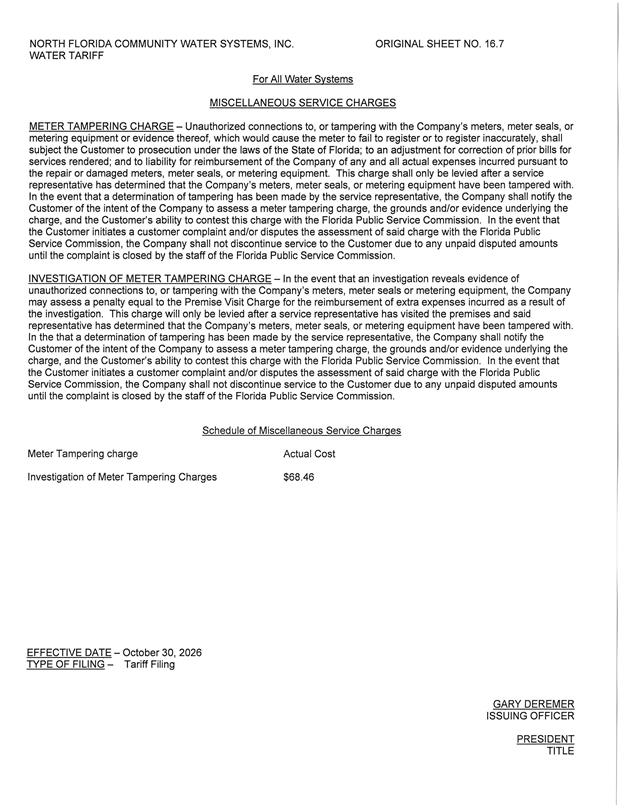
Yes. Staff recommends that NFCWS’ proposed tariff,
Original Sheet No. 16.7, shown on Attachment B indicating a meter a tampering charge
at actual cost and the investigation of meter tampering charge of $68.46 should
be approved. The Utility should be required to file a proposed notice to
reflect the Commission-approved charges. The approved charges should be
effective for service rendered or connections made on or after the stamped
approval date on the tariff pursuant to Rule 25-30.475, F.A.C. In addition, the
tariff sheets should be approved upon staff’s verification that the tariffs are
consistent with the Commission’s decision and the proposed customer is
adequate. (McClelland)
Staff Analysis:
In its application, NFCWS proposed to implement a
meter tampering charge at actual cost. Rule 25-30.320(2)(j), F.A.C., provides
that a utility may refuse or discontinue service without notice in the event of
unauthorized or fraudulent use of service. Whenever service is discontinued for
fraudulent use of such service, the Utility, before restoring service, may
require the customer to make at his own expense all changes in piping or
equipment necessary to eliminate illegal use and to pay an amount reasonably
estimated as the deficiency in revenue resulting from the customer’s fraudulent
use before restoring service.
The
Utility also requested an investigation of meter tampering charge. In the
Utility’s original filing, NFCWS proposed a meter tampering charge of $50.00. However,
on September 16, 2026, in response to staff’s request for cost justification,
the Utility filed supplemental documents revising the requested investigation
of meter tampering charge from $50.00 to $68.46. This
charge is the same as the Utility’s existing premises visits charge. The
Utility stated that the task would incur the same cost as a premises visit.
NFCWS also explained that the language of its existing premises visit charge
would allow a meter investigation charge to fall within the definition of its
tariff.
Based on the above, staff recommends that NFCWS’ proposed
tariff, Original Sheet No. 16.7, shown on Attachment B indicating a meter a
tampering charge at actual cost and the investigation of meter tampering charge
of $68.46 should be approved. The Utility should be required to file a proposed
notice to reflect the Commission-approved charges approved charges should be
effective for service rendered or connections made on or after the stamped
approval date on the tariff pursuant to Rule 25-30.475, F.A.C. In addition, the
tariff sheets should be approved upon staff’s verification that the tariffs are
consistent with the Commission’s decision and the proposed customer is
adequate.
Issue 3:
Should this docket be closed?
Recommendation:
If a timely protest is filed, the tariff should not
be implemented while the protest is pending. If no protest is filed by a person
whose substantial interests are affected within 21 days of the issuance of the
Order, this docket should be closed upon the issuance of a Consummating Order.
(Rauch)
Staff Analysis:
If a timely protest is filed, the tariff should not
be implemented while the protest is pending. If no protest is filed by a person
whose substantial interests are affected within 21 days of the issuance of the
Order, this docket should be closed upon the issuance of a Consummating Order.