Discussion
of Issues
Issue 1:
Should the Commission approve the 2026 Territorial
Agreement between Talquin and Havana in Gadsden County, dated August 20, 2026?
Primary Recommendation:
Yes, subject to the condition detailed below, the
Commission should approve the 2026 Territorial Agreement between Talquin and
Havana in Gadsden County, as consistent with the Standards for Approval set
forth in Rule 25-6.0440(2), F.A.C. The 2026 Territorial Agreement, if approved,
amends the respective boundary lines between the Utilities, thereby eliminating
most extra-territorial connections. The agreement would also facilitate the
joint petitioners’ efforts to avoid uneconomic duplication of service
facilities, wasteful expenditures, and hazardous conditions, as well as the
transfer of two facilities from Talquin to Havana. Additionally, the
territorial boundary changes will provide the joint petitioners with greater
certainty to plan for growth and avoid future disputes. Talquin should be
required to notify the Commission in writing within 30 days of the date it
permanently discontinues electric service to the customer in Havana. (Prewett,
Barrett)
Alternative
Recommendation: All aspects of the
proposed 2026 Territorial Agreement between Talquin and Havana in Gadsden
County are appropriate except for Section 2.4, which would allow Talquin to provide electric service for an unspecified
amount of time to an address located in Havana’s service area until one of
three conditions are met. This exception to compliance with the proposed
boundary lines contemplated in Section 2.4 may result in continued uneconomic
duplication in the immediate geographic area for an unspecified period, such
that the Agreement represents a detriment to the public interest. After providing required transfer notification and
comparative utility rate information to the customer in Havana, the joint
petitioners should be required to submit a revision to the proposed 2026
Territorial Agreement that is exclusive of the provisions contained in Section
2.4. (Clark, McNulty)
Staff Analysis:
Pursuant to Section 366.04(2)(d), F.S., and Rule
25-6.0440(2), (F.A.C.), the Commission has jurisdiction to approve territorial
agreements between and among rural electric cooperatives, municipal electric
utilities, and investor-owned electric utilities. Unless the Commission
determines that the Agreement will cause a detriment to the public interest, it
should be approved.
Rule
25-6.0440(2), F.A.C., addresses the standards the Commission should consider
for approving territorial agreements for electric utilities. The rule states:
(2) Standards for Approval. In approving territorial
agreements, the Commission may consider:
(a) The reasonableness of the purchase price of any
facilities being transferred;
(b) The reasonable likelihood that the agreement, in and of
itself, will not cause a decrease in the reliability of electrical service to
the existing or future ratepayers of any utility party to the agreement;
(c) The reasonable likelihood that the agreement will
eliminate existing or potential uneconomic duplication of facilities; and
(d) Any other factor the Commission finds relevant in
reaching a determination that the territorial agreement is in the public
interest.
Proposed 2026 Territorial Agreement
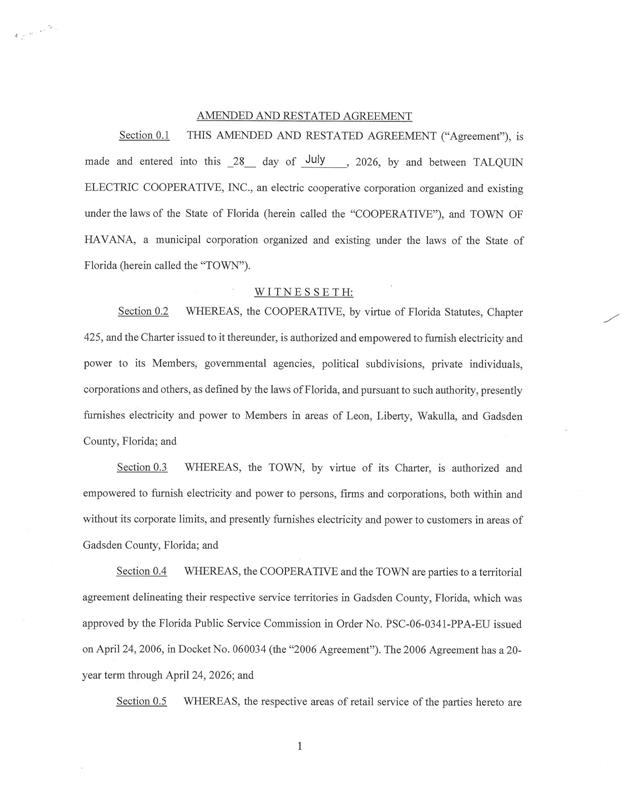
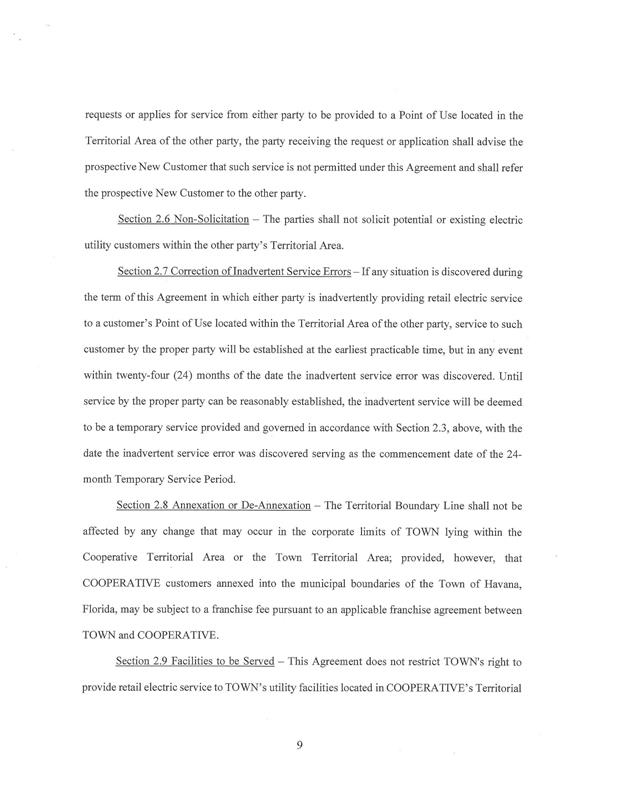
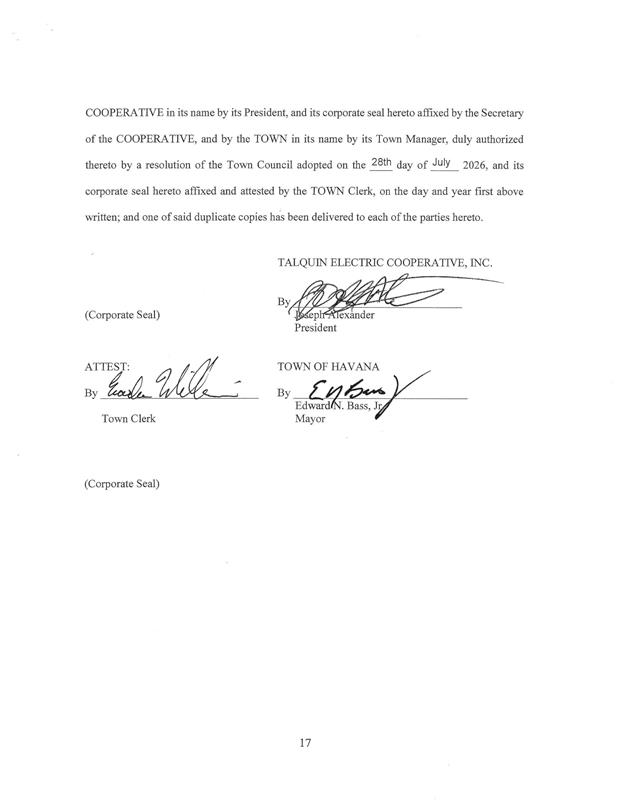
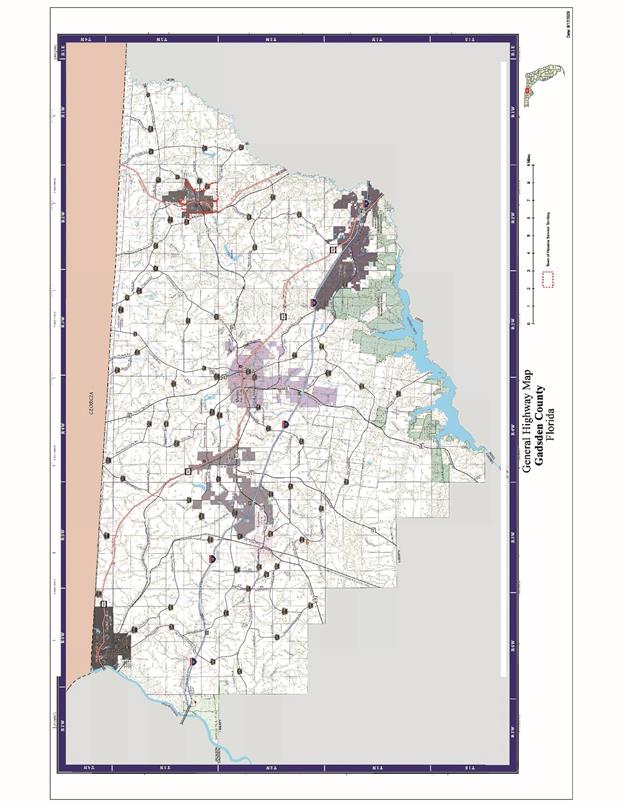
Talquin and Havana executed the 2026 Territorial Agreement
addressing common boundaries over the Gadsden County area on August 20, 2026,
to replace and supersede the existing territorial agreement from 2006. The
joint petitioners assert that the 2026 Territorial Agreement will primarily
align the territorial boundaries with the current parcel boundaries and also provide
for historical changes in service.
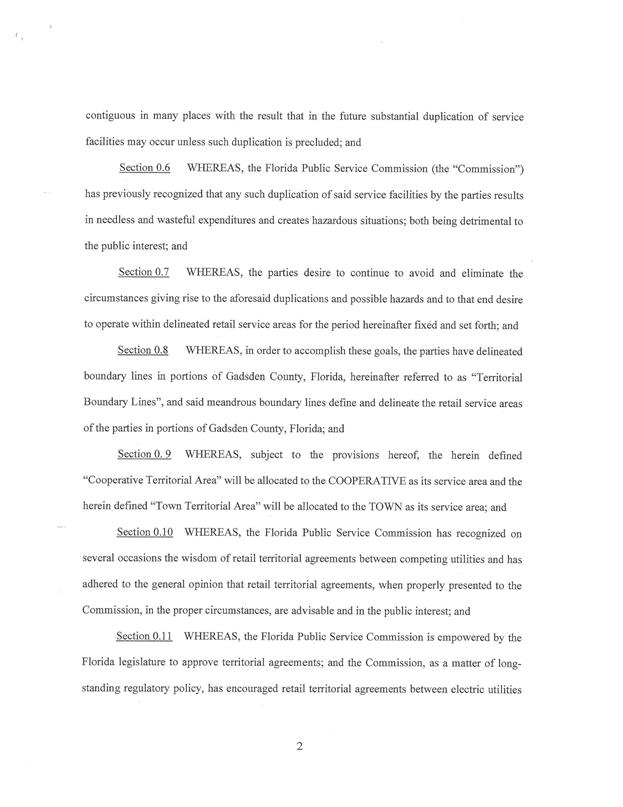
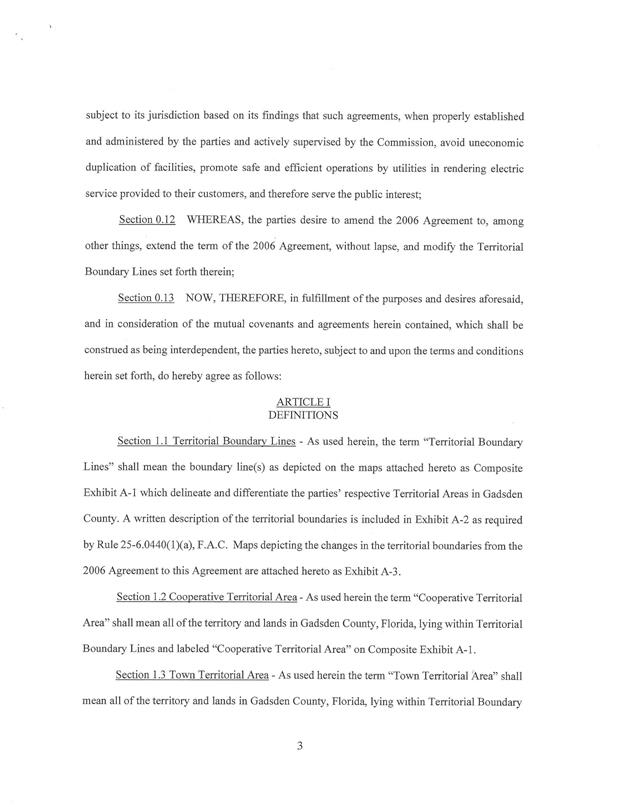
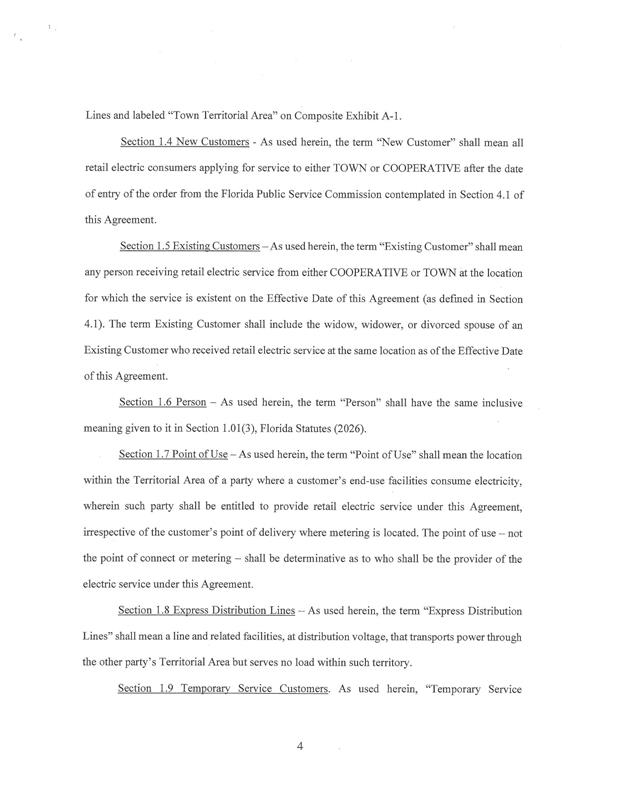
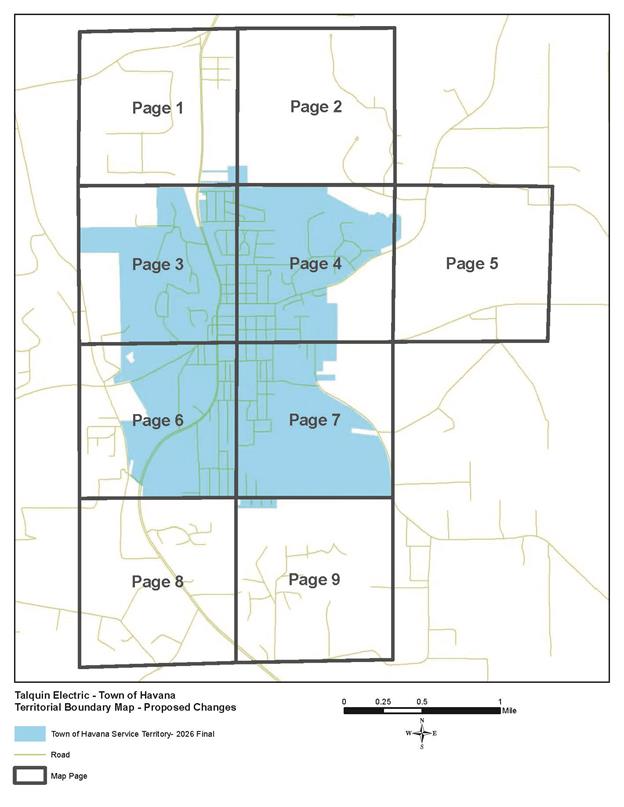
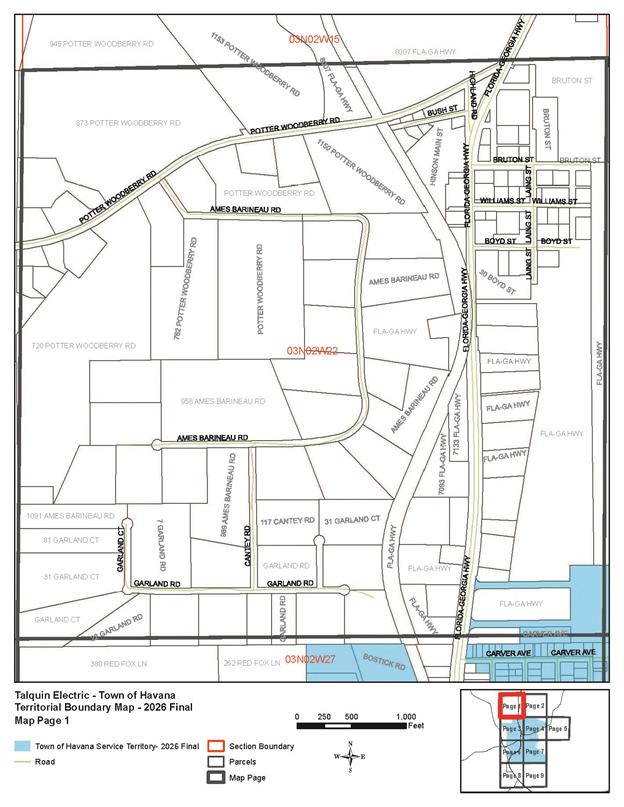
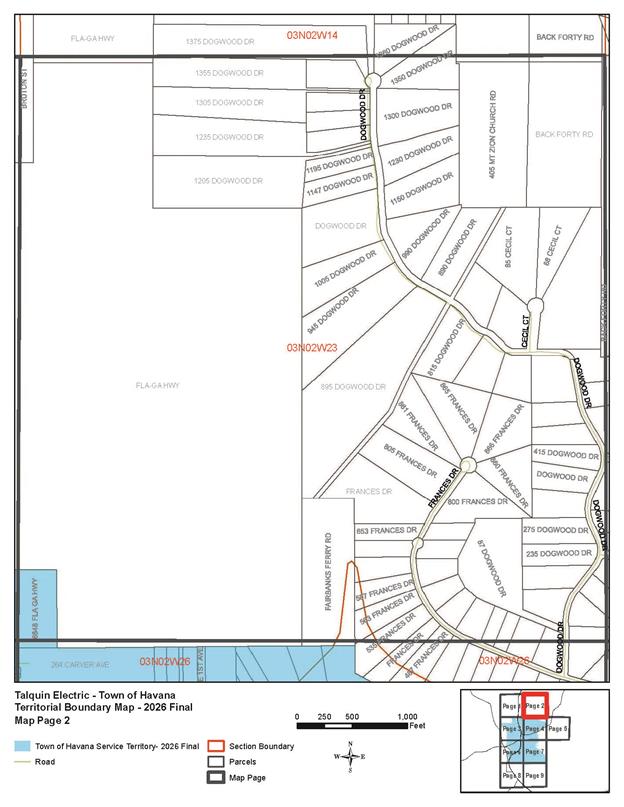
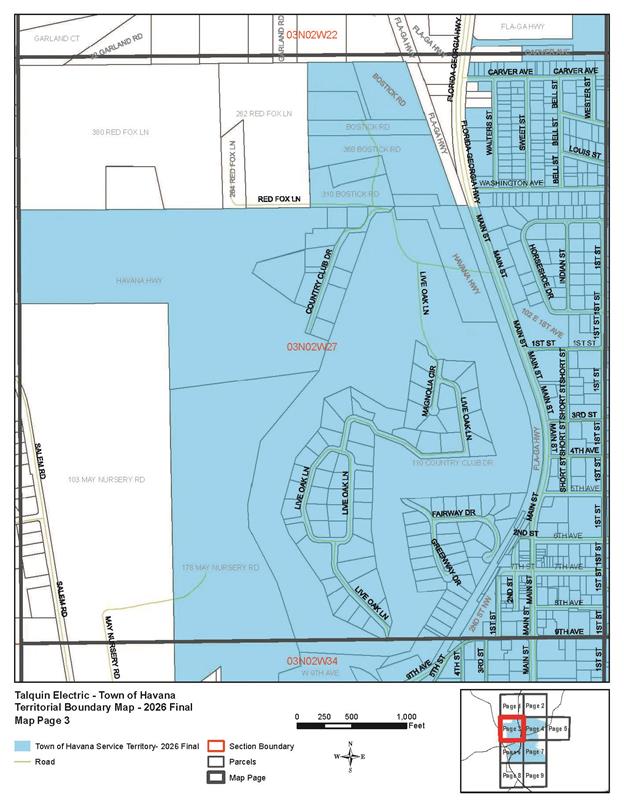
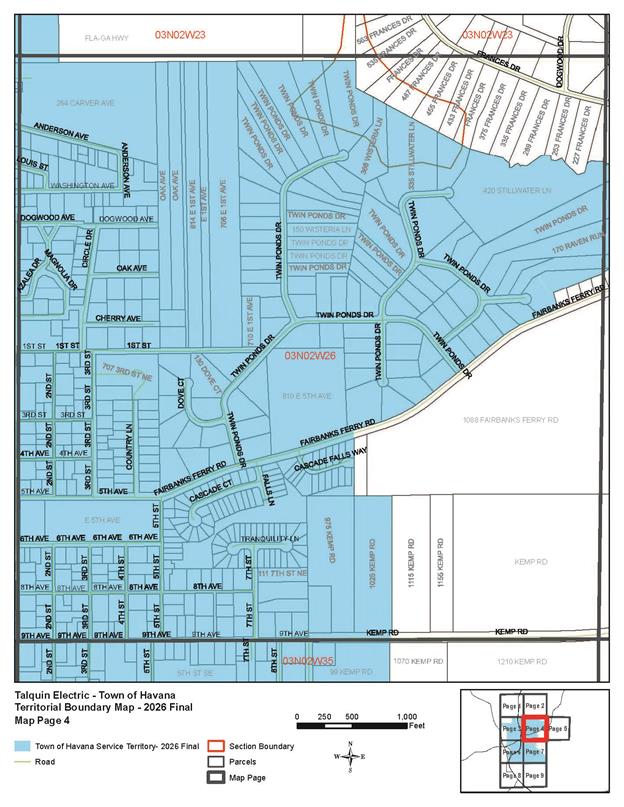
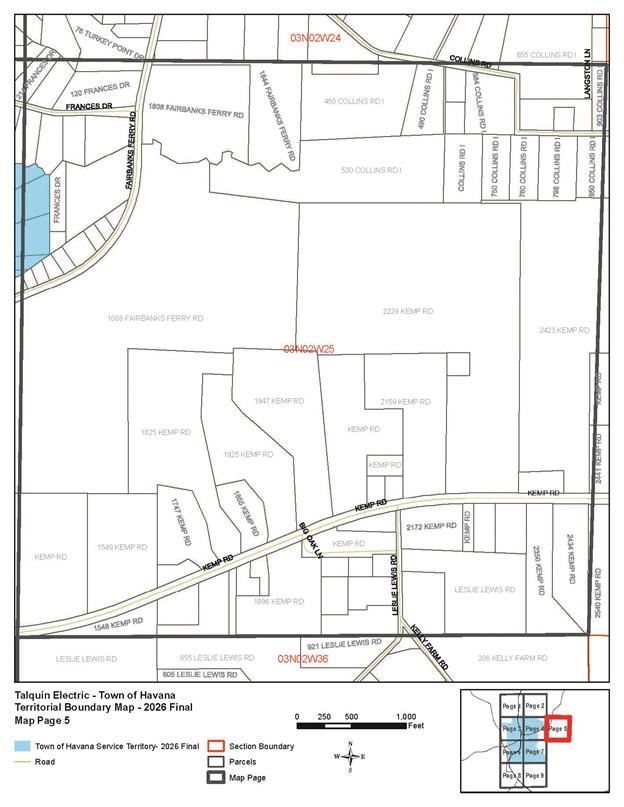
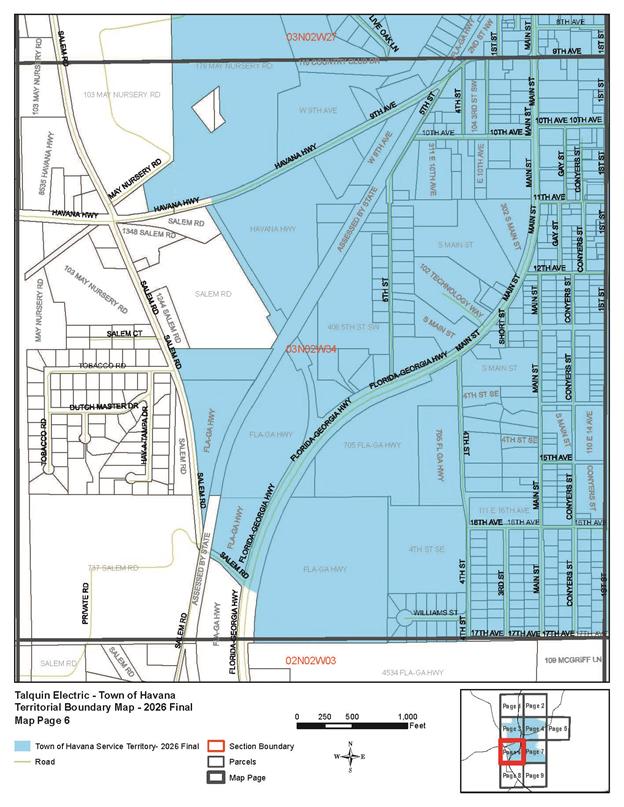
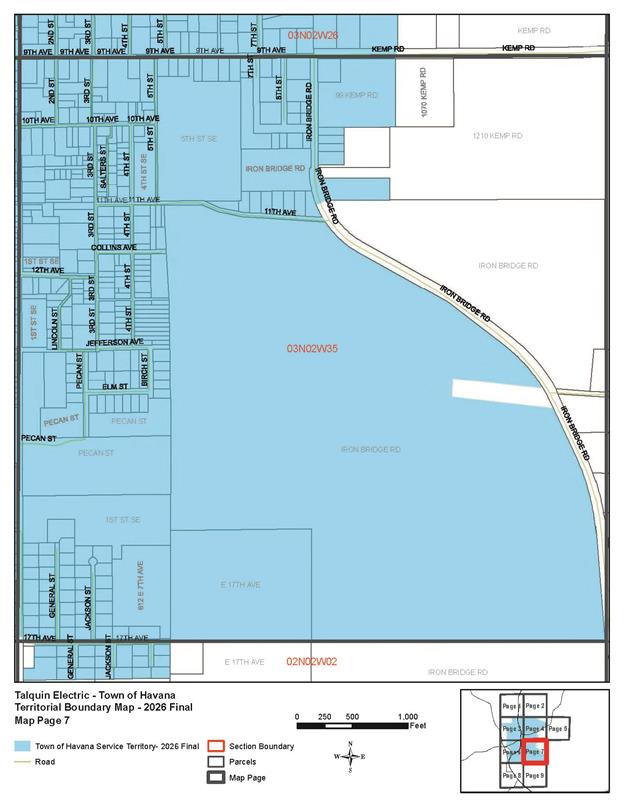
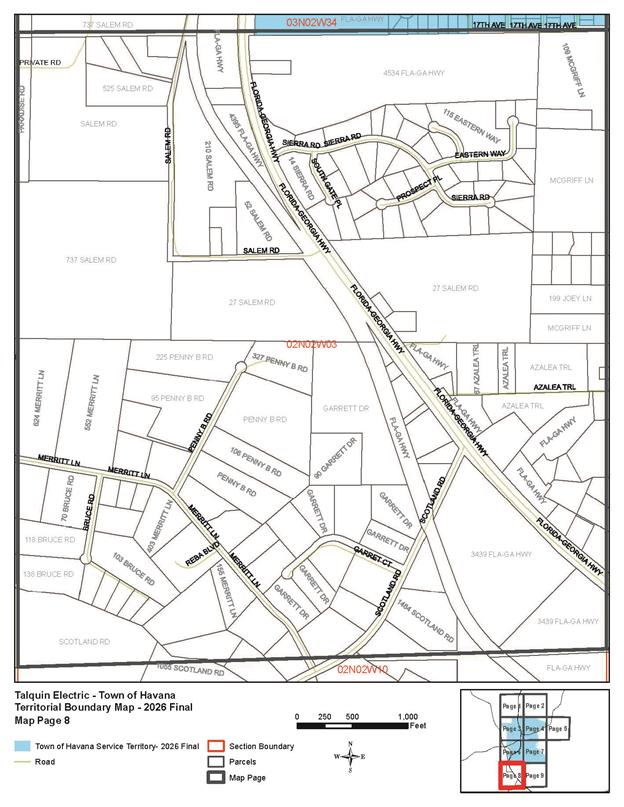
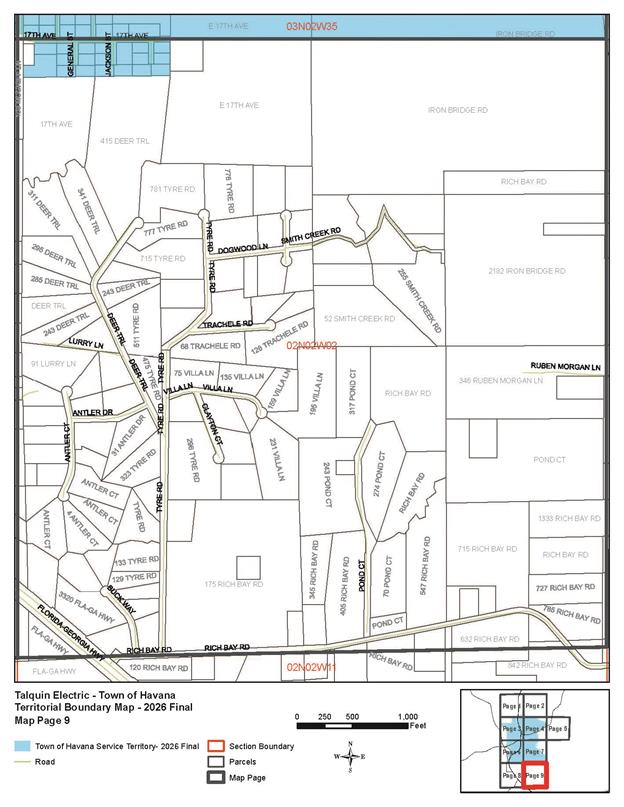
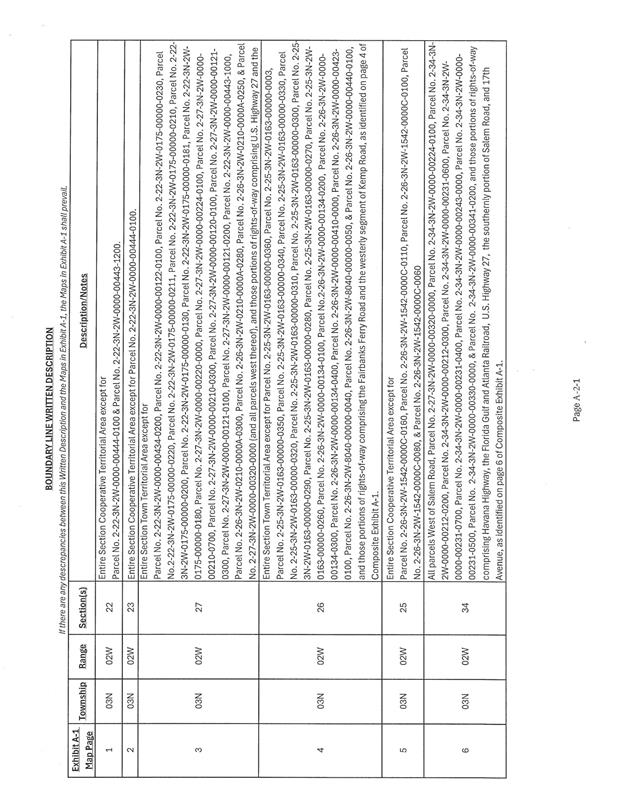
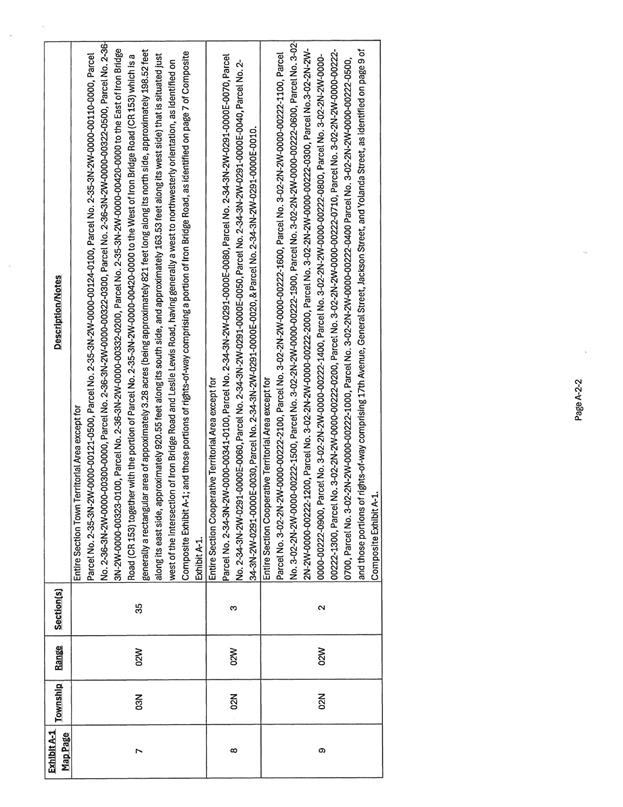
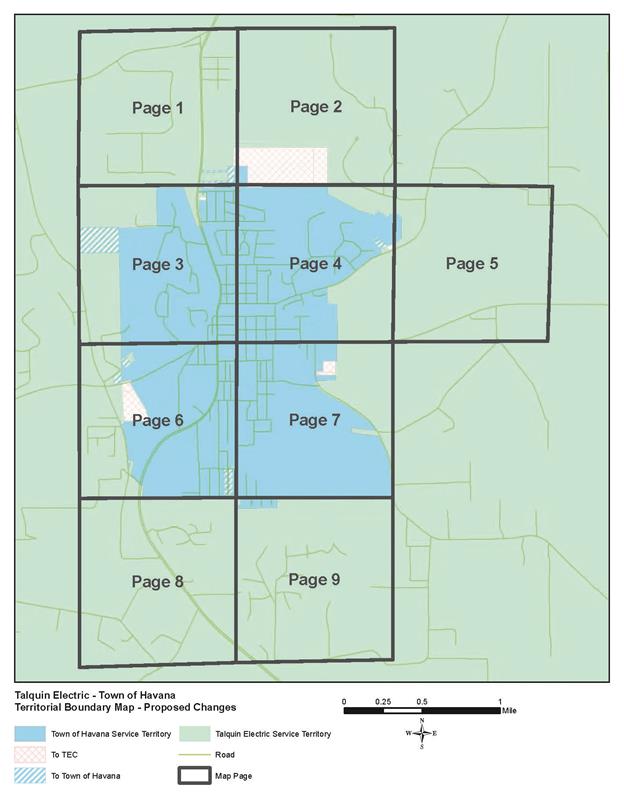
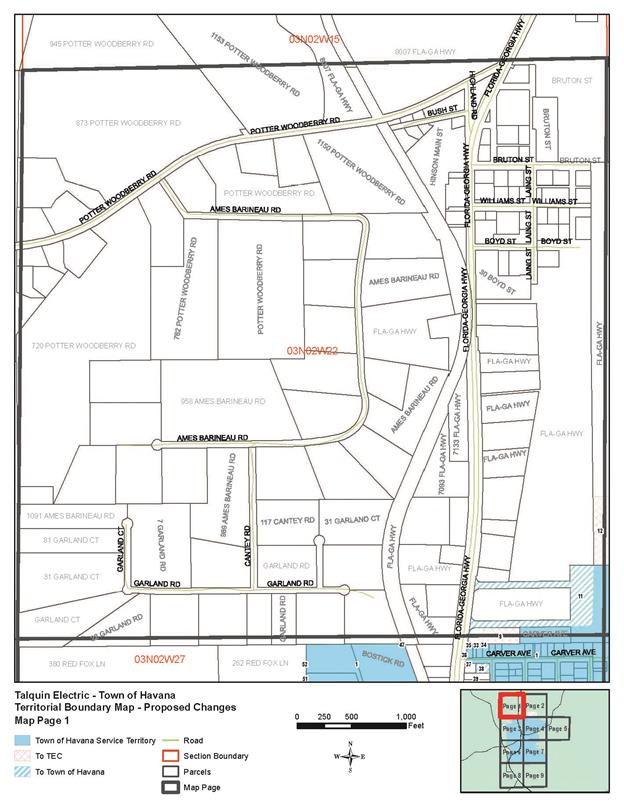
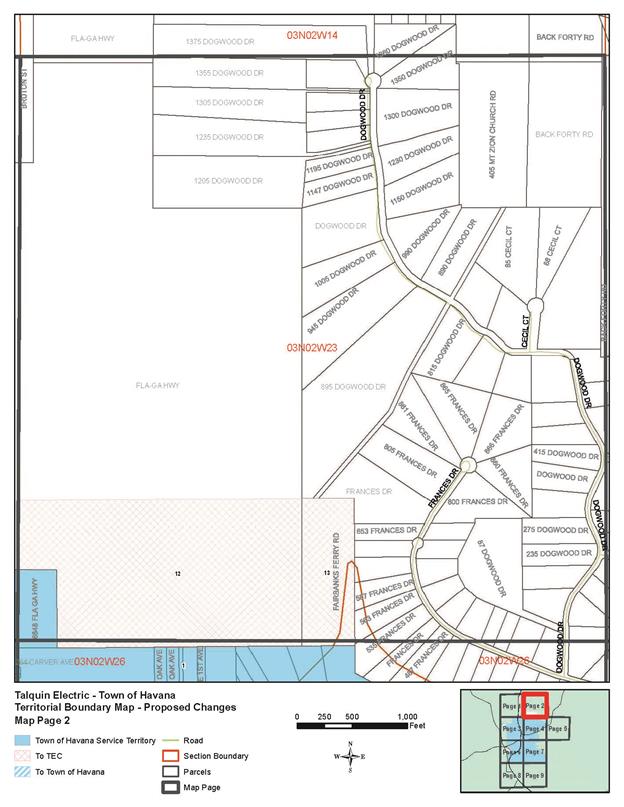
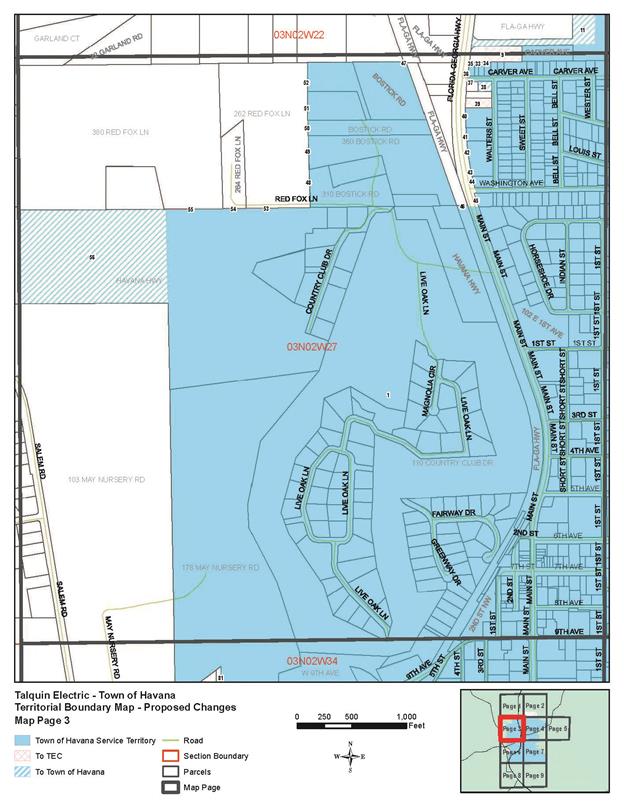
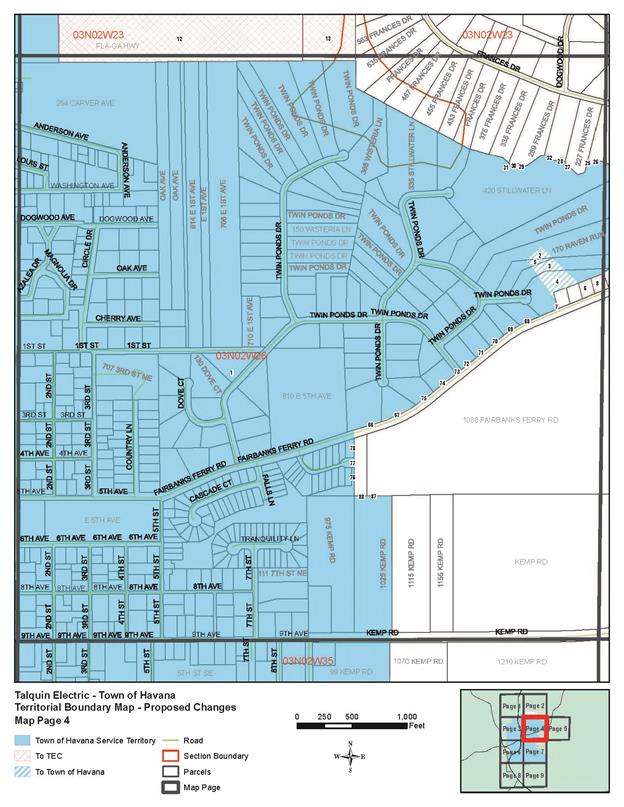
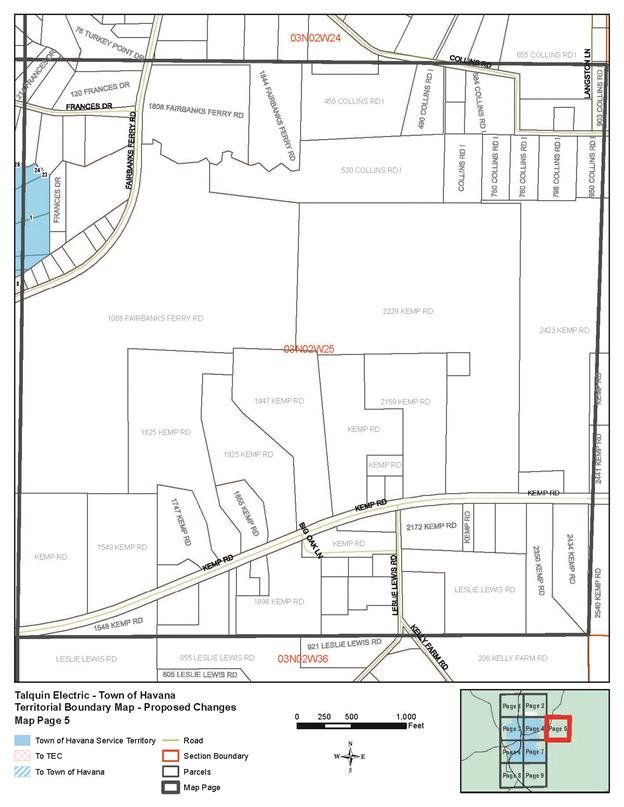
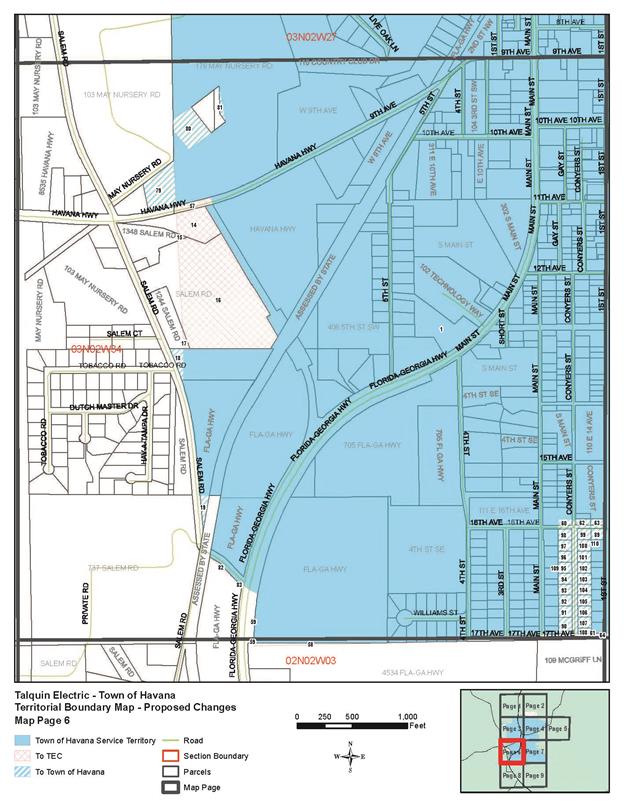
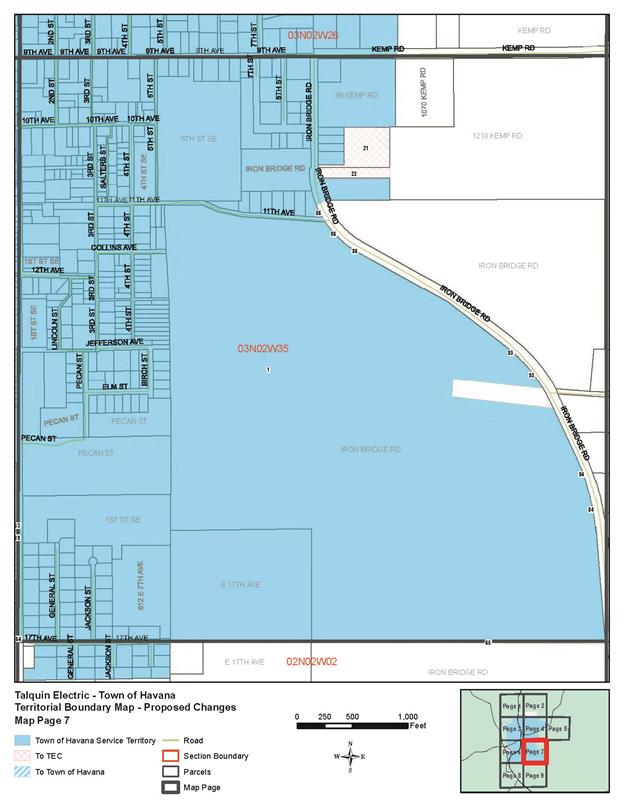
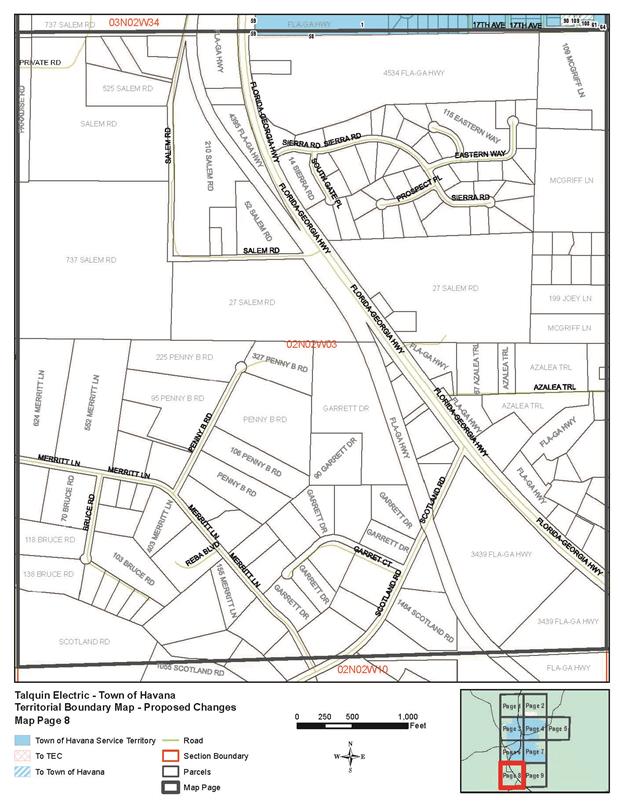
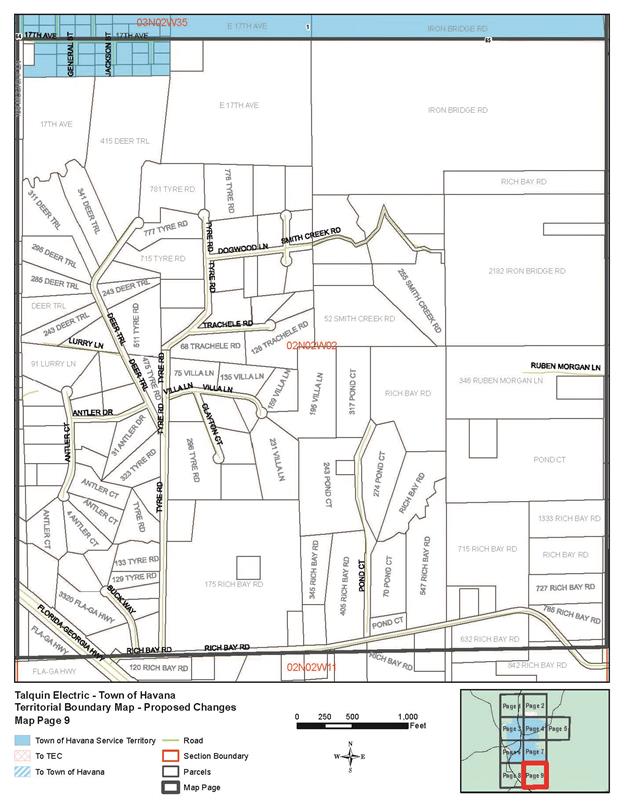
The 2026 Territorial Agreement includes nine maps
depicting the new territorial boundaries, written descriptions of the
territorial areas, and comprehensive terms and conditions the joint petitioners
negotiated. Among other things, the terms address the provision of new and
temporary service, the correction of inadvertent service errors, and the
procedures for the transfer of facilities. The 2026 Territorial Agreement also
includes the joint petitioners’ negotiated terms regarding the method of
compensation for transferred facilities. The joint petitioners’ filing does not
include a sample copy of notification letters provided to customers, as there
are no customers subject to transfer.
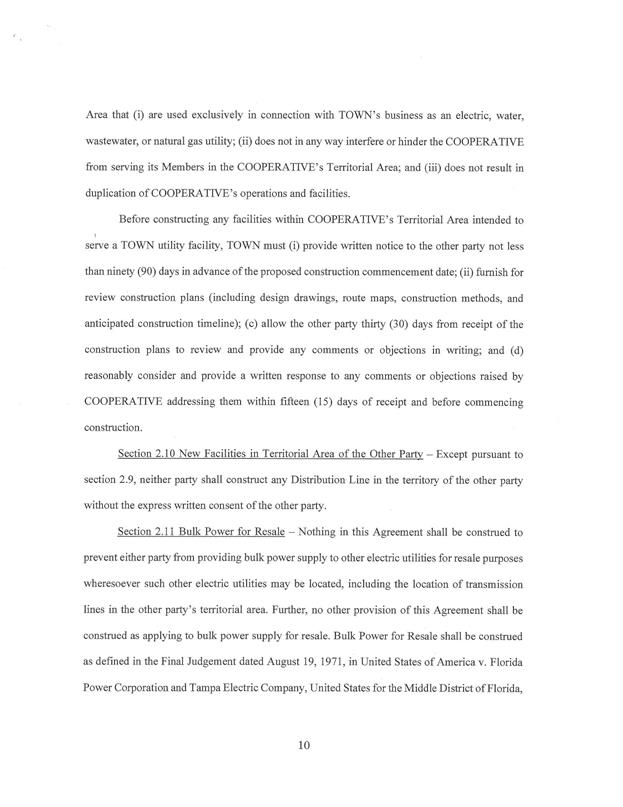
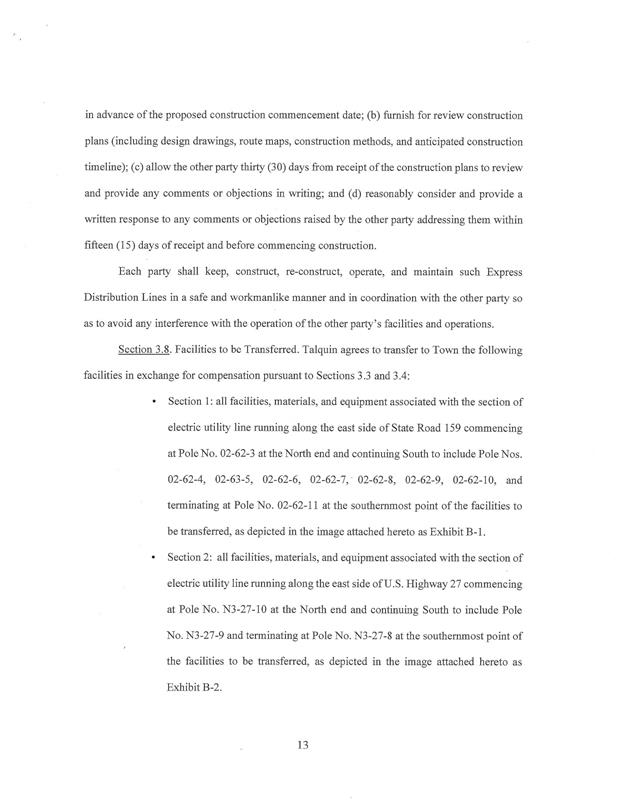
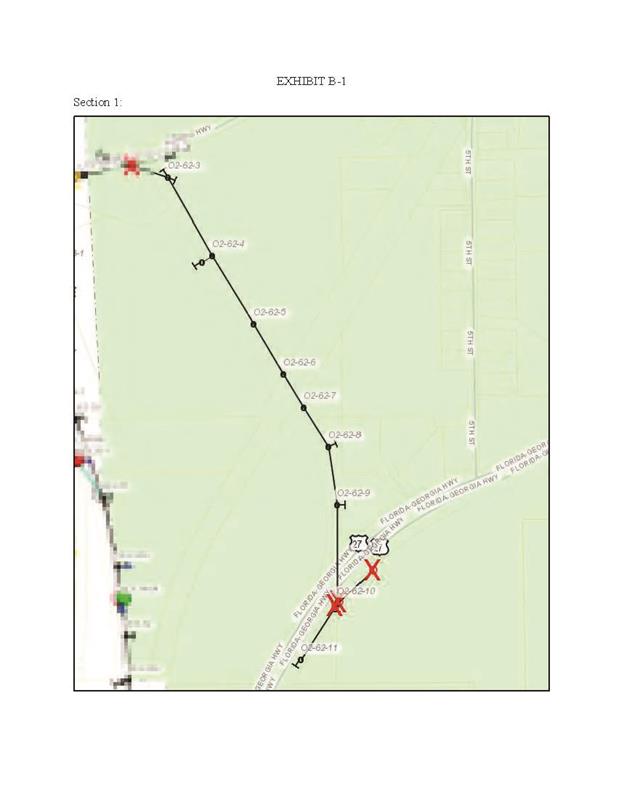
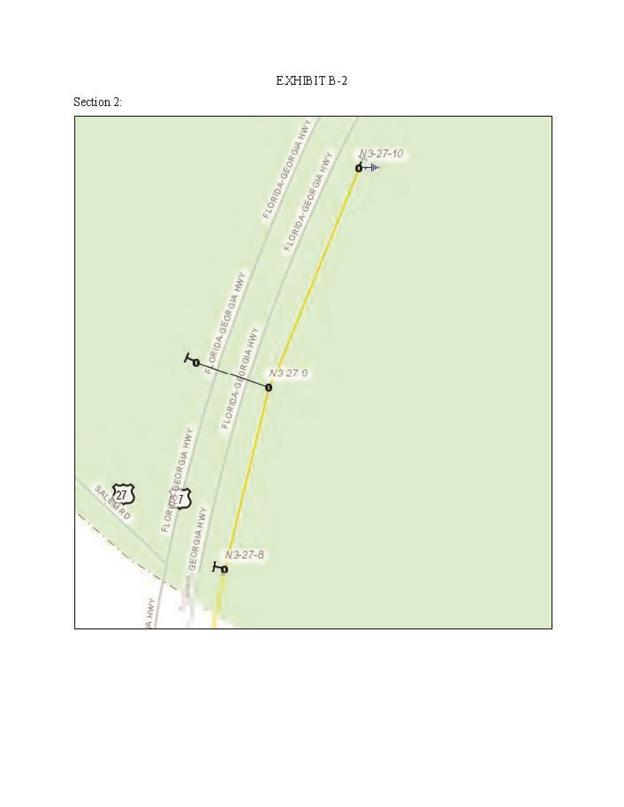
There are two sections of Talquin electric utility lines
and associated facilities that are proposed to be transferred from Talquin to
Havana. These facilities are identified in Exhibit B-1 and B-2 of the proposed
Agreement.
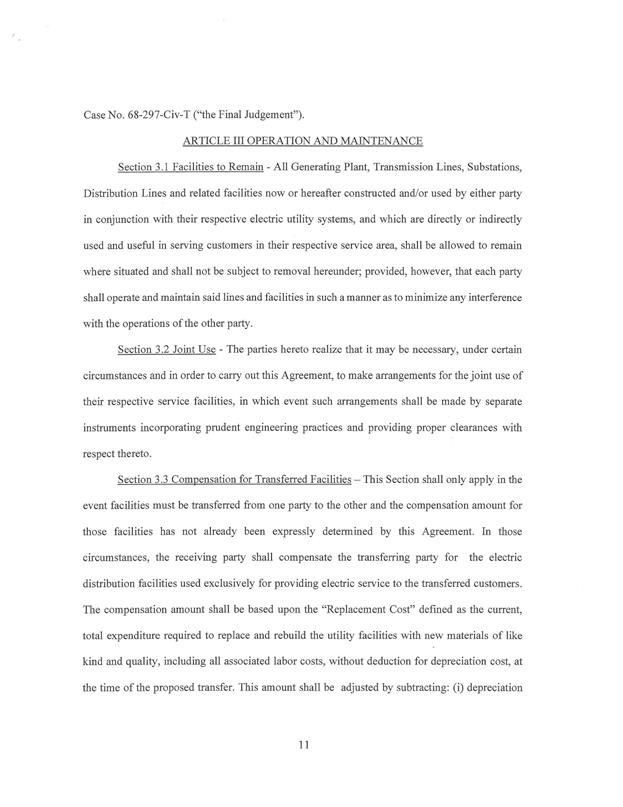
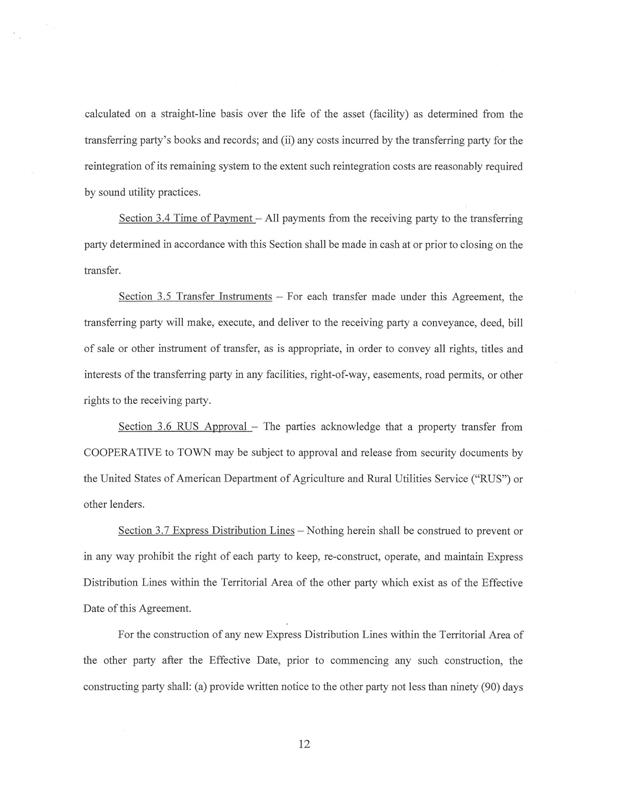
Section 3.3 of the proposed Agreement outlines the compensation for the
transferring facilities. Within six months of the Commission’s approval of the
proposed Agreement, the two sections of Talquin facilities located within
Havana’s territory would be transferred to Havana. Additionally, upon approval
of the Agreement, there will be two Talquin distribution lines remaining in
Havana’s territory that would not be transferred, including 1. A short electric
line segment along Iron Bridge Road (found on Map Page 7), and 2. A longer
electric line segment currently serving a Talquin customer, as discussed in
Section 2.4.
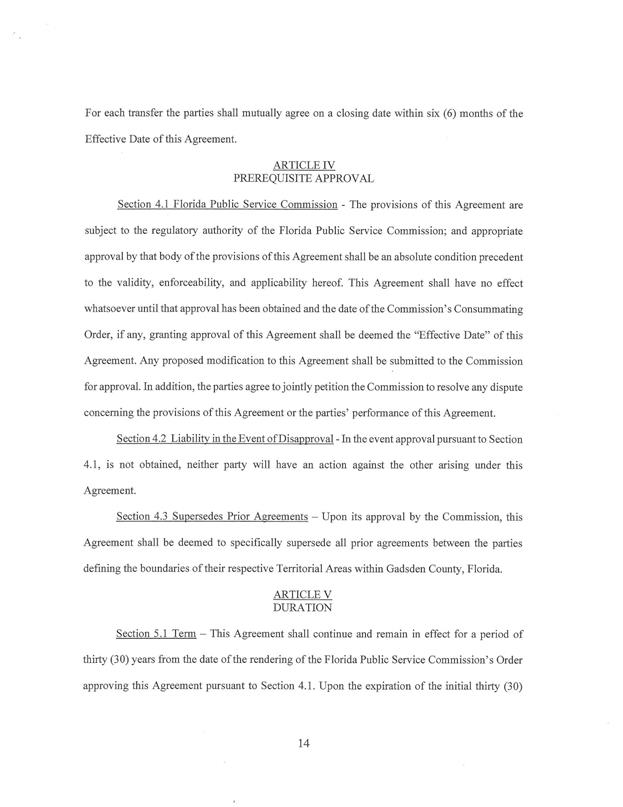
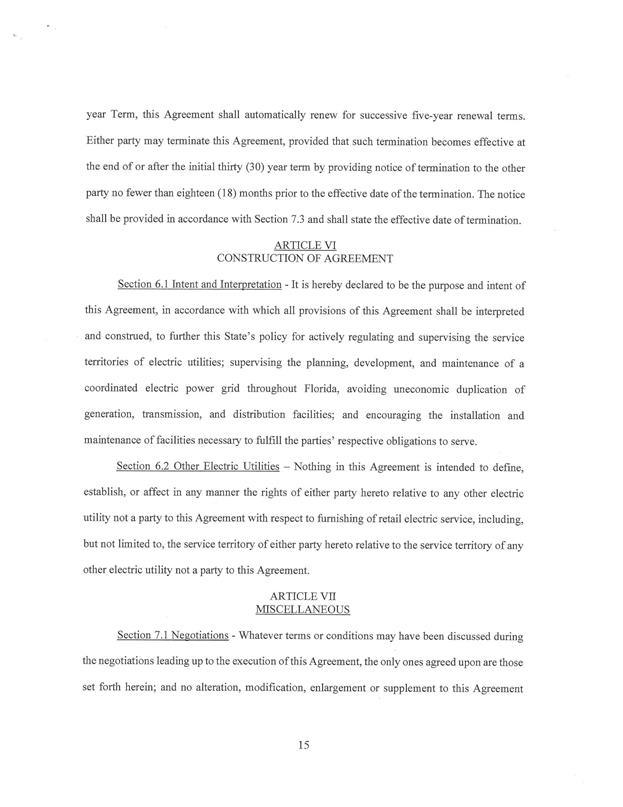
Pursuant to Section 5.1, the 2026 Territorial Agreement,
if approved, would remain in effect for 30 years from the date the Commission
issues its consummating order approving the agreement in its entirety. Upon the
expiration of the initial 30-year term, the agreement will automatically renew
for successive five-year terms, unless either party provides written notice of
termination to the other party no fewer than 18 months prior to the effective
date of the termination.
Proposed Boundary
Changes
The joint petitioners assert that the proposed boundary
line changes are primarily needed to align the territorial boundaries with the
current parcel boundaries, which will provide the Utilities with greater
certainty to plan or growth and avoid future disputes as the area surrounding
Havana continues to grow. Additionally, the joint petitioners assert future
developments will benefit from the easy and efficiency of working with one
utility to meet their electrical service requirements, therefore avoiding
duplication of services and wasteful expenditures.
The joint petitioners negotiated and are proposing
boundary line changes, in part, as a corrective measure to address
extra-territorial customers each party identified in their respective
territories. While
collaborating, the joint petitioners discovered some of the inadvertent
connections while analyzing the territorial service boundaries related to the
instant pleading.
Some of the proposed boundary line changes address the 24
extra-territorial customer connections (21 extra-territorial Havana customers
in Talquin’s territory and 3 extra-territorial Talquin customers in Havana’s
territory) that are not subject to transfer due to the uneconomic cost of
switching utility facilities. Instead, the Utilities have agreed to modify
their service territory boundaries to eliminate service to these
extra-territorial customers. Per the 2026 Territorial Agreement, the modified
boundaries will not eliminate Talquin’s service to the current Talquin customer
located in Havana, even though that customer will reside within Havana’s
service area.
The joint petitioners conducted a recent review of the
Havana and Talquin facilities along Conyers Street and identified some safety
issues primarily related to telecommunication attachments and their proximity
to the utilities’ electrical lines. In
a follow-up response, the joint petitioners stated that these safety issues have
been addressed.
Proposed Customer
Transfers, Notifications, and Bills
No customer transfers are proposed in the 2026 Territorial
Agreement. As such, the guidelines of Rule 25-6.0440(1)(d), F.A.C., regarding
notification of customers to be transferred does not apply in this instance.
Thus, the Utilities did not issue any notifications or bill comparisons.
The proposed Agreement includes specific language in
Section 2.4, which applies to a current Talquin customer that will become
extra-territorial under the proposed 2026 Territorial Agreement. The Utilities
agreed that the residential customer receiving service will become
extra-territorial until one of three conditions are met: (1) the customer
requests a service change from Talquin to Havana, (2) the residence being
served by Talquin is sold, assigned, or otherwise transferred, or (3) a new
customer applies for service at the address. Upon this transfer of service from
Talquin to Havana, Talquin will remove all facilities providing service to this
address or sell them for the amount calculated in Section 3.3.
Primary Staff Review
Primary staff analyzed the 2026 Territorial Agreement for
compliance with each component of Rule 25-6.0440(2), F.A.C. Primary staff notes
that while no specific purchase price was provided, the joint petitioners do
address the method of setting a compensation amount for asset transfers based
on replacement cost. Specifically, Talquin will transfer two electric lines and
associated facilities to Havana using the method found in Section 3.3 of the
proposed Agreement. The joint petitioners also assert that the transfer will
allow Havana to avoid the significant expenses of installing new facilities.
Primary staff believes the facility purchase arrangements per the Agreement are
acceptable.
Primary staff also evaluated the agreement according to
Rule 25-6.0440(2)(b), F.A.C., which addresses electrical system reliability for
existing or future customers. The joint petitioners assert the approval of the
2026 Territorial Agreement is not expected to result in a decrease in
reliability to existing or future customers of either utility. The joint petitioners
contend that the reliability of service to existing or future Talquin or Havana
customers would not decline because of the proposed Agreement.
Under the 2026 Territorial Agreement, the joint
petitioners have conceded that the current configuration may constitute
uneconomic duplication, but argue that the 2026 Territorial Agreement, as
proposed, will ensure that any uneconomic duplication will not further expand
or continue forever. The current customer residing in Havana has been a Talquin
customer for more than 50 years and the joint petitioners have determined that
Talquin’s continued service to this location was reasonable and would not
result in uneconomic duplication for an indefinite period of time.
The joint petitioners stated that at least five years is
expected to pass before future uneconomic duplication would occur (including
expenses such as routine maintenance, tree trimming, and pole inspections) for
the facilities serving the Havana customer.
Primary staff believes any potential uneconomic duplication proposed under the
2026 Territorial Agreement is not a strong argument favoring disapproval,
provided the Utilities follow the condition attached to staff’s recommended
approval. The 2026 Territorial Agreement provides for conditions as to when the
account would be transferred from Havana to Quincy. Primary staff weighed these
circumstances against the agreement’s broader benefits, including correcting
other extra-territorial connections, transferring facilities, and establishing
clearer boundaries to avoid future duplication and disputes.
On balance, primary staff finds that the 2026 Territorial
Agreement, including its limited exception for one customer with unique
circumstances, is reasonable and particular to this case. Primary staff also
believes Commission approval of this agreement will not recognize customer
preference or longevity alone as sufficient grounds for an exception; any
future proposal would require its own public-interest evaluation.
The Utilities addressed the subject of existing facilities
in the area of Conyers Street and 1st Street, where the Talquin and
Havana each have overhead electric facilities on opposite sides of the streets.
The joint petitioners stated that they believe the current configuration is safe
and reliable. The
joint petitioners further explained that the poles of both Utilities are the
appropriate distance from the roadway in accordance with the requirements from
the Florida Department of Transportation, and both Utilities believe their respective
facilities meet the requirements of the National Electric Safety Code (NESC)
and, therefore, there is no negative impact on the safety experienced by
vehicular traffic, pedestrians, and residents in the area. Based
on the responses provided by the Utilities, primary staff believes that the
presence of duplicative facilities does not appear to present safety issues
along Conyers Street and 1st Street. The placement of Talquin’s and
Havana’s overhead lines and poles is shown in the supplemental response
provided by the Utilities.[18]
Primary staff acknowledges that Section 2.4 is an
agreement the Utilities forged, although primary staff believes acceptance of
the proposed 2026 Territorial Agreement should be accompanied with a reporting
obligation. Primary staff believes requiring a reporting obligation as a
condition of approval will provide the Commission with a clear record of when
the triggering events contemplated by Section 2.4 have occurred. Because there
is uncertainty about when such events that would trigger the transfer of
service may occur, primary staff believes it is reasonable to require that
Talquin inform the Commission when Section 2.4 is triggered and it discontinues
service to its customer in Havana, and all related facilities are de-energized.
Primary staff believes this notification will help ensure that the potential
for continued extra-territorial service and associated uneconomic duplication
does not extend beyond the circumstances contemplated by the 2026 Territorial Agreement.
Primary Conclusion
The Commission should approve the 2026 Territorial
Agreement between Talquin and Havana in Gadsden County, as consistent with the
Standards for Approval set forth in Rule 25-6.0440(2), F.A.C. The 2026
Territorial Agreement, if approved, amends the respective boundary lines
between the Utilities, thereby eliminating most extra-territorial connections.
The Agreement would also facilitate the joint petitioners’ efforts to avoid
uneconomic duplication of service facilities, wasteful expenditures, and
hazardous conditions, as well as the transfer of two electric lines with
associated facilities from Talquin to Havana. Additionally, the territorial
boundary changes will provide the joint petitioners with greater certainty to
plan for growth and avoid future disputes. Talquin should be required to notify
the Commission in writing within 30 days of the date it permanently
discontinues electric service to the residence in Havana.
Alternative Staff Review
Alternate staff does not support
approving the 2026 Territorial Agreement, for reasons set forth below. In
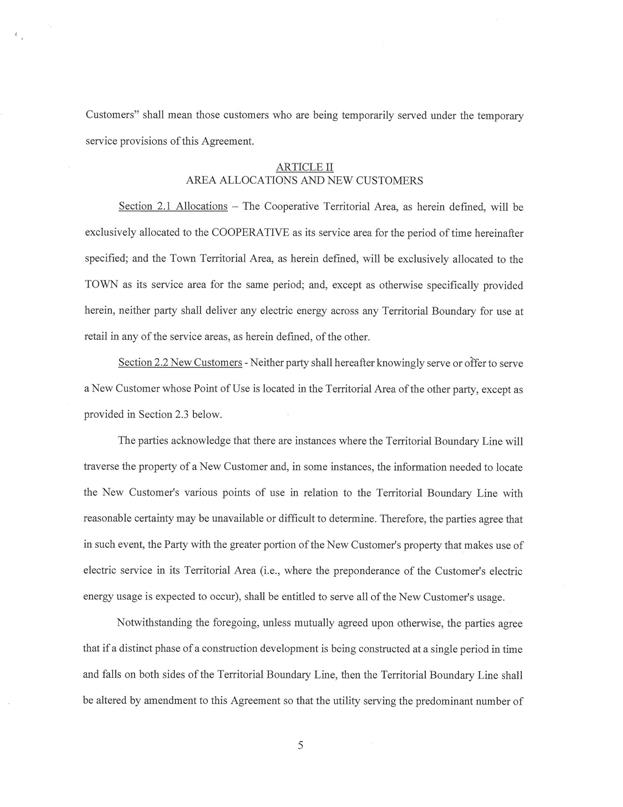
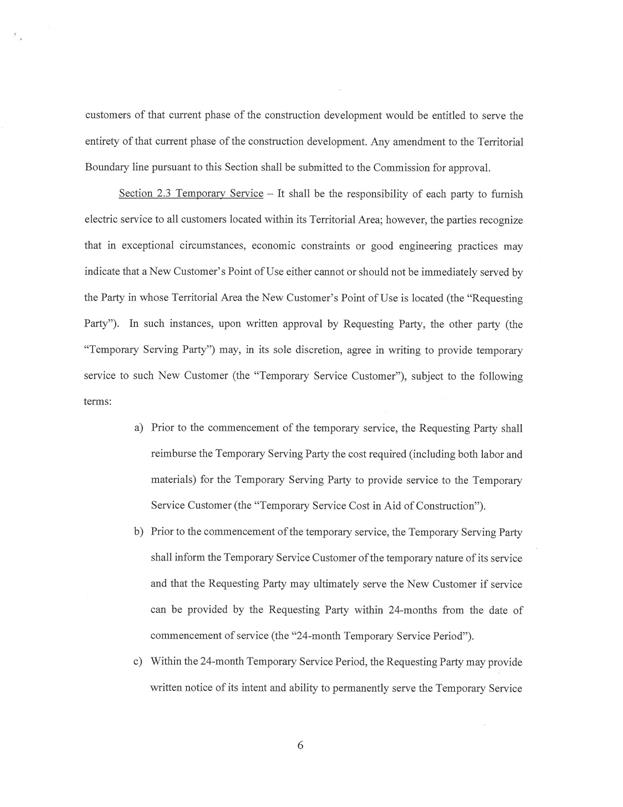
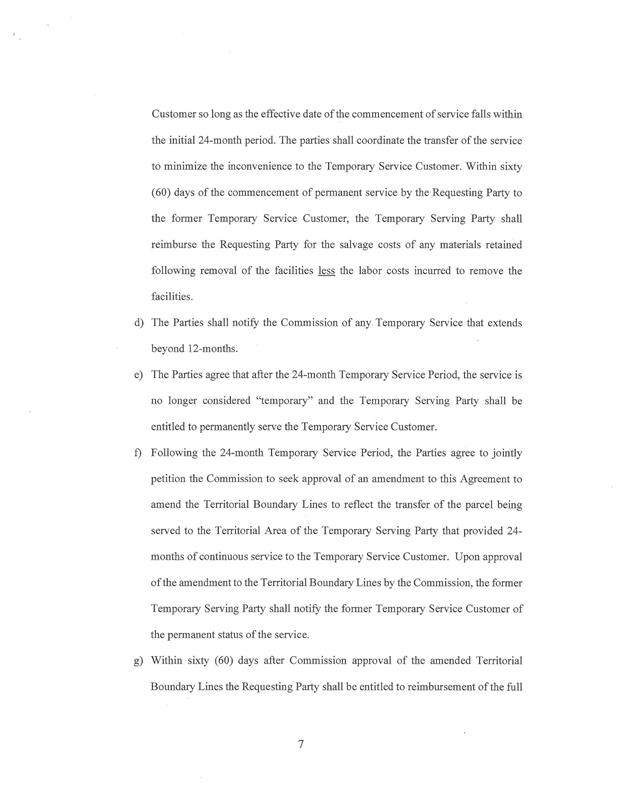
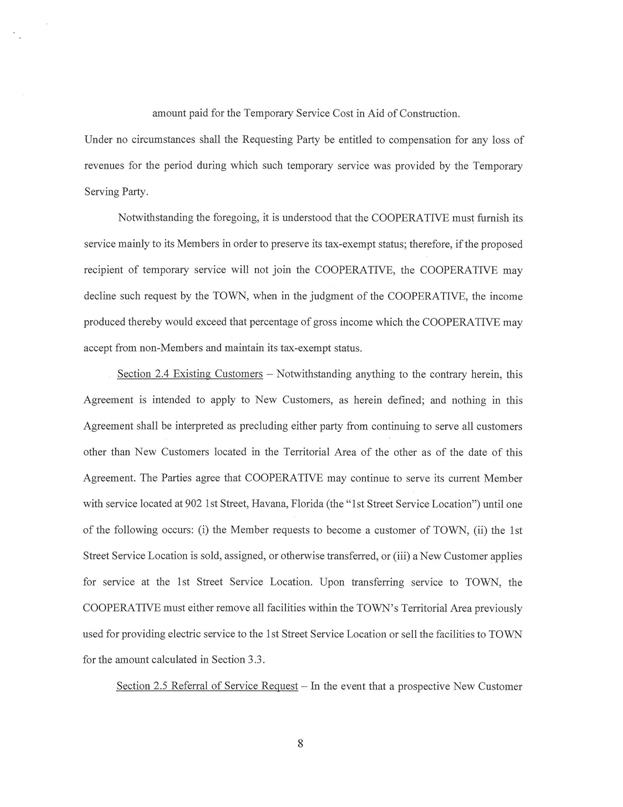
Section 2.4 of the 2026 Territorial Agreement, the joint petitioners proposed
an arrangement for a specific Talquin residential customer located within the
proposed territorial boundary of Havana. In part, Section 2.4 states:
. . . The Parties agree that COOPERATIVE
[Talquin] may continue to serve its current Member with service located at 902
1st Street, Havana, Florida (the “1st Street Service
Location”) until one of the following occurs: (i) the Member requests to become
a customer of TOWN [Havana], (ii) the 1st Street Service Location is
sold, assigned, or otherwise transferred, or (iii) a New Customer applies for
service at the 1st Street Service Location. Upon transferring
service to TOWN, the COOPERATIVE must either remove all facilities within the
TOWN’S Territorial Area previously used for providing electric service to the 1st
Street Service Location or sell the facilities to TOWN for the amount
calculated in Section 3.3. . ..
Alternate staff believes the
provisions in Section 2.4 appear to be counter to previously
Commission-approved territorial agreements in one important respect: the Commission has not approved a territorial
agreement that, in effect, creates an extra-territorial customer for an
indefinite period of time. In previous decisions, the Commission has allowed
utilities to address transfer arrangements for existing extra-territorial
customers over a set period of time. However, the instant case involves a
customer who is currently not extra-territorial but would become one as a
result of the proposed boundary change.
The joint petitioners assert that
the negotiated language in Section 2.4 recognizes the age of the Talquin
customer in Havana, as well as the customer’s longevity as a Talquin member
(more than 50 years).[19] In
response to a data request, the joint petitioners acknowledge Talquin’s
facilities are located on the east side and Havana’s are located on the west
side of Conyers Street in Havana, Florida. Talquin’s facilities currently serve
the Havana customer and consists of approximately 1,380 feet of single phase
primary line (two conductors for a total of 2,760 feet of energized
conductors).[20] The joint
petitioners contend that approval of the 2026 Territorial Agreement “would not
result in permanent uneconomic duplication for an indefinite period of time.”[21] Alternate
staff notes that this acknowledgement of uneconomic duplication of services is
concerning for several reasons.
First, the acknowledgement of
existing uneconomic duplication by the joint petitioners is in conflict with
the specific references noted earlier in Rule 25-6.0440(2)(c) F.A.C., which
allows the Commission to consider “the reasonable likelihood that the agreement
will eliminate existing or potential uneconomic duplication of facilities.”
Alternative staff notes that the joint petitioner’s boundary redraw for the
Conyers Street location, thereby transferring service area from Talquin to
Havana, is an essential step in eliminating the uneconomic duplication the
utilities recognize exists. However, the inclusion of Section 2.4 of the
proposed 2026 Territorial Agreement makes the redraw meaningless for purposes
of eliminating uneconomic duplication for an undetermined period of time.
Although Section 2.4 is a negotiated term like others in the 2026 Territorial
Agreement, the language contained in Section 2.4 does not appear to “eliminate
existing” uneconomic duplication as referenced in the rule. Instead, alternate
staff believes the provisions in Section 2.4 of the 2026 Territorial Agreement
effectively creates an extra-territorial customer.
Second, alternate staff
considered the specific ways in which duplicated services would continue to be
uneconomic in the future. Talquin acknowledged the on-going expenses to inspect
and maintain the facilities serving the customer located in Havana. In response
to a data request, Talquin asserts its next tree trimming cycle will be in the
2030-2032 timeframe, and its expenditures for the last trim cycle were about
$7,250 for the pole line near Conyers Street. Talquin stated the most recent
expense for routine pole inspections were about $400, and that expense will
reoccur in about the same time frame as the tree trimming.[22]
In addition to these scheduled maintenance costs, other costs related to
equipment failure or accidents may also impact the expenses required to keep
the electric line energized going forward. Accounting for the expenses
associated with tree trimming, pole inspections, and potential equipment
failure and/or accidents, it would be more cost-effective to address the issue
of uneconomic duplication at this time. Talquin states the removal of the
facilities would approximately take one month to schedule and complete, costing
approximately $3,600.[23]
Meanwhile, Havana could connect the customer by installing a service drop.23
Alternative Conclusion
All aspects of the
proposed 2026 Territorial Agreement between Talquin and Havana in Gadsden
County are appropriate except for Section 2.4, which would allow Talquin to
provide electric service for an unspecified amount of time to an address
located in Havana’s service area until one of three conditions are met. This
exception to compliance with the proposed boundary lines contemplated in
Section 2.4 may result in continued uneconomic duplication in the immediate
geographic area for an unspecified period, such that the Agreement represents a
detriment to the public interest. After providing required transfer
notification and comparative utility rate information to the customer in
Havana, the joint petitioners should be required to submit a revision to the
proposed 2026 Territorial Agreement that is exclusive of the provisions
contained in Section 2.4.
Issue 2:
Should this docket be closed?
Recommendation:
If the Commission
approves the primary staff recommendation, and if no protest is filed by a
person whose substantial interests are affected within 21 days of the issuance
of the Order, this docket should be closed upon the issuance of a Consummating
Order. If the Commission approves the alternative staff recommendation,
this docket should remain open until the Commission’s disposition of a revised 2026
Territorial Agreement. (Crawford, Rauch)
Staff Analysis:
If the Commission approves the primary staff
recommendation, and if no protest is filed by a person whose substantial
interests are affected within 21 days of the issuance of the Order, this docket
should be closed upon the issuance of a Consummating Order. If the Commission
approves the alternative staff recommendation, this docket should remain open
until the Commission’s disposition of a revised 2026 Territorial Agreement.