Discussion
of Issues
Issue 1:
Should the Utility's proposed final water and
wastewater rates be suspended?
Recommendation:
Yes, Palm Valley’s proposed final water and
wastewater rates should be suspended. (Bethea)
Staff Analysis:
Section 367.081(6), F.S., provides that the
Commission may, for good cause, withhold consent to the implementation of the
requested rates within 60 days after the date the rate request is filed.
Further, Section 367.081(10), F.S., permits the proposed rates to go into
effect (secured and subject to refund) at the expiration of five months from
the official date of filing if: (1) the Commission has not acted upon the
requested rate increase; or (2) if the Commission’s PAA action is protested by
a party other than the Utility.
Staff has reviewed the filing and has considered the
information filed in support of the rate application and the proposed final
rates. Staff believes that it is reasonable and necessary to require further
elaboration and explanation regarding this data and to require the production
of additional and/or corroborative data. To date, staff has initiated an audit
of Palm Valley’s books and records. The audit report is tentatively due on
January 12, 2027. Staff believes additional requests will be necessary to
process this case. Based on the foregoing, staff recommends suspension of the
Utility’s proposed rate increase.
Issue 2:
Should any interim revenue increase be approved?
Recommendation:
Yes, Palm Valley should be authorized to collect
annual water and wastewater revenues as indicated below:
|
|
Adjusted
Test
Year
Revenues
|
$
Increase
|
Revenue
Requirement
|
%
Increase
|
|
Water
|
$211,488
|
$96,815
|
$308,303
|
45.78%
|
|
Wastewater
|
$553,323
|
$232,660
|
$785,983
|
42.05%
|
(Sewards)
Staff Analysis:
Pursuant to Section 367.082(1), F.S., the Commission
may authorize the collection of interim rates during any proceeding for a
change of rates upon petition from any party or on its own motion. To establish
a prima facie entitlement for interim relief, the Utility shall demonstrate
that it is earning outside the range of reasonableness on its rate of return.
Pursuant to Section 367.082(2)(a), F.S., in a proceeding for an interim
increase in rates, the Commission shall authorize, within 60 days of the filing
for such relief, the collection of rates sufficient to earn the minimum of the
range of return on equity (ROE) approved in the last rate proceeding.
On September 18, 2026, Palm Valley filed rate base, cost
of capital, and operating income schedules to support its requested interim
increase. Pursuant to Section 367.082(5)(b)1., F.S., the achieved rate of
return for interim purposes must be calculated by applying adjustments consistent
with those used in the Utility’s most recent rate proceeding and annualizing
any rate changes. Staff reviewed Palm Valley’s interim request and Order No.
PSC-2010-0606-PAA-WS, from its last rate case (2010 Rate Case Order). Staff
has attached accounting schedules to illustrate its recommended rate base,
capital structure, and test year operating income amounts. The rate base
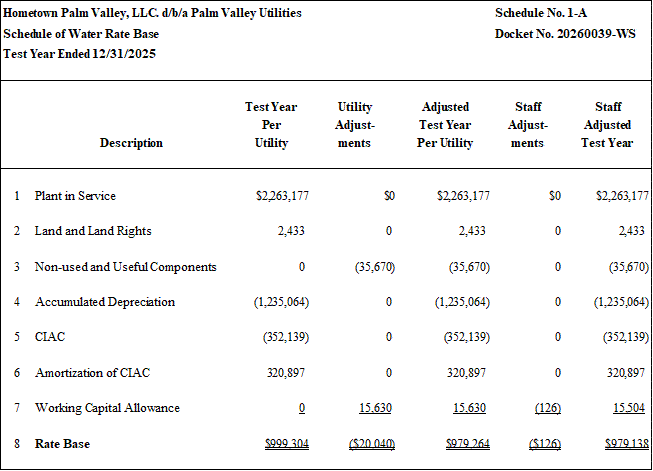
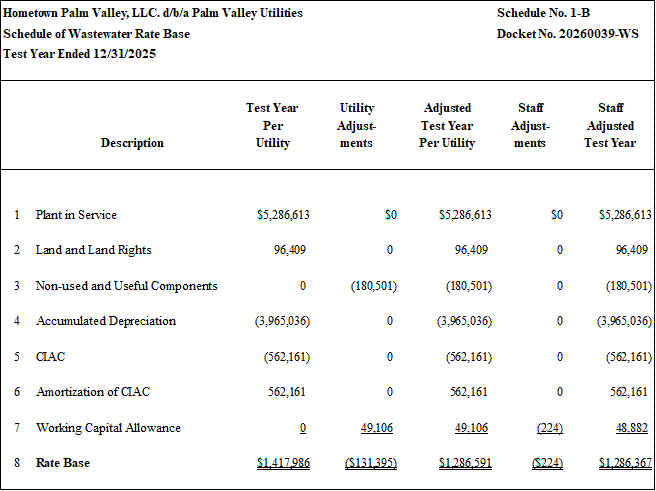
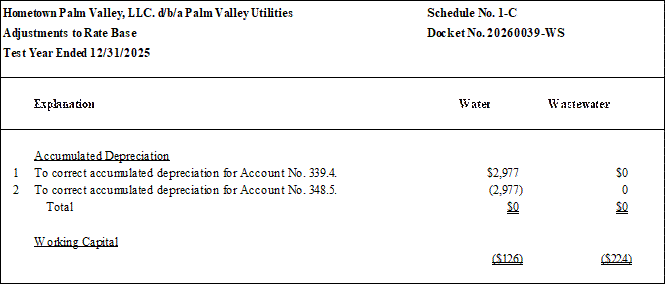
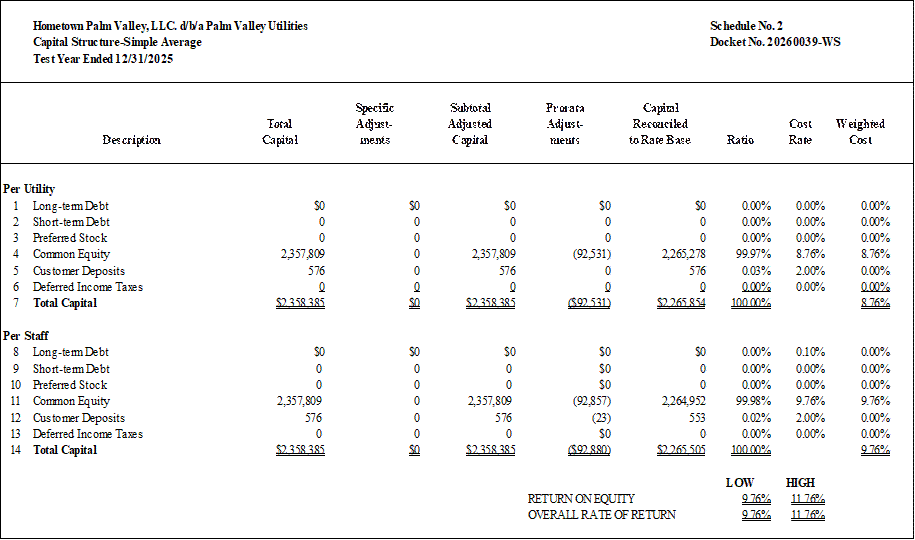
schedules are labeled as Schedule Nos. 1-A, 1-B, and 1-C. The capital structure
schedule is labeled Schedule No. 2. The operating income schedules are labeled
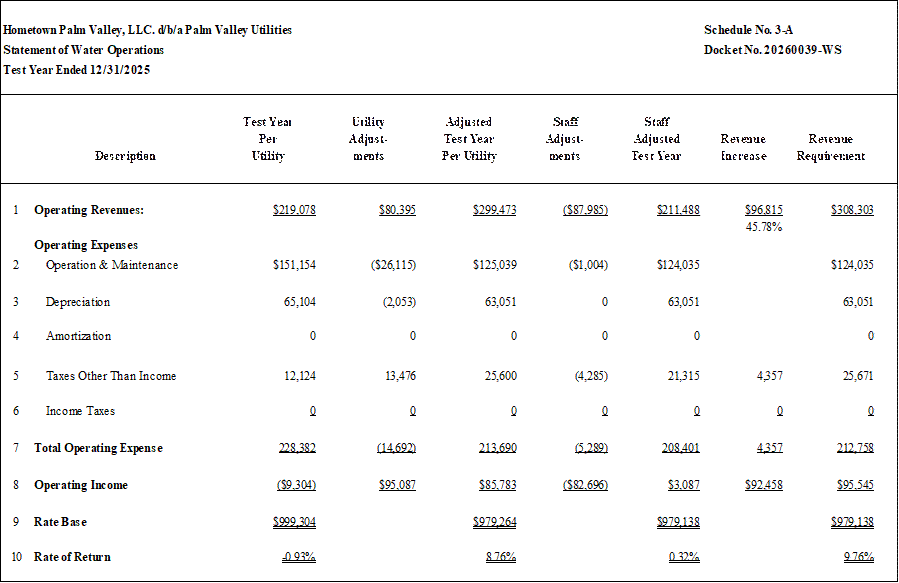
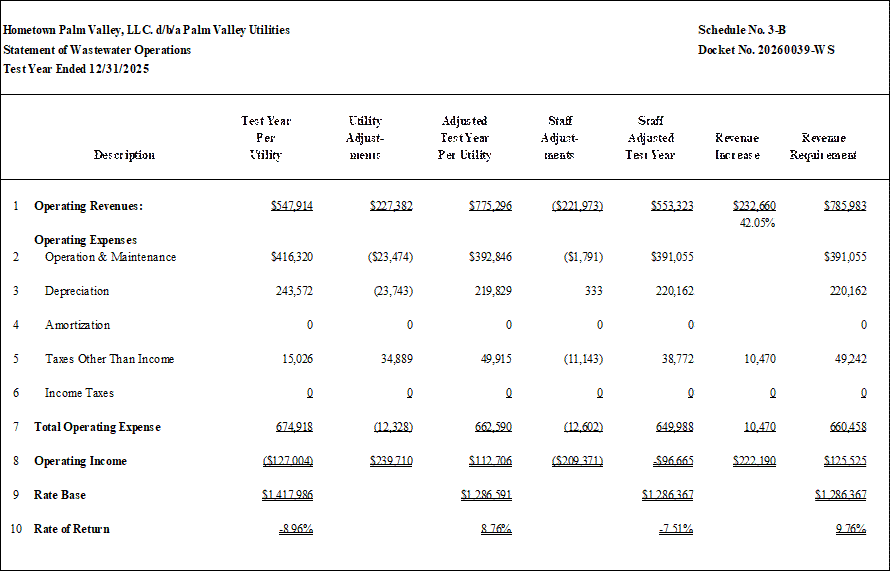
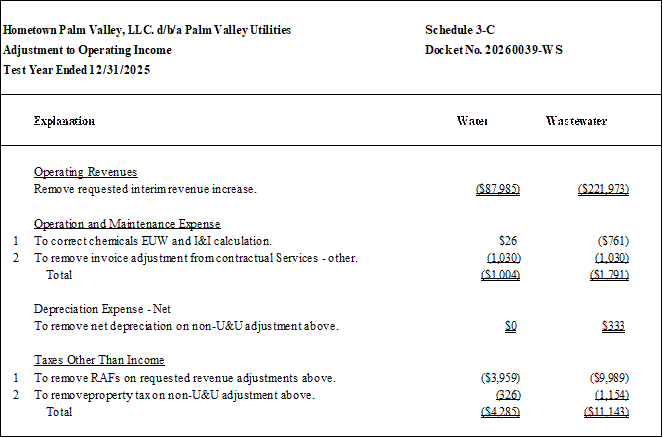
as Schedule Nos. 3-A, 3-B, and 3-C. Staff’s recommended adjustments are
discussed below.
Interim Rate Base
In its filing, the Utility calculated a rate base of
$979,264 for the water system, and $1,286,591 for the wastewater system. Palm
Valley adjusted used and useful (U&U) amounts based on non-used and useful
percentages established in the Utility’s last rate case. Palm Valley also made
working capital adjustments based on corresponding adjustments to operation and
maintenance (O&M) expense. Staff believes additional adjustments to
accumulated depreciation and working capital are necessary for interim
purposes.
Accumulated Depreciation
In its MFRs, Palm Valley calculated an accumulated
depreciation balance of $2,977 for Account No. 339.4, and a balance of $0 for
Account No. 348.5. The Utility clarified the balance of $2,977 should be
reclassified to Account No. 348.5.
This results in a net zero adjustment to accumulated depreciation for the water
system.
Used & Useful
Staff reviewed the Utility’s interim U&U
calculations on a per system basis. The review is based upon previous
Commission decisions and available usage and capacity data contained in Palm
Valley’s MFR schedules. Consistent with Commission practice, staff recommends
no adjustments for all distribution and collection systems, storage, and reuse
facilities that have been determined to be 100 percent U&U by the prior
rate case order.[4] Staff also recommends no
adjustments to the water treatment plant (WTP) and wastewater treatment plant
(WWTP) U&U values of 78 percent and 81 percent respectively contained in
Palm Valley’s interim rate base as approved in the prior rate case order.
Palm Valley made net non-U&U adjustments of $35,670 to
the water system, and $180,501 to the wastewater system. Staff does not have
any adjustment to these balances. As such, staff recommends net non-U&U
adjustments of $35,670 to the water system, and $180,501 to the wastewater
system.
Working Capital Allowance
Pursuant to Rule 25-30.433(3), Florida Administrative Code
(F.A.C.), working capital allowance for Class B utilities is calculated using
the formula method, which is one-eighth of O&M expenses. In its filing, Palm
Valley reflected a total working capital allowance balance of $15,630 for the
water system and $49,106 for the wastewater system. Based on staff’s
recommended adjustments to O&M discussed below, staff has reduced working
capital allowance by $126 for the water system and $224 for the wastewater system.
Therefore, staff recommends a working capital allowance balance of $15,504 for
the water system and $48,882 for the wastewater system.
Based on the above, staff recommends that Palm Valley’s
interim rate base should be $979,138 for the water system and $1,286,367 for
the wastewater system. The schedules for rate base are attached as Schedules
1-A, 1-B, and 1-C.
Interim Cost of Capital
In its filing, the Utility reflected an ROE of 9.76
percent on MFR interim schedule D-1. However, Palm Valley used a ROE of only
8.76 percent in its calculation of the revenue requirements. According to the
2010 Rate Case Order, the minimum of the Utility’s authorized range of return
on equity is 9.76 percent. Pursuant to Section 367.082, F.S., an interim
increase should be calculated using the minimum of the range of the ROE
authorized in the Utility's last rate case. Staff reached out to the Utility
and confirmed that its calculation using the lower ROE was an error. As such,
staff recommends using the minimum of the range of the ROE established in the
last order of 9.76 percent.
The Utility’s capital structure is a simple average
derived from the prior year balance and the test year balance. The resulting
capital structure was reconciled to rate base consistent with the Utility’s
last rate case.
Based on an analysis of the MFRs and the 2010 Rate Case
Order, and adjustments to rate base discussed above, staff recommends an
overall rate of return of 9.76 percent. The schedule for cost of capital is
attached as Schedule 2.
Interim Net Operating Income
In its filing, Palm Valley calculated test year revenues
of $299,473 for water and $775,296 for wastewater. To calculate the appropriate
amount of interim test year operating revenues, staff removed the Utility’s
requested interim revenue increase of $87,985 from water and $221,973 from
wastewater. Staff does not have any adjustment to the Utility’s interim test
year revenues. Based on the above, staff recommends that the appropriate
interim test year revenues, before any increase, are $211,488 for water and $553,323
for wastewater.
Operating Expenses
In its filing, the Utility
calculated operating expenses of $213,690 for the water system, and $662,590
for the wastewater system. Palm Valley included adjustments to O&M expense,
depreciation expense, and Taxes Other Than Income expense (TOTI). Staff
believes additional adjustments to Operating Expenses are necessary for interim
purposes.
O&M Expense
Palm Valley’s MFRs reflect an
O&M expense of $125,039 for the water system, and $392,846 for the
wastewater system. In its filing, the Utility proposed total decreases of
$26,115 for the water system and $23,474 for the wastewater system. The
majority of the adjustments were to reclassify expenses from one account to
another, resulting in net zero adjustments. The Utility also included
adjustments to remove RAFs and rate case expense incurred during the test year.
Staff believes these are appropriate adjustments. Staff has further adjustments
to chemicals expense and contractual services – other expense as discussed
below.
Chemicals Expense
As part of its MFR schedules,
Palm Valley included an adjustment for chemicals per dosage schedule in
addition to the adjustment approved by the prior rate case order. This
additional adjustment was not approved by the Commission.
Per Palm Valley’s last order, the
Commission determined an excessive unaccounted water (EUW) reduction of 3
percent, and an inflow and infiltration (I&I) reduction of 19 percent
should be made to the Utility’s chemicals and purchased power expenses.
In its MFRs, Palm Valley
reflected chemicals expense of $15,809 for the water system and $31,616 for the
wastewater system. This includes EUW and I&I adjustments to reduce
chemicals expense by $516 for the water system, and $6,476 for the wastewater
system. However, the calculations did not include the adjustment per dosage
schedule discussed above. Staff has recalculated EUW and I&I based on
chemicals expense including these adjustments. As such, staff recommends an
adjustment to reduce the EUW adjustment to water by $26 and increase the
I&I adjustment to wastewater by $761. This represents a total EUW
adjustment of $490 to the water system and a total I&I adjustment of $7,237
to the wastewater system. As such, staff recommends total chemicals expense of
$15,835 for the water system and $30,855 for the wastewater system.
Contractual Services – Other Expense
In its MFRs, the Utility included
$52,138 and $223,312 in contractual services – other expense for the water and
wastewater systems, respectively. Palm Valley included adjustments to increase
contractual services – other by $1,030 for both the water and wastewater
systems to account for two months of missing invoices for meter reading. However,
staff believes these adjustments are improper for interim purposes. Rule
25-30.437(2)(d), F.A.C., states that for the utility to “demonstrate that it is
earning outside the range of reasonableness” on its rate of return “the utility
must submit schedules of rate base, cost of capital and net operating income on
an historical basis, with all adjustments thereto.” Staff believes these
adjustments would misrepresent the historical contractual services – other
expenses that were incurred during the test year. Staff believes these
adjustments are appropriate for consideration in the final rate increase but
violate the nature of the interim process. As such, staff recommends removal of
$1,030 from contractual services – other for both the water and wastewater
systems.
Based on the adjustments above,
staff recommends reducing O&M expense by $1,004 ($26 - $1,030) for the
water system, and $1,791 (-$761 - $1,030) for the wastewater system. This
reflects total recommended O&M expenses of $124,035 for the water system
and $391,056 for the wastewater system.
Depreciation Expense
In its filing, the Utility
reflected depreciation expense of $63,051 for the water system and $219,829 for
the wastewater system. This included adjustments to decrease water depreciation
expense by $2,053 and wastewater depreciation expense by $23,743 due to a
corresponding non-U&U adjustment. Upon investigation of the Excel version
of the MFRs, staff discovered Palm Valley calculated the non-U&U adjustment
for wastewater using an incorrect set of depreciation expense accounts. Staff
has recalculated the non-U&U adjustment using the correct depreciation
expense accounts and recommends the non-U&U adjustment for wastewater
should be decreased by $333. In total, staff recommends a non-U&U
adjustment of $2,053 for the water system, and $23,410 for the wastewater
system based on the corresponding non-U&U adjustments discussed above. This
results in a total depreciation expense of $63,051 and $220,162 for the water
and wastewater systems, respectively.
TOTI
In its filing, Palm Valley calculated TOTI balances of
$25,600 for water and $49,915 for wastewater. Staff is recommending RAF
adjustments to decrease water and wastewater TOTI by $3,959 and $9,989,
respectively, based on the removal of the Utility’s requested increase as discussed
above. Staff also recommends decreasing TOTI by $326 and $1,154 for water and
wastewater, respectively, to remove property taxes associated with staff’s
recommended non-U&U adjustments. As such, staff recommends TOTI balances of
$21,315 ($25,600 - $3,959 - $326) and $38,772 ($49,915 - $9,989 - $1,154) for
water and wastewater, respectively.
Summary
Based on the above, staff
recommends a total decrease of $5,289 (-$1,004 - $4,285) to water Operating
Expenses and $12,602 (-$1,791 + $333 - $11,143) to wastewater Operating
Expenses. As such, staff recommends total Operating Expenses of $208,401 for
water and $649,988 for wastewater.
Interim Revenue Requirement
In its filing, the Utility requested interim revenue
requirements to generate annual revenue of $299,473 for water and $775,296 for
wastewater. Based on the above adjustments, staff’s recommended interim rate of
return resulted in a revenue requirement that exceeded what Palm Valley
requested. In such circumstances, it has been Commission practice to limit the
revenue requirement to the level requested by a Utility. However,
the Utility’s request is held artificially low because it did not reflect the
correct ROE as established in the 2010 Rate Case Order. Staff recommends using the minimum of the range of
the ROE authorized in the Utility's last rate case, pursuant to Section 367.082, F.S.
As such, staff recommends an interim revenue requirement
of $308,303 for the water system, and $785,983 for the wastewater system. This
represents interim increases in annual revenues of $96,815, or 45.78 percent,
for water and $232,660, or 42.05 percent, for wastewater. The schedules for
operating income are attached as Schedules 3-A, 3-B, and 3-C.
Issue 3:
What are the appropriate interim water and
wastewater rates?
Recommendation:
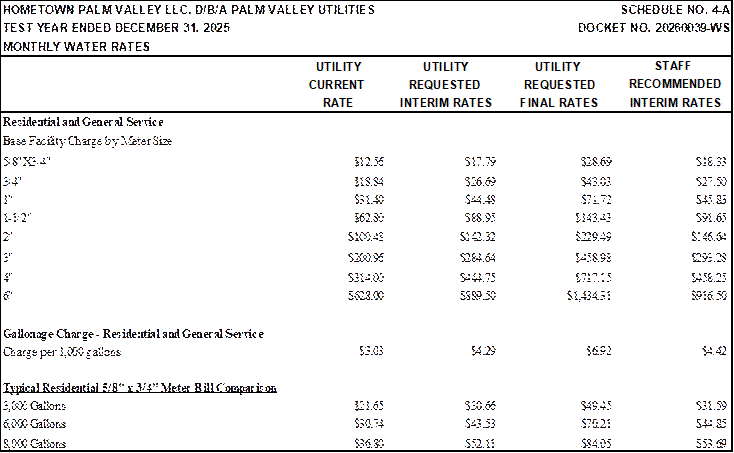
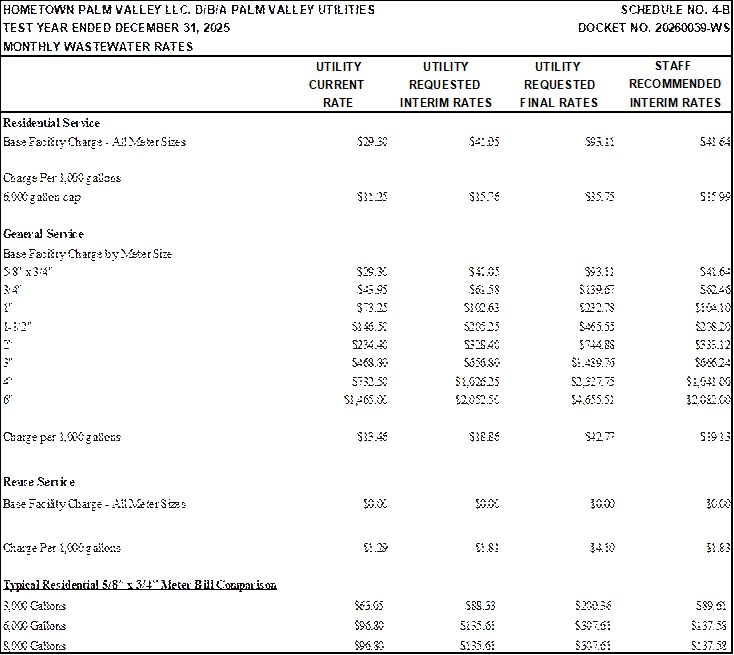
The interim rate increase of 45.97 percent for water
and 42.11 percent for wastewater should be applied as an across-the-board
increase to the water and wastewater rates, respectively. The rates, as shown
on Schedule Nos. 4-A and 4-B should be effective for service rendered on or
after the stamped approval date on the tariff sheets pursuant to Rule
25-30-475(1), F.A.C. The Utility should file revised tariff sheets and a
proposed customer notice to reflect the Commission-approved rates. In addition,
the approved rates should not be implemented until the required security has
been filed, staff has approved the proposed customer notice, and the notice has
been received by the customers. The Utility should provide proof of the date
notice was given within 10 days of the date of the notice. (Bethea)
Staff Analysis:
Staff recommends that
interim service rates for Palm Valley be designed to allow the Utility the
opportunity to generate annual operating revenues of $308,303 for water and $785,983
for wastewater. Before removal of miscellaneous revenues, this would result in
an increase of $96,815 (or 45.78 percent) for water and $232,660 (or 42.05
percent) for wastewater. To determine the appropriate percentage increase to
apply to the service rates, miscellaneous revenues should be removed from test
year operating revenues. The calculation is as follows:
Table 3-1
Percentage Service Rate
Increase
|
|
Water
|
Wastewater
|
|
1 Total Test Year Operating Revenues
|
$211,488
|
$553,323
|
|
2 Less: Miscellaneous Revenues
|
$875
|
$875
|
|
3 Test Year Revenues from Service Rates
|
$210,613
|
$552,448
|
|
4 Revenue Increase
|
$96,815
|
$232,660
|
|
5 Percentage Service Rate Increase (Line 4/ Line 3)
|
45.97%
|
42.11%
|
Source: Staff’s Interim Recommended Revenue
Requirement
The interim rate increase of 45.97 percent for water and 42.11
percent for wastewater should be applied as an across-the-board increase to the
water and wastewater rates, respectively. The rates, as shown on Schedule Nos.
4-A and 4-B should be effective for service rendered on or after the stamped
approval date on the tariff sheets pursuant to Rule 25-30-475(1), F.A.C. The
Utility should file revised tariff sheets and a proposed customer notice to reflect
the Commission-approved rates. In addition, the approved rates should not be
implemented until the required security has been filed, staff has approved the
proposed customer notice, and the notice has been received by the customers.
The Utility should provide proof of the date notice was given within 10 days of
the date of the notice.
Issue 4:
What is the
appropriate security to guarantee the interim increase?
Recommendation:
The appropriate security to guarantee the funds
collected subject to refund is a corporate undertaking by Hometown Communities
Limited Partnership (Hometown Communities)
on behalf of its subsidiary, Palm Valley. Hometown Communities should be
required to provide a written guarantee that it will support a corporate
undertaking on behalf of Palm Valley in the amount of $222,570. (Maxwell)
Staff Analysis:
Pursuant
to Section 367.082, F.S., revenues collected under interim rates shall be
placed under bond, escrow, letter of credit, or corporate undertaking subject
to refund with interest at a rate ordered by the Commission. As recommended in
Issue 1, the total interim increase is $329,475. In accordance with Rule
25-30.360, F.A.C., staff calculated the potential refund of revenues and
interest collected under interim conditions to be $222,570. This amount is
based on an estimated 8-month collection period of interim rates.
The
criterion for a corporate undertaking includes sufficient liquidity, equity
ownership, and profitability to guarantee any potential refund. Staff reviewed Palm
Valley’s parent company, Hometown Communities’
2023, 2024, and 2025 confidential financial statements filed with the
Commission to determine if Palm Valley can support a corporate undertaking for
the requested amount.[6] Staff’s
analysis indicated that over the three-year period ending December 31, 2025,
the Utility’s parent, Hometown Communities, has sufficient profitability,
interest coverage, and equity ownership over the period. However, its
liquidity is insufficient due to negative working capital but has an
acceptable level of cash available which is sufficient to support a corporate
undertaking in the amount of $222,570.
Based on the
analysis of Hometown Communities’ financial position,
staff recommends that Palm Valley can support a corporate undertaking in the
amount of $222,570. Staff’s recommendation is contingent upon Hometown
Communities providing a signed letter by a corporate officer or partner that it
will support Palm Valley in its corporate undertaking endeavor. A parent
company supporting a corporate undertaking on behalf of its subsidiary for
interim purposes is consistent with Commission practice in prior rate cases.[7]
This brief
financial analysis is only appropriate for determining if the Utility, through
its parent, can support a corporate undertaking in the amount proposed and
should not be considered a finding regarding staff’s position on other issues
in this proceeding. In no instance should maintenance and administrative costs
associated with any refund be borne by the customers. Such costs are the
responsibility of, and should be borne by, the Utility.
Pursuant to Rule 25-30.360(6), F.A.C., the Utility
should provide a report by the 20th day of each month indicating the monthly
and total revenue collected subject to refund. Should a refund be required, the
refund should be with interest and undertaken in accordance with Rule
25-30.360, F.A.C.
Issue 5:
Should this docket be closed?
Recommendation:
The docket should remain open pending the
Commission’s final action on the Utility’s requested rate increase. (Rauch)
Staff Analysis:
The docket should remain open pending the
Commission’s final action on the Utility’s requested rate increase.